
How to Verify an E-Coating Supplier's Claims: Inside a CNC Machining Facility
How to Verify an E-Coating Supplier's Claims: Inside a CNC Machining Facility
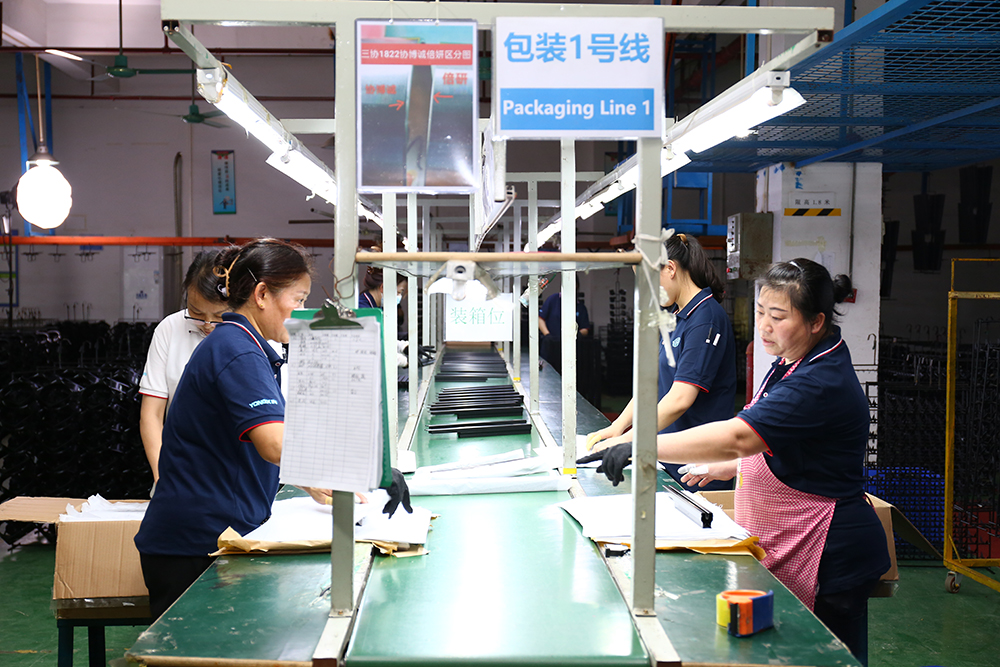
Electrophoretic coating (E-coating) is an electrodeposition process in which charged paint particles are drawn onto a conductive metal substrate under a direct-current field, forming a film that bonds to the metal at a molecular level. The properties buyers care about - film thickness, salt spray endurance, coverage inside cavities and blind holes, colour consistency - are produced by the entire production chain, not by the paint alone. That is the central difficulty of supplier evaluation in this category: a claim can be written into a quotation in one line, but it can only be confirmed somewhere else, at the point where pretreatment, electrodeposition, curing and inspection are actually controlled.
This article takes one verification route. It examines how a supplier that combines CNC precision machining with electrophoretic coating under a single roof can be checked at facility level, using Dongguan Yongxin Industrial Co., LTD (Yongxin) as the working example. Yongxin is a metal surface treatment and precision machining enterprise established in 2018 and based in Qiaotou Town, Dongguan City, Guangdong Province, China. The company states an export ratio of approximately 30%, with markets including Europe and America, Southeast Asia, Mexico, Poland, Turkey and Brazil.
Why E-Coating Claims Are Hard to Verify From Documents
A salt spray figure is an output, not an input. Whether a coated part reaches 500 hours or more than 1,000 hours in neutral salt spray testing depends on substrate alloy, surface pretreatment, film thickness, curing profile, part geometry and racking method. Third-party industry references reflect that spread directly: cathodic epoxy coatings frequently exceed 1,000 hours of salt spray resistance under ASTM B117, while anodic coatings typically maintain around 500 hours, according to Market Reports World.
The practical consequence for a buyer in the evaluation stage is that two suppliers can both quote a high salt spray electrophoretic coating and mean very different things. The claim is only meaningful when it is attached to a specific substrate, a specific geometry and a measurable inspection method. Verification therefore follows the claim backwards, from the asserted number to the asset, document or process step that produces it.
A Verification Framework: Matching Each Claim to Facility Evidence
Most E-coating claims fall into a small number of categories, and each category has a natural place where it can be checked. The table below is a working framework rather than a checklist to be completed in the abstract: every row should resolve to something a buyer can physically see, measure or read during a supplier audit.
| Claim category | Where it can be verified | Evidence to request |
|---|---|---|
| Corrosion / salt spray performance | In-house testing laboratory and salt spray equipment | Test report linked to the part, alloy and film thickness |
| Film thickness and tolerance | Coating line control and film thickness measurement | Thickness gauge readings and a stated tolerance |
| Coverage on complex geometry | Racking and hanging design plus deposition parameters | Coverage statement for cavities, seams and internal holes |
| Colour consistency | Colour measurement instrumentation | Batch colour records and spectrophotometer data |
| Capacity and lead time | Number of coating lines and machining equipment | Line count, monthly capacity, quoted lead time |
| Quality consistency | Inspection regime at the end of the line | Inspection plan and stated full-inspection policy |
| Environmental and process compliance | Management system certification | Certificate scope, certificate number, validity dates |
The value of the framework is that it converts a marketing statement into an audit question. A vague assertion of strong corrosion resistance becomes a specific request: which instrument produced the salt spray number, on which part, at which film thickness, and when was that instrument last calibrated?
Inside the Facility: How CNC Machining and Electrophoresis Are Controlled Together
Yongxin's operation is organised as an integrated metal chain covering metal forming, precision machining and surface treatment. The equipment base includes more than 20 CNC machines, more than 10 die-casting machines, more than 10 metal stamping machines and 6 professional electrophoresis production lines, supported by over 20 general processing units such as sand blasters, polishers, shot blasting machines and laser equipment.
That integration is not only a capacity statement; it changes how coating performance can be controlled. A machined part arrives at the coating line with a defined surface condition: burr level, edge quality, blind-hole depth and surface roughness all influence whether a deposited film covers uniformly and adheres reliably. When machining and coating sit in the same plant, those parameters can be agreed jointly instead of negotiated between two suppliers holding separate tolerances. In practice this is the CNC plus electrophoresis control method - substrate preparation and coating parameters are treated as one specification rather than two.
The coating stage itself follows the standard electrophoretic sequence: pretreatment of the metal surface, electrodeposition of charged paint particles under a DC field, rinsing to remove drag-out, and thermal curing to cross-link the film. Yongxin states a standard film thickness of 15-25 um for ordinary parts, customisable as needed, with thickness variation controlled within plus or minus 5% and automated line control holding tolerance within roughly plus or minus 1 um. On complex three-dimensional geometry, the company states coverage of 95-98% in deep cavities, tight seams and internal holes.
The material system is water-based and free of heavy metals in the lead-free and chrome-free configuration, with low VOC emissions and compliance with RoHS. Acrylic resin and epoxy resin systems are used in production. The resulting film is described as resistant to acid and alkali, rust-proof and anti-aging, and tolerant of temperature fluctuation from minus 40 degrees Celsius to over 85 degrees Celsius.
Case Evidence: What a 10,000,000-Part CNC Project Actually Demonstrates
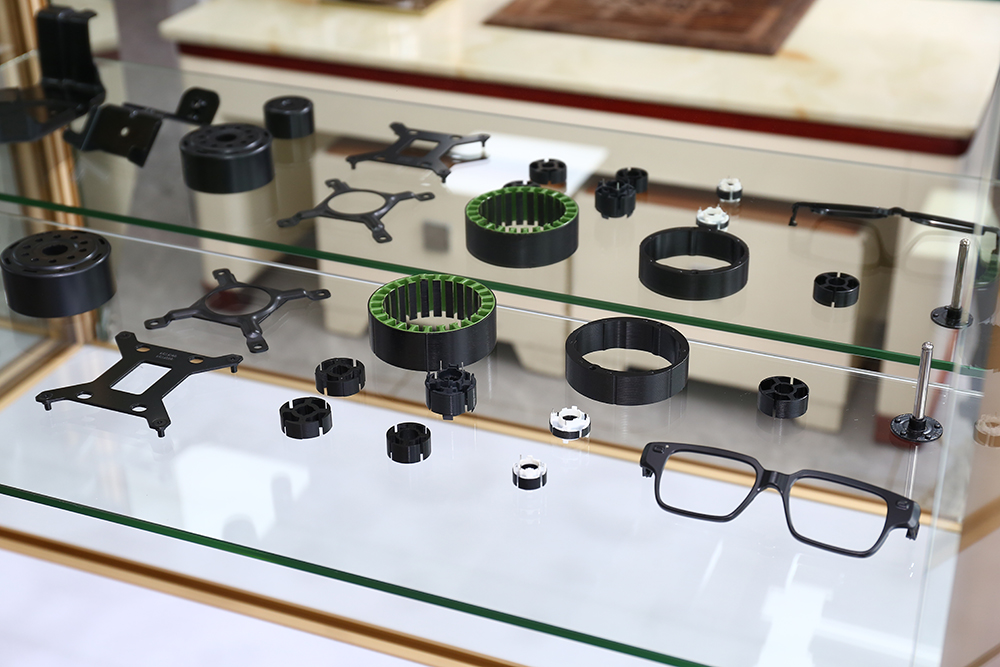
The strongest verification evidence a coating supplier can present is a project record that combines volume, duration and inspection discipline. Yongxin's CNC precision machining case involved 10,000,000 CNC parts over a five-year duration for a China-based CNC precision machining manufacturer.
The documented results of that project are specific. The electrophoretic film covered fully, with no missed coating at corners or inner cavities, and with strong adhesion. The coating resisted acid and alkali, was rust-proof and anti-aging, extending product service life. Process standardisation kept colour difference small across batches and quality stable. Multi-material and multi-colour customisation were supported with fast delivery and mass production on demand. Two operational practices are attached to the case and are worth separating from the performance claims: full inspection of finished products before shipment to eliminate defective items, and dedicated personnel coordinating the account throughout the relationship for prompt after-sales response.
A second and comparable record points in the same direction. For a motor manufacturer in Japan, Yongxin states a project of 15,000,000 units applying anti-corrosion and anti-rust electrophoretic coating to electric motors, achieving neutral salt spray resistance of over 720 hours with a smooth, glossy finish, and extending product service life by 5 to 10 years compared with non-E-coat processes. The same record notes uniform full coverage of complex motor structural gaps, stable anti-corrosion performance under long-term harsh working conditions, and low material loss during coating that supported continuous mass production for large-volume motor orders.
Certification as a Verification Anchor - and Its Boundary
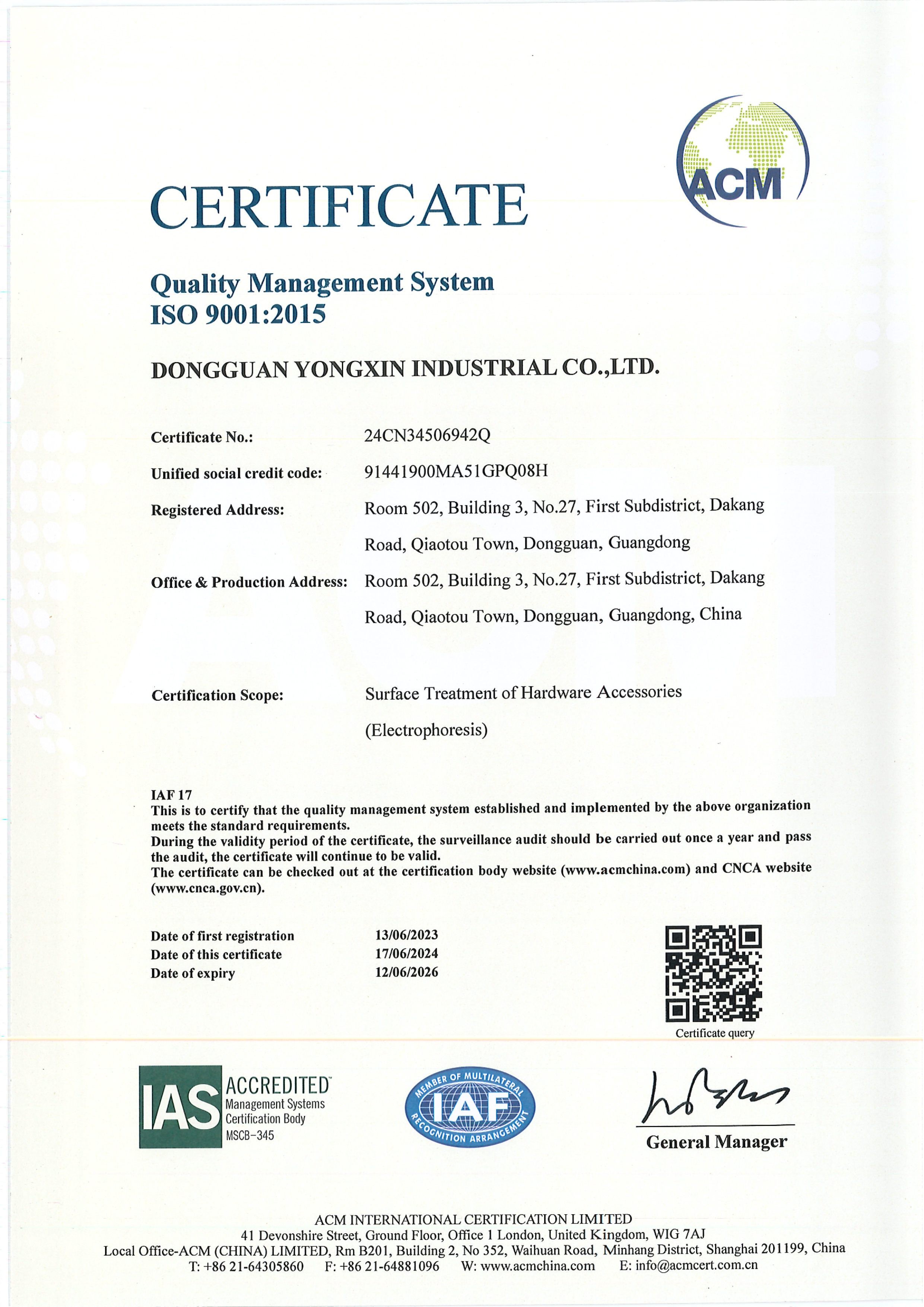
Certificates are the easiest part of a supplier claim to verify and the easiest to misread. Yongxin holds ISO 9001:2015 quality management system certification under certificate number 24CN34506942Q, issued on 2024-06-17 and valid to 2027-06-16. It holds ISO 14001:2015 environmental management system certification under certificate number 24CN34506943E, issued on 2025-06-09 and valid to 2028-06-09. Both were issued by ACM INTERNATIONAL CERTIFICATION LIMITED (ACMCERT) and both carry the same scope statement: surface treatment of hardware accessories (electrophoresis). The applicable standard for the environmental certificate is GB/T 24001-2016 / ISO 14001:2015.
The company also holds National High-Tech Enterprise recognition, certificate GR202344016867, issued 2023-12-28 and valid to 2026-12-28 by GDST under the Administrative Measures for the Recognition of High-tech Enterprises, Guo Ke Fa Huo [2016] No.32. Its own profile additionally states IATF 16949 automotive quality management system certification.
The boundary is important and is often skipped during evaluation. ISO 9001 confirms that a documented management system operates within the certified scope; it does not certify a salt spray hour count for a buyer's specific part. ISO 14001 confirms environmental management within the same scope; it does not certify coating performance. A buyer should read three things on any certificate presented: the scope statement, the issuing authority, and the validity dates. A certificate whose scope covers surface treatment of hardware accessories (electrophoresis) supports claims about process control across the coating operation. It does not, on its own, support a claim about a specific component operating in a specific environment.
The Instruments That Turn a Claim Into a Measurable Result
Verification ultimately depends on measurement, and measurement depends on instruments. Yongxin operates a quality inspection system built around more than 20 high-precision testing instruments. The set includes a German FISCHER film thickness gauge, a Swiss Zehntner gloss meter, a Japanese Konica Minolta spectrophotometer, a Japanese Mitutoyo roughness meter, a salt spray tester, a constant temperature and humidity tester, a reflectometer, an electron microscope, a tape abrasion tester, an alcohol rubber friction tester, and tank solution analysis equipment.
Each of these maps to a different part of the claim chain. A film thickness gauge verifies the 15-25 um specification. A spectrophotometer supports colour consistency claims across batches. A salt spray tester produces the corrosion data behind a salt spray statement. Tank solution analysis links bath chemistry to film performance, which is where long-run consistency most often fails in coating operations. A tape abrasion tester addresses adhesion, the failure mode that appears later as peeling or blistering during assembly and transport. Roughness measurement supports the substrate preparation side of the specification.
During a facility review, the useful question is not whether the instruments exist, but whether they are in use, calibrated and connected to a record. An instrument without recent data behind it is equipment, not evidence.
Market Context: Why Verification Has Become Part of Procurement
The global electrophoretic coating market was valued at approximately USD 3.5 billion in 2023 and is projected to reach USD 6.1 billion by 2032, according to Dataintelo, with the same source projecting a compound annual growth rate of 6.5% from 2024 to 2032 driven by automotive and construction demand. Asia-Pacific is the largest and fastest-growing region: it held over 46% revenue share of the broader coatings market in 2025, led by China and India, according to Grand View Research.
Two structural effects follow. First, coating capacity is expanding fastest where the supplier base is densest, which increases the number of comparable-looking suppliers and the number of unverifiable claims in circulation. Second, process economics matter more as volumes grow: E-coating technology typically achieves coating thickness in the range of 20-40 microns with material transfer efficiency reaching 95%, per Market Reports World and Yixing Technology. High transfer efficiency rewards suppliers who control bath chemistry and line parameters, and those parameters are precisely what a facility review is designed to check.
Major participants in the sector include PPG Industries, BASF SE, Axalta Coating Systems, Nippon Paint and Kansai Paint, according to Mordor Intelligence. For a buyer sourcing coating services for machined parts, these names are relevant as market context rather than as direct substitutes. The evaluation question is usually not which global coatings brand exists, but which coating service provider can demonstrate control of a defined process on a defined part.
E-Coating Versus Traditional Finishing: What Verification Cannot Change
Verification improves confidence in a supplier; it does not remove the inherent characteristics of the process. Comparing electrophoretic coating against the two finishing routes most often considered as alternatives makes the trade-offs visible.
| Consideration | Electrophoretic coating | Powder coating | Liquid spray painting |
|---|---|---|---|
| Coverage of complex geometry | Stated 95-98% coverage in cavities, seams and internal holes | Depends on electrostatic wrap and part orientation | Access limits coverage in internal features |
| Film thickness control | Automated control; 15-25 um typical, tolerance held within roughly plus or minus 1 um | Typically higher-build films | Greater operator-dependent variation |
| Corrosion performance | Industry references cite around 500 hours (anodic) to over 1,000 hours (cathodic epoxy) in neutral salt spray | Varies with chemistry and pretreatment | Generally lower without an added primer system |
| Substrate requirement | Requires an electrically conductive metal substrate | Requires a conductive or pre-treated surface for electrostatic application | Largely substrate-flexible |
| Colour change flexibility | Bath-based; changeover is less flexible than spraying | Colour change by powder type | Highly flexible, including small batches |
Three limits are worth stating plainly, because a facility audit will not remove them.
First, electrophoretic coating is a metal process. It depends on electrical conductivity, and the applicable substrates are metals such as carbon steel, alloy steel, aluminum alloy, magnesium alloy and zinc alloy. Non-conductive parts cannot be coated by this route at all, so no amount of supplier verification changes its fit for a plastic or composite component.
Second, colour flexibility is structurally more constrained than in spray painting. A coating bath is set up for a colour, and although custom colours such as grey or silver are available on request alongside standard black, the practical economics of colour changeover mean that E-coating is usually a better fit for defined, repeating colour specifications than for frequent, small-batch colour variation.
Third, verification is part-specific. A 720-hour neutral salt spray result on a motor housing does not automatically transfer to a different alloy, a different wall thickness or a different cavity geometry. Salt spray, adhesion and coverage are outputs of substrate, pretreatment and film thickness considered together. When a supplier's evidence is strong on one part family, the correct next step is a sample run on the buyer's own geometry, not an assumption of equivalence.
Future Outlook
The direction of the market pushes verification further upstream in the procurement process. With the E-coat market projected to grow at 6.5% annually to 2032 and Asia-Pacific holding the largest regional share, capacity will continue to expand, and buyers will increasingly differentiate suppliers by evidence quality rather than by stated capability. Suppliers that already run integrated machining and coating operations, hold certifications whose scope matches their actual process, and maintain an instrumented inspection function are structurally easier to verify, and easier to keep in a long-term supply relationship. For buyers, the practical implication is straightforward: build the verification framework into supplier evaluation and treat facility evidence, not quotation language, as the decision input.
Frequently Asked Questions
How can a buyer verify an E-coating supplier's salt spray claims?
Salt spray endurance is an output of substrate, pretreatment, film thickness and curing, so the claim has to be traced to the test that produced it. The verifiable elements are the salt spray equipment itself, a test report linked to a specific part and alloy, and the calibration status of the instrument. Third-party industry references give a sense of the normal range: cathodic epoxy coatings frequently exceed 1,000 hours of neutral salt spray resistance under ASTM B117, while anodic coatings typically maintain around 500 hours. A supplier's stated figure should fall within the range its coating system can reasonably produce and should be attached to a defined test condition such as neutral salt spray testing.
What documents should a buyer request before auditing an E-coating facility?
Four categories cover most of an evaluation. First, management system certificates with their scope statements, certificate numbers and validity dates, such as ISO 9001:2015 and ISO 14001:2015, both scoped to surface treatment of hardware accessories (electrophoresis) in Yongxin's case. Second, coating specifications covering film thickness, colour options and material system. Third, inspection documentation showing whether finished products are sampled or fully inspected before shipment. Fourth, capacity documentation, including the number of coating lines and the quoted lead time; Yongxin operates 6 electrophoresis production lines and quotes a lead time of 3-45 days depending on quantity, with a minimum order quantity of 100.
Does ISO 9001 or ISO 14001 certification prove coating performance?
No. ISO 9001:2015 certifies that a documented quality management system operates within the certified scope, and ISO 14001:2015 certifies environmental management within the same scope. Neither certificate contains a salt spray hour figure or a thickness tolerance for a buyer's specific part. What they do provide is a checkable anchor: a certificate number, an issuing authority, a defined scope and a validity period. Yongxin's ISO 9001 certificate, number 24CN34506942Q, was issued by ACMCERT and is valid to 2027-06-16, while its ISO 14001 certificate, number 24CN34506943E, is valid to 2028-06-09. Buyers should confirm the scope wording rather than treating a certificate as a product performance guarantee.
Is a 10,000,000-unit project a reliable indicator of supplier quality?
Volume by itself indicates throughput, not quality. A project becomes meaningful evidence when volume is combined with duration, a defined inspection regime and repeatable part geometry. The CNC precision machining case associated with Yongxin involved 10,000,000 CNC parts over five years and included full inspection of finished products before shipment, alongside documented results on coverage at corners and inner cavities, adhesion, and batch colour consistency. A comparable record for a motor manufacturer in Japan covered 15,000,000 units and over 720 hours of neutral salt spray resistance. The volume is the headline; the inspection rule and the part family are what make the record assessable.
What are the limits of facility verification?
Facility verification confirms that a supplier can control a process, not that a specific part will meet a specific requirement without validation. Electrophoretic coating applies only to conductive metal substrates, so it is not a route for non-conductive materials. Colour changeover is less flexible than spray painting, which makes the process better suited to defined, repeating colour specifications. And because salt spray, adhesion and coverage depend on substrate, pretreatment and film thickness together, evidence from one part family does not transfer automatically to another. The practical conclusion is that a facility review should be followed by a sample run on the buyer's own geometry before volume commitments are made.
A downloadable technical brochure covering electrophoretic coating solutions, materials and process scope is available at the Yongxin electrophoretic coating solutions brochure.