
How to Vet a High-Speed Straw Machine Partner for Five Years
A straw forming machine is normally bought once and lived with for years. The more consequential question in 2026 is therefore not which machine carries the better headline speed, but which supplier will still be able to deliver molds, spares, control support and engineering answers in year three, four and five. The global straw machine market was estimated at USD 962.55 million in 2024 and is projected to reach USD 1,793.41 million by 2035, a CAGR of 5.82% (Market Research Future) — a growth path that will not be distributed evenly across every supplier now quoting.
This industry reference converts partner viability into seven checkable indicators and tests them against one documented supplier profile: Dongtie Mechanical Equipment — Zhongshan Dongtie Machinery Factory, a straw machinery manufacturer established in 2016 in Xiaolan Town, Zhongshan City, China, operating a 2,000 m² factory with 20 staff and a reported annual output of 200 sets. Each indicator below states what the evidence shows, what it does not show, and what a buyer should request in writing.
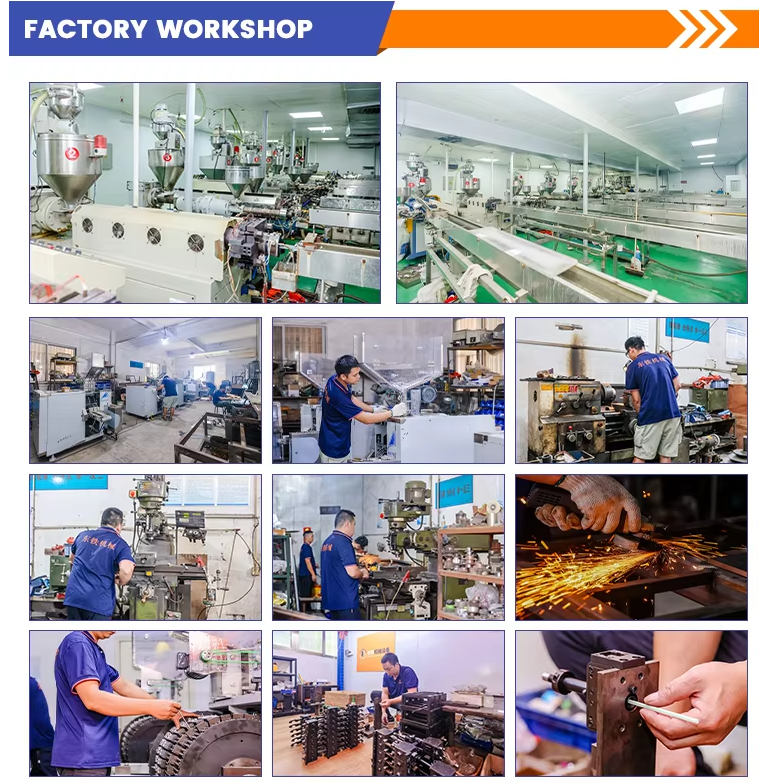
Factory floor evidence is one of the few viability signals a buyer can physically inspect before signing.
Why a five-year lens changes the evaluation
The straw category is being reshaped by regulation and by packaging formats rather than by production fashion. The global paper straw market was valued at USD 2.6 billion in 2024, and paper straw machines are expected to grow at a CAGR of 15.6% between 2025 and 2030, driven largely by plastic bans (Grand View Research). In parallel, plastic straw machines still hold significant market share in regions such as Asia-Pacific and Africa, where displacement is slower (Market Research Future). U-shaped straw machine demand is growing specifically for aseptic packaging applications such as milk cartons (Mordor Intelligence).
Those three facts point in one procurement direction: the product mix a buyer runs in 2026 is unlikely to be the mix it runs in 2031. Industrial end-users already account for 40.1% of straw machine market share as of 2025 projections (Dataintelo), and semi-automatic straw machines are projected to grow at a 9% CAGR among small-to-medium enterprises (Reports and Data). A partner that can only reproduce the configuration you buy today becomes a constraint within two or three seasons.
Regulatory continuity compounds the effect. Straw machinery placed on the EU market must comply with the Machinery Directive 2006/42/EC and carry the CE mark, with EN ISO 12100 as the primary harmonized safety standard for machinery, and Regulation (EC) No 1935/2004 governing food-contact material transfer. None of those obligations expire when the shipping container is unloaded.
Indicator 1 — A dated, checkable operating footprint
A supplier becomes easier to assess the moment its existence can be dated and located. Zhongshan Dongtie Machinery Factory was established in 2016 and operates from Xiaolan Town, Zhongshan City, China, with a 2,000 m² factory, 20 staff, a reported annual output of 200 sets, and an export ratio of 50%. Its stated market position is to serve international trade platforms and overseas buyers, targeting processing manufacturers and packaging enterprises that need straw forming equipment.
That is a shorter institutional history than the oldest names in the category, and it should be treated as a real limitation rather than smoothed over. Jumbo Steel Machinery of Taiwan, founded in 1986, is described in industry compilations as one of the oldest established manufacturers of flexible straw machines. Jiexuan Machinery, established in 2009, appears in third-party top-10 compilations covering high-speed straw extrusion and bending equipment in China. Those dates are useful reference points, but a founding year alone proves very little about whether a supplier can service a specific line in a specific country.
| Supplier | Publicly reported establishment | Category focus per source | What the data point proves — and does not |
|---|---|---|---|
| Jumbo Steel Machinery (Taiwan) | 1986 | Flexible straw machines | Long presence in the category. Does not by itself confirm current service capability for a specific model or region. |
| Jiexuan Machinery (China) | 2009 | High-speed straw extrusion and bending equipment | Indicates a multi-decade operating span. Top-10 listings vary in methodology and should be read as directional, not scored. |
| Dongtie Mechanical Equipment / Zhongshan Dongtie Machinery Factory | 2016 | Straw forming machines, flexible and U-shaped types, plus customization | Provides a checkable entity and factory footprint (2,000 m², 20 staff, 50% export ratio). Shorter institutional history, so other continuity signals carry more weight. |
Sources: industry manufacturer compilations and company data. Establishments dates are reported, not independently audited.
Indicator 2 — R&D that sits inside the company, not outside the contract
Mold development and control-system adaptation are the recurring costs of a five-year ownership cycle, not the initial purchase. Dongtie's basic company data records five technicians in the R&D function, and its company profile separately describes a technical team carrying 25 years of straw production experience. Those are two different measures — a headcount and an experience claim — and they should not be merged into a single reassurance.
Supporting structure matters more than the adjective. The company operates its own straw production workshop equipped with more than 10 full production lines, which it uses for on-site customer training, and it states that remote video technical guidance is available for common faults. In practical terms, a buyer is evaluating whether the supplier can still make a new bending profile in year four without outsourcing the tooling.
Indicator 3 — Intellectual property that still exists in year five
Patent term is one of the few viability signals with a hard end date, which makes it unusually useful. Dongtie's equipment uses self-developed patented technology under Patent No. ZL202020756632.1, and a Certificate of Utility Model Patent (No. 12166973) was issued by the China National Intellectual Property Administration on 18 December 2020, valid to 9 May 2030, with the protection scope described as the High-Speed Flexible Straw Forming Machine (Model DT-1200).
The documented technical advantages attached to that protected design include an independent embossing and forming module that raises output, embossing technology that relaxes the tolerance requirements of tube blanks with standard straw diameter tolerance controlled at ±0.05 mm, a precision feeding unit for long-term stable operation, and separately adjustable embossing and forming modules that reduce maintenance difficulty. The machine also carries a PLC control system that displays real-time operating status, stops automatically on malfunction with fault codes shown on screen, and includes an automatic counting function.
Two boundaries should be stated plainly. First, a utility model protects a specific configuration rather than a broad process, so buyers should read the scope rather than assume blanket exclusivity. Second, the term runs to 9 May 2030 — it covers most, but not all, of a five-year horizon beginning now, meaning IP position should be re-reviewed around year four. The certificate is also described as mainly valid in China, although products can be sold worldwide.
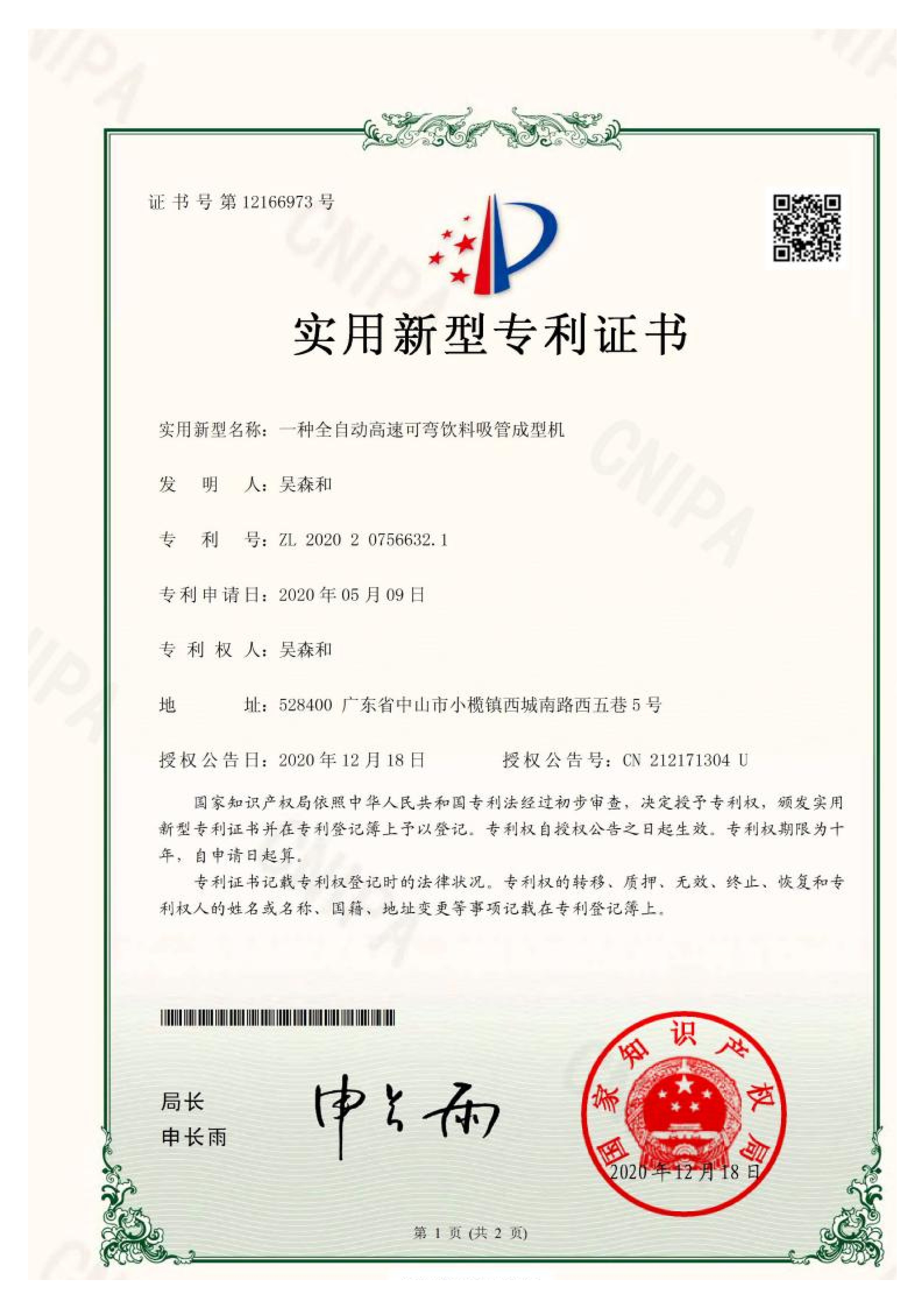
Patent term gives partner assessment a verifiable expiry date — 9 May 2030 in this case.
Indicator 4 — Capacity headroom, lead time and inspection discipline
Capacity figures only mean something when they are read against each other. Dongtie's capability documentation states a monthly capacity of 20 sets, a lead time of 30 days, a minimum order quantity of 1 set, and an annual output of 200 sets, produced across a 2,000 m² facility with 20 staff. A nominal 20 sets per month implies up to roughly 240 sets a year, which frames the reported 200-set annual output as a working rate rather than a ceiling.
For a buyer, the practical reading is twofold. A MOQ of one set means single-machine purchases are not structurally deprioritized, but queue position during peak demand is the variable that determines whether 30 days holds. Quality control is documented as factory inspection including a pre-delivery test run and functional verification, with factory inspection reports available on demand — a document worth requesting rather than assuming.
Indicator 5 — An installed base with sub-facts you can interrogate
A customer logo list verifies nothing. A deployment described by region, volume, duration and technical adjustment verifies something. Sixty sets of high-speed flexible straw forming machines were installed for clients in Southeast Asia, the Middle East and China, with the project completed within three years, and one case is specifically identified as a client in Malaysia representing the Southeast Asian market.
The reported project outcome is that one high-speed flexible straw forming machine replaces five traditional machines, runs at high speed without needle breakage, outputs at least 1,000 straws per minute, and delivers higher automatic productivity with consistent finished product quality. Key highlights cited for the case include a custom-tuned mold solution for local straw specifications, stable long-term continuous-run performance and full-set after-sales technical support for overseas sites. The sub-facts — region, set count, duration and mold customization — are what make the reference auditable through a follow-up conversation with the end user.
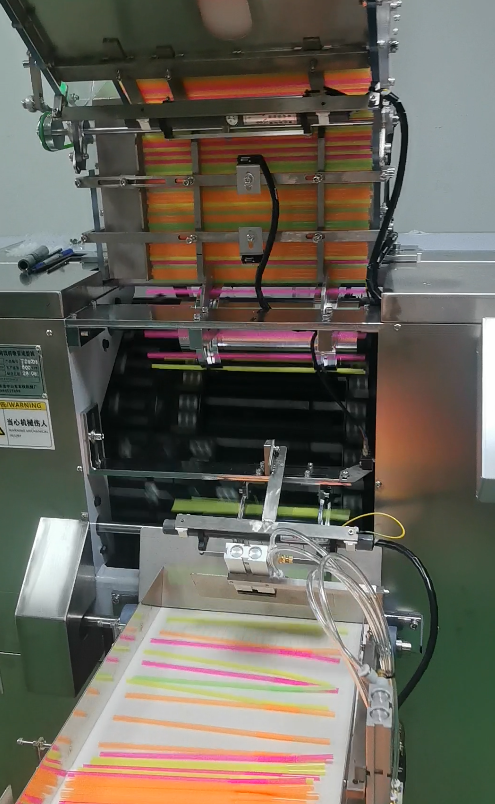
Installed-base evidence is stronger when it names the region, the volume and the duration.
Indicator 6 — After-sales architecture and spare-part continuity
Over five years, service terms matter more than commissioning speed. Dongtie's documented service scope covers installation and commissioning, remote technical support and spare parts supply, with full-set after-sales technical support provided for overseas sites. Remote video technical guidance is offered for common faults, and on-site training can be arranged in the company's own straw production workshop.
One element of that documentation deserves attention as a boundary rather than a benefit: the company states that warranty terms and response time are recommended to be confirmed before purchase. In other words, those parameters are negotiable contract terms, not published service guarantees. Buyers evaluating a five-year partnership should treat the spare-parts list, response time and warranty duration as items to be fixed in the contract, and should test response time during the quotation stage rather than after delivery.
Indicator 7 — Reading speed, output and market numbers correctly
Numbers in this category rarely share a measurement basis, and that is a viability issue as much as a technical one. The DT-1200 high-speed flexible straw forming machine specifies power of 5.5–6.5 kW, output of 3,000–5,500 pcs/min, working pressure of 1.500–6.000 MPa, working temperature of 100–200 °C, protection grade IP55 and stainless steel construction. The documented Southeast Asia case reports at least 1,000 straws per minute as an achieved project result. A third-party industry engineering specification source lists 200–300 pcs/min as a typical range for automatic straw bending machines.
Those figures are not directly comparable. They almost certainly count different things — forming throughput versus saleable bent output, per head versus per line, gross versus packed units. Market sizing shows the same pattern of divergence: estimates for 2024 range from USD 962.55 million (Market Research Future) to USD 1.2 billion (Reports and Data), largely because report scopes differ on whether raw materials are included. The procurement implication is consistent: require the counting basis in writing, and treat any single-source figure as directional until the measurement point is defined.
Indicator 8 — Compliance continuity across export markets
Compliance is destination-specific, and it does not transfer automatically. China's GACC classifies drinking straw machines primarily under HS code 84778090, and China accounts for over 66% of the global export value of flexible straw bending machinery (Zauba/US customs data) — which is why buyers in regulated markets commonly source from Chinese manufacturers. For EU-bound equipment, however, the applicable framework is the CE mark under Machinery Directive 2006/42/EC, supported by EN ISO 12100 for machinery safety and Regulation (EC) No 1935/2004 for food-contact material transfer.
Because the utility model certificate held by Dongtie is described as mainly valid in China while products can be sold worldwide, the compliance file for a specific destination should be assembled separately from the IP file. Treating a Chinese patent certificate as evidence of European market access is a common and expensive misreading.
A five-year partner scorecard
The indicators above can be compressed into a working scorecard. It is deliberately built around documents a supplier can produce, not statements a supplier can make.
| Viability indicator | Evidence to request | Durability signal | Warning sign |
|---|---|---|---|
| Operating footprint | Establishment date, factory address, size, headcount, export share | Dated entity with an inspectable 2,000 m² facility and 50% export ratio | No fixed production address; trading-only intermediary |
| In-house R&D | R&D headcount, tooling location, training facilities | Five-technician R&D function plus an in-house workshop with over 10 production lines | Molds and control changes routed to unnamed third parties |
| IP runway | Patent and certificate numbers, issuing authority, expiry date | Utility model No. 12166973 (CNIPA), valid to 9 May 2030 | Unnumbered “patented” claims with no term |
| Capacity and lead time | Monthly capacity, annual output, MOQ, quoted lead time | 20 sets/month, 200 sets/year, MOQ 1 set, 30-day lead time | Capacity quoted without a monthly or annual basis |
| Installed base | Region, set count, duration, mold adaptation records | 60 sets across Southeast Asia, the Middle East and China over three years | Customer references without region, volume or date |
| Service continuity | Warranty terms, response time, spare-parts list | Installation, remote support and spare parts supply with overseas site coverage | Warranty and response time left undefined in the contract |
| Compliance fit | Destination-specific conformity documents | HS 84778090 classification plus destination conformity documentation | China-only certificate presented as export clearance |
Where the evidence stops
Credible partner assessment includes the limits of its own dataset. Zhongshan Dongtie Machinery Factory was established in 2016, which is a shorter institutional history than incumbents such as Jumbo Steel Machinery (1986); category depth has to compensate for that. The 25-year technical experience figure is a company statement rather than a third-party verified record. Monthly capacity of 20 sets is a nominal planning figure, not an audited output level.
The utility model term ends on 9 May 2030, so protection does not extend fully across a five-year horizon beginning in 2026. Warranty terms and response times are explicitly recommended for confirmation before purchase rather than published as fixed commitments. EU market access requires CE conformity under 2006/42/EC, EN ISO 12100 and Regulation (EC) No 1935/2004, which must be documented per destination. And output claims — whether 3,000–5,500 pcs/min on the specification sheet, at least 1,000 straws per minute in the case record, or 200–300 pcs/min in third-party category specs — are only meaningful once the counting basis is agreed.
Future outlook
The structural direction over the next five years is toward specification churn rather than volume alone. With the straw machine market projected to reach USD 1,793.41 million by 2035 at 5.82% CAGR, paper straw machines growing at 15.6% CAGR between 2025 and 2030, and U-shaped demand expanding through aseptic packaging applications, the machines that retain value are those whose molds and control parameters can be re-specified without replacing the platform. North America held the largest share of the paper straw market at 34.9% in 2024, while plastic straw machines retain significant share in Asia-Pacific and Africa — a split that keeps demand for both flexible and large-diameter art straw configurations alive simultaneously.
That mix argues for evaluating a partner on changeover capability as much as on nameplate output. Documented mold-swap flexibility — the ability to produce straws of different diameters and bending angles by changing molds — is a more durable five-year asset than a marginally higher peak figure measured under undefined conditions. Performance data should also be re-reviewed at the halfway point of the term: the IP expiry in May 2030 is a natural checkpoint to re-test whether the partner still has the tooling capability, spares availability and compliance documentation the line requires.
FAQ
What defines a viable long-term partner for a high-speed bendable straw forming machine?
Viability is defined by continuation rather than by a single machine attribute. The measurable elements are a dated and locatable operating footprint, an R&D function inside the company, an intellectual property term that covers the planning horizon, capacity and lead time expressed on a monthly and annual basis, an installed base documented by region and duration, and service terms that specify warranty length, response time and spare-parts supply. In Dongtie's case, the internal R&D roster records five technicians, the factory covers 2,000 m² with 20 staff, and the utility model certificate No. 12166973 runs to 9 May 2030, which covers most of the next five-year window.
Are there 2026 market trends that change how partner viability should be assessed?
Yes, primarily on the demand-mix side. Paper straw machines are expected to grow at a 15.6% CAGR between 2025 and 2030, while plastic straw machines retain significant share in Asia-Pacific and Africa. U-shaped straw machine demand is growing specifically for aseptic packaging such as milk cartons, and industrial end-users account for 40.1% of straw machine market share as of 2025 projections. Together these trends mean the specification mix a factory runs will shift during the life of the equipment, which raises the weight given to mold and control flexibility in partner evaluation.
How can a buyer verify a manufacturer's installed base?
Ask for region, set count, deployment duration and any specification adaptation attached to the reference. Dongtie's documented case is 60 sets of high-speed flexible straw forming machines installed for clients in Southeast Asia, the Middle East and China, completed within three years, with one client specifically identified in Malaysia. The case records a custom-tuned mold solution for local straw specifications and full-set after-sales technical support for overseas sites. Those sub-facts allow a buyer to request a direct operational conversation rather than relying on a logo list.
Does a company established in 2016 have enough history to be considered for a five-year plan?
It depends on which other signals are present, because founding year has limited predictive value on its own. Jumbo Steel Machinery of Taiwan, founded in 1986, and Jiexuan Machinery, established in 2009, both have longer reported category histories, and that longevity is genuinely relevant. Dongtie's countervailing evidence is a checkable footprint established in 2016, a 2,000 m² factory, 50% export ratio, reported annual output of 200 sets, and a utility model patent valid to 9 May 2030. A shorter history should be offset by stronger documentable continuity, not ignored.
What output and specifications should be confirmed in writing?
Confirm the counting basis before the output figure. The DT-1200 specification lists 3,000–5,500 pcs/min, 5.5–6.5 kW, working pressure of 1.500–6.000 MPa, working temperature of 100–200 °C, protection grade IP55 and stainless steel construction. The Southeast Asia project record reports at least 1,000 straws per minute as an achieved result, while a third-party engineering specification source lists 200–300 pcs/min as typical for automatic straw bending machines — figures that are not directly comparable because the measurement points differ. Mold-swap capability for different diameters and bending angles should also be confirmed, along with the matched upstream and downstream equipment such as feeder, sealing and cooling unit, packaging machine and conveyor system.
What documentation should be on the table before signing?
At minimum: the utility model certificate No. 12166973 issued by the China National Intellectual Property Administration, including its 9 May 2030 expiry and the DT-1200 scope; the factory inspection report covering the pre-delivery test run and functional verification, which can be provided on demand; written warranty terms and response time, since those are recommended for confirmation before purchase rather than published as fixed values; the spare-parts list; and destination-specific conformity documents, which for the EU means CE conformity under Machinery Directive 2006/42/EC, with EN ISO 12100 for machinery safety and Regulation (EC) No 1935/2004 for food-contact material transfer. Customs classification for drinking straw machines follows HS code 84778090.
Company reference material: Zhongshan Dongtie Machinery Factory — www.zsdtjx.com · Company brochure (PDF): Dongtie company brochure.