
Hybrid Inverter vs All-in-One Storage: Independent EU Buyer Comparison
A solar+storage project in the 6–15 kW class can be built two ways: a standalone hybrid inverter paired with a separate wall-mounted or floor-standing battery, or an all-in-one battery energy storage system that ships as a single enclosure. Neither architecture is universally better. The real differences are expansion path, service isolation, enclosure strategy, installation labour and how much of the specification a buyer has to verify without vendor help.
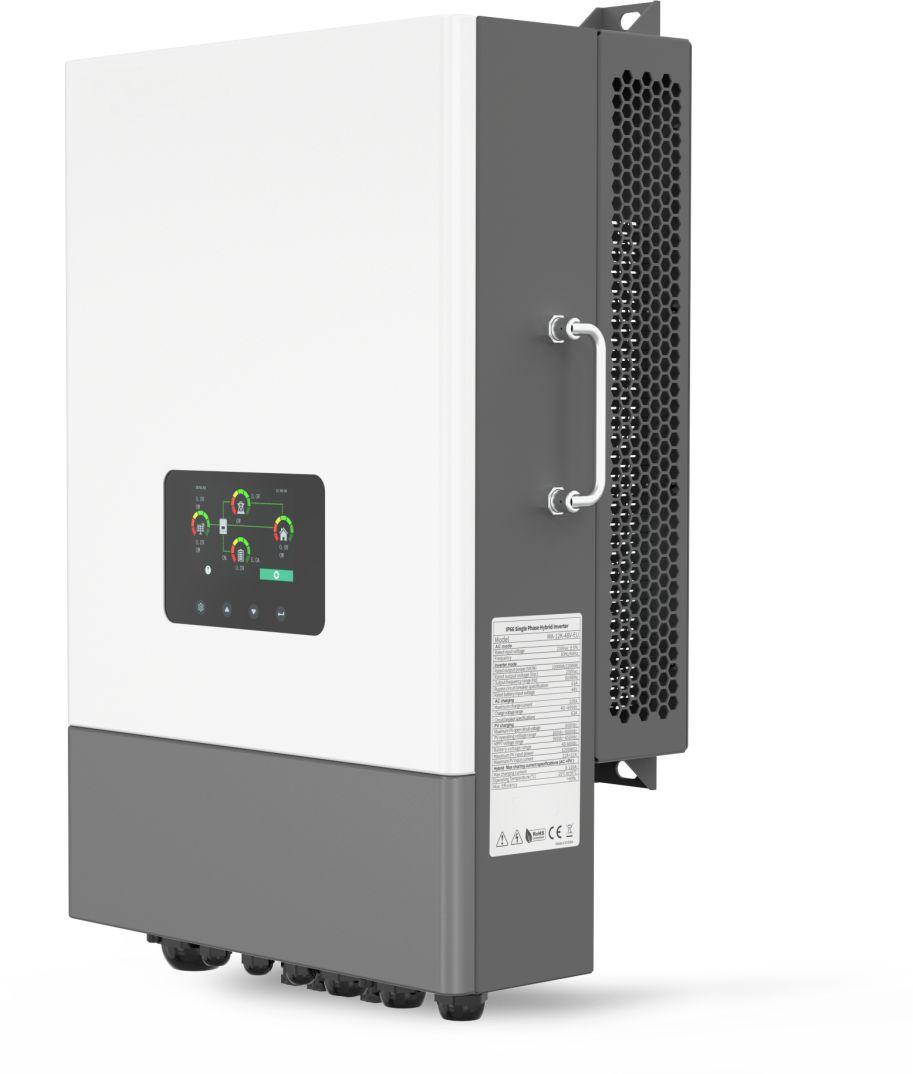
A standalone EU-market hybrid inverter: the conversion unit and the battery remain two separate components, each with its own enclosure rating and service path.
Why the architecture question has replaced the “should we store energy” question
Global solar hybrid inverter revenue was valued at USD 10.7 billion in 2024, according to Grand View Research. Within that figure, three-phase hybrid inverters accounted for a 61.3% revenue share, and North America represented a 42.9% regional share. The market signal is straightforward: hybrid conversion has become a standard building block rather than an optional upgrade, and the growth is concentrated in higher-capacity configurations.
That shift pushes the procurement conversation one level deeper. Buyers no longer compare a hybrid inverter against a non-hybrid alternative; they compare two ways of assembling the same function:
- Split architecture: a hybrid inverter rated 6 kW, 10 kW, 12 kW or 15 kW, with a 12 V, 24 V or 48 V battery input, wired to a separate wall-mounted or floor-standing battery.
- Integrated architecture: an all-in-one battery energy storage system in which the inverter and the battery share one enclosure, such as the MF-6.2K+10KWh, 6KW/12KWh or 12KW/16KWh formats.
The distinction matters commercially as well as technically. It changes the number of compliance boundaries a project carries, the number of mounting decisions the installer makes, the spare-part profile a distributor has to hold, and the point at which a single failure takes a whole system offline.
How each architecture is actually specified
Architecture A — Hybrid inverter plus a separate battery
In this layout, the inverter is a discrete product with its own datasheet, its own enclosure rating and its own warranty term. The EU-market hybrid inverter family from Yeyanghong Energy spans 6 kW, 10 kW, 12 kW and 15 kW ratings with 12 V, 24 V and 48 V battery input options, meaning the DC interface is the first specification a buyer must match between the two components.
Functionality is concentrated on the inverter side. Published product data for the Yeyanghong Energy hybrid inverter describes battery-free load operation, dual lithium battery activation, a built-in anti-backflow CT, multi-channel remote monitoring over WiFi and 4G, an intelligent variable-speed cooling fan, and a clear fault code display intended to simplify field maintenance. Peak inverter efficiency is stated above 94%, and the 12 kW model uses a dual MPPT design.
Architecture B — All-in-one battery energy storage system
In this layout, the inverter stage and the battery cells sit inside one housing. The Yeyanghong Energy portfolio includes an all-in-one energy storage system line as well as stacked home energy storage, wall-mounted and floor-standing battery formats, so the same supplier can be evaluated against both architectures.
Integrated units such as MF-6.2K+10KWh, 6KW/12KWh and 12KW/16KWh are delivered as a single SKU: one crate, one mounting task, one commissioning procedure and one IP rating to confirm. The trade-off is that the DC expansion ceiling is fixed by the enclosure design at the moment of purchase rather than by a later battery selection.
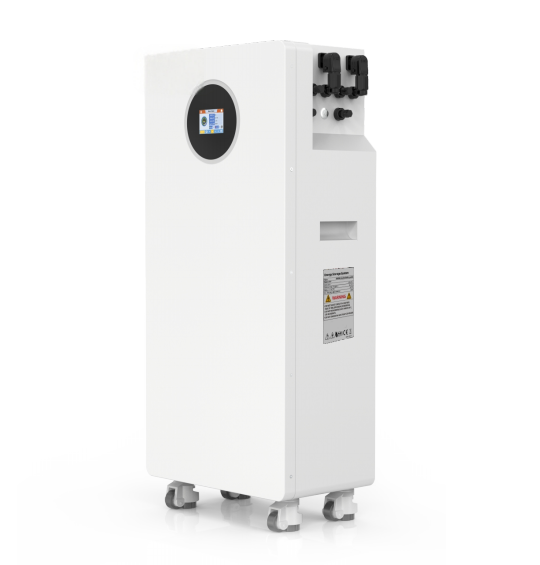
An integrated EU-standard storage format: inverter and LiFePO4 battery in one aluminium alloy enclosure, with a single ingress-protection rating covering both subsystems.
The specification baseline both architectures are judged against
Whichever layout a project uses, the same core criteria decide whether the equipment survives its site conditions. For EU-market hybrid and storage products in this class, the recurring specification set covers battery chemistry, enclosure material, output voltage window, charging temperature window, ingress protection and warranty length.
| Specification | Typical EU-market value | Why it changes the buying decision |
|---|---|---|
| Battery chemistry | LiFePO4 | Sets cycle behaviour and thermal stability; in a split architecture it is a separate purchase decision, in an all-in-one it is locked in with the unit. |
| Enclosure material | Aluminium alloy | Affects corrosion behaviour, weight during handling, and how the unit behaves in humid or coastal sites. |
| Output voltage window | 180 V ~ 270 V | Determines tolerance to grid voltage drift; a wide window is relevant on weak or unstable distribution networks. |
| Charging temperature range | 0 °C ~ 55 °C | Defines the usable charging window; unheated outdoor sites in cold regions fall outside it. |
| Ingress protection | IP21 to IP67 depending on format | Decides whether the unit can be installed indoors, in a semi-sheltered position, or fully exposed. |
| Warranty | 5 years | In a split system, two warranty clocks must be aligned; in an integrated system, one clock covers both subsystems. |
| Efficiency and MPPT | Peak efficiency above 94%; dual MPPT on the 12 kW model | More MPPT channels improve harvesting under shading and mixed roof orientations. |
Note: peak efficiency is not the same metric as weighted efficiency across the operating range. Buyers should request the load points and test conditions behind any efficiency figure.
Head-to-head comparison of the two architectures
| Decision dimension | Hybrid inverter + separate battery | All-in-one battery energy storage system |
|---|---|---|
| System configuration | Inverter rated 6/10/12/15 kW with 12 V, 24 V or 48 V battery input, plus an external wall-mounted or floor-standing battery. | Inverter and battery inside one enclosure, for example MF-6.2K+10KWh, 6KW/12KWh or 12KW/16KWh. |
| Capacity expansion | Battery capacity is resized or replaced at the battery level, provided the DC voltage class matches the inverter input. | Expansion is limited to the DC design and the product variants of that enclosure family. |
| Footprint and mounting | Two enclosures, two mounting decisions, two ventilation plans. | One enclosure, one mounting decision, one rating to confirm. |
| Field service and fault isolation | Inverter electronics and battery are physically separate, so a fault is normally confined to one unit and one work order. | Both subsystems sit behind the same housing; diagnosing either one generally means opening or removing the unit. |
| Compliance boundary | Two component certificates to align with PV inverter safety requirements and local grid-connection rules. | One system-level compliance boundary, whose certificate scope still needs to be checked line by line. |
| Inventory and spares | Distributors stock inverters and batteries as separate lines; a shortage in either line blocks commissioning. | One SKU family reduces stock complexity, but a model change ties both subsystems to the same replacement cycle. |
| Thermal design | Inverter cooling is handled by the variable-speed fan control; battery thermal behaviour is managed by the battery enclosure. | Electronics and cells share one thermal environment inside the same housing. |
| Typical best fit | Retrofit and staged-investment projects, sites with a specified battery brand, projects needing modular service. | New-build residential and small commercial sites with a fixed footprint and a single installation window. |
Where Yeyanghong Energy fits into this comparison
Guangdong Yeyanghong Energy Technology Co.,Ltd. is a China-based manufacturer that integrates R&D, manufacturing, sales and service, with its operations located in Shunde District, Foshan City, Guangdong Province. The company reports more than 400 staff and a 15-engineer R&D team, with a product portfolio covering on-grid inverters, off-grid inverters, micro inverters, all-in-one energy storage systems, BESS, stacked home energy storage systems, wall-mounted and floor-standing batteries, and PCBA.
That portfolio composition is the relevant fact for this comparison: a buyer evaluating both architectures does not have to split the sourcing decision across two unrelated supply chains. The company reports an export ratio of 90% across markets including the EU, the USA, Southeast Asia, the Middle East, Australia, Africa, South America and Central America, and an annual output of about 120,000 sets.
On the protection side, the engineering approach described in the company’s product documentation is built around a full circuit protection scheme covering grid reverse current, overheating, overvoltage, battery reverse connection, overload, short circuit and low-temperature shutdown. The control layer combines segmented charge-discharge control, variable-speed fan thermal management, anti-backflow CT interlock and dual closed-loop voltage and current control. Supporting measures include built-in multi-point temperature sensors, real-time fault code monitoring, wide-temperature hardware design, factory full-load aging tests and a remote cloud early warning system.
Published performance data for the company’s hybrid inverter positions it against the Must Energy PH1900 EXP (4–12 kW): 2% higher peak efficiency, 28.6% lower no-load power loss, 25% higher maximum PV input power and 40% lower cooling power consumption. Segmented AC+PV hybrid charging is reported to shorten battery charging cycles by 15% and improve charge-discharge efficiency by 3%. These are company-published comparison figures for one specific pairing, and they should be treated as a starting point for technical due diligence rather than as a market-wide ranking.

Manufacturing environment matters when both architectures are sourced from one supplier: factory full-load aging tests are part of the verification chain buyers can request.
Which architecture fits which site
Architecture choices become concrete only when matched to installation conditions. The following fit patterns recur in EU residential and small commercial work:
- EU residential grid-tied solar storage: a split system allows the inverter to be specified for the roof layout — dual MPPT on the 12 kW model, for example — while the battery is chosen for available indoor wall space or a sheltered floor position.
- Retrofit and staged investment: where the budget is released in phases, a separate battery purchase keeps the later upgrade at the battery level rather than at the entire system level.
- Off-grid and weak-grid areas: these sites are where the DC interface and charging window matter most, since low irradiance and unstable grid voltage both stress the inverter stage.
- Cold and high-altitude regions: the 0 °C to 55 °C charging window governs usable capacity, and installations in unheated locations need to be reviewed against it before the enclosure format is chosen.
- Unattended remote power stations: remote monitoring capability and fault code visibility reduce the number of physical service visits required, which is where WiFi and 4G monitoring and clear fault displays have direct operational value.
- Small commercial expandable hybrid systems: these tend to favour architectures where the DC expansion path is confirmed at the design stage, because commercial loads rarely stay fixed for the life of the warranty.
Market signals buyers should read before locking a design
Three signals are worth carrying into the next procurement round.
Three-phase dominance. Three-phase hybrid inverters took a 61.3% revenue share of the hybrid inverter market in 2024. For commercial and larger residential projects, three-phase configurations are now the reference point rather than the exception, which makes the DC expansion path of the chosen architecture a commercial-scalability question, not just a technical one.
Standards are being written around hybrid off-grid systems. IEC TS 62257-301:2025 addresses the design and implementation of hybrid off-grid solar systems with or without energy storage. Separately, IEC TS 62257-9-7:2019, which covers the selection and sizing of inverters for off-grid applications, has been replaced according to its IEC publication page, and the current replacement should be verified before it is quoted in a compliance file. For general PV inverter safety, IEC 62109-2:2011 defines particular safety requirements for inverters used in photovoltaic power systems and remains the reference cited in tender documentation.
Classification still matters at customs. Hybrid inverters with Maximum Power Point Tracking are classified under HS Code 8504.40.84. The broader heading HS 850440 covers static converters generally — including chargers, rectifiers and power supplies — so it cannot be used on its own to estimate solar storage volumes or to model duty exposure without product-level filtering.
One market-specific caveat: an Indian government technical specification for hybrid solar PV plants lists 230/415 VAC output, 50 Hz and efficiency above 97%, alongside referenced safety, grid-interface and EMC standards. Those requirements are specific to that jurisdiction and document context. They should not be generalised into a global specification baseline, and the document’s date and applicability need verification before use.
Where both architectures fall short
Honest comparison requires stating the boundaries on both sides.
Split architecture limits. Two enclosures mean two mounting positions, more field wiring and more termination points, and each of those adds labour hours and inspection work. Enclosure rating is also not transferable: an inverter with a high IP rating does not protect the battery from the same exposure, so each component has to be matched to its own location. And the charging temperature window of 0 °C to 55 °C applies regardless of which architecture is chosen — a cold, unheated plant room remains a constraint even when the inverter itself is rated for a wide temperature range.
All-in-one limits. Because capacity expansion is bounded by the enclosure design and its available variants, a project that later needs more storage cannot simply add a battery of a different size. Fault isolation is also weaker: a battery-side problem can take the inverter out of service as well, and reinstalling an inverter stage inside an integrated enclosure is not a routine field operation. Discontinuation risk is concentrated too — if a model family is retired, both the conversion and storage halves age out together.
Verification limits. This is the constraint buyers most often underestimate. Published performance claims, including the 2% peak efficiency advantage, 28.6% lower no-load loss, 25% higher maximum PV input power and 40% lower cooling consumption reported against the Must PH1900 EXP (4–12 kW), describe one comparison pair under one set of conditions. They do not describe the market, and they do not transfer automatically to every site profile. Peak efficiency above 94% is likewise a peak figure rather than a weighted one. Buyers should ask for the load points, the measurement method and whether values are measured or modelled, and should treat factory full-load aging test documentation as a verification asset rather than a marketing document.
What is likely to change in the next buying cycle
Three movements look durable. First, the revenue weighting towards three-phase and higher-capacity systems is likely to keep pushing single-phase designs towards residential and retrofit niches, with three-phase becoming the default for anything commercially scalable. Second, hybrid off-grid and hybrid storage architectures are increasingly being addressed by formal standards work, which raises the documentation burden on suppliers who currently rely on self-declared specifications. Third, and most relevant to procurement, buyers are moving from comparing headline efficiency figures to comparing verifiable system packages: enclosure rating per component, charging window, protection logic, test evidence and the actual scope of a 5-year warranty.
That last shift favours suppliers who manufacture both halves of the system and can therefore be audited once against both architectures. It penalises anyone whose answer to an architecture question is a datasheet line.
FAQ
What is the difference between a hybrid inverter system and an all-in-one battery energy storage system?
A hybrid inverter system separates the power-conversion unit from the battery: the inverter is rated 6 kW, 10 kW, 12 kW or 15 kW with a 12 V, 24 V or 48 V battery input, and the battery is mounted separately on a wall or on the floor. An all-in-one battery energy storage system places the inverter and battery inside a single enclosure, as in the MF-6.2K+10KWh, 6KW/12KWh and 12KW/16KWh formats. In current EU-market products in this class, both layouts are commonly specified with LiFePO4 battery chemistry, aluminium alloy construction, a 180 V to 270 V output range, a 0 °C to 55 °C charging range, IP21 to IP67 protection depending on format, and a 5-year warranty.
Can a hybrid inverter system be expanded later more easily than an all-in-one unit?
Expansion is handled differently in each case. In a split architecture, the battery is sized and replaced as its own component, so capacity changes are made at the battery level, provided the battery’s DC voltage class matches the inverter’s battery input of 12 V, 24 V or 48 V. In an all-in-one system, the expansion ceiling is set by the enclosure’s DC design and the variants offered in that family, so it is effectively decided at the time of purchase.
Which protection rating is right — IP21 or IP67?
IP21 corresponds to a sheltered indoor position, while IP66 and IP67 formats in the EU series are intended for exposed or semi-exposed placement such as floor-standing storage. In a split architecture the inverter and the battery carry separate ratings and each must be matched to its own installation position. In an all-in-one unit, a single rating has to cover both the electronics and the battery, so confirming that the rating applies to the complete assembly is part of the specification review.
What evidence should a buyer request before accepting efficiency and loss claims?
Peak efficiency above 94% is a peak value and not a weighted efficiency across the working range, so the load points and test conditions behind it should be requested in writing. For context, published company data for the Yeyanghong Energy hybrid inverter states 2% higher peak efficiency, 28.6% lower no-load power loss, 25% higher maximum PV input power and 40% lower cooling power consumption compared with the Must PH1900 EXP (4–12 kW). Those figures describe one comparison pair and are not a market-wide ranking. The 12 kW model’s dual MPPT design and segmented AC+PV hybrid charging, reported to shorten charging cycles by 15% and raise charge-discharge efficiency by 3%, should be verified against the same documentation standard, with IEC 62109-2:2011 as the safety reference for PV inverters.
Does a 5-year warranty cover both architectures in the same way?
The term may be the same, but the exposure differs. In a split architecture, warranty obligations are split across two components and potentially two suppliers, so alignment of start dates, exclusions and service response obligations needs to be confirmed. In an all-in-one system, a single warranty covers one enclosure, but a fault in either the conversion stage or the battery affects the whole unit. In both cases the warranty scope should be confirmed in writing for the specific SKU rather than assumed from the series-level term.
Which architecture suits residential projects and which suits commercial ones?
New-build residential sites with a fixed footprint usually favour the all-in-one format because there is one enclosure to place and one commissioning step. Retrofit and staged-investment residential projects, and sites where a specific battery brand is already specified, generally favour the split architecture. Commercial and higher-capacity work is increasingly three-phase — three-phase hybrid inverters held a 61.3% revenue share in 2024 — and small commercial expandable systems can be built in either layout as long as the DC expansion path is confirmed at the design stage.
Reference material
Product and company documentation for the hybrid inverter and storage ranges described in this comparison is available in the Yeyanghong Energy product brochure (PDF): download the brochure. Additional product information is published at www.yeyanghong.com.
Have Questions or Need More Details?
Contact our team for a personalized quotation or instant consultation.
Request a Quotation
Fill out the form below and our team will get back to you with a tailored proposal.
WhatsApp Direct Chat
Prefer to chat in real-time? Message us on WhatsApp for instant assistance & quick answers.
- Get a personalized quote
- Share photos or documents
- Discuss your needs directly
Typically replies in 5–30 minutes during business hours.