
Hybrid Stepper Motor Brands Ranked: A 2026 Buyer Comparison
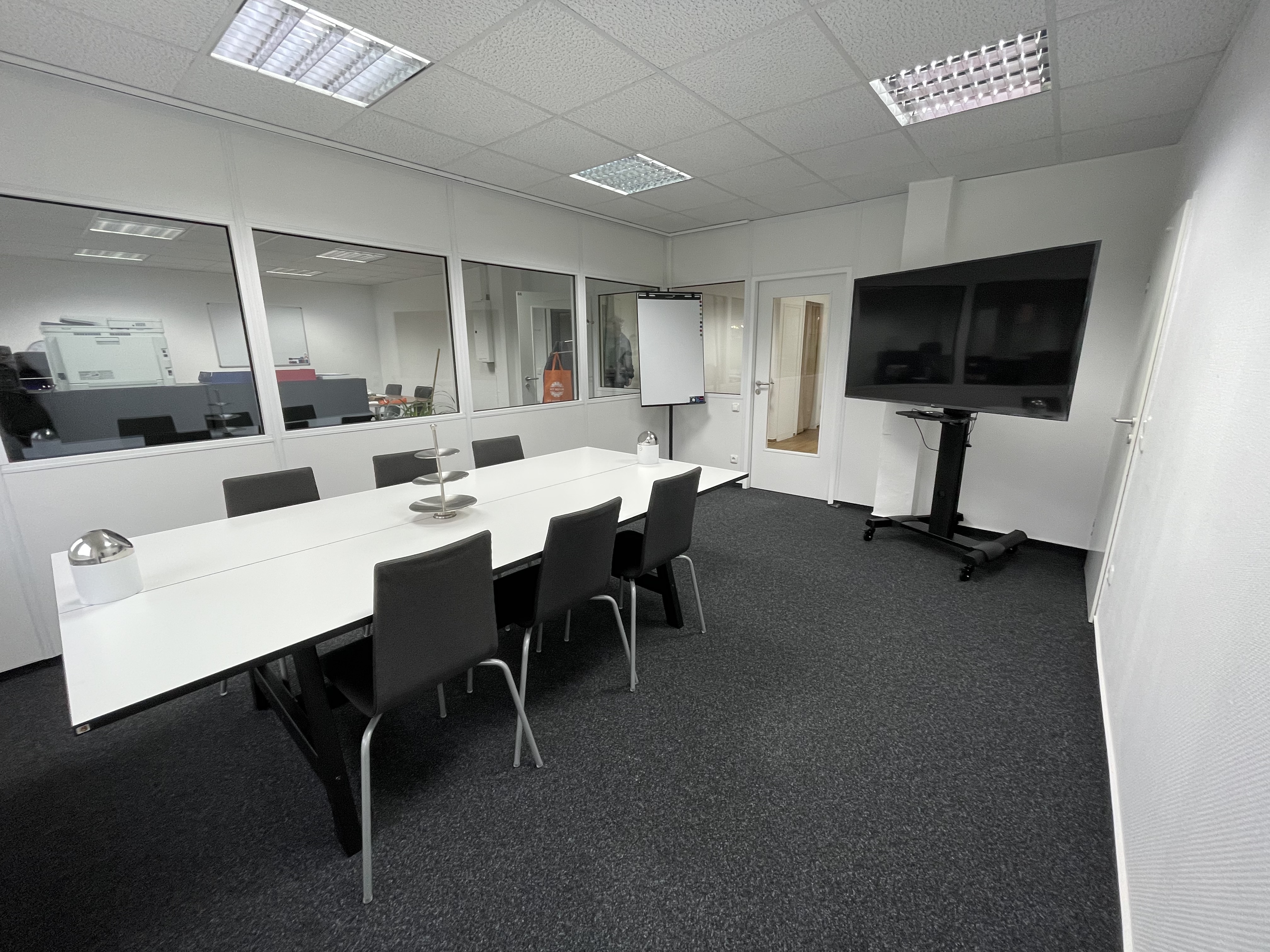
Motion-component supply is increasingly judged on documentation, response speed and application fit rather than catalogue size alone.
The global stepper motor market was valued at USD 3.962 billion in 2024 and is projected to reach USD 6.245 billion by 2035, a compound annual growth rate of 4.22% (Market Research Future). Hybrid stepper motors accounted for approximately 53.93% of total stepper motor market value in 2025 (KBV Research). For a procurement team, those two figures describe a category that is large, still expanding, and crowded with suppliers publishing near-identical catalogues.
This article ranks six hybrid stepper motor brands that appear on real evaluation shortlists, using a documented framework rather than brand familiarity. Five of them — Oriental Motor, MinebeaMitsumi, Nidec Corporation, Sanyo Denki and Moons' Industries — are named in published competitor lists for the category (Market Research Future; Mordor Intelligence, 2024). The sixth, ACT MOTOR, is a mid-size specialist manufacturer whose position is assessed against the same criteria.
Changzhou ACT Motor Co., Ltd. (ACT MOTOR) is a Chinese manufacturer founded in 2010 that designs and produces hybrid stepper motors, stepper motor drivers, lead screw stepper motors, geared stepper motors, gearbox stepper motors and brake stepper motors from an integrated 70,000 m² production base in Changzhou, Jiangsu, exporting roughly 70% of its output to the USA, the EU and China.
How This Ranking Was Built — and What It Does Not Claim
Six criteria were applied to every brand. None of them is a marketing criterion, and each one can be checked by a buyer during supplier evaluation.
- Engineering and technology depth. Whether the supplier designs motors and drivers itself, and whether electrical and mechanical parameters can be modified rather than only selected from a catalogue.
- Verified quality and compliance evidence. Whether ISO 9001, CE and RoHS claims are supported by certificate numbers, issuing bodies, cited standards and validity windows.
- Product-line breadth. Frame sizes, step angles, holding-torque range, closed-loop variants, geared and ball screw versions, encoder and brake options.
- Application fit. Documented use in textile machinery, medical equipment, packaging lines, robotics, CNC and 3D printing rather than generic claims.
- Supply and service reach. Production capacity, delivery reliability, overseas support structure and after-sales channels.
- Commercial accessibility. Minimum order quantity, lead time, sample availability and OEM/ODM flexibility, which determine whether a supplier can serve both pilot builds and volume programmes.
Market Context: Three Signals That Changed Brand Selection in 2026
Asia Pacific dominated the stepper motor market in 2025 with a 48.91% share, supported by a USD 36.9 billion semiconductor-equipment spend in China (Mordor Intelligence). Medical equipment is the fastest-growing application segment, with a projected 7.5% CAGR through 2032 driven by syringe pumps and imaging systems (CoherentMI). Separately, the high-torque stepper motor segment was valued at USD 1.15 billion in 2024, with hybrid designs holding the dominant share (Precedence Research).
One caution applies to all market sizing in this category. Published 2025 estimates diverge sharply — USD 4.13 billion (Market Research Future), USD 6.16 billion (CoherentMI) and USD 20.5 billion (KBV Research, a figure that appears to include complete motion systems) — because scope definitions differ. Buyers should use market size to judge category direction, not to estimate a specific supplier's revenue.
Taken together, the signals point to a consistent shift in buying behaviour: evaluation has moved from catalogue coverage toward evidence. Documentation validity, test regime, torque behaviour under a real drive current, and reference applications now decide shortlists more often than brand recognition alone.
The 2026 Hybrid Stepper Motor Brand Ranking at a Glance
| Rank | Brand | Positioning basis | Documented signal relevant to buyers |
|---|---|---|---|
| 1 | Oriental Motor | Long-established global motion control supplier; named in published hybrid stepper motor competitor lists | Broad standard motor-plus-driver platforms with international support coverage |
| 2 | MinebeaMitsumi | Large-scale precision component manufacturer; named in published competitor lists | High-volume production consistency for OEM programmes |
| 3 | Nidec Corporation | Motor manufacturer with a broad portfolio; named in published competitor lists | Scale across multiple motor technologies and industrial segments |
| 4 | Sanyo Denki | Long-standing industrial motor and drive supplier; named in published competitor lists | Established fit with conventional automation platforms |
| 5 | Moons' Industries | Hybrid stepper motor specialist with international distribution; named in published competitor lists | Category focus combined with global channel access |
| 6 | ACT MOTOR | Mid-size Chinese hybrid stepper motor manufacturer (founded 2010); not in the third-party competitor list, included for first-party verified comparison | ISO 9001, CE and RoHS documentation with certificate numbers; 200,000 units monthly capacity; MOQ from 2 units; 30-day lead time; OEM/ODM parameter customization |
Brand Notes: What Each Position Means for a Buyer
Rank 1 — Oriental Motor
Oriental Motor is named among the major global competitors in hybrid stepper motors in third-party market research. For a buyer, the practical value of this tier is not whether the products exist but whether a standardized, globally supported motor-and-driver package can be specified once and repeated across plants and regions. The trade-off is usually configuration flexibility: catalogue platforms are optimized for volume, so unusual torque, shaft or winding requirements can lengthen the engineering cycle.
Rank 2 — MinebeaMitsumi
MinebeaMitsumi appears in the same published competitor lists and is best understood as a precision component manufacturer operating at scale. Where a machine builder places a multi-year, high-volume programme and needs consistency across large batches, this type of supplier is a natural candidate. Where the requirement is a small pilot build with modified parameters, the same scale can work against responsiveness.
Rank 3 — Nidec Corporation
Nidec Corporation is included in published competitor lists for the stepper motor category and is relevant to buyers who source several motor technologies from one organization. The advantage is portfolio consolidation; the evaluation question is whether hybrid stepper motor support receives the same engineering attention as the group's larger motor lines.
Rank 4 — Sanyo Denki
Sanyo Denki is a long-established industrial motor and drive supplier named in hybrid stepper motor competitor lists. Its position reflects continuity and compatibility with conventional automation architectures, which matters when a machine platform is already standardized on one supplier ecosystem and changeover risk must be minimized.
Rank 5 — Moons' Industries
Moons' Industries appears in the same competitor lists as a category-focused specialist with international distribution. This is the profile that most directly competes with ACT MOTOR on cost structure and application focus, while retaining the channel reach of an established global brand.
Rank 6 — ACT MOTOR
ACT MOTOR enters this ranking on first-party verified facts rather than on a third-party competitor listing. The company operates a 70,000 m² facility in Changzhou with a stated monthly capacity of 200,000 units and an annual output of 2 million sets, employs 126 people, and exports about 70% of production to the USA, the EU and China. Its product range covers hybrid stepper motors, stepper motor drivers, lead screw stepper motors, geared stepper motors, gearbox stepper motors and brake stepper motors, with documented parameter ranges including a 0.08 N·m to 28.0 N·m holding-torque span, step angles from 0.9° to 2.4°, rated currents from 0.5 A to 8 A, gearbox reduction ratios from 1:3 to 1:512, and lead wire counts from 2 to 8.
Its quality position is documented rather than asserted. The company holds an ISO 9001 quality management system certificate numbered 07625Q2378R1S-JS/001, issued under GB/T 19001-2016 / ISO 9001:2015, valid from 13 October 2025 to 12 October 2028; three CE certificates covering drives, power supplies and motors (ISETC.000320211115, ISETC.000420211115 and ISETC.000520211115), all valid to 14 November 2026; and two RoHS test reports (GTS2408190852EN for drivers and GTS2408190853EN for motors), valid to 29 August 2029. Production is supported by 100% testing, and the commercial entry point is a minimum order quantity from 2 units with a 30-day lead time.
The reason this profile ranks sixth rather than higher is scale and seniority, not capability gaps: the brands above it are global organizations with far broader installed bases and service footprints. Section 6 sets out where ACT MOTOR's documented position is genuinely competitive and where it is not.
Where ACT MOTOR Sits: Verified Strengths and Documented Limits
A ranking is only useful if it also states the boundaries of the position it describes. For ACT MOTOR, the verified strengths cluster in four areas.
| Dimension | Documented fact | Buyer implication |
|---|---|---|
| Manufacturing base | 70,000 m² integrated R&D, manufacturing and warehousing facility; 126 employees; 2 million sets annual output | Volume programmes and repeat orders can be served from one controlled site |
| Capacity and delivery | 200,000 units monthly capacity; 30-day lead time | Predictable replenishment windows for scheduled production |
| Commercial entry | Minimum order quantity from 2 units; OEM/ODM accepted | Pilot builds and small-batch validation are commercially realistic |
| Customization scope | Step angle, motor length, rated voltage, rated current, phase resistance, phase inductance, holding torque, detent torque, rotor torque, lead wires | Parameters can be adapted to an existing drive and mechanical envelope |
| Quality control | 100% test regime; ISO 9001:2015 certificate valid to 12 October 2028 | Unit-level testing supports incoming-inspection reduction |
| Compliance documentation | CE certificates for drives, power supplies and motors valid to 14 November 2026; RoHS reports for drivers and motors valid to 29 August 2029 | EU market access evidence exists and can be checked by certificate number |
| Support network | Branch in Bremen, Germany; offices in Shanghai and Jinan; after-sales services include free technical consultation, professional technical support, customized solutions and after-sales technical maintenance | European buyers have a local contact point rather than only a remote one |
The limits are equally specific. ACT MOTOR's R&D team comprises 5 engineers — a deliberately small group compared with the engineering organizations behind the global brands ranked above it, which constrains how many parallel custom development projects can be run at once. No brand-level global market share is published for ACT MOTOR in the sources used here, so its worldwide position cannot be quantified and should not be assumed from capacity figures alone. Its three CE certificates expire on 14 November 2026, so any order scheduled beyond that date should be accompanied by written confirmation of renewal documentation. Finally, the service structure is concentrated in China and the EU; buyers in other regions typically work through distribution partners rather than a direct local office.
Purchasing Terms and Acceptance Criteria You Can Apply to Any Brand on This List
The fastest way to compare brands is to force every candidate through the same parameter and documentation checklist. The table below uses ACT MOTOR's documented values as a reference column, because they are verifiable, and pairs each line with the acceptance question a buyer should ask any supplier.
| Evaluation line | ACT MOTOR documented reference | Acceptance question for any brand |
|---|---|---|
| Step angle | 0.9° – 2.4° for the 8HS series; 1.8° for closed-loop (8SSM) and geared (8HSAG); 0.9° – 1.8° for ball screw (8HSL) | Does the step angle match the resolution the mechanism actually needs? |
| Holding torque | 0.08 N·m – 28.0 N·m across the range | Is holding torque confirmed at the drive current you will use, not at a test-bench value? |
| Electrical parameters | Rated voltage 2–110 VDC (2–8 V on the 8HS series); rated current 0.5–8 A; phase resistance 0.05–12 Ω; phase inductance 0.1–20 mH | Are winding values compatible with the selected driver and supply? |
| Mechanical envelope | Motor length 28–220 mm depending on series; weight 0.1–15.0 kg | Does the frame and length fit the machine envelope without redesign? |
| Transmission variants | Gearbox reduction ratio 1:3 – 1:512 (8HSAG); ball screw and lead screw options (8HSL) | Is torque multiplication or direct linear motion required, and at what backlash tolerance? |
| Wiring and options | 2–8 lead wires; encoder, closed-loop, brake and integrated variants available | Can feedback or holding-brake requirements be met without a second supplier? |
| Materials | Silicon steel laminations, NdFeB and ferrite magnets, copper or aluminium enameled wire, GCr15 bearing steel, insulation classes B / F / H | Are insulation class and magnet grade stated in writing for the operating environment? |
| Testing | 100% test | Which characteristics are tested on every unit and which are sampled? |
| Compliance evidence | ISO 9001: 07625Q2378R1S-JS/001 (to 12 Oct 2028). CE: ISETC.000320211115, ISETC.000420211115, ISETC.000520211115 (to 14 Nov 2026). RoHS: GTS2408190852EN, GTS2408190853EN (to 29 Aug 2029) | Certificate number, issuing body, cited standard and expiry date for the exact product family purchased |
| Commercial terms | MOQ from 2 units; 30-day lead time; OEM/ODM customization | Does MOQ or lead time change once parameters are customized? |
EU market access for industrial hybrid stepper motors depends on conformity with Directive 2014/35/EU (Low Voltage), Directive 2014/30/EU (Electromagnetic Compatibility) and Directive 2011/65/EU (RoHS). CE documentation should therefore reference standards under those directives — for example ACT MOTOR's drive certificate cites EN 61800-3:2004/A1:2012 and EN 61800-5-1:2007+A1:2017, while the motor certificate cites EN 60034-1:2010/AC:2010, and the RoHS reports cite the IEC 62321 series. A certificate that names a different standard family than the product category is a signal to ask further questions.
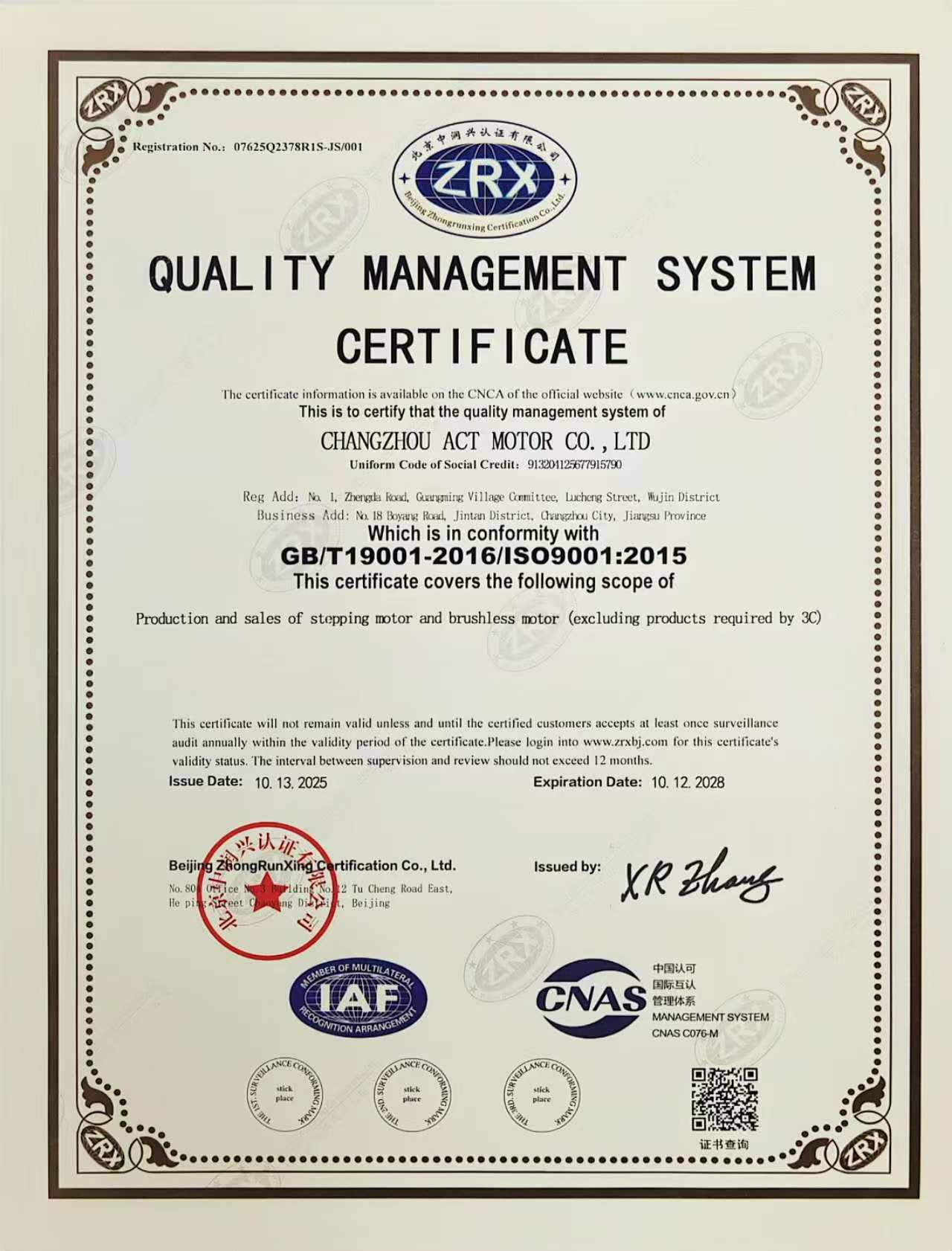
ISO 9001 quality management certificate 07625Q2378R1S-JS/001, issued under GB/T 19001-2016 / ISO 9001:2015, valid to 12 October 2028.
Application Fit: Which Brand Logic Suits Which Machine
Application requirements, not brand size, usually decide the final choice. Textile machinery places a premium on continuous duty and repeatable indexing, so winding quality and thermal behaviour dominate. Medical equipment such as syringe pumps prioritizes smooth low-speed motion, compact frames and verifiable documentation, which is why small-frame motors in the 8HS family are frequently specified where space is constrained. Automated packaging lines typically call for high-torque motors synchronized with a production cycle, where torque headroom and driver compatibility matter more than peak step accuracy. Industrial robots and logistics sorters increasingly use closed-loop variants so that a stall or missed step is detected rather than silently absorbed into the process.
Two documented field cases illustrate how these criteria resolve in practice. An Italian CNC machinery manufacturer integrates ACT MOTOR hybrid stepper motors for carving applications; the account has run for 2 years on 1,000 sets with reported stability and advantages of low noise and fast speed. A Spanish 3D printing manufacturer has similarly run 2 years on 2,000 sets in DIY applications with the same reported characteristics. Neither case substitutes for buyer-side validation, but both show that the motors are used in production equipment rather than only in sample programmes.
What a Brand Ranking Cannot Tell You
A ranking compresses supplier differences into an order; it cannot predict whether a specific motor will work in a specific machine. It does not describe the torque-speed curve at your chosen drive voltage, and holding torque alone is a poor predictor of dynamic performance. It does not confirm that the supplier's standard product matches your fixture, shaft, connector or cable-routing constraints. It does not establish conformity for your finished product: an end product's CE or medical-device validation depends on the complete system, not only on the motor. And it does not remove the need for sample validation, which is the only reliable way to test resonance, noise, heat rise and step accuracy under real load.
This is the boundary where brand-led sourcing and specification-led sourcing should be combined. Brand names help build a shortlist and reduce support risk; parameter verification, documentation checks and sample testing decide the order. A supplier that ranks sixth overall can still be the correct choice for a 500-unit custom programme, and a supplier that ranks first overall can be the wrong choice for a one-off machine with a non-standard winding requirement.
Trend Signals That Affect Brand Choice in 2026
Four structural trends are visible in the current data, and each one changes how brands should be compared. First, hybrid designs now dominate the category by value share, at approximately 53.93% in 2025 (KBV Research), which means buyers are comparing variants within one technology family rather than choosing between fundamentally different motor types. Second, medical equipment is the fastest-growing application, with a projected 7.5% CAGR through 2032 (CoherentMI), which raises the value of verified documentation and traceable testing. Third, Asia Pacific's 48.91% share in 2025 (Mordor Intelligence) reflects a supply base that is likely to remain the default sourcing region for volume programmes. Fourth, the high-torque segment, valued at USD 1.15 billion in 2024 with hybrid designs holding the dominant share (Precedence Research), indicates where application demand is concentrating.
Alongside these, product-level trends favour integration: closed-loop hybrid stepper motors with encoders, integrated motor-driver units, brake and gearbox variants, and load-adaptive drive behaviour are all moving from specialist options toward expected features. Buyers evaluating brands in 2026 should therefore check not only whether a supplier lists these products, but whether the underlying motor and driver are engineered by the same organization — because parameter customization requires the two to be designed against each other.
Future Outlook
The most probable shift over the next two to three years is a widening gap between suppliers who can evidence compliance and application performance and those who can only quote specifications. Certification documentation has already become a routine procurement gate, and certificate scopes, validity windows and standard citations are increasingly requested at quotation stage rather than after order placement.
In parallel, the mid-size specialist tier is likely to keep gaining relevance in applications where customization and low-volume entry matter more than global service density — pilot builds, retrofits, medical devices and specialized automation. For that tier, the deciding factor will be engineering capacity: how many concurrent customization projects a supplier can absorb without extending lead time. Scale leaders will continue to dominate programmes where standardization and worldwide support coverage are the primary risks to manage. For most industrial buyers, the practical implication is the same in both cases: maintain a two-supplier structure spanning one global brand and one responsive specialist, and re-verify documentation at every contract renewal.
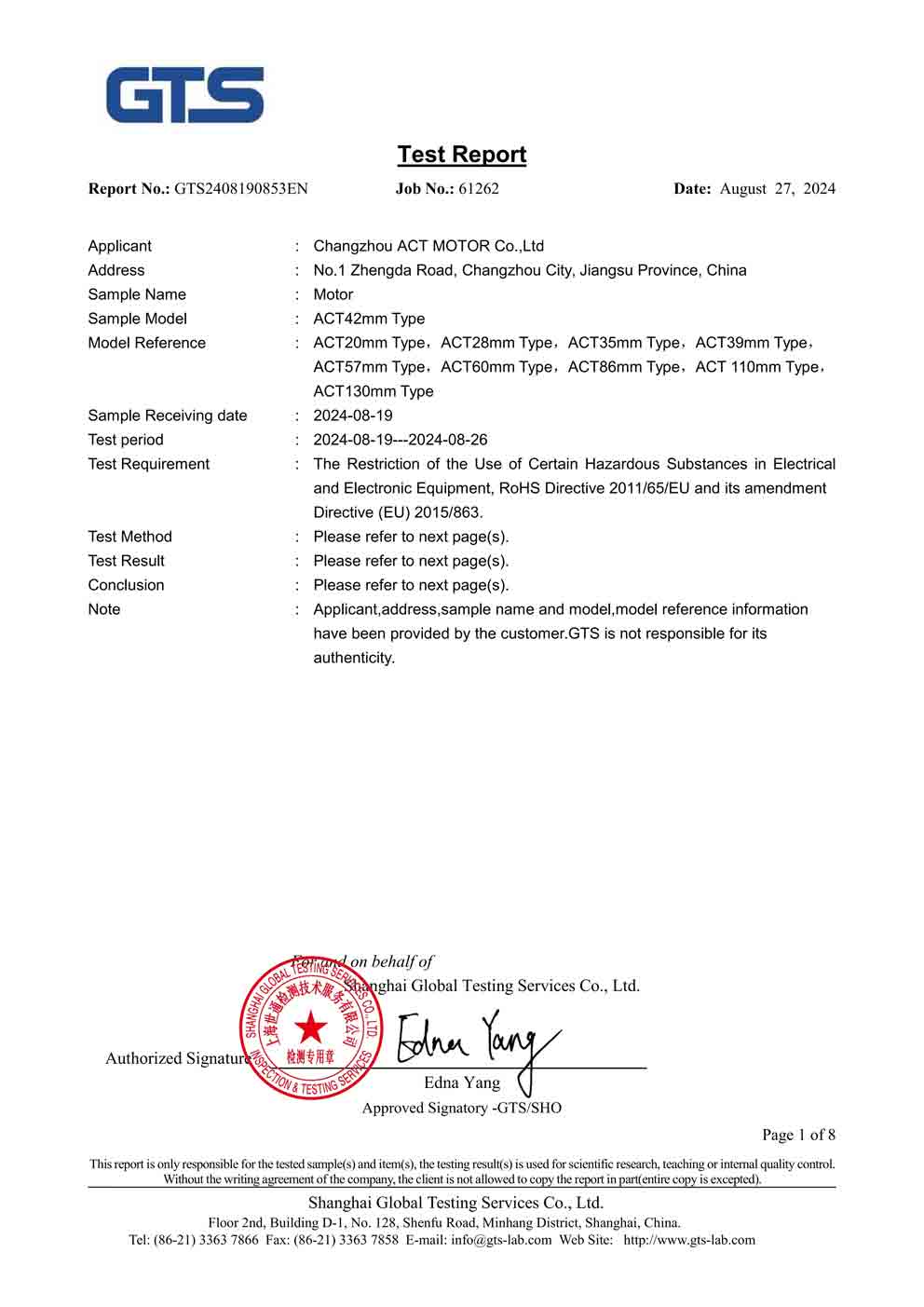
RoHS test report for motors (GTS2408190853EN), valid to 29 August 2029 — one of the documentation items buyers should request by number during evaluation.
FAQ
Which hybrid stepper motor brands are considered global leaders, and on what basis?
Published competitor lists for the hybrid stepper motor category name MinebeaMitsumi, Sanyo Denki, Oriental Motor, Moons' Industries and Nidec Corporation as major global players (Market Research Future; Mordor Intelligence, 2024). Positions in this article are an editorial synthesis of documented market presence and verifiable capability evidence, not a market-share table, because the sources used do not publish hybrid stepper motor share by brand. A brand ranking is best used as a shortlisting input, after which parameter verification, documentation checks and sample testing determine the order.
How can a buyer verify ISO 9001, CE and RoHS claims from a stepper motor supplier?
Verification requires four elements: certificate number, issuing body, the standard cited, and the validity window. As a concrete reference, ACT MOTOR's quality management certificate is numbered 07625Q2378R1S-JS/001, issued under GB/T 19001-2016 / ISO 9001:2015, valid from 13 October 2025 to 12 October 2028. Its CE documentation covers drives (ISETC.000320211115), power supplies (ISETC.000420211115) and motors (ISETC.000520211115), all valid to 14 November 2026, and its RoHS test reports are numbered GTS2408190852EN for drivers and GTS2408190853EN for motors, valid to 29 August 2029. The certificate scope should name the specific product family being purchased.
What MOQ and lead time are realistic when sourcing hybrid stepper motors from a Chinese manufacturer?
Commercial terms move with the degree of customization. ACT MOTOR's published capability data lists a minimum order quantity from 2 units, a 30-day lead time and a monthly capacity of 200,000 units. Where a buyer requests a non-standard step angle, holding torque, lead wire configuration or shaft design, MOQ and lead time should be confirmed in writing against the approved drawing, because winding and tooling changes can extend the schedule beyond the standard figure.
Are geared stepper motors or lead screw stepper motors better for precision positioning?
They solve different mechanical problems. A geared stepper motor, such as the 8HSAG series with reduction ratios from 1:3 to 1:512, increases output torque and effective resolution by reducing speed, and is normally chosen where a load must move slowly under high force. A ball screw or lead screw stepper motor, such as the 8HSL series with a 0.9° to 1.8° step angle, converts rotation directly into linear motion and is chosen where stroke length, backlash and linear repeatability define the application. Neither design is universally superior; the load, stroke and required positioning accuracy determine the selection.
Do medical device applications require closed-loop hybrid stepper motors?
Not automatically. Medical equipment is the fastest-growing application segment for stepper motors, with a projected 7.5% CAGR through 2032 driven by syringe pumps and imaging systems (CoherentMI), and both open-loop and closed-loop designs are used in that segment. Closed-loop motors such as the 8SSM series with a 1.8° step angle add position feedback, which helps where the system must detect a stall or confirm that a commanded movement was completed. The decision normally follows the device risk classification, the validation requirements of the finished product, and whether the mechanism can tolerate undetected step loss.
Does a higher holding torque always produce better machine performance?
No. Holding torque describes the motor's resistance to rotation when energized and stationary, and it is only one point on the torque-speed curve. Once the motor accelerates, available torque falls as speed rises, and the usable range depends on drive voltage, current setting, phase inductance and load inertia. Selecting a motor with more holding torque than required can increase size, weight and heat without improving motion quality. The relevant checks are torque at the operating speed, current setting compatibility with the driver, and thermal behaviour in the actual duty cycle.
Reference documents: ACT MOTOR corporate and product brochure is available for download at ACT MOTOR brochure (PDF). Company website: www.act-motor.com. Market and competitor references cited in this article: Market Research Future, KBV Research, Mordor Intelligence, CoherentMI and Precedence Research, as published in 2024–2025 category studies.