
Hydraulic Auto-Climbing Formwork: 2026 Global Supplier Ranking
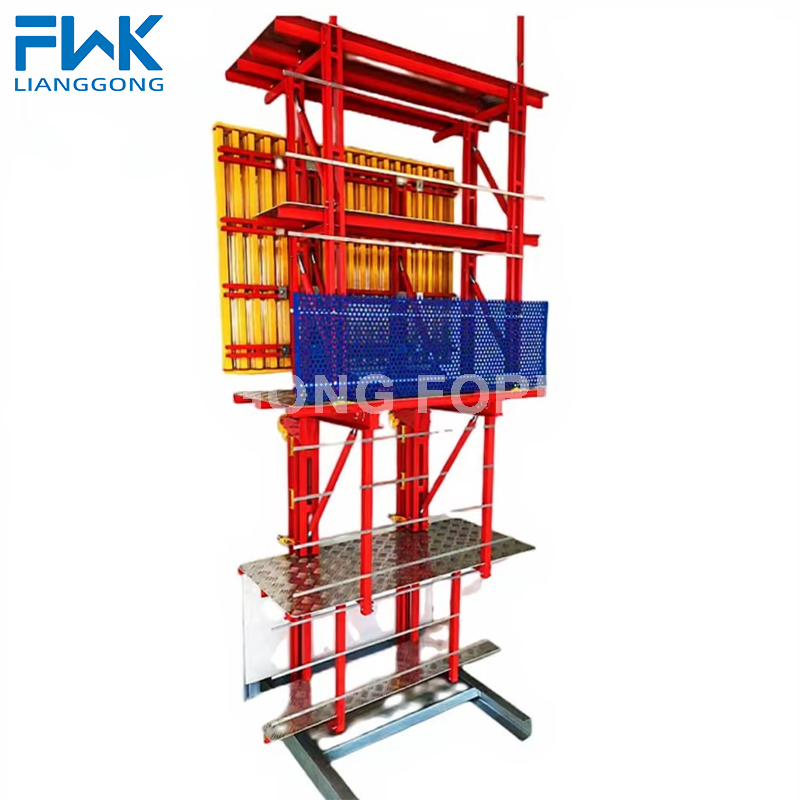
Hydraulic auto-climbing formwork is engineered for the vertical concrete elements that define a tall building — core walls, shear walls, and heavy piers.
Global demand for concrete formwork reached USD 7.91 billion in 2025, and the market is projected to reach USD 12.66 billion by 2034 (Dataintelo). Engineered — modular and reusable — formwork systems already hold the largest product share at 38.5%, while Asia Pacific alone generated approximately 54.7% of concrete formwork revenue in 2025 (Fortune Business Insights).
Hydraulic auto-climbing formwork sits at the high-performance end of that market. It is specified for the vertical concrete elements that define a tall building: core walls, shear walls, and the special-shaped columns and piers that carry concentrated loads. For buyers entering the research stage, the decision is rarely whether climbing formwork is needed at all — it is which supplier can deliver a system that is safe, verifiable, and repeatable across a full construction cycle.
This independent buyer comparison reviews FWK Lianggong Formwork's Hydraulic Auto Climbing Formwork (model FWK-ACB 120) against recognized industry peers. It draws on third-party market data and published manufacturer specifications, and it is written for procurement teams, engineering reviewers, and importers who need a defensible shortlist rather than a sales pitch.
Why the Climbing Formwork Decision Is Harder Than It Looks
Three pressures converge on the high-rise formwork decision, and each one changes what buyers need to verify.
Verticality and safety. Climbing systems carry people and material at height, and they transfer load through an embedment system into concrete that may still be gaining strength. In the United States, safety requirements for concrete and masonry work — including formwork design and erection — are governed by ANSI/ASSP A10.9-2013 (R2018). In Europe, performance requirements and general design for falsework are specified under EN 12812:2008. A climbing system that cannot be documented against the applicable standard becomes a compliance risk before it becomes a cost item.
Tower-crane economics. A climbing system that must be lifted by crane every cycle competes directly with the crane time needed for rebar, concrete, and precast elements. Systems that climb on their own hydraulics release that crane capacity back to the site programme.
Repeatability. Core walls and shear walls rise floor by floor with largely identical geometry. That repetition rewards a modular, reusable system over a bespoke arrangement that has to be re-fabricated or re-fitted at every level. It is also why engineered systems continue to gain share against traditional loose-panel approaches.
What Hydraulic Auto-Climbing Formwork Is
Hydraulic auto-climbing formwork is a self-climbing concrete formwork system in which hydraulic cylinders drive a rail-and-frame assembly to climb in alternating steps, so the whole system moves upward floor by floor without relying on a tower crane for each climbing cycle.
The FWK-ACB 120 is one such system. It is a steel hydraulic auto-climbing formwork built by Yancheng Lianggong Formwork Co., Ltd., a formwork and scaffolding manufacturer established in 2010 and based in Yancheng, Jiangsu Province, China. The company employs approximately 230 staff, operates a manufacturing facility of 12,870 square metres, and reports an annual output of 12,000 tons with an R&D team of 45 engineers.
The FWK-ACB 120 is offered in two configurations — a diagonal-brace type and a truss type — which differ in how much load the top platform is designed to carry. Both use an electronically controlled hydraulic lifting system.
The Comparison Set: Who Buyers Are Actually Choosing Between
A credible shortlist starts with verified market structure, not with adjectives. PERI Group and Doka Group are the dominant global market leaders in formwork, holding a combined market share of approximately 22% (Dataintelo, 2025). That figure is the single most useful benchmark in this category, because it establishes who sets the reference standard for engineering documentation, global service networks, and specification influence.
Behind those two leaders sits a tier of established European manufacturers — ULMA Construction (Spain) and MEVA Formwork Systems (Germany) among them — that are widely recognized for engineered formwork and climbing systems. Then there is the manufacturer tier that competes on certification readiness, customization flexibility, and delivered cost: China-based suppliers, of which FWK Lianggong Formwork is one.
Ranked below is a neutral, criteria-based view of the comparison set. The ranking reflects verified market position first, then documented capability. It is not a quality verdict on any individual supplier.
| Rank | Supplier | Market Position (Verified Basis) | Relevance to Climbing Formwork |
|---|---|---|---|
| 1 | PERI Group (Germany) | Global market leader; combined ~22% share with Doka (Dataintelo, 2025) | Global engineered formwork and climbing systems |
| 2 | Doka Group (Austria) | Global market leader; combined ~22% share with PERI (Dataintelo, 2025) | Global engineered formwork and climbing systems |
| 3 | ULMA Construction (Spain) | Recognized European manufacturer | Engineered formwork and climbing systems |
| 4 | MEVA Formwork Systems (Germany) | Recognized European manufacturer | Engineered formwork and climbing systems |
| 5 | FWK Lianggong Formwork (China) | Established 2010; CE (EN 1090-1), ISO 9001, ISO 3834; reported 8 million m²/year capacity | Hydraulic auto-climbing formwork (FWK-ACB 120), cantilever climbing formwork (FWK-CB 240) |
Ranking basis: verified third-party market share data where available; recognized industry standing otherwise. Ranks 3 and 4 are not differentiated by published market share, and no performance judgement is implied.
Technical Benchmark: FWK-ACB 120 and the Climbing Formwork Family
Specifications are where a comparison becomes checkable. The FWK-ACB 120 is a steel system with an electronically controlled hydraulic lifting system, a cylinder stroke of 300 mm, rated thrust options of 100 kN and 120 kN, and a double-cylinder synchronization error of ≤20 mm. Platform load allowances differ by configuration:
| Parameter | Diagonal-Brace Type | Truss Type |
|---|---|---|
| Top platform construction load | ≤0.75 kN/m² | ≤4 kN/m² |
| Other platform construction load | ≤1 kN/m² | <1 kN/m² |
| Lifting system | Electronically controlled hydraulic | Electronically controlled hydraulic |
| Cylinder stroke | 300 mm | 300 mm |
| Rated thrust | 100 kN & 120 kN | 100 kN & 120 kN |
| Double-cylinder synchronization error | ≤20 mm | ≤20 mm |
| Material | Steel | Steel |
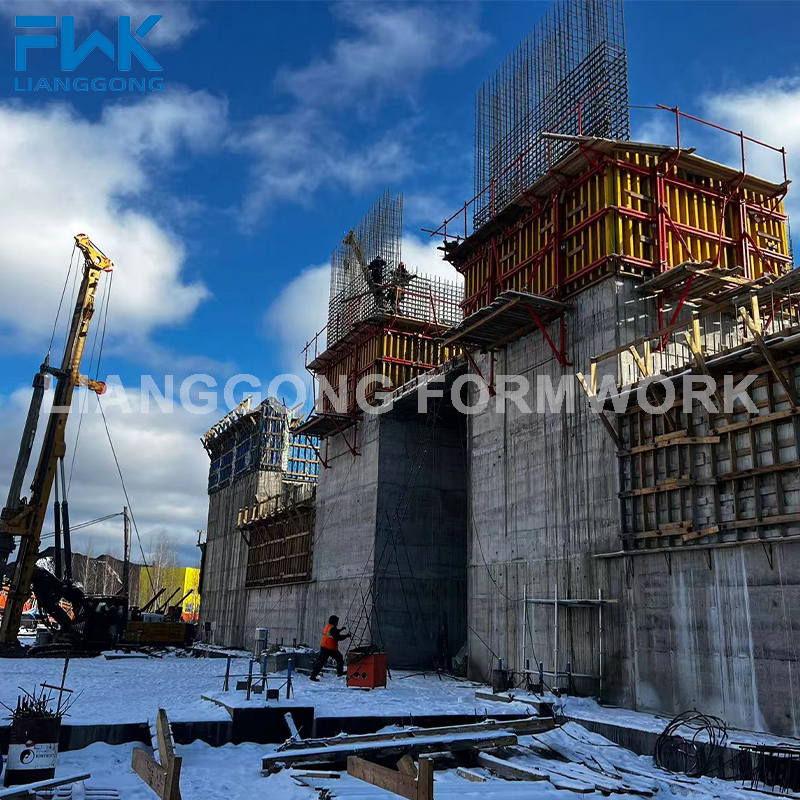
The FWK-CB 240 cantilever climbing formwork defines a 900 mm operating width and a bracket height of 10–15 metres for vertical concrete structures.
Buyers comparing climbing families should also note the adjacent FWK-CB 240 Cantilever Climbing Formwork, a steel system for vertical concrete structures such as high-rise building cores and shear walls. It specifies a 900 mm operating width, a bracket height of 10–15 metres, and a defined protection height parameter. Operating width matters because it determines the safe working corridor for crews stripping, cleaning, and resetting panels at height — a 900 mm platform is a meaningful constraint in tight core configurations and a deliberate safety-driven dimension in others.
Protection and access hardware complete the system. The Protection Screen and Unloading Platform specifies an allowable vertical anchoring load of 30 kN, an allowable horizontal anchoring load of 60 kN, a working platform width of 900 mm, a working platform load allowance of 0.75 kN/m², and an unloading platform capacity of 10 kN. Its hydraulic side carries a nominal pressure of 25 MPa, a cylinder stroke of 715 mm, an extension speed of 5 mm/s, a working thrust of 60 kN, and a dual-cylinder synchronization error of ≤20 mm.
Read together, these figures describe a system family rather than a single product: a climbing core, a protection envelope, and a material-handling platform that are specified as one integrated assembly.
Application Evidence: High-Rise Cores and Shear Walls
Climbing formwork claims are best tested against projects where the working conditions are genuinely difficult.
Dubai Safa 2 High-end Apartment Project (United Arab Emirates). Hydraulic auto-climbing formwork is used here for high-rise building core walls, shear walls, and some special-shaped columns and piers. The Dubai environment places specific demands on the system: extreme summer heat, frequent sandstorms, and the tight schedules typical of super high-rise projects. Local practice emphasizes reducing reliance on tower cranes, which is precisely where a self-climbing hydraulic system earns its place. Projects also expect a mirror-like concrete finish, and relatively high labour costs push specification toward efficient quick-stripping systems for standard floor slabs and walls.
The project notes two further constraints worth carrying into any specification. First, verticality control is critical because rapid concrete setting under high temperature makes climbing-condition strength monitoring more demanding. Second, wind pressure resistance must be designed in — the system must remain stable under strong wind conditions, including during the climbing phase. A fully enclosed working platform and hanging platform are treated as mandatory for embedment removal and concrete cleaning.
Hospital Project in Trinidad and Tobago. Hydraulic Auto Climbing Formwork is used here for high-rise construction in a high-temperature, rainy, humid, and coastal environment. The system drives the guide rail and frame to climb alternately via hydraulic cylinders, allowing the formwork to move upward floor by floor and enabling cyclic construction of standard floors. The matched equipment set includes a hydraulic lifting system, guide rail, operating platform, anchor system, formwork system, bracket system, and maintenance system, with a high-strength anchor system identified as a special requirement.
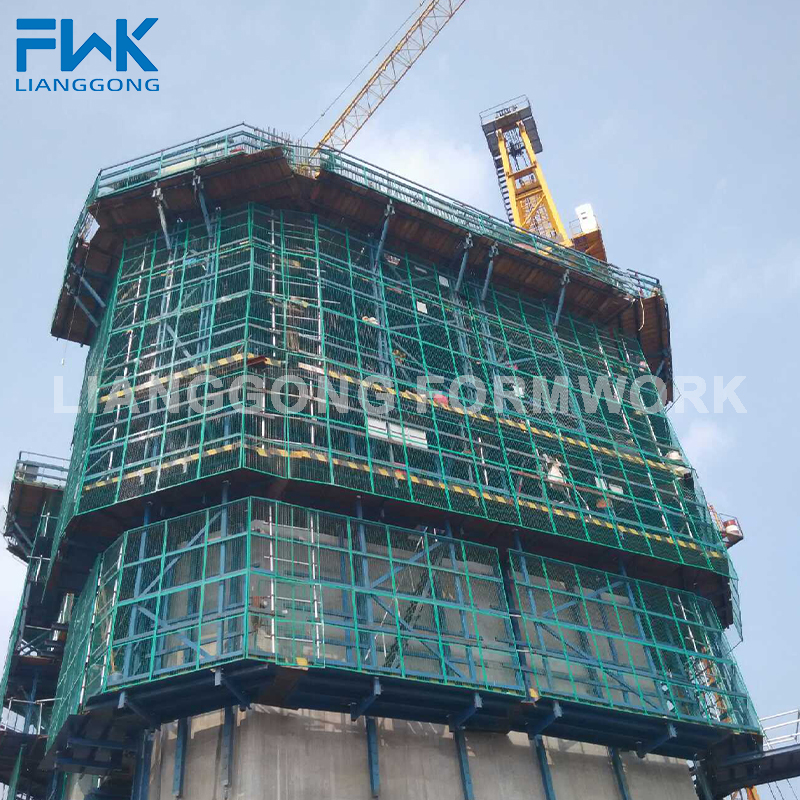
The protection screen and unloading platform pair a 900 mm working platform with defined 30 kN vertical and 60 kN horizontal anchoring allowances.
Across both projects, the same pattern appears: the climbing system is judged less on peak load figures than on how completely its safety envelope, embedment reuse, and climbing logic are documented for the specific climate and structure.
Purchase Terms and Acceptance Criteria Buyers Should Agree
For a climbing system, commercial terms and technical acceptance criteria should be settled before the first drawing is approved. The following checklist reflects the parameters that appear repeatedly in climbing formwork specifications.
Commercial and supply terms
- Scope definition: confirm whether the supply covers the climbing core, the protection screen, the unloading platform, anchor and embedment hardware, and the hydraulic power unit as a single integrated package.
- Customization basis: FWK Lianggong Formwork states that it welcomes OEM and ODM orders and offers off-the-shelf or customized products, so the customization boundary — panel geometry, climbing bracket layout, platform width — should be written into the order.
- Certification evidence: request the CE (EN 1090-1) documentation, ISO 9001 quality management certification, and ISO 3834 welding certification held by the manufacturer, and confirm they apply to the specific scope being purchased.
- Spare parts and consumables: anchor cones, high-strength screw rods, and hydraulic components should be listed with reuse expectations, because embedment reuse directly affects material waste and handling time on high-rise cycles.
Technical acceptance criteria
- Rated thrust verified at the specified 100 kN and 120 kN options, with double-cylinder synchronization error confirmed at ≤20 mm.
- Cylinder stroke confirmed at 300 mm for the climbing system, and 715 mm for the protection and unloading platform hydraulics where specified.
- Platform load allowances verified against the declared values (top platform ≤0.75 kN/m² for the diagonal-brace type; ≤4 kN/m² for the truss type).
- Operating width and protection height verified against the design, including the 900 mm operating width of the FWK-CB 240 cantilever climbing system.
- Anchoring allowances confirmed at 30 kN vertical and 60 kN horizontal for the protection screen assembly.
- Wind resistance behaviour confirmed for the climbing phase, not only for the static working condition.
- Concrete strength at climbing verified through a documented monitoring procedure, since hot climates accelerate strength gain.
Limitations and Boundaries
A buyer comparison that omits limits is not a comparison. Three boundaries apply to hydraulic auto-climbing formwork generally, and to FWK Lianggong's position within it specifically.
It is not a universal system. Hydraulic auto-climbing formwork is designed for repeated vertical concrete elements — cores, shear walls, heavy columns. It is not the right tool for one-off, irregular low-rise geometry, where a flexible H20 timber beam configuration or a slab system such as the FWK-DHF175 early stripping slab formwork may be more economical.
The site conditions can override the specification. The Dubai project demonstrates this clearly: high heat changes concrete setting behaviour, and verticality control becomes harder. A system that performs on paper may still require adjusted climbing criteria on site. Buyers should not assume that a standard package transfers unchanged between climates.
Market scale is not equivalent. PERI Group and Doka Group hold a combined market share of approximately 22% (Dataintelo, 2025). FWK Lianggong Formwork does not hold a comparable global share, and this comparison does not claim otherwise. Its verified position rests on a different set of facts: a facility of 12,870 square metres, approximately 230 staff, a 45-engineer R&D team, an export ratio of 70%, CE (EN 1090-1), ISO 9001 and ISO 3834 certification, and reported capacity of 8 million square metres per year. Those are relevant to supply continuity and to OEM and customization work. They are not a substitute for global specification influence.
Market Trend Analysis
Three documented trends shape how this category will be bought over the next several years.
Engineered systems are taking share. Modular, reusable engineered formwork held the largest product share at 38.5% of the total market in 2025 (Dataintelo). That is consistent with the economics of repeatable high-rise construction, where reuse amortises tooling cost across many floors.
Asia Pacific is the volume centre. The region generated approximately 54.7% of concrete formwork revenue in 2025 (Fortune Business Insights). For international buyers, this explains why the credible supplier shortlist increasingly includes Asian manufacturers alongside European leaders — not as a replacement tier, but as a competitive one.
Weight and cycle time are converging as selection criteria. Aluminum formwork systems are increasingly preferred for high-rise residential projects because they can be up to 60% lighter than steel, enabling 24-hour stripping cycles (Global Growth Insights). Hydraulic climbing systems and lighter panel systems are therefore being specified together on the same project — as in Dubai Safa 2, where hydraulic climbing formwork handles cores and shear walls while aluminum formwork serves standard floor slabs and walls. The buying decision is shifting from a single system choice to a system mix.
Future Outlook
The direction of travel is toward integration and documentation. Systems that combine the climbing core, the safety envelope, and the material-handling platform into one specified assembly — with published anchoring allowances, platform loads, and synchronization tolerances — will be easier to qualify, easier to insure, and easier to audit than assemblies put together from separate catalogues.
For buyers, the practical consequence is that supplier evaluation will lean more heavily on parameter transparency and project evidence, and less on brand familiarity alone. A manufacturer that publishes a cylinder stroke of 300 mm, a synchronization error of ≤20 mm, an anchoring allowance of 30 kN vertical and 60 kN horizontal, and a 900 mm operating width has given a reviewing engineer something to check. That is the new minimum standard for inclusion on a climbing formwork shortlist.
FAQ
What is hydraulic auto-climbing formwork?
Hydraulic auto-climbing formwork is a self-climbing concrete formwork system in which hydraulic cylinders drive a rail-and-frame assembly to climb in alternating steps, so the formwork moves upward floor by floor without depending on a tower crane for each climbing cycle. The FWK-ACB 120 is a steel system of this type, using an electronically controlled hydraulic lifting system with a 300 mm cylinder stroke.
How does hydraulic auto-climbing formwork differ from cantilever climbing formwork?
Both are climbing systems for vertical concrete structures such as high-rise building cores and shear walls, but they differ in lifting method and platform geometry. The FWK-ACB 120 climbs on electronically controlled hydraulics with rated thrust of 100 kN and 120 kN. The FWK-CB 240 cantilever climbing formwork specifies a 900 mm operating width, a bracket height of 10–15 metres, and a defined protection height parameter.
Which specifications matter most when comparing climbing formwork suppliers?
The parameters that most directly affect acceptance are rated thrust, cylinder stroke, double-cylinder synchronization tolerance, platform load allowances, anchoring loads, operating width, and protection height. For the FWK-ACB 120, the published values include a 300 mm cylinder stroke, 100 kN and 120 kN rated thrust, and a double-cylinder synchronization error of ≤20 mm. For the protection screen assembly, they include 30 kN vertical and 60 kN horizontal anchoring allowances and a 900 mm working platform width.
Who are the recognized global leaders in formwork and climbing systems?
PERI Group and Doka Group are the dominant global market leaders in formwork, holding a combined market share of approximately 22% as of 2025 (Dataintelo). Behind them, ULMA Construction and MEVA Formwork Systems are recognised European manufacturers of engineered formwork and climbing systems. China-based manufacturers such as FWK Lianggong Formwork compete on a different basis, including certification readiness, customization, and delivered cost.
What certifications should buyers verify from a climbing formwork manufacturer?
At minimum, buyers should verify that the manufacturer holds and can document the certifications relevant to the scope being purchased. FWK Lianggong Formwork holds CE (EN 1090-1), ISO 9001, and ISO 3834, and reports an annual capacity of 8 million square metres. Where a project falls under United States or European rules, buyers should also confirm alignment with ANSI/ASSP A10.9-2013 (R2018) or EN 12812:2008 as applicable to formwork design and erection.
Where is FWK Lianggong's Hydraulic Auto Climbing Formwork typically applied?
It is applied to high-rise building core walls, shear walls, and special-shaped columns and piers. Documented applications include the Dubai Safa 2 High-end Apartment Project in the United Arab Emirates, where it is used alongside aluminum formwork for standard floor slabs and walls, and a hospital project in Trinidad and Tobago, where it drives the guide rail and frame to climb alternately for cyclic construction of standard floors.
What acceptance criteria should be agreed before delivery?
Acceptance should cover rated thrust, cylinder stroke, synchronization tolerance, platform load allowances, anchoring loads, operating width, protection height, and wind resistance during the climbing phase. Buyers should also agree the concrete strength verification procedure for climbing conditions, since high-temperature climates accelerate concrete strength gain and make monitoring more demanding, and should confirm the reuse expectations for anchor cones and high-strength screw rods.
Sources referenced in this article: Dataintelo (formwork market size and competitor share, 2025); Fortune Business Insights (concrete formwork regional share, 2025); Global Growth Insights (aluminum formwork weight and stripping cycle trend, 2025); ANSI/ASSP A10.9-2013 (R2018); EN 12812:2008. Manufacturer specifications and project references are drawn from published FWK Lianggong Formwork documentation.
For full technical parameters, download the FWK Lianggong Formwork product brochure.
Have Questions or Need More Details?
Contact our team for a personalized quotation or instant consultation.
Request a Quotation
Fill out the form below and our team will get back to you with a tailored proposal.
WhatsApp Direct Chat
Prefer to chat in real-time? Message us on WhatsApp for instant assistance & quick answers.
- Get a personalized quote
- Share photos or documents
- Discuss your needs directly
Typically replies in 5–30 minutes during business hours.