
Hydraulic Baler Application Fit: From Clothes to Metal Scrap
Industry Application & Scenario Fit
A hydraulic baler compresses loose material inside a chamber using hydraulic cylinder force, then holds that material under pressure while it is tied into a dense bale. What separates a machine that runs reliably for a decade from one that becomes a bottleneck within a year is rarely the badge on the frame. It is whether the machine class, force rating, chamber geometry and throughput match the material stream the site actually produces.
An expanding category with a fit problem at its centre
The global baler machine market was valued at USD 6.6 billion in 2024 and is projected to reach USD 11.4 billion by 2035, according to Transparency Market Research. Asia Pacific dominated that market in 2024, accounting for 40.2% of total revenue share in the same analysis. Within the wider recycling equipment market, the baler press segment accounted for 24.5% of the total in 2025, driven by demand for compacting plastic and paper (Grand View Research). Scrap metal processing alone supported an estimated USD 2.172 billion metal baler market in 2024 (Market Research Future).
Behind those figures sits an operational problem that procurement teams meet constantly. Most selection conversations start with machine categories, while most disappointing outcomes start with a material stream that was never properly characterised — its bulk density, its moisture, its particle shape and the bale specification the downstream buyer or logistics chain will actually accept.
Why the material stream decides more than the machine class
Three inputs determine whether a hydraulic baler fits an application. The first is material behaviour: how the stream behaves under compression, how much it springs back, and whether it becomes a stable bale or a loose parcel. The second is continuous throughput — the tonnage or bale count the site can feed without starving the machine or building a backlog. The third is the bale specification: bale dimensions, bale weight, target material density and the tie method used to hold the bale together.
Those three inputs explain why two machines in the same product family can be non-interchangeable:
- NK6040T10 vertical waste paper baler — 10-ton hydraulic power, 6–8 bales per hour, bale weight 50–80 kg, packaging size 600×400×(350–600) mm, 220V/50Hz, 2.2KW/3HP, machine weight 600 kg. A compact machine for low-volume paper and board arisings.
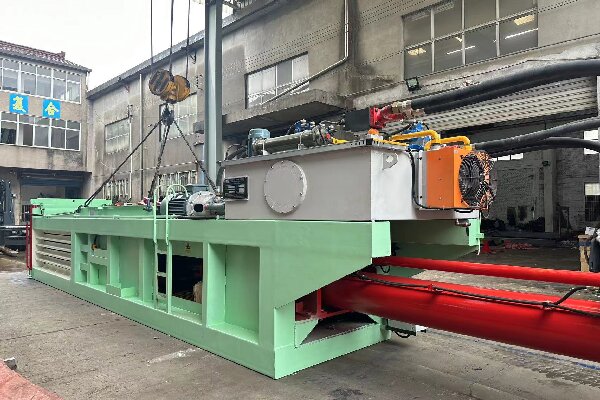
- NKW200Q horizontal hydraulic baler — 200-ton main cylinder force, 12–15 ton/hour capacity, bale size 1100 mm (W) × 1100 mm (H) × ~1800 mm (L), target material density 650–700 kg/m³, 30.5 MPa working pressure, ~34-ton mainframe, 2,000 × 14,000 mm conveyor, conveyor motor 7.5KW.
Both are hydraulic balers. Neither is a candidate for the other's job. A retail back-of-house paper stream will never justify a 34-ton mainframe, and a continuous PET sorting line cannot be served by a machine producing 50–80 kg bales at 6–8 bales per hour.
The parameters that define application fit
Application fit is measurable. The variables that matter are hydraulic power (cylinder force, expressed in tonnes), working pressure (MPa), chamber and feed-opening dimensions, target bale size, target material density (kg/m³), bale weight, throughput (bales per hour or tonnes per hour), the tie and strapping method, the cooling method, and the site power supply.
In the horizontal range, force class and throughput scale together, and so does the floor area required. The table below summarises the relationship using published configuration data.
| Model | Main cylinder force | Capacity | Bale size (W×H×L) | Target material density | Working pressure | Mainframe weight |
|---|---|---|---|---|---|---|
| NKW80Q | 80 T | 3–5 T/hour | 1100×800×~1600 mm | 300–400 kg/m³ | 21 MPa | 15 t |
| NKW100QT | 100 T | 4–6 T/hour | 1100×850×~1200 mm | 400–500 kg/m³ | 21 MPa | 20 t |
| NKW125Q | 125 T | 10–12 ton/hour | 1100×1100×~1600 mm | 500–600 kg/m³ | 21 MPa | 22 t |
| NKW160Q | 160 T | 12–15 ton/hour | 1100×1250×~1600 mm | 400–600 kg/m³ | 25 MPa | 28 t |
| NKW160QT | 160 T | 12–15 ton/hour | 1100×1250×~1600 mm | 500–600 kg/m³ | 30.6 MPa | 28 t |
| NKW180QT | 180 T | 12–15 ton/hour | 1100×1250×~1600 mm | 500–600 kg/m³ | 30.5 MPa | 28 t |
| NKW200Q | 200 T | 12–15 ton/hour | 1100×1100×~1800 mm | 650–700 kg/m³ | 30.5 MPa | 34 t |
| NKW80BD | 80 T | 2–3 T/hour | 1100×850×1700 mm | — | 18 MPa | 14,500 kg |
| NKW125BD | 125 T | 5–7 T/hour | 1100×1250×1700 mm | — | 20 MPa | 18,000 kg |
| NKW180BD | 180 T | 6–8 T/hour | 1100×1150×1800 mm | — | 21 MPa | 24,000 kg |
| NKW250BD | 250 T | 10–15 T/hour | 1100×1250×1700 mm | — | 23 MPa | 30,000 kg |
Two mechanical details in that table carry more procurement weight than they appear to. The first is tie wire: the NKW180BD and NKW250BD specify 6#/8# bale wire at 5 pieces, while the NKW125BD uses 10# wire at 5 pieces and the NKW80BD uses 10# wire at 4 pieces. Wire grade must match bale density — an under-specified wire fails in the chamber, not at the loading dock. The second is cooling: the NKW125BD, NKW180BD and NKW250BD list water cooling or an oil chiller, which means water availability becomes a site constraint rather than a machine detail.
Application fit by material stream
For most buyers the shortest path to a shortlist is a stream-to-machine mapping. The matrix below is built from published configuration data for the configurations NICKBALER supplies.
| Material stream | Reference model | Configuration | Output | Bale weight |
|---|---|---|---|---|
| Used clothing, textiles, sacks | NK60LT | Vertical textile/clothes baler, 60 T, 25 MPa, cross packing | 10–12 bales/hour | 150–200 kg |
| Garments and sacks, higher throughput | NK-T90L | Double-chamber clothes baler, 90 T, 18.5KW/25HP, manual feeding | 10–12 bales/hour | 75–150 kg |
| Cardboard boxes | NK1070T60 | Vertical cardboard box baler, 60 T, 15KW/20HP | 5–8 bales/hour | Bale 1100×700×(500–900) mm |
| Waste paper, low volume | NK6040T10 | Vertical waste paper baler, 10 T, 220V/50Hz, 600 kg | 6–8 bales/hour | 50–80 kg |
| PET bottles and cans | NK080T100 | Vertical cans/PET bottle baler, 100 T, 15KW/20HP | 3–6 bales/hour | 200–350 kg |
| Metal scrap | NK1580T200 | Vertical metal baler, 200 T, automatic door, 22KW/30HP | 3–6 bales/hour | 1,000–2,000 kg |
| Scrap tyres | NKOT150 | Vertical tyre baler, 150 T hydraulic power | — | — |
| Coco coir fibre | NK110T150 | Vertical hydraulic baler, 150 T, fibre baling machine | — | — |
| Alfalfa, wheat straw, peanut hay | NKB280 | Straw/hay bagging machine, 45KW×2/120HP, chain conveyor feed | 30–32 bales/hour; 10–12 T/hour | 400–450 kg dry |
| Straw and hay, medium volume | NKB280-1 | Straw/hay bagging machine, 45KW×2/120HP | 30–32 bales/hour; 4–6 T/hour | 300–400 kg dry |
| Wood shavings, sawdust (moisture ≤13%) | NKB220 | Block making machine, 200 T, 21 MPa, 22 s compress time, 40HP | 90 blocks/hour; 2.5–3 T/hour | 30–35 kg/bag |
| Pre-cut material preparation | NKC150 | Vertical cutting machine, 150 T, 1,500 mm cutting width, 1,000 mm stroke | 40–50 s per cycle | — |
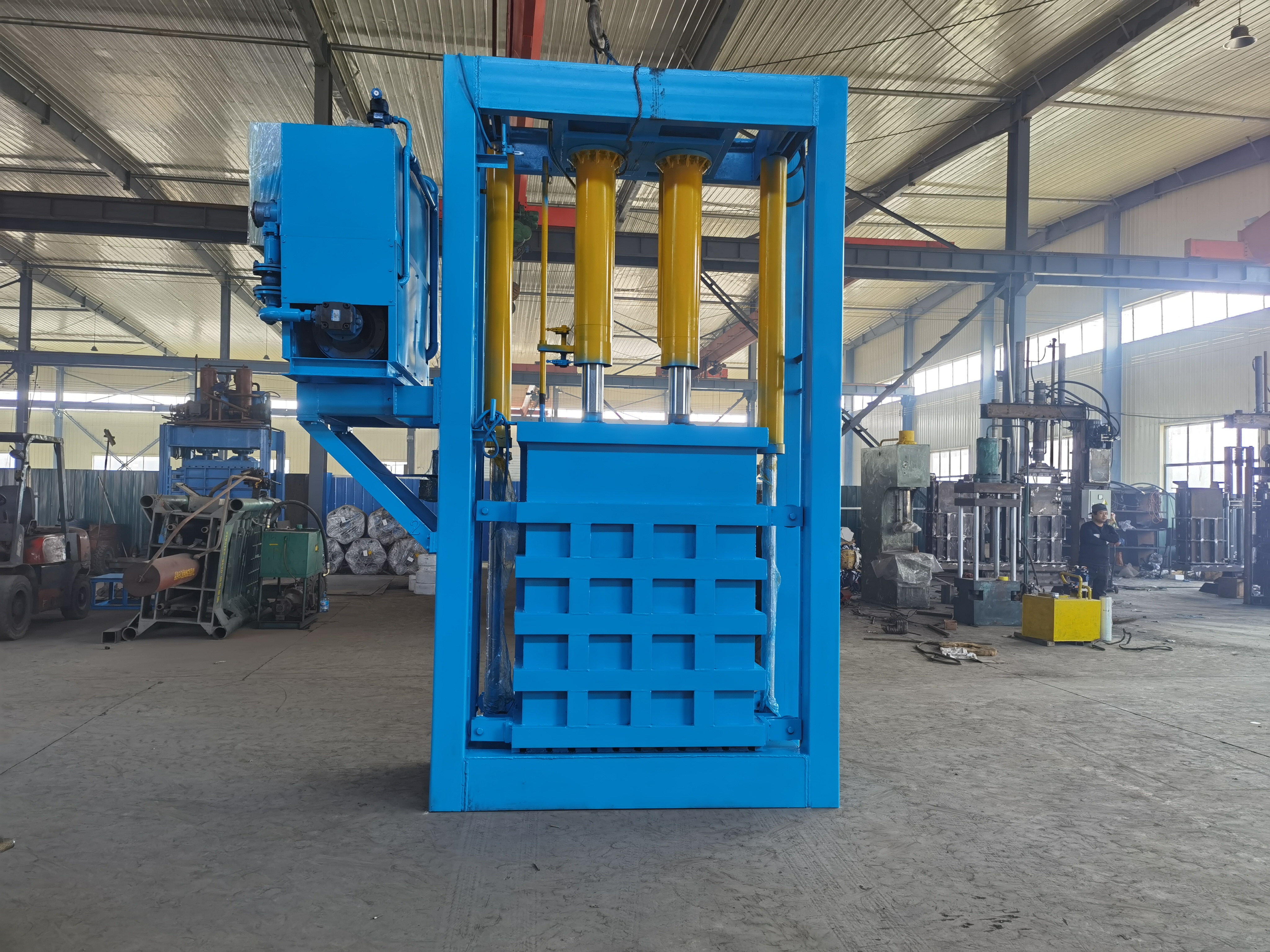
Textiles and used clothing. The NK60LT is a vertical textile/clothes baler with 60-ton hydraulic power, 25 MPa system pressure, 150–200 kg bales and 10–12 bales per hour, using cross packing of four front-back and two left-right straps. Where a site needs two workstations feeding one machine, the NK-T90L double-chamber clothes baler packs garment and sack material into 75–150 kg bales at 10–12 bales per hour. The difference between the two is chamber strategy and bale weight, not force class.
Cardboard and waste paper. The NK1070T60 vertical cardboard box baler applies 60 tons to a 1100×700×1450 mm chamber, producing bales of 1100×700×(500–900) mm at 5–8 bales per hour. Where paper volume is genuinely small — a single retail unit, for example — the NK6040T10 at 10 tons and a 220V/50Hz supply is the more rational match. Choosing the larger machine for a small stream does not improve the bale; it simply adds a handling step and load on the operator.
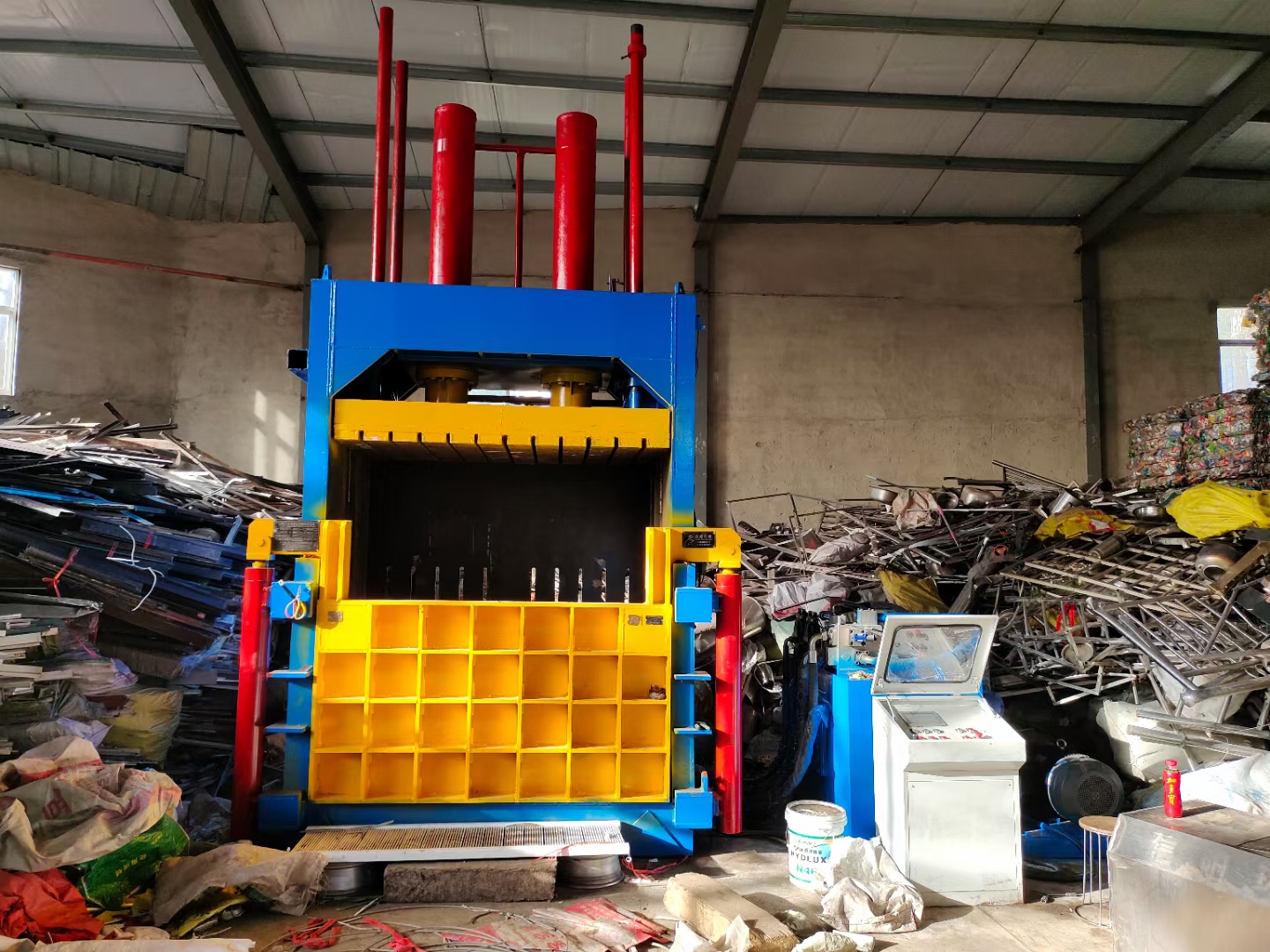
Metal scrap and drums. The NK1580T200 vertical metal baler machine applies 200 tons through a 1500×800 mm feed opening to produce 1500×800×1100 mm bales weighing 1,000–2,000 kg at 3–6 bales per hour, from carbon steel construction with an automatic door. The bale weight is the decisive figure: a 1,000–2,000 kg bale changes how the downstream handling equipment must be specified, not just how the baler is specified.
Bottles and cans. The NK080T100 is a vertical cans/PET bottle baler rated at 100 tons, with a 1000×800×1500 mm chamber and 200–350 kg bales at 3–6 bales per hour. It sits between light paper machines and metal-duty machines, which is exactly where beverage container streams sit in density terms.
Agricultural and fibrous streams. Straw, hay and similar material behave differently again. The NKB280 straw/hay bagging machine handles alfalfa, wheat straw and peanut hay at 30–32 bales per hour and 10–12 tonnes per hour, producing dry bales of 400–450 kg and using plastic bags or woven bags rather than wire. The NKB280-1 uses the same power configuration (45KW×2/120HP) with a lower throughput of 4–6 tonnes per hour and 300–400 kg bales. Wood shavings and sawdust move into a block making process instead: the NKB220 applies 200 tons at 21 MPa with a 22-second compress time to produce 90 blocks per hour at 30–35 kg per bag and 2.5–3 tonnes per hour.
Uniform-weight output. Where bales must be a consistent unit weight rather than a consistent volume, the NKB20 constant weight bagging machine produces 20 kg bales at 750×400×330 mm with a 15KW/20HP motor, and the NKB10 produces 1–1.5 kg bales at 200×130×100 mm with an 18.5KW/25HP motor. These sit downstream of the compaction decision and are frequently overlooked during initial specification.
How NICKBALER approaches the fit question
Shaanxi Nick Machinery Equipment Co., Ltd. (brand: nkbaler) was established in 2013 and operates a manufacturing facility covering 5,000 m², employing approximately 50 staff, with an R&D team of 15 engineers. The company specialises in designing, developing, producing and selling packaging and baling equipment for industries worldwide. Its core product portfolio covers Vertical Balers, Full-Automatic Horizontal Balers, Manual Horizontal Balers and Press Bagging Machines — a range that spans the fit matrix above rather than concentrating on a single machine class.
Products are applied in the food, pharmaceuticals, packaging, chemicals, electronics, metals, waste treatment and recycling industries, and the application footprint covers markets including the United Arab Emirates, Angola, Argentina, Australia, Bangladesh, Bulgaria, Bahrain, Brazil, Canada, Switzerland, Algeria, Ecuador, Egypt, Spain, Finland, Fiji, Greece, Guatemala, Hungary, Indonesia, Israel, India, Kenya, Kuwait, Sri Lanka, Lithuania, Malaysia, Netherlands, Nigeria, New Zealand, Pakistan, Portugal and Saudi Arabia.
Within the range there is also a duty-cycle distinction worth understanding at selection stage. NK BALER is described as the standard long-cylinder servo hydraulic baler, designed for regular daily baling work — cost-effective and stable for general compression requirements. NICK BALER is the upgraded version: heavier machine weight with thicker material and stronger structure, with higher-grade components in both the hydraulic system and the electric control system, intended for continuous heavy-load work with a lower failure rate. In application-fit terms, this is a question about expected operating hours and load profile, not about material type.
Operating conditions that shape the selection
Baling projects of this type are typically specified as material compression and packaging projects, with the machine performing compacting and packaging as a single function. The standard operating profile is continuous automatic operation with a PLC-controlled cycle and 24/7 industrial duty. Matched equipment generally includes a conveyor line, wire rope and woven bags, with low noise design, low energy consumption and high efficiency stated as recurring site requirements.
That profile has consequences for selection. A PLC-controlled continuous cycle implies that the feed system, not the baler, usually determines real output — which is why conveyor specification appears in the horizontal model data as a separate line item with its own motor rating. The NKW200Q, for example, lists a 2,000 × 14,000 mm conveyor with a 7.5KW motor and a conveyor weight of about 7 tonnes, against a mainframe weight of 34 tonnes.
Market signals relevant to application planning
Several verified market signals are worth carrying into an application decision. Asia Pacific held 40.2% of global baler revenue share in 2024 (Transparency Market Research). China was one of the top exporters of hydraulic baling presses under HS Code 8462, with 91 significant shipments recorded between June 2024 and May 2025 (Volza Global Export Data). The scrap metal segment — where the metal baler market alone was estimated at USD 2.172 billion in 2024 (Market Research Future) — is a distinct demand pool from paper, plastics and textiles, and supports different machine classes.
Market sizing in this category should be read with care. Global baler market estimates vary significantly by report scope: Transparency Market Research places the 2024 market at USD 6.6 billion, while Global Market Insights estimated USD 4.9 billion for 2025 and Grand View Research USD 7.18 billion for 2025. The divergence reflects differences in scope — particularly whether agricultural equipment is included alongside industrial baling machinery. Buyers using market data for capacity planning should confirm the scope definition before relying on any single figure.
The competitive field is also geographically broad, with Harris Equipment (US) specialising in heavy-duty horizontal systems alongside European suppliers such as Bramidan (Denmark), Bollegraaf (Netherlands) and HSM (Germany). The practical implication for application fit is that heavy-duty horizontal capacity exists across multiple supply regions, so a shortlist should be built on configuration match and evidence rather than on availability alone.
Where a hydraulic baler is not the answer: boundaries and trade-offs
Compaction is not free, and a credible application assessment has to state where the technology stops paying. Traditional handling — loose material loaded directly into containers, open-top skips, or manual pressing — remains adequate where volumes are low, where the off-taker does not require a bale, or where the material will not form a stable bale at all.
Where a baler is introduced, several boundaries are visible in the published specifications themselves:
- Vertical machines are operator-dependent. Both the NK-T90L and the NK1580T200 list manual feeding arrangements, and vertical throughput figures sit in the 3–12 bales per hour range across the range. A site planning a continuous multi-shift line should not assume a vertical machine can absorb that duty.
- Horizontal machines consume floor area and foundation capacity. The NKW200Q mainframe measures approximately 11 × 4.3 × 5.8 m at about 34 tonnes, with a 2,000 × 14,000 mm conveyor weighing a further ~7 tonnes. This is a layout decision, not a plug-in retrofit.
- Power supply is a hard constraint. The horizontal NKW series specifies 380V/50Hz operation; the NK6040T10 specifies 220V/50Hz; the NKB280, NKB280-1 and NKB220 accept 200–480V/50Hz/3-phase. Sites should confirm supply before shortlisting.
- Moisture limits the material, not the machine. The NKB220 block making machine specifies a moisture requirement of 13% or under. Wetter shavings or sawdust will not form a stable block regardless of force applied.
- Cooling infrastructure may be required. The NKW125BD, NKW180BD and NKW250BD list water cooling or an oil chiller — meaning water availability and heat management belong in the site plan.
- Consumables must match density. Tie wire specification differs by force class (10# wire at 4–5 pieces on the lighter horizontal models, 6#/8# at 5 pieces on the NKW180BD and NKW250BD). Under-specified wire is a bale integrity risk, not a consumable saving.
- Material mismatch is not solvable by size. A vertical cardboard baler and a vertical metal baler differ in force class, chamber geometry and bale weight by an order of magnitude. No single configuration covers both streams well.
Compliance constraints that differ by market
Safety requirements for baling equipment are market-specific and should be confirmed before configuration is finalised. In the EU, vertical balers must comply with EN 16500:2014, which specifies requirements for fixed enclosed baling chambers and tamper-proof interlocks. In the United States, commercial balers must adhere to ANSI Z245.51-2013 for design and construction safety and ANSI Z245.5-2013 for installation and operation. Where equipment is exported from one market for use in another, the applicable installation standard is the one at the point of use — which is a specification question, not a documentation formality.
A procurement checklist for application fit
The following sequence reduces the most common source of mismatch — specifying a machine before the stream has been quantified.
- Characterise the material stream: composition, bulk density, moisture and particle shape.
- Set the target bale: dimensions, weight and required density, as dictated by the off-taker or logistics chain.
- Quantify throughput in tonnes per hour or bales per hour, measured against the feed system rather than the baler alone.
- Define duty cycle: intermittent daily use, or continuous PLC-controlled 24/7 operation.
- Select the machine class on that basis — vertical, horizontal automatic, or a specialist configuration for tyres, fibre, straw and hay, or block making.
- Confirm site constraints: floor area, foundation capacity, power supply, cooling water, conveyor length.
- Confirm consumables: tie-wire grade and count, or bag type where bagging machines are used.
- Confirm compliance against the standard applicable at the point of installation.
Future outlook
The direction of the category is toward tighter integration between the baler and the material handling system around it. Continuous automatic operation with PLC-controlled cycles and 24/7 industrial duty is already the stated operating profile for mainstream industrial baling projects, and matched equipment — conveyor lines, wire rope, woven bags — is specified as part of the system rather than as an accessory. As the baler press segment continues to hold a substantial share of the recycling equipment market, the differentiation between suppliers is likely to shift further toward configuration accuracy, documentation and long-run reliability rather than headline force ratings. For buyers, that makes application fit — not machine class — the durable selection criterion.
Frequently asked questions
What is a hydraulic baler and how does it work?
A hydraulic baler compresses loose material inside a chamber using hydraulic cylinder force, then holds the material under pressure while it is tied or bagged into a stable bale. Machines differ by cylinder force, chamber and feed-opening dimensions, bale size, target material density and throughput. The NK1580T200, for example, is a vertical metal baler machine applying 200-ton hydraulic power through a 1500×800 mm feed opening to produce 1500×800×1100 mm bales of 1,000–2,000 kg at 3–6 bales per hour.
Which hydraulic baler configuration suits clothing and textile waste?
Two configurations cover most textile streams. The NK60LT is a vertical textile/clothes baler with 60-ton hydraulic power, 25 MPa system pressure, 10–12 bales per hour and bale weights of 150–200 kg, using a cross packing pattern of four front-back and two left-right straps and a 1000×700×1250 mm chamber. The NK-T90L is a double-chamber clothes baler for garment and sack material, rated at 90 tons with 18.5KW/25HP, producing 75–150 kg bales at 10–12 bales per hour with manual feeding.
How should a site choose between a vertical and a horizontal hydraulic baler?
The decision is driven by throughput and site layout. Vertical machines handle moderate volumes with manual feeding and bale weights in the 50–350 kg range for paper, board, bottles and cans — the NK1070T60 produces 5–8 bales per hour and the NK6040T10 produces 6–8 bales per hour. Horizontal machines are specified for continuous conveyor-fed duty: capacity runs from 3–5 T/hour on the NKW80Q to 10–15 T/hour on the NKW250BD, but so does the footprint — the NKW220Q-class mainframe is approximately 11 × 4.3 × 5.8 m at about 34 tonnes, with a 2,000 × 14,000 mm conveyor.
Can one hydraulic baler handle both metal scrap and cardboard?
Not effectively. Cardboard and paper are handled by machines such as the NK1070T60 vertical cardboard box baler at 60-ton hydraulic power, or by horizontal models with target material densities between 300 and 700 kg/m³ depending on configuration. Metal scrap requires a different force class and chamber: the NK1580T200 vertical metal baler applies 200 tons and produces bales weighing 1,000–2,000 kg. The chamber dimensions, bale weight and tie requirements are not interchangeable between the two streams.
What are the practical limits of a hydraulic baler installation?
Several limits appear directly in the specifications. Moisture restricts some materials — the NKB220 block making machine requires 13% moisture or under. Power supply varies by model: the NKW series specifies 380V/50Hz, the NK6040T10 specifies 220V/50Hz, and the NKB280, NKB280-1 and NKB220 accept 200–480V/50Hz/3-phase. Cooling may require infrastructure, as the NKW125BD, NKW180BD and NKW250BD list water cooling or an oil chiller. Tie wire must match bale density, with 10# wire at 4–5 pieces on lighter horizontal models and 6#/8# wire at 5 pieces on the NKW180BD and NKW250BD.
What output can be expected from agricultural straw and hay baling?
The NKB280 straw/hay bagging machine processes alfalfa, wheat straw and peanut hay at 10–12 tonnes per hour and 30–32 bales per hour, producing dry bales of 400–450 kg with plastic bags or woven bags on a chain conveyor feed, powered at 45KW×2/120HP. The NKB280-1 uses the same power configuration with a lower capacity of 4–6 tonnes per hour and dry bale weights of 300–400 kg. Wood shavings and sawdust are handled by a different process — the NKB220 block making machine produces 90 blocks per hour at 2.5–3 tonnes per hour and 30–35 kg per bag.
Which safety standards apply to baling equipment?
Requirements differ by market. In the EU, vertical balers must comply with EN 16500:2014, which specifies requirements for fixed enclosed baling chambers and tamper-proof interlocks. In the United States, commercial balers must adhere to ANSI Z245.51-2013 for design and construction safety and ANSI Z245.5-2013 for installation and operation. The applicable standard is determined by the market of installation rather than the market of manufacture.
A consolidated specification reference covering the configurations discussed here is available in the NICKBALER product brochure.