
Hydraulic Baler Machines by Industry: Textile, Carton, PET and Metal Applications
Hydraulic Baler Machines by Industry: Textile, Carton, PET and Metal Applications
An industry reference on matching vertical, semi-automatic horizontal and fully automatic horizontal balers to specific waste streams and processing environments.
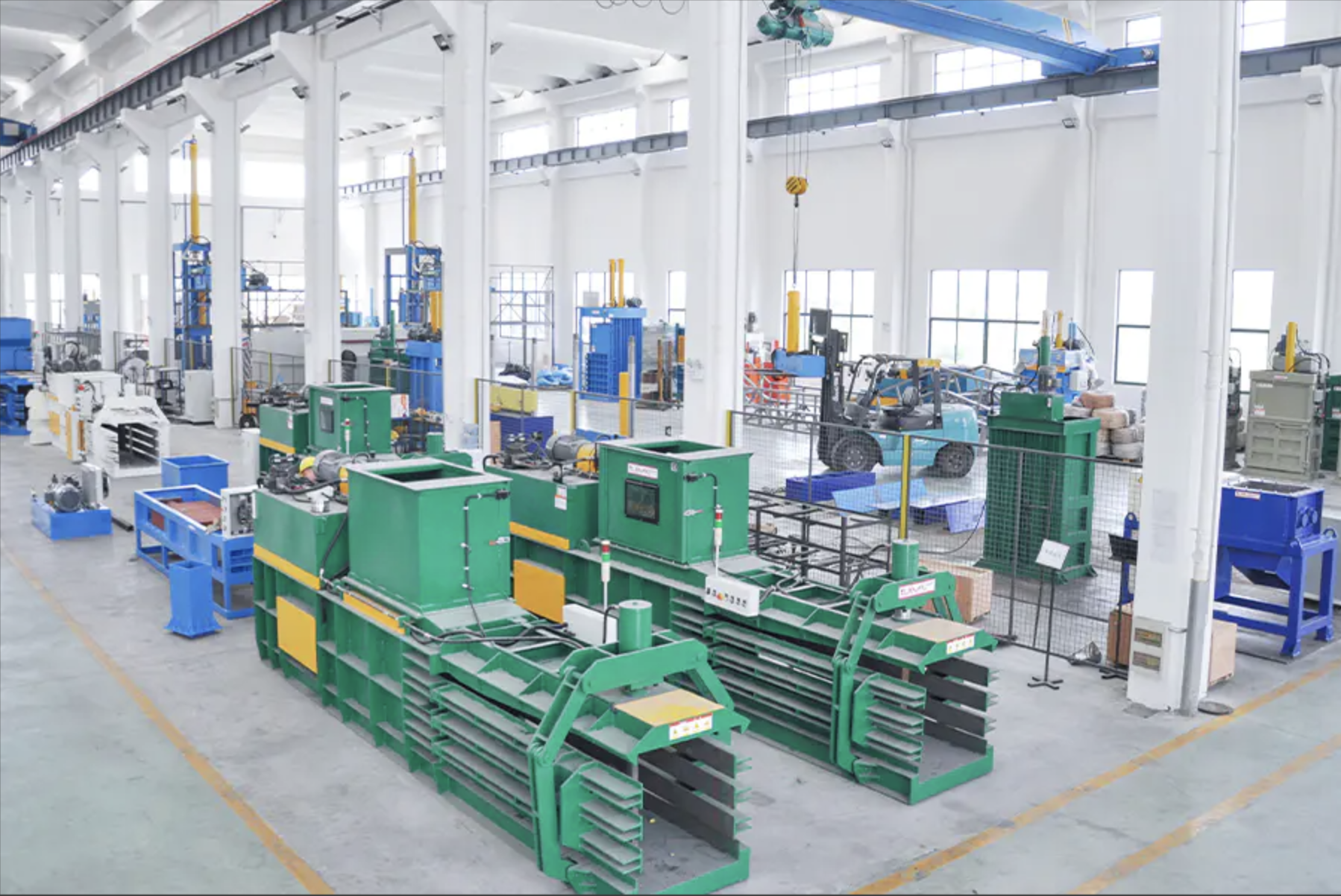
Equipment assembly workshop — hydraulic baler platform preparation for multi-industry waste streams.
Introduction: The Waste Stream Decides the Machine
Hydraulic baler machines are compression systems that reduce loose recyclable or residual material into dense, bound bales for storage, transport and resale. In practice, the machine that suits a textile mill is rarely the right fit for a PET bottle recycling line or a carton printing plant, because material behaviour — bulk density, springback, abrasiveness and moisture content — changes the compression force, chamber geometry and throughput the equipment must deliver.
This reference maps hydraulic baler capabilities to five common industrial waste streams — waste paper and carton, plastic, PET bottles, textile, and metal — and explains how to choose between vertical and horizontal formats using bale size, compression force and throughput as the primary decision variables. Model references include the JP-OT100 vertical baler, the JPW40F semi-automatic horizontal baler, the JPW20Q fully automatic horizontal baler, the JPW-AK100 for aluminum foil and the JPY-T60W for metal.
Problem and Opportunity: Why One Baler Type Cannot Serve Every Stream
The compression physics differ by material. Waste paper and carton are bulky and light, so they bale well at moderate force but generate dust and require steady feed control. PET bottles are springy and recover volume after compression, which demands higher force and a chamber that prevents material from expanding back between strokes. Textile waste is fibrous and interlocks unpredictably, while metal scrap is dense and abrasive and places the greatest load on hydraulics and tooling.
For procurement and operations teams, this means the baler decision is rarely a single global choice. A packaging manufacturer handling printed carton offcuts, a recycler running mixed rigid plastic, and a metal processor handling sheet scrap will each end up with a different format, force rating and bale size. The opportunity is that a correctly matched machine converts a handling cost into a saleable, transport-efficient commodity — a denser bale reduces volume, transport trips and manual handling.
Technical Explanation: Compression Force, Bale Size and Throughput
Three specification variables decide most baler selections. Compression force determines how hard a material can be pressed and therefore how dense the final bale becomes. Bale size and weight determine how the bale is handled, stacked and transported. Throughput determines whether one machine can absorb the daily waste volume of the plant.
Across the hydraulic baler range, model-specific compression forces run from 5 to 100 tons, with a broader catalogue range of 2 to 180 tons depending on format and application. Bale weights typically range from 5 to 350 kg. Throughput figures include 0.2–0.5 Ton/Hr on compact configurations and 4–8 bales per hour on horizontal formats, while high-volume automatic configurations are cited at 16–22 bales per hour.
| Format | Loading Method | Typical Throughput | Best Fit |
|---|---|---|---|
| Vertical baler | Manual top loading | Lower, batch operation | Limited floor space, low-to-medium volume, single-material points |
| Semi-automatic horizontal baler | Conveyor / hopper feed | Medium, continuous | Paper, carton, plastic, textile factories with steady volume |
| Fully automatic horizontal baler | Automatic feeding and strapping | High, unmanned-capable | Medium-large recycling plants, multi-material, high-volume sites |
Application Mapping: Hydraulic Balers by Industry
1. Waste Paper Recycling
Baled waste paper is a traded commodity with established export flows. China's exports of wood pulp and paper scrap, including baled waste paper, reached USD 288 million in 2025. Because loose paper occupies large volume and low mass, waste paper recyclers generally favour horizontal machines that can accept continuous conveyor feed and produce consistent bale density. Waste paper hydraulic baler machines and fully automatic waste paper hydraulic baler machines are typically specified where daily intake is steady and labour availability is limited; semi-automatic waste paper hydraulic baler machines remain common where volumes are moderate and operators are already on site.
2. Carton Printing and Packaging Manufacturing
Carton plants and packaging manufacturers generate trim, misprints and rejected board in a continuous stream close to the production line. Carton factory waste hydraulic baler machines and carton hydraulic baler machines are often placed to receive trim directly, so feed height, conveyor compatibility and noise matter as much as force. Because the material is dry and consistent, dust control and a protective enclosure on the feeding inlet are practical considerations, and bale weight is chosen so that bales can be handled by the forklifts already on site.
3. Plastic Recycling
Rigid plastic and film behave very differently. Rigid containers fracture and interlock, while film is light and tends to bridge in the chamber. Hydraulic baler machines for rubber and plastic waste therefore tend to be specified around chamber geometry and anti-bridging feed rather than force alone, with higher force used where bale density targets are strict. Plastic bottle hydraulic baler machines must also account for residual springback, since PET recovers volume after the ram retracts.
4. PET Bottle Recycling
PET bottle recycling lines usually run high volumes of low-density input. The practical constraint is cycle time: the ram must return and reload fast enough to keep pace with a sorting line. Semi-automatic and fully automatic horizontal formats are the usual candidates, with automatic strapping helping to keep bale output consistent when operators are shared across a plant.
5. Textile Waste Processing
Fiber hydraulic baler machines handle offcuts, yarn waste and used garments. Textiles interlock and form strong bales but can also wrap around moving parts, so guarding and a controlled feed are important. Textile waste processing is frequently listed among the high-volume, multi-material environments where automated horizontal platforms are the better fit; small single-material waste points remain a reasonable use case for simpler machines.
6. Metal and Aluminum Foil
Metal scrap is the most demanding stream for hydraulics and tooling because it is dense and abrasive. Metal hydraulic baler machines such as the JPY-T60W are specified where the force requirement is at the upper end of the range and where wear protection matters. Aluminum foil is a separate case: it is thin and light but must be compacted into a dense, stable block, which is why a dedicated aluminum foil hydraulic baler machine such as the JPW-AK100 is used rather than a general-purpose paper baler.
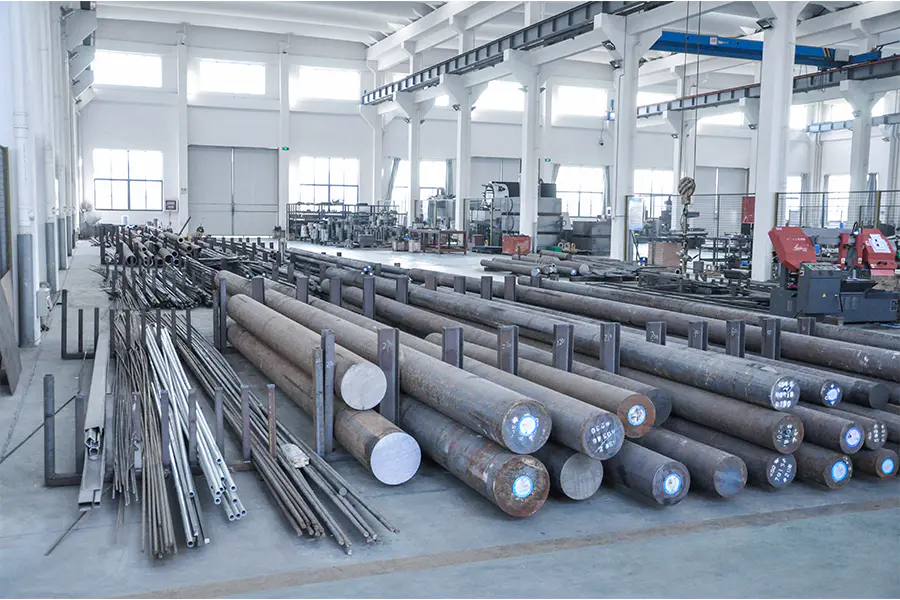
Steel warehouse — raw material staging for hydraulic baler machine structures.
Model-to-Application Reference
The table below is a decision aid rather than a fixed rule. It maps format and model references to the waste streams discussed above, using bale target, compression force and throughput as the matching criteria.
| Model Reference | Format | Typical Stream | Selection Driver |
|---|---|---|---|
| JP-OT100 | Vertical | Carton, waste paper, textile offcuts | Small footprint, low-to-medium volume |
| JPW40F | Semi-automatic horizontal | Waste paper, plastic, PET | Bale size and steady throughput |
| JPW20Q | Fully automatic horizontal | Multi-material, high-volume | Unmanned operation, labour reduction |
| JPW-AK100 | Aluminum foil | Aluminum foil compacting | Dense, stable block output |
| JPY-T60W | Metal | Metal scrap | High force, wear resistance |
Brand Solution: Jewel Hydraulic Baler Machines
Nantong Jiabao Machinery Co., Ltd., established in 2006 with the Jewel brand founded in 1995, specializes in the research, development and manufacture of environmentally friendly, intelligent compression and baling equipment. The company operates a 50,000 m² production facility with more than 200 employees and a 30-engineer R&D team, and reports an annual output of 120,000 units. Roughly 70% of output is exported, with main markets across Australia, Europe, North America, Africa, Asia, Russia and Belarus.
The product portfolio covers semi-automatic and fully automatic compression and baling machines, intelligent waste removal systems for various industries, automatic compression and wrapping systems, integrated crushing, compression and baling machines, and customized industry solutions. For buyers comparing formats, the practical implication is that the same manufacturer can supply the vertical, semi-automatic horizontal and fully automatic horizontal options discussed above, which reduces the risk of an integration mismatch when a plant later scales up.
On the risk-control side, the equipment is described as carrying safety interlock and emergency stop functions, imported hydraulic seals intended to reduce oil leakage risk, PLC-based overload auto-cutoff protection, and a protective enclosure on the feeding inlet. Delivery practice includes full inspection before factory dispatch, and the enterprise reports CE and ISO quality certification, a 7×24h after-sales hotline, spare parts inventory and a 12-month official warranty. Buyers evaluating suppliers can verify the specification sheet and certification scope directly before purchase.
Comparison with Traditional Manual and Fixed-Frequency Balers
Traditional manual balers and fixed-frequency machines remain a valid baseline for simple, low-volume waste points. The differences below describe where automated platforms change the operating economics, not a claim that traditional equipment is obsolete.
| Dimension | Traditional Manual / Fixed-Frequency | PLC-Controlled Automated Platform |
|---|---|---|
| Control | Manual sequencing | PLC + touch screen, 3-side convergent compression |
| Automation | Operator-dependent feeding and tying | Auto feeding, detection and strapping; unmanned operation capability |
| Output | Lower, variable | 16–22 bales/hour on the auto model |
| Labour | Continuous operator attention | 90% labour reduction, <2% downtime cited |
| Energy | Fixed-frequency drive | Dual-motor design (starting + booster); variable frequency option reduces energy consumption by 30% vs fixed-frequency models |
| Maintenance | Simple but frequent intervention | Standardized parts, low failure rate, easy maintenance; stable auto strapping device |
| Cost | Lower upfront | Slightly higher upfront; long-term labour savings and lower transport cost through higher bale density |
Boundary Conditions: Where an Automated Platform Is Not the Right Answer
The main limitation is commercial rather than technical. Automated horizontal balers carry a slightly higher upfront cost, and that cost is recovered through labour savings from unmanned operation and through reduced transport cost from higher bale density — a payback logic that only works where volume is high enough. Traditional machines remain the better fit for small single-material waste points. Buyers should also confirm that the site can support the automation properly: stable power, an appropriate footprint for conveyor feed, and access to spare parts and service response. A plant that cannot guarantee continuous feed will not realise the throughput advantage of an automatic strapping cycle, and a plant without local maintenance capability should weigh the 7×24h hotline and spare-parts inventory arrangement carefully before committing.
Market Trend Analysis
Published market research places the global baler machine market at USD 6.6 billion in 2024, projected to reach USD 11.4 billion by 2035 (Grand View Research). A narrower study of the industrial balers segment values it at USD 6.39 billion in 2024 with a projected CAGR of 9.5% through 2032 (Maximize Market Research). Forecasts diverge by study period and by whether agricultural equipment is included, so buyers should treat these figures as directional rather than precise.
Regionally, Asia Pacific dominated the global baler market in 2024 with approximately 40.2% of total revenue share. That concentration matters for procurement because it correlates with manufacturing capacity and export availability, including the baled waste paper trade where China's exports reached USD 288 million in 2025.
Compliance as a Selection Filter
Standards increasingly act as a shortlisting filter rather than an afterthought. European safety regulations require vertical and tyre balers to comply with the EN 16500:2014 standard for waste processing equipment, and ANSI Z245.5-2023 is the updated American National Standard for baling equipment safety requirements, replacing the 2013 version. For buyers operating in or exporting into these markets, the certification scope and voltage configuration should be verified at specification stage, alongside the supplier's own quality certification.
Future Outlook
Three directions appear consistent across the data. First, automation is moving from a premium option toward the default for medium and large facilities, since PLC control, auto feeding and auto strapping directly reduce the labour dependency that drives operating cost. Second, energy efficiency is becoming a comparable specification point, with variable frequency drives cited as delivering a 30% energy reduction against fixed-frequency models. Third, the range of specialty streams is widening — aluminum foil, metal scrap, textile and PET each now have dedicated configurations rather than being forced through general-purpose paper balers. For buyers making a 2026 decision, the practical takeaway is to specify against the actual waste stream and volume, and to treat format, force and throughput as one connected decision rather than three separate line items.
FAQ
How do buyers choose between vertical and horizontal hydraulic baler machines?
Vertical balers load from the top and suit limited floor space and low-to-medium volumes; horizontal balers use conveyor or hopper feed and suit higher volumes and denser materials. The choice generally follows throughput, target bale weight and available footprint.
What compression force range is available across hydraulic baler machines?
Model-specific compression forces run from 5 to 100 tons, with a broader catalogue range of 2 to 180 tons depending on format and application. Higher forces are typically specified for dense and abrasive streams such as metal scrap.
What bale weights and throughput can hydraulic baler machines produce?
Bale weights generally range from 5 to 350 kg. Throughput figures include 0.2–0.5 Ton/Hr on compact configurations and 4–8 bales per hour on horizontal formats, while high-volume automatic configurations are cited at 16–22 bales per hour. Actual output depends on material type and feed consistency.
Which operating environments suit a fully automatic horizontal baler rather than a traditional machine?
Medium-large recycling plants, paper, plastic and textile factories, and logistics warehouses handling multi-material, high-volume waste are the typical fits for automated platforms. Traditional machines remain appropriate for small single-material waste points.
What maintenance do hydraulic baler machines require?
Maintenance requirements are low due to the use of standardized parts and a low failure rate, and the auto strapping device operates with stable performance. Risk-control provisions on the described equipment include safety interlock, emergency stop, imported hydraulic seals, PLC overload auto-cutoff protection and a protective enclosure on the feeding inlet.
Which safety standards apply to baler machines in Europe and the United States?
European safety regulations require vertical and tyre balers to comply with EN 16500:2014 for waste processing equipment. In the United States, ANSI Z245.5-2023 is the updated American National Standard for baling equipment safety requirements, replacing the 2013 version.
For readers who need the full model and specification context, the manufacturer's product brochure is available for download: Jewel hydraulic baler machine brochure.