
Hydraulic Baler Machines for Aluminum Foil and PET Recycling
Hydraulic Baler Machines for Aluminum Foil and PET Recycling
Aluminum foil trim, PET bottles and carton waste are all light materials, but they behave very differently inside a compression chamber. Foil folds into low-density nests that spring back once pressure is released; PET bottles trap air and resist compaction until that air is forced out; corrugated and paper waste arrives in volume and rewards a steady, continuous feed. For a buyer specifying hydraulic baler machines, that difference is the specification. Compression force, chamber geometry, bale weight, throughput and power supply combine into a configuration that suits one waste stream well and another poorly.
This guide maps three lightweight recycling scenarios to documented machine configurations. It uses the JPW-AK100 aluminum foil baler from Jewel as a worked example, because foil is the stream where the gap between a general-purpose baler and a fit-for-purpose one is widest. The same reasoning then extends to PET bottles and to carton and paper waste, where the deciding factors shift from density to volume, bale handling and automation.
Jewel is the baler brand of Nantong Jiabao Machinery Co., Ltd., a compression and baling equipment manufacturer established in 2006, with the brand itself founded in 1995. The company operates a 50,000 m² production facility in Rugao, Jiangsu, with more than 200 employees, and reports that approximately 70% of its output is exported to markets including Europe, North America, Australia, Asia, Africa, Russia and Belarus.
Why material density decides the configuration, not tonnage alone
Bulk density is the first variable to settle. A cubic metre of loose foil trim weighs a fraction of a cubic metre of flattened PET bottles, and both weigh less than a cubic metre of stacked corrugated board. Because a baler exists to raise that density inside a fixed chamber, the useful comparison is not which machine carries the largest tonnage figure, but how much force reaches the material, in what chamber, and what bale leaves the machine at the end.
Three conditions decide whether a configuration fits a waste stream:
- Force applied across the chamber cross-section. A high tonnage acting on a small bale face concentrates pressure where light, springy material needs it. The same tonnage spread across a large chamber produces a bigger but less dense bale.
- Feed opening against piece size and arrival rate. A 500 × 320 mm feeding mouth suits trim, dust and small containers; a 1000 × 720 mm opening suits flattened cartons and bottles arriving in bulk. Feed size below the material size means manual preparation upstream.
- Bale weight and dimensions against handling. A 5–15 kg bale can be moved by hand or cart in many layouts, while a 400–600 kg bale needs mechanical handling, a suitable floor and a transport arrangement that accepts that format.
Throughput deserves separate attention because suppliers do not report it in the same unit. Some data sheets give tonnes per hour — the JPW-AK100 at 0.4–0.8 t/h, the JPW40F at 1–2 t/h, the JPY-T60W at 0.5–1 t/h. Others give bales per hour — the JP-OT100 at 5–6, the JP8060T5X at 4–7, the JP7050T8 and JPW-K6046 at 6–8. These are not interchangeable without the bale weight, and comparing a 5–15 kg bale per hour against a 400–600 kg bale per hour as if the numbers were equivalent is one of the most common specification errors in this category.
Aluminum foil and light fiber: high force in a small chamber
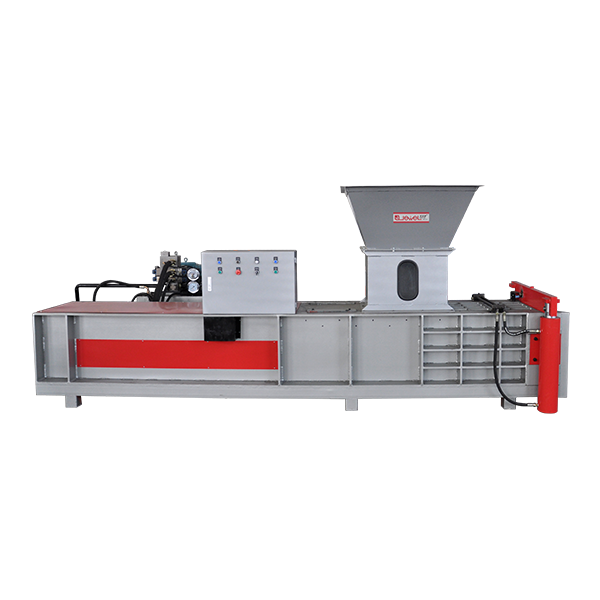
The JPW-AK100 is documented as an aluminum foil baler with a 100-ton compression force, a bale cross-section of 320 × 320 mm, a bale length of 200–250 mm and a feeding mouth of 500 × 320 mm. Finished bales weigh 5–15 kg. Documented capacity is 0.4–0.8 tonnes per hour, power is 18.5 kW / 25 hp at 380 V / 50 Hz, the machine measures 4000 × 920 × 1350 mm and its net weight is 2600 kg. Jewel's product data also lists fiber-based materials among comparable inputs.
Read together, those figures describe a specific logic rather than a general-purpose machine. The force acts on a small bale face, which is what light, springy foil needs: pressure is concentrated instead of being spread across a large chamber where the material would simply fold away from the ram. The resulting bale is small and comparatively dense, and a 5–15 kg bale is light enough for manual or cart handling in many plant layouts, which affects labour planning and floor space as much as the baler itself does.
The same figures define the boundaries. At 0.4–0.8 t/h, the JPW-AK100 matches a converting, printing or packaging operation where foil and light fiber accumulate as trim and offcuts rather than as a high-volume waste flow. A site generating several tonnes per hour would find the machine a bottleneck, not a solution. Equally, a 320 × 320 mm bale may not meet the receiving specification of a downstream buyer who expects a particular bale size or minimum bale weight, so that requirement should be confirmed with the off-taker before the machine is ordered, not after.
Where less density is acceptable and the priority is low power consumption in a small footprint, Jewel documents a different option: the JP8060T5X waste compactor, with a 5-ton compression force, an 800 × 600 × 400 mm bale, 650 × 470 mm feeding mouth, 4–7 bales per hour, 50–80 kg bale weight, 2.2 kW / 3 hp at 380 V / 50 Hz and a 550 kg machine weight. Its larger bale face and lighter force suit volume reduction of light bulky waste where dense briquetting is not the objective. For foil specifically, the achievable density should be confirmed on a test bale rather than assumed from the tonnage figure.
PET bottles: air release, feed continuity and bale handling
PET bottles fail to compact for a different reason: they are hollow and elastic. Air must escape, the feed must be continuous enough to keep the chamber loaded, and the bale must be held under tension by strapping until it stabilises. That makes automation level, strapping channel count and bale weight the practical decision variables, not force alone.
The JPW20Q is documented as a fully automatic horizontal baler with a 20-ton compression force, a 500 × 500 × 500 mm bale, a 700 × 460 mm feeding mouth, 2–4 strapping channels and a bale weight of 30–70 kg. Power is 7.5 kW / 10 hp at 380 V / 50 Hz, the machine measures 3400 × 3010 × 2400 mm and weighs 2.8 tonnes. Jewel's published certification record for this model lists CE certificate TTC-22-1609/01/01 against EN ISO 12100:2010 and EN 60204-1:2018 — the kind of document a European buyer should request by number rather than accept as a logo on a brochure.
For higher volumes, the JPW40BL is described as a plastic bottle recycling machine with a 40-ton compression force, a 720 × 720 mm bale section adjustable between 300 mm and 1000 mm in length, a 1000 × 720 mm feeding mouth, four strapping channels and a 250–350 kg bale weight, running on 15 kW / 20 hp with a 5500 × 1150 × 1900 mm footprint. The JPW40F offers a semi-automatic alternative at the same 40-ton force, with a 720 × 720 mm bale section of 500–1300 mm length, 200–400 kg bales, 11 kW / 15 hp and a documented capacity of 1–2 t/h.
Choosing between them is largely a labour and handling question. Fully automatic operation reduces the operator time tied to each bale, while a semi-automatic machine depends on manual tying and consistently staffed attendance. Bale weight then drives the rest of the plant: 30–70 kg bales can be shifted with a pallet truck in many layouts, whereas 250–400 kg bales require a forklift, a reinforced handling area and a transport format that accepts them. One caution applies to the JPW20Q in particular: its data sheet specifies force, bale size and strapping but not a tonnage-per-hour figure, so throughput should be confirmed in writing rather than inferred from the 20-ton rating.
Documented project evidence points to the same priorities. A PET recycling project in Japan required a solution that would raise the compression density of bottles and produce compact, well-formed bales in a high-dust environment; the project record states that the resulting bales improved storage and transport efficiency and supported the added value of the recycled product. Dust is worth noting in its own right: fine PET dust affects ventilation, filter maintenance and operator exposure, and should be part of the site assessment for any high-throughput bottle line.
Carton and paper waste: where volume changes the answer
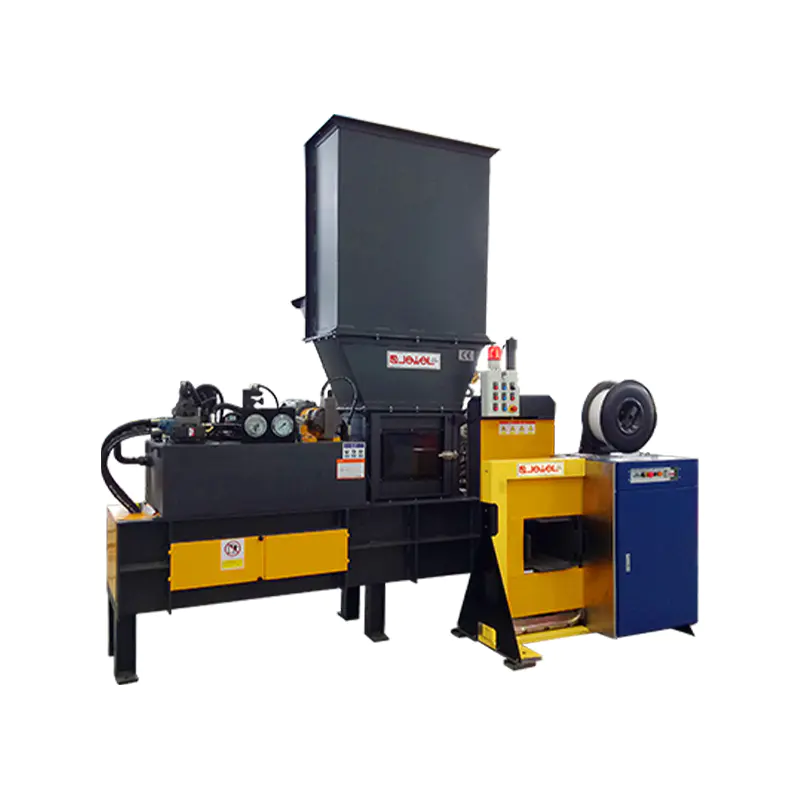
Carton and paper waste reverse the emphasis. Generation is continuous, volume is high, and the cost of stopping a corrugator or printing line to clear waste usually exceeds the cost of the baler. Fit is therefore judged on how waste reaches the machine, how much floor space the machine and its bales occupy, and whether baling can run without an operator standing beside it.
Where waste is heavy and generated at a single point, a vertical machine can be the practical choice. The JP-OT100 is documented as a vertical baler with a 100-ton compression force, a 1400 × 700 × 1700 mm compression chamber, a 1400 × 600 mm feeding mouth, a bale measuring 1400 × 700 mm with a length of 700–1100 mm and a bale weight of 400–600 kg. It produces 5–6 bales per hour on 15 kW / 20 hp at 380 V / 50 Hz, and the machine itself weighs 3500 kg, which makes floor loading and access a site question rather than a detail.
Where waste arrives continuously from production, horizontal and integrated configurations apply. The JPW40F at 1–2 t/h and 200–400 kg bales suits a semi-automatic line with an operator on tying duty. The JPW20Q, at 30–70 kg per bale, suits sites where automated baling matters more than bale mass. For plants that need the waste conveyed from the machine to the baler and baled without manual handling, Jewel's JPW-K6046 bagging machine is documented with a 10-ton compression force, a 540 × 400 mm feeding mouth, 6–8 bales per hour, 50–80 kg bales, 2.2 kW / 3 hp and a 600 kg machine weight; the company's published project record for a Russian corrugator plant describes exactly this pattern — automatic collection, compression and baling of waste from carton production, with a conveying system and unmanned operation.
Paper dust is a separate stream that should not be forced through a carton baler. The JPW-AK60 briquetting machine is documented with a 60-ton compression force, a 300 × 300 mm bale section of 200–300 mm length, 5–10 kg bales, a 0.2–0.5 t/h capacity, 15 kW / 20 hp and a 2100 kg machine weight, and Jewel lists paper dust among its comparable materials. For small sites on a 220 V supply, the JP7050T8 is documented with a 670 × 400 mm feeding mouth, 6–8 bales per hour, 50–80 kg bales, 2.2 kW / 3 hp and a 590 kg machine weight.
One distinction prevents a costly error: aluminum foil is not scrap metal. The JPY-T60W is documented as a metal baler with a 60-ton compression force, a 900 × 430 mm feeding mouth, a 430 × 280 mm bale section of 150–250 mm length, 15–20 kg bales, 22 kW / 30 hp and a 0.5–1 t/h capacity. Coated, thin-gauge foil behaves nothing like rigid metal scrap, and specifying a metal baler for a foil stream without evidence of the resulting bale is a mismatch, not a precaution.
Scenario-to-model fit at a glance
The table below groups documented configurations by the waste stream they were designed around. It reports only published figures and does not rank the models against one another, because a machine that is the wrong size for one plant is not a weaker machine.
| Waste stream | Model and type | Compression force | Bale size / weight | Documented capacity | Power and fit boundary |
|---|---|---|---|---|---|
| Aluminum foil, light fiber | JPW-AK100 aluminum foil baler | 100 t | 320 × 320 × (200–250) mm; 5–15 kg | 0.4–0.8 t/h | 18.5 kW / 25 hp, 380 V / 50 Hz; small bale face concentrates force, suited to trim-level volumes rather than multi-tonne flows |
| Light bulky waste | JP8060T5X waste compactor | 5 t | 800 × 600 × 400 mm; 50–80 kg | 4–7 bales/h | 2.2 kW / 3 hp, 380 V / 50 Hz, 550 kg; larger bale face with modest force, so density should be proven on a test bale |
| PET bottles, mixed plastic | JPW20Q fully automatic horizontal | 20 t | 500 × 500 × 500 mm; 30–70 kg | Not stated on the data sheet | 7.5 kW / 10 hp, 380 V / 50 Hz, 2.8 t; 2–4 strapping channels, CE record TTC-22-1609/01/01 |
| PET, plastic bottles at volume | JPW40BL plastic bottle baler | 40 t | 720 × 720 × (300–1000) mm; 250–350 kg | Not stated on the data sheet | 15 kW / 20 hp, 380 V / 50 Hz; heavier bales require forklift handling and a matching transport format |
| Carton, paper, mixed fiber | JPW40F semi-automatic horizontal | 40 t | 720 × 720 × (500–1300) mm; 200–400 kg | 1–2 t/h | 11 kW / 15 hp; manual tying and consistent operator attendance required |
| Carton at a single generation point | JP-OT100 vertical baler | 100 t | 1400 × 700 × (700–1100) mm; 400–600 kg | 5–6 bales/h | 15 kW / 20 hp, 380 V / 50 Hz, 3500 kg; chamber and machine weight dominate site planning |
| Carton in unmanned lines | JPW-K6046 bagging machine | 10 t | 50–80 kg bales | 6–8 bales/h | 2.2 kW / 3 hp, 600 kg; documented in an integrated, conveying-based carton waste system |
What buyers should verify for each waste stream
Verification is where scenario fit becomes a defensible specification. The checks below follow directly from the figures above and apply to any supplier, not only to Jewel.
- Measure the real bulk density and daily volume. Weigh or estimate the material actually generated per shift, not the peak the plant would like to handle. A 0.4–0.8 t/h machine and a 1–2 t/h machine occupy different positions in a plant's waste flow, and the lower figure is the honest one if the material simply is not generated faster.
- Check the feeding mouth against the largest piece. Foil nests, whole bottles and unflattened cartons are all larger than their compacted form. If the opening is smaller than the material, an upstream shredder or a manual preparation step must be costed in.
- Confirm the bale specification with the off-taker. Bale weight, cross-section and length determine who can handle and accept the bale. A 5–15 kg foil bale and a 400–600 kg carton bale serve different downstream logistics, and no machine should be ordered before the receiving format is agreed.
- Compare throughput in the same unit. Convert bales per hour to tonnes per hour using the documented bale weight, then compare. Where a data sheet gives no capacity figure, request it in writing rather than assuming the force rating implies volume.
- Match the power supply exactly. Most models here are 380 V / 50 Hz; the JP7050T8 is documented at 220 V / 50 Hz. Voltage is listed as customizable across the range, so the site supply should be stated before the order, not adapted afterwards.
- Plan for machine weight and footprint. The documented range in this group runs from a 550 kg compactor to a 3500 kg vertical baler, with the JPW-AK100 at 2600 kg and the JPW20Q at 2.8 tonnes. Floor loading, access routes and the space needed for bale storage are part of the specification.
- Request the compliance documents by number. A CE certificate reference such as TTC-22-1609/01/01, tied to EN ISO 12100:2010 and EN 60204-1:2018, can be checked. A logo cannot.
- Validate on a test bale. Jewel lists customization across structure, process and performance, a 100% test regime, a minimum order quantity of one unit and a 60-day lead time against a stated monthly capacity of 100 units. Whether a specific foil, bottle or carton stream reaches the required density should still be demonstrated on the buyer's own material.
On the service side, the same supplier states a 7×24 technical response with a 48-hour on-site target, lifelong maintenance and free training. Those are commitments to verify in the contract terms — response time definitions, spare-parts availability and who performs the training — rather than assumptions to carry into a purchase.
Market context and its limits
Commercial research places the total baler market, including agricultural and industrial machines, at USD 7.18 billion in 2025, projected at USD 7.96 billion in 2026 and USD 18.02 billion by 2034. Within that, the hydraulic waste paper baler segment is estimated at USD 1.45 billion in its 2024 base year with a forecast of USD 2.24 billion by 2032 and a 5.5% CAGR, while the hydraulic metal recycling baler segment was valued at USD 913 million in 2023 with a forecast of USD 1,318 million by 2031.
These figures come from commercial research publications rather than official statistics, and their scopes differ: total balers, hydraulic waste paper balers and hydraulic metal recycling balers are three separate definitions. They should not be added together or used interchangeably. For a buyer, the value of the data is directional — the category is expanding across several material segments — while the decision about which configuration fits a foil, PET or carton stream remains a plant-level question that market totals cannot answer.
Outlook
The direction of travel favours tighter bale specifications rather than larger machines. As recycled content requirements and secondary-material trading place more emphasis on consistent bale density and shape, the cost of a poorly matched configuration moves downstream into transport, storage and buyer rejection. That shifts the weight of the purchasing decision toward documented, model-specific evidence: measured force in a defined chamber, a stated bale weight, a throughput figure in an unambiguous unit, and a test bale made from the buyer's own material. Suppliers that can produce that evidence for a specific stream will be easier to qualify than those offering a single tonnage figure across every application.
Frequently asked questions
How do I choose between a vertical and a horizontal hydraulic baler for a recycling project?
The choice follows waste volume, bale weight and available floor space. A vertical machine such as the JP-OT100, documented at 100 tons of force with a 1400 × 700 × 1700 mm chamber and 400–600 kg bales at 5–6 bales per hour, suits sites with heavy waste arriving at a single point and enough floor capacity for a 3500 kg machine. Horizontal models such as the JPW40F, at 1–2 t/h with 200–400 kg bales, suit continuous waste from production lines. Automation level, not orientation alone, decides operator workload.
What compression force is needed for aluminum foil waste?
There is no single force threshold, because force only means something relative to the chamber it acts on. The JPW-AK100 applies 100 tons to a 320 × 320 mm bale face and produces 5–15 kg bales at 0.4–0.8 t/h, while the JP8060T5X applies 5 tons to an 800 × 600 × 400 mm bale and produces 50–80 kg bales at 4–7 bales per hour. The correct approach is to test the actual foil stream and measure the resulting bale density rather than compare tonnage figures alone.
Can one hydraulic baler handle PET bottles and cardboard?
It can, provided the configuration suits the harder of the two materials in force, feed size and bale specification. Jewel lists waste paper, plastic, carton, textile and PET recycling among the applicable industries for several models, including the JPW20Q and JPW40F. The practical limits are switching time, strapping pattern, dust control and whether one bale format is acceptable for both off-takers. Where a plant handles both streams at volume, separate configurations are often easier to justify than one compromised machine.
Why do bale weights differ so much between models?
Bale weight follows from chamber cross-section, bale length and achievable density. In Jewel's documented range, the JPW-AK100 produces 5–15 kg bales, the JPW20Q 30–70 kg, the JPW40BL 250–350 kg and the JP-OT100 400–600 kg. The heavier bales reduce the number of handling movements per tonne but require forklifts, reinforced floors and transport arrangements that accept that format, so bale weight is a logistics decision as much as a machine decision.
What site requirements should be checked before installation?
Confirm the supply voltage and frequency first — most models in this range are documented at 380 V / 50 Hz, while the JP7050T8 is listed at 220 V / 50 Hz. Then check floor loading against machine weight, which ranges from 550 kg for the JP8060T5X to 3500 kg for the JP-OT100, together with footprint dimensions, access for delivery, space for bale storage and, for PET and paper dust, ventilation and filter maintenance. Where waste is conveyed automatically, the interface between the conveyor and the baler should be agreed before delivery.
How should throughput be compared between two baler models?
Convert both figures to the same unit. Where a data sheet gives bales per hour, multiply by the documented bale weight to reach tonnes per hour before comparing with a machine rated in tonnes per hour; where a machine such as the JPW20Q lists no capacity figure at all, request it in writing. Comparing 4–7 bales per hour of 50–80 kg bales against 1–2 t/h directly, without conversion, overstates or understates capacity depending on which side is quoted.
Further specification detail on Jewel's baling and compression equipment, including model dimensions and material applicability, is published at Jewel's official website. A downloadable product brochure covering the range is also available: Jewel baler brochure (PDF).
Have Questions or Need More Details?
Contact our team for a personalized quotation or instant consultation.
Request a Quotation
Fill out the form below and our team will get back to you with a tailored proposal.
WhatsApp Direct Chat
Prefer to chat in real-time? Message us on WhatsApp for instant assistance & quick answers.
- Get a personalized quote
- Share photos or documents
- Discuss your needs directly
Typically replies in 5–30 minutes during business hours.