
Hydraulic Baler Machines: Top 2026 Buying Criteria
Buyers evaluating hydraulic baler machines in 2026 are not only comparing compression tonnage. They are also reviewing automation levels, material compatibility, certification coverage, and service capacity within a market that is projected to grow from USD 6.6 billion in 2024 to USD 11.4 billion by 2035, according to Grand View Research. This article breaks down the top criteria used in supplier evaluations and explains how they apply to real equipment categories and documented installations.
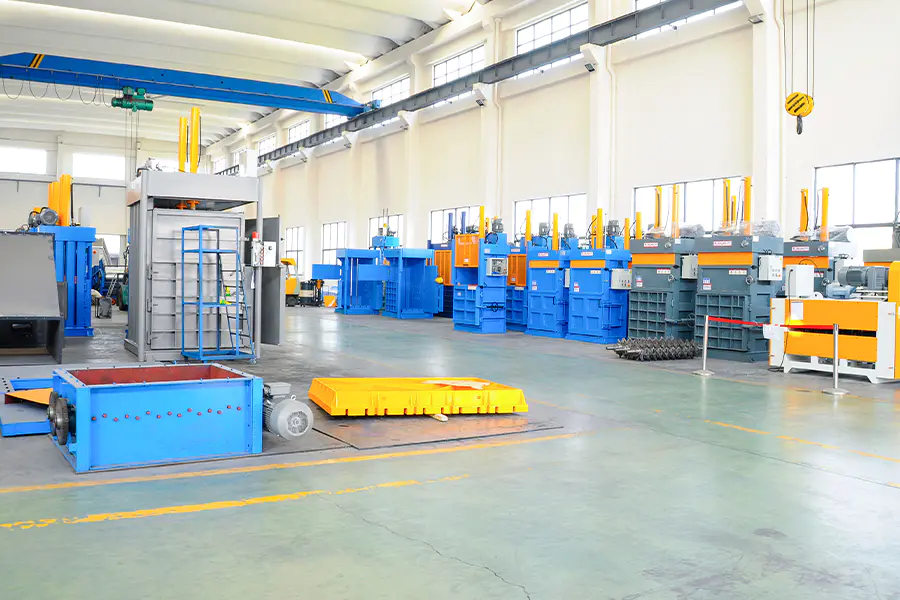
Hydraulic baler assembly workshop at Nantong Jiabao Machinery.
Problem and Opportunity
Industrial waste accumulation remains a cost and safety issue across manufacturing and recycling operations. Cardboard factories, PET recyclers, and mixed-waste processors share the same fundamental challenges: bulky materials occupy floor space, transport volume is inefficient, and manual clearing consumes labour hours.
In a documented case in Russia, a cardboard box factory used a JPW40F semi-automatic horizontal baler to automate collection, compression, and baling of carton waste. According to the project record, the factory built an efficient and coherent unmanned waste processing system with a reasonable investment, reducing labour and management costs while enabling immediate monetisation of waste. This is the opportunity that modern hydraulic baler machines create.
Brand Solution
Nantong Jiabao Machinery Co., Ltd. (brand: Jewel) is a Chinese manufacturer of hydraulic baler machines. Established in 2006, the company operates a 50,000 m² production facility with more than 200 employees, including a 30-engineer R&D team. Its main products are semi-automatic and fully automatic compression and baling machines, intelligent waste removal systems, automatic compression and wrapping systems, and integrated crushing, compression, and baling machines.
Jewel’s capability profile shows a setup designed for both standard and customized orders. The factory can produce 100 machines per month, offers a lead time of about 60 days, and accepts a minimum order of one unit. Every machine is tested before delivery, and after-sales support is structured around a 7×24-hour technical response, on-site assistance within 48 hours, lifelong maintenance, and free training.
Top 2026 Buying Criteria
Across recent project records and verified market data, five decision criteria dominate the evaluation of hydraulic baler machines. They are presented here in the order in which buyers typically apply them.
1. Compression Force and Bale Density
Compression force determines both the range of materials a baler can process and the density of the finished bale. Higher density leads to lower transport and storage costs and, for some recyclables, a more valuable end product.
A PET recycling enterprise in Japan illustrates this point. The buyer required a solution that could effectively increase the compression density of PET bottles and produce compact, aesthetically pleasing bales. The machine used was a JPW40BL, a plastic bottle baler with 40 tons of compression force, a feeding mouth of 1000 x 720 mm, and bale dimensions of 720 x 720 x (300–1000) mm. Bale weight ranges from 250 to 350 kg. The result was improved storage and transportation efficiency and a higher perceived value for the recycled material.
2. Automation Level
Automation is the second major evaluation axis. Buyers with continuous waste flows increasingly prefer fully automatic or semi-automatic horizontal balers over manual loading alternatives.
A cardboard box factory in Mexico chose a high-efficiency, fully automatic waste removal system built around the JPW40BL. The system integrated with the existing production lines and processed waste in real time, eliminating accumulation, improving workshop space utilisation, and reducing manual clearing costs.
Buyers with lower throughput can still benefit from automation through a semi-automatic horizontal baler. The JPW40F, for example, provides continuous push-pack discharge and is suitable for cardboard and carton waste, with a 40-ton compression force and bales of 720 x 720 x (500–1300) mm.
3. Material Compatibility
Material compatibility is the third criterion. The same baler is rarely optimal for paper, plastic, metal, and fibre waste. Buyers now map machine specifications to the particular waste family they generate.
The product range illustrates this. The JPW-AK60 is a briquetting machine for paper dust and similar fibrous materials, with 60 tons of compression force and bale dimensions of 300 x 300 x (200–300) mm. The JPW-AK100 is an aluminium foil baler with 100 tons of force and bales of 320 x 320 x (200–250) mm. The JPY-T60W metal baler handles scrap metal with a 60-ton press and produces bales with a cross-section of 430 x 280 x (150–250) mm. For general light waste, the JP8060T5X waste compactor offers a bale size of 800 x 600 x 400 mm.
Buyers should use material type as the starting point of the shortlist, and then verify that the feeding mouth, chamber size, and baling capacity match their actual waste volume.
4. Certification and Compliance
Certification is the fourth criterion and often a gating requirement. For EU-bound equipment, a CE attestation is expected. For broader supplier evaluation, third-party audits such as SGS provide evidence of manufacturing consistency.
Jewel’s CE certificate TTC-22-1609/01/01 covers the JPW20Q fully automatic horizontal baler. It is issued by INTEGRA and is valid until 16 September 2027, covering the Machinery Directive 2006/42/EC and the Low Voltage Directive 2014/35/EU, with safety standards EN ISO 12100:2010 and EN 60204-1:2018.
The SGS Made-in-China Supplier Audit report QIP—ASR2541890 is valid from 10 December 2025 to 10 December 2028 and covers the full range of baler machines, including hydraulic balers, waste paper balers, cardboard balers, and baling press machines. Buyers can request these documents during the vendor qualification phase.
5. After-Sales Support and Customization
The fifth criterion is the after-sales framework. Baling equipment operates in demanding environments, so uptime depends on spare parts availability, technical response, and maintenance planning.
Jewel’s after-sales commitment includes 7×24-hour technical response, a 48-hour on-site service window, lifelong maintenance, and free training. Customization is also used as a purchasing criterion: the company can modify structure, process, or performance, and its minimum order quantity is one unit. For a plant replacing an ageing baler, that combination reduces commissioning risk and makes it easier to match a machine to an existing production line.
Technical Explanation
To use these criteria in a tender, buyers need to interpret the technical specification of a hydraulic baler. At the simplest level, a hydraulic baler uses a hydraulic cylinder to push a platen against material in a compression chamber. The compacted material is then tied with wire or plastic strapping and ejected.
The main architecture options are vertical and horizontal balers. Vertical balers have a smaller footprint and are typically used for lower volumes and medium-sized bales. Horizontal balers are better suited to continuous or high-volume operations. Horizontal machines can be semi-automatic, with manual loading, or fully automatic, with integrated conveyors and automated discharge.
The table below compares representative models from Jewel across these categories. The figures are taken from the manufacturer’s published product parameters.
| Machine Type | Example Model | Compression Force | Bale Dimension (mm) | Typical Application |
|---|---|---|---|---|
| Vertical Baler | JP7050T8 | — | 800*600*400 | Light waste paper and cardboard |
| Semi-Automatic Horizontal | JPW40F | 40 ton | 720*720*(500-1300) | Cardboard, carton waste |
| Fully Automatic Horizontal | JPW20Q | 20 ton | 500*500*500 | PET and mixed recyclables |
| Plastic Bottle Baler | JPW40BL | 40 ton | 720*720*(300-1000) | PET bottles, plastics |
| Briquetting Machine | JPW-AK60 | 60 ton | 300*300*(200-300) | Paper dust, fibrous waste |
| Aluminum Foil Baler | JPW-AK100 | 100 ton | 320*320*(200-250) | Aluminium foil, fibre-based materials |
| Metal Baler | JPY-T60W | 60 ton | 430*280*(150-250) | Metal scraps |
Application Use Cases
Installation records help connect machine specifications to real operating conditions. In Tunisia, a cardboard box factory installed a JPW-AK60 briquetting machine to clear waste paper accumulation from its corrugator line and printing machines. The project eliminated waste paper accumulation and created a cleaner production environment.
In Italy, a cardboard box factory replaced ageing balers and introduced preprocessing equipment to handle large-format waste cardboard. The selected machine was the JPA5076T25X hydraulic baler, which has a 25-ton compression force and produces bales of 1500 x 760 x 900 mm. Waste treatment efficiency improved significantly.
In Belarus, a waste recycling operation used a JPW40BL to solve bulkiness and compression problems with PET bottles, woven bags, HDPE bottles, and cardboard. The regular-shaped bales improved transport and storage efficiency.
In Australia, a mixed-waste project used the JPW40BL for plastics, small amounts of glass, and metal scraps. The line achieved full-line unmanned operation, reducing labour costs and operational risk.
Market Trend Analysis
Market data supports the attention given to automation and supplier capability. Grand View Research estimates the global baler market at USD 6.6 billion in 2024 and projects it to reach USD 11.4 billion by 2035. Maximize Market Research values the industrial balers segment at USD 6.39 billion in 2024, with a CAGR of 9.5% through 2032. In 2024, Asia Pacific accounted for approximately 40.2% of global baler revenue.
In this market context, buyers are increasingly evaluating specialised hydraulic baler companies. Established international names include HSM GmbH and Bramidan A/S. Chinese manufacturers such as Jewel compete through broad product range, customization, shorter lead times, and integrated system capability. This does not mean one category is inherently better; it means the shortlist should be compared against the specific evaluation criteria above.
Comparison with Traditional Solutions
Compared with manual baling or basic fixed-frequency presses, hydraulic baler machines offer higher bale density, lower labour requirements, and better integration with sorting and conveying systems. The main boundary is economic. Fully automatic systems require more capital and are justified when waste volumes are continuous and large enough to offset investment through labour savings and higher bale revenue. For smaller workshops with irregular waste output, a vertical baler or a semi-automatic horizontal unit remains the more rational choice.
Buyers should therefore model the full economics: purchase price, installation, energy consumption, maintenance, labour savings, and the resale value of denser bales. That calculation will determine how much automation is appropriate.
Future Outlook
The direction of the market is toward tighter integration. Hydraulic baler machines are increasingly designed as parts of a production line rather than standalone equipment. Automated collection, conveying, and baling will continue to displace manual handling in high-volume plants. At the same time, compliance documentation and customised engineering will become more important as buyers treat balers as long-term capital assets.
FAQ
Q: What should I check first when comparing hydraulic baler machines?
A: Start with the material type, daily waste volume, and required bale size. These factors determine whether a vertical, semi-automatic horizontal, or fully automatic horizontal baler is appropriate. Then check compression force, feeding mouth size, baling capacity, and the available floor space.
Q: Which hydraulic baler machine is suitable for plastic bottles?
A: The JPW40BL is designed for PET bottle and plastic waste. Its key parameters include a 40-ton compression force, a feeding mouth of 1000 x 720 mm, bale dimensions of 720 x 720 x (300–1000) mm, and a bale weight of 250–350 kg.
Q: Are CE and SGS certifications important for hydraulic baler machines?
A: CE certification shows that a specific machine meets EU safety directives for machinery and low voltage. SGS supplier audits verify manufacturing consistency across a product range. For reference, the JPW20Q holds CE certificate TTC-22-1609/01/01, and the company has SGS audit report QIP—ASR2541890 covering its full range.
Q: Can hydraulic baler machines be customized for specific waste streams?
A: Yes. Customization can cover structure, process, and performance. Jewel offers customization with a minimum order of one unit, a typical lead time of 60 days, and 100% testing before delivery.
Q: What is the difference between vertical and horizontal hydraulic balers?
A: Vertical balers have a smaller footprint and are typically used for moderate volumes and medium-sized bales. Horizontal balers handle higher volumes and can be semi-automatic or fully automatic. The right choice depends on waste volume, material type, available space, and the level of automation desired.
For readers who need full parameter tables and model comparisons, the manufacturer’s 2026 brochure is available at: https://cdn.socialarks.com/sbsp/24909/common/2026/0605/2026%20%20%E9%93%9D%E7%AE%94%E6%A0%B7%E5%86%8C.pdf
Have Questions or Need More Details?
Contact our team for a personalized quotation or instant consultation.
Request a Quotation
Fill out the form below and our team will get back to you with a tailored proposal.
WhatsApp Direct Chat
Prefer to chat in real-time? Message us on WhatsApp for instant assistance & quick answers.
- Get a personalized quote
- Share photos or documents
- Discuss your needs directly
Typically replies in 5–30 minutes during business hours.