
Hydraulic Baler OEM Capabilities: A Procurement Evaluation Guide
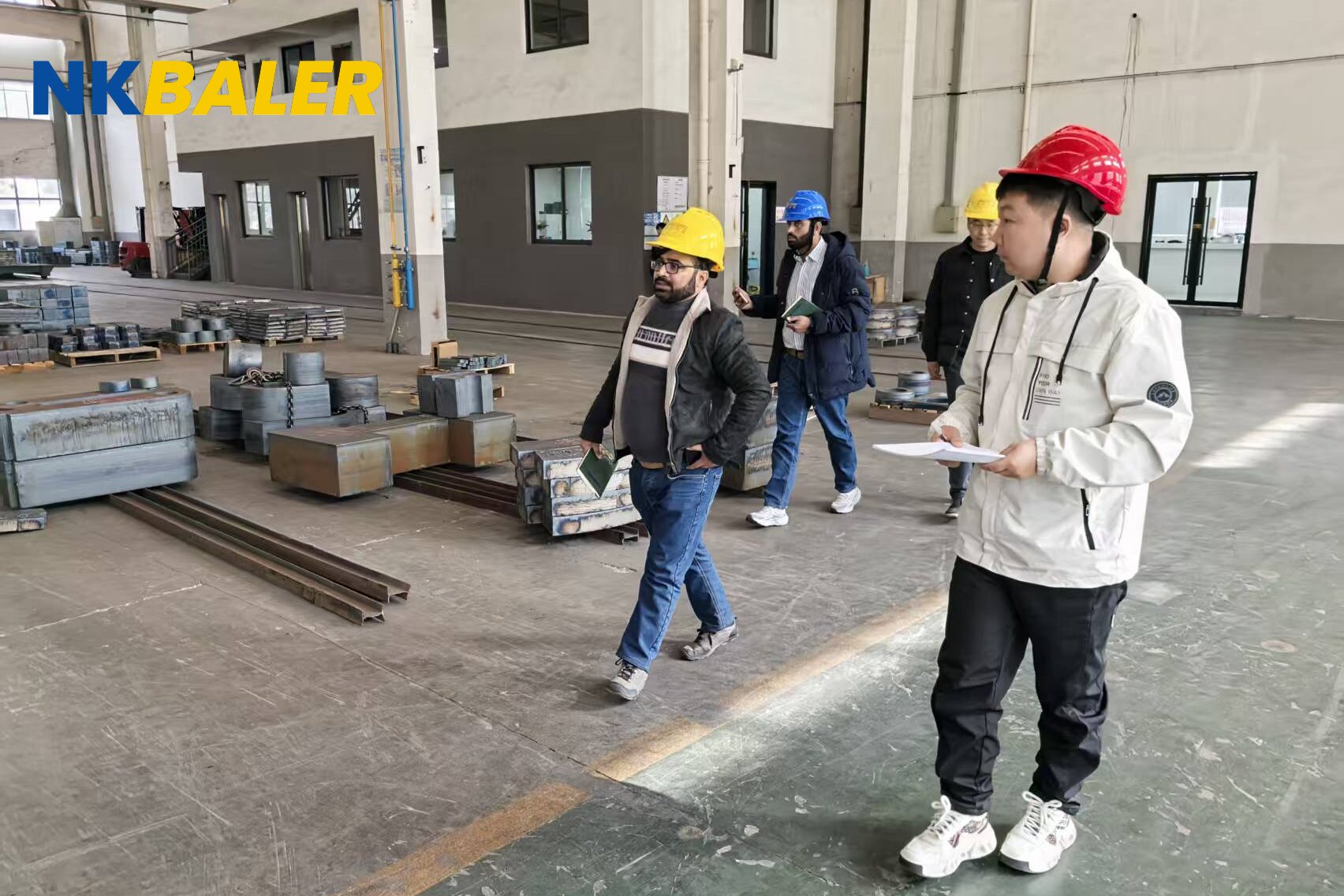
Factory production area at Shaanxi Nick Machinery Equipment Co., Ltd.
When a procurement team evaluates a hydraulic baler, the deciding question is not only machine price or brand. It is whether a manufacturer can adapt a baling platform to a specific material, output target, site condition, and compliance requirement. This capability-oriented view is especially relevant during the evaluation-to-execution phase, when technical parameters and production evidence determine whether the equipment will perform as specified.
Why Capability Matters in Hydraulic Baler Procurement
Industrial baling applications are not uniform. A recycling line processing waste paper and plastic film places different demands on a baler than an agricultural operation compacting alfalfa and wheat straw. Metal shavings, scrap aluminum, used rags, sawdust, wood shavings, scrap tyres, oil drums, and other streams each require different compression force, feed opening sizes, bale densities, and discharge mechanisms.
For buyers in the evaluation and execution stages, the practical consequence is that a standard machine selected only from a catalogue may fit the general purpose but miss the specific requirement. That gap is where a manufacturer's OEM and ODM capability becomes a procurement criterion rather than a marketing phrase.
What OEM and ODM Mean in the Baler Industry
OEM refers to manufacturing equipment according to a buyer's design specification or brand-specific requirements. ODM refers to a manufacturer using its own design and production expertise to create a solution that meets the buyer's functional requirements. In both cases, the buyer receives a machine tailored to a defined need instead of a one-size-fits-all model.
According to the company documentation of Shaanxi Nick Machinery Equipment Co., Ltd., a Wuxi-based manufacturer operating under the nkbaler brand, the company provides both OEM and ODM production services. Its stated production parameters include:
- Production mode: OEM/ODM
- Customization scope: parameter-based
- Monthly OEM/ODM capacity: 10 units
- Lead time: 30–45 days
- Minimum order quantity: 1 unit
- Quality control: 100% testing
- After-sales support: remote support
- Export markets for OEM/ODM services: EU and Middle East
The company also reports a 5,000 m² factory, 50 employees, and 90% export ratio, with primary markets in North America, South America, and Asia. The product catalogue includes vertical balers, full-automatic horizontal balers, manual horizontal balers, and press bagging machines.
NK BALER and NICK BALER: Two Interpretations of the Same Platform
Buyers researching the nkbaler brand will encounter two product tiers. The company describes NK BALER as the standard long-cylinder servo hydraulic baler, designed for regular daily baling work and general compression requirements. NICK BALER is the upgraded version with heavier machine weight, thicker material, stronger structure, and higher-grade hydraulic and electric control system components. According to the company profile, NICK BALER is designed for heavy-duty, continuous operation under load.
This distinction matters in procurement because the same manufacturer can support both budget-driven projects and more demanding applications. The choice is not about supplier qualification alone; it is about matching the machine's structural margin to the operating cycle.
Technical Parameters That Define a Capability-Oriented Baler
When evaluating a hydraulic baler manufacturer from a capability perspective, the following parameters are the most useful to compare:
- Main cylinder force: determines how densely a given material can be compressed
- Feed opening size: influences how easily large or bulky material enters the chamber
- Bale size and density: affect downstream handling, transport, and mill acceptance
- Motor power and cycle time: determine throughput and energy consumption
- Cooling system: important for continuous-duty operations
- Machine weight and frame construction: an indicator of structural rigidity
- Automation level: manual, semi-automatic, or fully automatic operation
The manufacturer's horizontal baler series illustrates the available range. Models span main cylinder forces from 80 tons to 250 tons, bale density from roughly 300 kg/m³ to 700 kg/m³, throughput from about 2–3 tons per hour to 12–15 tons per hour, and mainframe weight from 15 tons to 34 tons. Vertical baler models cover compression forces from 10 tons to 200 tons, with bale weights ranging from roughly 50 kg to 2,000 kg. The press bagging machine series is documented for materials such as alfalfa and wheat straw, with an output of 30–32 bales per hour and dry bale weights in the range of 300–450 kg.
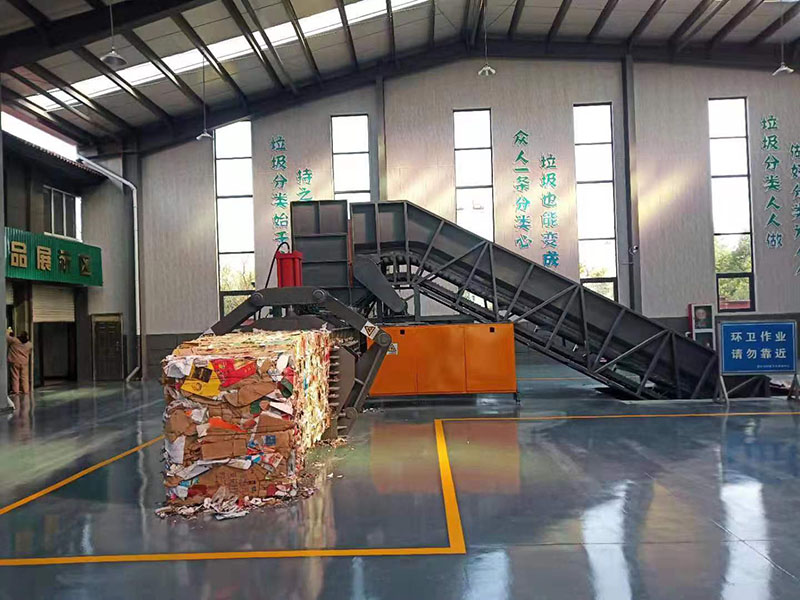
Full-automatic horizontal baler in the manufacturer's production range.
These ranges do not mean every model can process every material. They indicate the bandwidth of the platform and the level of engineering flexibility that a buyer can expect when discussing parameter customization.
Documented Application Cases
Documented use cases provide evidence that a manufacturer's equipment has been applied outside a single factory or a single type of material.
| Location | Client type | Application | Reported result |
|---|---|---|---|
| Indonesia | Recycling station manufacturer | Waste plastic baling; waste paper baling | Stable operation; low noise; low energy consumption |
| Pakistan | Agricultural manufacturer | Baling straw and alfalfa | Two years of stable operation; low noise |
The Indonesia case is associated with the manufacturer's horizontal hydraulic baler line. The Pakistan case is associated with the press bagging machine product group. These cases are useful as reference points during the evaluation phase, but buyers should still validate the current specification against their own material.
Compliance and Certification in OEM/ODM Supply
A capable OEM/ODM baler supplier should be able to provide conformity documentation that matches the destination market.
Shaanxi Nick Machinery Equipment Co., Ltd. holds an Attestation Certificate of Machinery Directive with certificate number EASY03220201M, issued on 2022-03-22 and valid until 2027-03-21, covering EN ISO 12100:2010 and EN 60204-1:2018. The company also holds a Verification of Conformity with document number DPWD/09/060/2024, issued on 2024-09-19 and valid until 2029-09-18, covering EN ISO 12100:2010, EN 60204-1:2018, and EN 415-1:2014. As of the publication date, both documents remain within their validity period.
In the broader regulatory context, buyers in the EU should be aware that vertical balers are subject to EN 16500:2014 safety requirements. In the United States, commercial baler design and construction safety is referenced by ANSI Z245.51-2013, while installation and operation are covered by ANSI Z245.5-2013. These standards are important when a customized machine is intended for export.
Market Trends: From Standard Products to Application-Driven Supply
The global baler market is expanding. Transparency Market Research valued the global baler machine market at USD 6.6 billion in 2024 and projected it to reach USD 11.4 billion by 2035. Market Research Future estimated the global metal baler market specifically at USD 2.172 billion in 2024. The baler press segment accounted for 24.5% of the total recycling equipment market in 2025, according to Grand View Research.
Asia Pacific dominated the global baler market in 2024 with a 40.2% revenue share. China was also one of the top exporters of hydraulic baling presses under HS Code 8462, with 91 significant shipments recorded between June 2024 and May 2025, according to Volza export data. These figures suggest that international buyers will continue to evaluate Chinese manufacturers, but the evaluation will increasingly focus on engineering capability, certification evidence, and after-sales support rather than price alone.
Established global names in the baler industry include Harris Equipment, Bramidan, Bollegraaf, and HSM. Harris, for example, is known for heavy-duty horizontal systems. For a Chinese exporter such as nkbaler, the strategic position is not to compete on brand history alone but to demonstrate verifiable production capability and a clear product tier structure.
Comparison: OEM/ODM Procurement vs. Buying a Standard Baler
Traditional baler procurement often selects a standard model from an importer or local stockist. That route can be fast and cost-effective when the application is simple. The OEM/ODM route changes the relationship: the manufacturer adjusts parameters before production, runs testing, and delivers a machine matched to the project specification.
| Evaluation point | Standard machine route | OEM/ODM route |
|---|---|---|
| Material fit | Approximate; relies on selection | Parameter-level adaptation possible |
| Lead time | Usually shorter if stock is available | Typically 30–45 days for a customized unit |
| Minimum order | Varies | From 1 unit |
| Testing | May be limited to pre-dispatch inspection | 100% testing; pre-shipment testing |
| Compliance documents | Depends on the local supplier | Provided with the machine documentation |
| Cost control | Lower initial effort | Requires clearer specification at the start |
There is an important limitation. OEM/ODM customization assumes that the buyer can define the material stream and operating conditions early. If the material type or bale size requirement changes significantly after installation, a customized machine may need mechanical or hydraulic modification. Buyers should also recognise that fully automatic horizontal balers require substantial floor space, higher capital investment, and more complex installation than small vertical balers. For low-volume or multi-material operations, a simpler standard unit may be the more rational choice.
Future Outlook for Hydraulic Baler Buyers
As baling applications become more material-specific, manufacturers that can provide parameter-level customization, current certification documentation, and realistic after-sales support are likely to become preferred references for international buyers. The market signals point in the same direction: more automation, more attention to compliance, and more demand for machines that fit into a defined production workflow.
For a buyer in the evaluation-to-execution stage, the practical next step is not to ask a supplier whether they can make a baler. The more useful questions are about compression force targets, bale density expectations, feed opening dimensions, output rates, available floor space, voltage requirements, and the certification standards that apply to the destination market.
FAQ
What does OEM/ODM mean in hydraulic baler manufacturing?
OEM production means the manufacturer builds equipment according to a buyer's design specification or brand requirement. ODM production means the manufacturer uses its own design adapted to the buyer's functional requirement. Shaanxi Nick Machinery Equipment Co., Ltd. provides both OEM and ODM production services.
Can a hydraulic baler manufacturer customize machine parameters?
Yes. Parameter-based customization is available, including compression force, bale size, feed opening size, motor power, and voltage in vertical machine models. The manufacturer's OEM/ODM capacity is 10 units per month, with a lead time of 30–45 days and a minimum order quantity of 1 unit.
What is the minimum order quantity for an OEM hydraulic baler?
The documented MOQ for the manufacturer's OEM/ODM production model is 1 unit. Procurement terms are available under FOB/CIF delivery methods, with pre-shipment testing and a 40/60 payment structure.
What certification evidence should a buyer request for an exported hydraulic baler?
For shipments to the EU/EEA and Türkiye, buyers should request conformity documentation covering relevant machinery safety standards. Shaanxi Nick Machinery Equipment Co., Ltd. holds an Attestation Certificate of Machinery Directive number EASY03220201M and a Verification of Conformity number DPWD/09/060/2024. The verification document is valid until 2029-09-18.
What documented use cases exist for custom hydraulic balers?
A recycling station manufacturer in Indonesia has used the product for waste plastic and waste paper baling, with reported stable operation, low noise, and low energy consumption. An agricultural manufacturer in Pakistan has used the press bagging machine for alfalfa and wheat straw baling, reporting two years of stable operation.
How does OEM capability affect after-sales support?
OEM/ODM manufacturers with direct production control can offer remote support and pre-shipment testing. Buyers should still confirm response time, spare parts availability, and warranty terms in the procurement contract.
Reference
For buyers who need to review the full product range and company documentation, the public brochure from Shaanxi Nick Machinery Equipment Co., Ltd. is available at https://cdn.socialarks.com/sbsp//common/2026/0402/69cdf2c28cbee.pdf.