
Hydraulic Baler Shortlist: Paper, Plastic, Textile, Foil
Hydraulic Baler Shortlist: Paper, Plastic, Textile, Foil
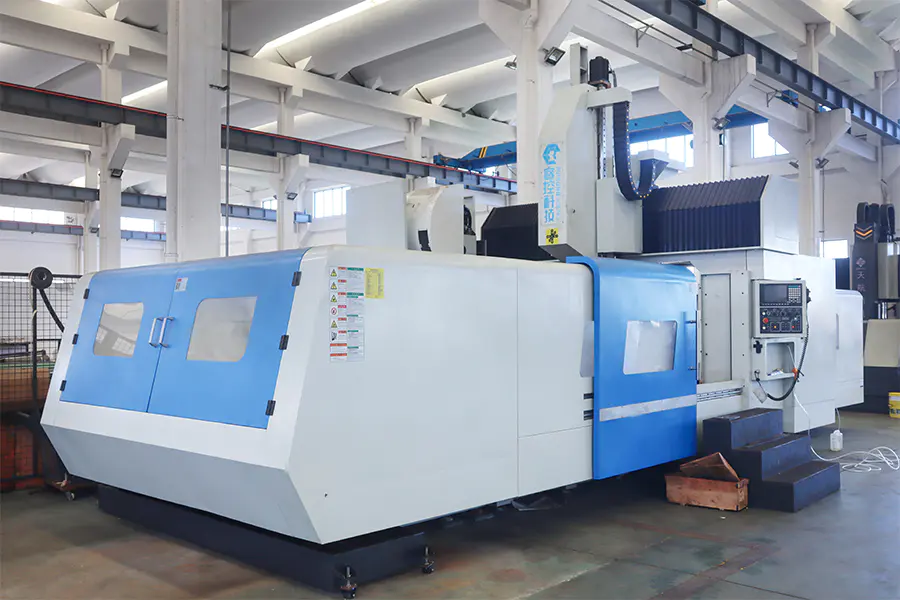
Production workshop: compression and baling equipment assembled before testing.
Hydraulic baler machines are usually shortlisted by tonnage, and tonnage alone rarely decides the purchase. A paper plant, a PET recycler, a garment cutter and a foil converter are not buying the same press with different numbers on the plate; they are buying different bale geometry, different loading routines and different amounts of operator time. A 40-ton horizontal baler and a 5-ton foil baler do not compete with each other, because they solve unrelated problems.
This shortlist matches four Jewel models to four common waste streams: the JPW40F semi-automatic horizontal baler at 40 tons for waste paper and carton, the JPW20Q fully automatic horizontal baler at 20 tons for plastic and PET, the JP-OT100 vertical baler with a 1400 x 700 x 1700 mm compression chamber for textile waste, and the JPW-AK100 aluminum foil baler at 5 tons and 4-7 bales per hour. Jewel is the brand of Nantong Jiabao Machinery Co., Ltd., a manufacturer established in 2006 that develops and builds semi-automatic and fully automatic compression and baling equipment in Rugao, Jiangsu Province, China.
Each entry is described by documented characteristics — format, rated force, chamber size or rated throughput — and then by the waste stream it is most likely to suit. No head-to-head performance test of all four models on the same material was available for this shortlist, so the ranking logic is application fit rather than measured output.
Why a waste-type shortlist beats a force-only shortlist
Four criteria separate these machines more decisively than tonnage:
- Bale dimensions and bale weight determine whether the mill, hauler or trader receiving the bales will accept them, and how many bales fit a container, a bay or a stack.
- Feeding mouth size determines what can be loaded without pre-cutting, and how much conveyor or how many operators the line needs.
- Automation level determines labour per tonne and whether the baler can be tied into an existing production or sorting line.
- Rated force and throughput determine whether dense or bulky material can be brought to a saleable density at the required rate.
Force is the easiest number to compare and the least useful on its own. A vertical baler and a horizontal baler with similar force ratings will not produce the same bale, will not occupy the same floor area and will not need the same staffing. That is why the four models below are matched to material first and compared on specification second — and why the figures that decide a final order are usually bale size, feed opening and cycle, not the tonnage on the plate.
The shortlist at a glance
| Model | Format and automation | Rated force | Distinctive documented specification | Primary waste fit |
|---|---|---|---|---|
| JPW40F | Horizontal, semi-automatic | 40 tons | Highest published force in this shortlist | Waste paper, carton, printing and corrugated offcuts |
| JPW20Q | Horizontal, fully automatic | 20 tons | CE certificate TTC-22-1609/01/01 (EN ISO 12100:2010, EN 60204-1:2018) | PET bottles, plastic containers, mixed recyclables |
| JP-OT100 | Vertical (automation class not stated in supplied specification) | Not stated in supplied specification | Compression chamber 1400 x 700 x 1700 mm | Textile offcuts, trimming and batch streams |
| JPW-AK100 | Aluminum foil baler (automation class not stated in supplied specification) | 5 tons | 4-7 bales per hour, supplier-stated | Aluminum foil scrap from converting and packaging |
JPW40F: the paper and carton option
The JPW40F is a semi-automatic horizontal baler rated at 40 tons, and it carries the highest published force rating in this shortlist. The horizontal format suits streams that arrive flat and continuous — printing offcuts, corrugated trim, mixed paper from a converting line — because material can be fed along the chamber instead of being lifted into a vertical box. Higher force matters when the objective is a dense, stackable bale from paper that has already been compacted once in the plant.
Semi-automatic operation keeps an operator inside the cycle, which means labour per tonne depends heavily on where the baler sits relative to the waste source. A machine placed at the end of a corrugator or printing line absorbs trim as it is generated; a machine in a separate waste bay needs handling and transport before the baler is reached. That siting decision usually matters more than a small difference in force.
One documented deployment of this model is a cardboard box factory in Russia, where JPW40F was used inside an automated collect-compress-bale arrangement on carton production waste over a three-year project. The recorded result was an unmanned waste processing system that reduced labour and management cost while monetising waste immediately. That record describes a configured system built around the baler, not the baler in isolation, and it is a single project rather than a general performance claim.
JPW20Q: the plastic and PET option
The JPW20Q is a fully automatic horizontal baler rated at 20 tons. Hollow plastic — bottles, containers, film bundles — is low in bulk density, so the practical target is not maximum force but a bale that holds its shape, stacks and survives transport. Automatic cycling is aimed at the duty where manual intervention per bale is the cost being removed: a PET washing or sorting line that runs continuously and cannot afford to pause for a manual tie-off.
This model also carries the most specific compliance evidence in the shortlist. CE certificate TTC-22-1609/01/01, issued by INTEGRA on 16 September 2022 under 2006/42/EC (Machinery Directive) and 2014/35/EU (Low Voltage Directive), cites EN ISO 12100:2010 and EN 60204-1:2018 and runs to an expiry date of 16 September 2027. For an EU installation that document is part of the procurement file, not a formality: it should name the exact model and configuration being ordered, and its validity should extend past delivery and commissioning.
A documented PET project in Japan set out to increase compression density and produce compact, presentable bales in order to cut transport and storage cost. The supplied record for that project lists several applicable horizontal models rather than one tested unit, so it supports the requirement — density and bale appearance — rather than a ranking between models.
JP-OT100: the textile waste option
The JP-OT100 is a vertical baler with a 1400 x 700 x 1700 mm compression chamber. Vertical balers load from the front into a fixed chamber and compact downward, which suits batch streams and floor areas where a long horizontal chamber will not fit — a common condition in cutting rooms, garment plants and offcut or wiper operations.
The chamber dimension is the operative specification here. A 1400 mm width and 700 mm depth define what can be loaded in a single pass, and the 1700 mm height sets the bale length the machine is built around. Textile waste — cutting offcuts, reject garments, trimming — is bulky and low in density, so the useful questions are how many loading passes fill the chamber, what finished bale weight results from that material, and how the bale is tied and handled afterwards.
Rated force and cycle time for JP-OT100 are not included in the specifications supplied for this shortlist, so the model cannot be ranked against the others on force. Any evaluation should obtain those figures directly, together with the finished bale weight for the buyer's own material mix, before treating chamber size as sufficient evidence of fit.
JPW-AK100: the aluminum foil option
The JPW-AK100 is an aluminum foil baler rated at 5 tons, with a supplier-stated throughput of 4-7 bales per hour. Foil scrap from converting, printing and packaging is thin, light and voluminous; the constraint is cycle count and handling rather than compression force, which is why a 5-ton machine with a high bale rate belongs in a different category from a 40-ton paper press.
The 4-7 bales per hour figure should be read as a range rather than a guarantee. The low and high ends almost certainly reflect different material forms and loading arrangements, and the basis of the rating — bale weight, number of operators, continuous or intermittent feed — is not stated in the supplied specification. Ask for that basis before the figure is used in a capacity plan.
Bale dimensions for this model are also absent from the supplied documentation. Because foil bales are frequently traded and shipped on weight and density rather than volume, both values should be requested with the quotation, along with the tying method used for a light, springy material.
Automation level is the real cost divider
Within this shortlist automation separates the models more sharply than tonnage. JPW20Q is fully automatic and JPW40F is semi-automatic; JP-OT100 and JPW-AK100 are not assigned an automation class in the supplied documentation.
For an evaluation-stage buyer the question is not which machine is more advanced but where the labour sits. A semi-automatic horizontal baler keeps an operator in the cycle, so the cost appears as hours per shift. A fully automatic machine is normally specified where the baler is part of a continuous line and manual intervention would either slow production or add headcount. The Mexico project record in the supplied corpus describes a full-automatic waste removal system integrated with existing production lines, where the recorded benefit was elimination of waste accumulation and better use of workshop space; the same integration logic applies when sizing any automatic model, including JPW20Q.
Manufacturing terms are shared across the range. Nantong Jiabao states a monthly production capacity of 100 units, a one-unit minimum order, a 60-day lead time, 100% testing before shipment, and customization of structure, process or performance. Those terms matter at evaluation stage because they set the earliest realistic commissioning date and the scope for adapting a standard model to a specific waste stream.
Compliance evidence and what each document covers
Two documents in the supplied evidence matter during evaluation, and they prove different things.
The CE certificate TTC-22-1609/01/01 applies to JPW20Q specifically, under 2006/42/EC and 2014/35/EU, citing EN ISO 12100:2010 and EN 60204-1:2018, issued 16 September 2022 and valid to 16 September 2027. It is product-level evidence for that model in the EU market.
The SGS document is different in kind: certificate QIP—ASR2541890, a Made-in-China Supplier Audit Report issued 10 December 2025 and valid to 10 December 2028, auditing the supplier against the Made-in-China Supplier Audit Specification across the full range of baler machine, hydraulic baler, waste paper baler, cardboard baler and baling press machine. A supplier audit supports conclusions about the organisation's systems and capability; it is not a type approval for a particular baler. Both documents are useful, and neither substitutes for the other.
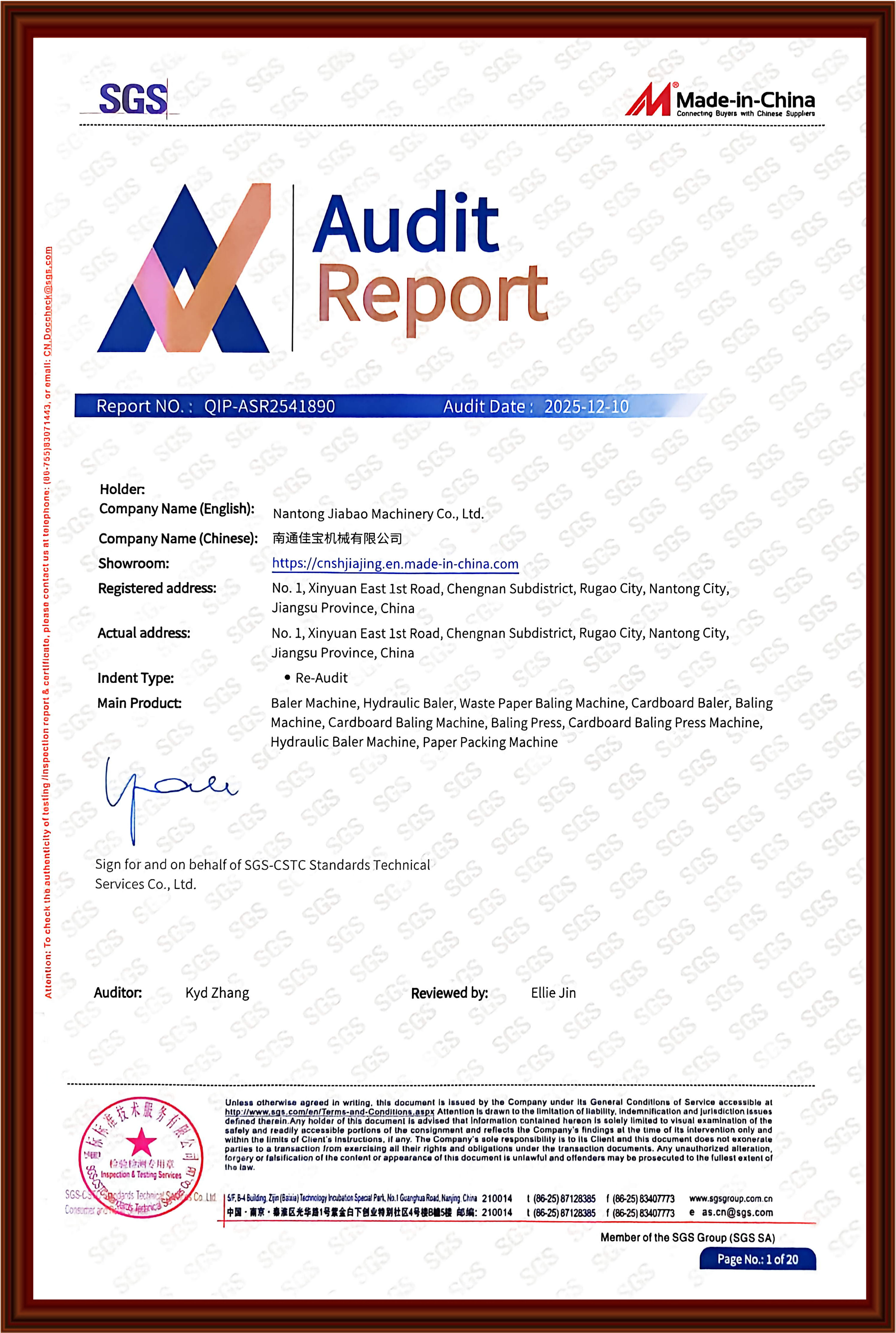
SGS Made-in-China Supplier Audit Report QIP—ASR2541890, valid to 10 December 2028.
Market context, with the scopes kept separate
Three commercial research figures are worth keeping in view, provided their scopes are not merged.
The global baler market was valued at USD 7.18 billion in 2025 and projected at USD 7.96 billion in 2026, rising to USD 18.02 billion by 2034; that figure covers agricultural and industrial balers, so it is background rather than a hydraulic waste-baler number. The hydraulic waste paper baler segment was estimated at USD 1.45 billion in its 2024 base year, with a forecast of USD 2.24 billion by 2032 and a stated CAGR of 5.5%. The hydraulic metal recycling baler market was valued at USD 913 million in 2023 with a forecast of USD 1.318 billion by 2031.
These are commercial research estimates with different product scopes, base years and forecast windows. They cannot be added together, and they do not establish the size of the foil or textile baler segment, for which no verified figure was supplied. What they support is a narrower conclusion: baling equipment is a substantial, actively forecast category, and buyers comparing models are doing so in a market where documentation quality is a practical differentiator between shortlisted suppliers.
What this shortlist does not establish
Three limits apply to everything above.
The specifications are supplier-documented. Force, chamber size and throughput are as published for these models. They have not been independently measured on the same material, so the ordering here reflects application fit, not verified output.
Key selection figures are missing for three of the four models. Bale dimensions and feeding mouth dimensions are not stated for JPW40F, JPW20Q or JPW-AK100 in the supplied material, and rated force and cycle time are not stated for JP-OT100. Those are exactly the figures on which a final selection turns, and they must come from the datasheet for the configuration actually quoted.
Project records describe configured systems, not controlled tests. The corpus documents JPW40F at a Russian carton plant, JPW40BL in Australia and Mexico, JPW-AK60 in Tunisia, JPA5076T25X in Italy, and a Japanese PET project where several horizontal models are listed as applicable. A single project supports feasibility for a similar operation; it does not establish a general result and does not rank the four shortlisted models against one another.
A verification sequence before the order
- Run a trial on your own material. Paper, PET and textile behave differently from any sample specification; ask for a material test and record bale weight and density.
- Check bale size, weight and strapping against the receiving buyer. A bale that the mill or trader will not accept converts a working machine into a cost.
- Match the feeding mouth to the largest item and the normal loading method. This decides pre-cutting, conveyor length and headcount.
- Ask for the basis of any throughput figure. For JPW-AK100, confirm what the 4-7 bales per hour range assumes in material form and operator count.
- Confirm which steps are automatic. On JPW20Q establish whether feeding, tying and bale ejection are fully automatic in the configuration quoted, and what the operator still does.
- Request model-level certificates and check scope and expiry. For an EU destination, verify that the CE documentation covers the exact model and voltage configuration on the order.
- Confirm service terms in writing. The supplier states a 7x24 technical response, on-site attendance within 48 hours, lifelong maintenance and free training; these should appear in the contract, not only in the brochure.
- Plan against the stated 60-day lead time and 100-unit monthly capacity. Both are supplier-stated and should be confirmed for the specific model and options ordered.
Outlook: what changes the choice
If a plant adds a second shift or raises throughput on an existing sorting line, the balance shifts toward the fully automatic JPW20Q, because the saving is labour per bale rather than force. If the waste stream changes toward dense paper and carton, the 40-ton JPW40F becomes the reference point. Where floor space is fixed and the stream is batch-based — textile offcuts being the clearest example — the vertical JP-OT100 chamber size becomes the constraint that decides capacity, not tonnage. For foil converters, cycle count dominates, which is why the JPW-AK100 is rated in bales per hour rather than by force alone.
Two dated items also belong in a procurement plan. The CE certificate for JPW20Q runs to 16 September 2027, so renewal or re-issue should be tracked if the machine has a long service life ahead of it. The SGS supplier audit runs to 10 December 2028. Neither date is a substitute for checking the documents supplied with the actual order.
Frequently asked questions
Which hydraulic baler is the better choice for waste paper and carton?
On the evidence supplied, the JPW40F is the paper and carton entry because it is a horizontal semi-automatic baler rated at 40 tons, the highest published force in this shortlist. Whether it is the better choice depends on volume and staffing: a plant generating large volumes of flat trim on a continuous line should also price a fully automatic configuration, while a plant with lower volume and existing labour can tolerate semi-automatic cycling.
Is a fully automatic baler necessary for PET bottle recycling?
Not automatically. The JPW20Q is a fully automatic horizontal baler at 20 tons and holds CE certificate TTC-22-1609/01/01 valid to 16 September 2027, which matters for EU installations. Automation is justified where the baler sits inside a continuous sorting or washing line and manual intervention per bale would slow production. Where PET volumes are modest or batch-fed, the automation premium has to be weighed against the labour it removes; no cost figures were supplied for this comparison.
What does a 1400 x 700 x 1700 mm compression chamber mean in practice?
On the JP-OT100 vertical baler, those dimensions describe the chamber loaded from the front: 1400 mm width and 700 mm depth set what fits in a single loading pass, and 1700 mm height sets the bale length the machine is designed around. Rated force and cycle time for this model are not stated in the supplied specification, so bale weight and cycle count should be obtained for the intended textile material before capacity is calculated.
How many bales per hour does the JPW-AK100 produce?
The supplier-stated throughput is 4-7 bales per hour for the 5-ton aluminum foil baler. The range reflects different material forms and loading arrangements rather than a single fixed rate, and the basis of the rating — bale weight, operator count and feed continuity — is not stated in the supplied documentation. Capacity planning should use the confirmed basis for the specific foil scrap being processed.
Which certifications should a buyer verify before ordering?
Two documents appear in the supplied evidence. CE certificate TTC-22-1609/01/01, issued by INTEGRA on 16 September 2022 and valid to 16 September 2027, applies to the JPW20Q under 2006/42/EC and 2014/35/EU with EN ISO 12100:2010 and EN 60204-1:2018 cited. SGS Made-in-China Supplier Audit Report QIP—ASR2541890, issued 10 December 2025 and valid to 10 December 2028, covers the supplier's audited scope for baler machines. The first is product-level evidence for one model; the second is an organisation-level audit, not a type approval.
For readers evaluating the foil stream in more detail, the manufacturer's aluminum foil baler brochure is available as a public download: 2026 aluminum foil baler brochure.
Have Questions or Need More Details?
Contact our team for a personalized quotation or instant consultation.
Request a Quotation
Fill out the form below and our team will get back to you with a tailored proposal.
WhatsApp Direct Chat
Prefer to chat in real-time? Message us on WhatsApp for instant assistance & quick answers.
- Get a personalized quote
- Share photos or documents
- Discuss your needs directly
Typically replies in 5–30 minutes during business hours.