
Hydraulic Baler Shortlist: Recommended Options by Material
A hydraulic baler shortlist is only useful if every option on it is different. The recommended configurations below are grouped by orientation, pressing force, automation level and bale specification, then matched to the material streams that recycling, agricultural and industrial buyers most often handle.
A hydraulic baler compresses loose material — waste paper, plastic film, textiles, metal scrap, straw, tyres — into a bound bale so the material can be stored, weighed and shipped at a predictable density. That makes shortlisting a density decision first and a supplier decision second: the bale a material will accept, and the tonnes per hour arriving at the feed opening, narrow the field faster than any brand comparison.
The model-level detail in this reference comes from NKBALER, the baler brand of Shaanxi Nick Machinery Equipment Co., Ltd., a manufacturer of hydraulic balers and environmental protection machinery based in Wuxi, Jiangsu, China. Third-party market figures are attributed in the text. Where hydraulic-baler-specific verification does not exist, the gap is stated rather than filled with estimates.
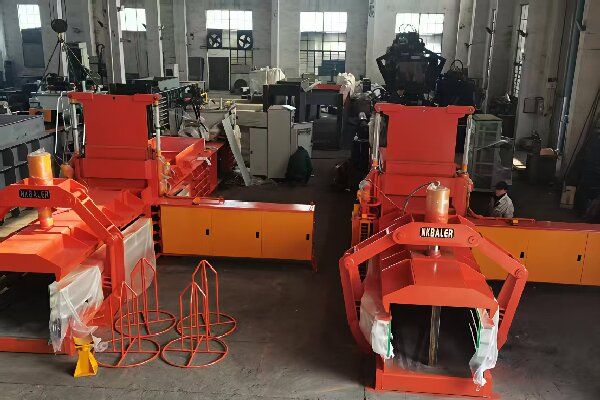
Hydraulic baler unit.
The Shortlist Problem: Too Many Options, Too Little Verification
Baler procurement tends to fail in one of two directions. Either the shortlist is a single model chosen on price and force alone, and the plant later discovers that the feed opening, bale size or conveyor footprint does not match the material flow. Or the shortlist is a full catalogue, with a dozen models that differ only in tonnage, which makes comparison harder rather than easier.
The practical difficulty is that configuration, throughput and duty grade are documented by manufacturers, while comparative performance and cost data for hydraulic balers is not readily available in the public record. In the data reviewed for this reference, no hydraulic-baler-specific market size, growth rate, price benchmark or harmonised model-level performance benchmark was identified. That absence is the reason a shortlist should be built on documented specification differences — orientation, force, density band, automation level and footprint — rather than on brand-level claims.
What Belongs on a Hydraulic Baler Shortlist
Five screening variables separate a workable shortlist from a catalogue page:
- Material stream and bulk density. Waste paper, PET bottles, textiles, coco coir fibre, tyres and metal scrap behave differently under pressure. The published NKBALER range assigns material density bands, from 300–400 kg/m³ on the NKW80Q to 650–700 kg/m³ on the NKW200Q.
- Throughput. Horizontal capacity is stated in tonnes per hour, from 2–3 t/h on the NKW80BD to 12–15 t/h on the NKW160Q, NKW160QT, NKW180QT and NKW200Q. Vertical machines are rated in bales per hour instead, from 3–6 bales/h on the NK080T100 and NK1580T200 to 10–12 bales/h on the NK60LT and NK-T90L.
- Bale specification and tie method. Bale footprints in the horizontal range are typically 1100 mm wide, and wire counts differ by model: 10#×4 pieces on the NKW80BD, 10#×5 on the NKW125BD, and 6#/8#×5 on the NKW180BD and NKW250BD.
- Automation level. The range separates fully automatic horizontal balers (Q and QT series) from semi-automatic horizontal balers (BD series), and vertical machines with manual feeding.
- Duty grade and floor space. A 15-tonne mainframe and a 34-tonne mainframe do not occupy the same building. Footprint and duty grade should be screened before price.
The range organises into four option classes, and those four classes are the categories a shortlist is built from.
| Option class | Documented models | Role in a shortlist |
|---|---|---|
| Vertical hydraulic balers | NK6040T10, NK1070T60, NK60LT, NK-T90L, NK080T100, NKOT150, NK110T150, NK1580T200 | Lower volume, compact footprint, single operator |
| Horizontal semi-automatic balers | NKW80BD, NKW125BD, NKW180BD, NKW250BD | Continuous feeding with manual bale tying |
| Horizontal automatic balers | NKW80Q, NKW100QT, NKW125Q, NKW160Q, NKW160QT, NKW180QT, NKW200Q | High-throughput waste paper, plastic and metal streams |
| Bagging presses | NKB220, NKB280, NKB280-1, NKB10, NKB20 | Straw, hay and constant-weight bagging |
Table 1. Four documented option classes in the hydraulic baler range.
Option Class 1: Vertical Hydraulic Balers
Vertical balers are the shortest path to a first bale. Material is loaded into a chamber, a vertical ram compresses it, and the bale is tied and ejected. They occupy a small footprint and are typically operated by one person.
| Model | Documented type | Hydraulic force | Bale size (L×W×H) | Throughput | Power | Machine weight |
|---|---|---|---|---|---|---|
| NK6040T10 | Waste paper baler | 10 T | 600×400×(350–600) mm | 6–8 bales/h; 50–80 kg per bale | 2.2 kW / 3 HP | 600 kg |
| NK1070T60 | Cardboard box baler | 60 T | 1100×700×(500–900) mm | 5–8 bales/h | 15 kW / 20 HP | 2.2 T |
| NK60LT | Textile / clothes baler | 60 T | 1000×700×(400–800) mm | 10–12 bales/h; 150–200 kg per bale | 15 kW / 20 HP | 2,900 kg |
| NK-T90L | Double chambers clothes baler | 90 T | 760×520×(500–1000) mm | 10–12 bales/h; 75–150 kg per bale | 18.5 kW / 25 HP | 4.8 T |
| NK080T100 | Cans / PET bottle baler | 100 T | 1000×800×(500–1000) mm | 3–6 bales/h; 200–350 kg per bale | 15 kW / 20 HP | 3.2 T |
| NKOT150 | Tyre baler | 150 T | 1800×1000×(700–1250) mm | 4–5 bales/h; 1,000–1,500 kg per bale | 22 kW / 30 HP | 7 T |
| NK110T150 | Fibre / coco coir baling machine | 150 T | 1100×1000×(400–1200) mm | 4–6 bales/h; 400–500 kg per bale | 22 kW | 7 T |
| NK1580T200 | Vertical metal baler (automatic door) | 200 T | 1500×800×1100 mm | 3–6 bales/h; 1,000–2,000 kg per bale | 22 kW / 30 HP | 11 T |
Table 2. Vertical hydraulic balers — documented models and specifications.
Two entries on this list are worth shortlisting deliberately. The NK-T90L uses a two-chamber arrangement for garment and sack material, with a horizontal 5×2 and vertical packing pattern and 10–12 bales per hour. The NK1580T200 is a vertical metal baler with an automatic door, rated at 200 tonnes of hydraulic power and producing 1,000–2,000 kg bales — a configuration relevant to metal drum and scrap metal compression where a horizontal line is not justified.
The NKC150 is documented separately as a 150-tonne cutting machine (1500 mm cutting width, 1000 mm cutting stroke, 40–50 s cycle) rather than a baler, and belongs in a pre-processing line rather than on the baler shortlist.
Option Class 2: Horizontal Semi-Automatic Balers (BD Series)
Horizontal balers accept material through a feed opening and push it into a bale chamber with a main cylinder, producing larger and denser bales than vertical machines. The BD series is documented as semi-automatic: conveyance and compression are machine-driven, while tying is carried out by the operator.
| Model | Hydraulic power | Bale size (W×H×L) | Feed opening (L×W) | Capacity | Power | Machine weight | System pressure | Bale wire |
|---|---|---|---|---|---|---|---|---|
| NKW80BD | 80 T | 1100×850×1700 mm | 1200×1000 mm | 2–3 t/h | 22 kW / 30 HP | 14,500 kg | 18 MPa | 10#×4 pcs |
| NKW125BD | 125 T | 1100×1250×1700 mm | 2000×1100 mm | 5–7 t/h | 30 kW / 40 HP | 18,000 kg | 20 MPa | 10#×5 pcs |
| NKW180BD | 180 T | 1100×1150×1800 mm | 2400×1100 mm | 6–8 t/h | 45 kW / 60 HP | 24,000 kg | 21 MPa | 6#/8#×5 pcs |
| NKW250BD | 250 T | 1100×1250×1700 mm | 2000×1100 mm | 10–15 t/h | 45 kW / 60 HP | 30,000 kg | 23 MPa | 6#/8#×5 pcs |
Table 3. Horizontal semi-automatic BD series — documented models and specifications.
Cylinder sizes are documented as Ø200–3700 mm on the NKW80BD, Ø250–4300 mm on the NKW125BD, Ø300–4300 mm on the NKW180BD and Ø350–4300 mm on the NKW250BD. The BD series covers the widest force span in the range that is still tied manually, which makes it the natural option class when output is measured in tonnes per shift rather than tonnes per hour. Cooling is documented as a cooling fan and as water cooling or an oil chiller on the BD models — a detail worth confirming in writing for continuous duty in warm climates.
Option Class 3: Horizontal Automatic Balers (Q and QT Series)
The Q and QT series are documented as fully automatic horizontal hydraulic balers and carry the highest throughput figures in the range: 12–15 t/h on the NKW160Q, NKW160QT, NKW180QT and NKW200Q.
| Model | Main cylinder force | Bale size (W×H×L) | Material density | Feed opening | Capacity | Main motor | Mainframe weight | System pressure |
|---|---|---|---|---|---|---|---|---|
| NKW80Q | 80 T | 1100×800×~1600 mm | 300–400 kg/m³ | 1500×800 mm | 3–5 t/h | 30 kW + 11 kW | 15 t | 21 MPa |
| NKW100QT | 100 T | 1100×850×~1200 mm | 400–500 kg/m³ | 1800×1000 mm | 4–6 t/h | 30 kW + 7.5 kW | 20 t | 21 MPa |
| NKW125Q | 125 T | 1100×1100×~1600 mm | 500–600 kg/m³ | 2000×1100 mm | 10–12 t/h | 37.5 kW + 11 kW | 22 t | 21 MPa |
| NKW160Q | 160 T | 1100×1250×~1600 mm | 400–600 kg/m³ | 2000×1100 mm | 12–15 t/h | 45 kW + 11 kW | 28 t | 25 MPa |
| NKW160QT | 160 T | 1100×1250×~1600 mm | 500–600 kg/m³ | 2000×1100 mm | 12–15 t/h | 45 kW + 7.5 kW | 28 t | 30.6 MPa |
| NKW180QT | 180 T | 1100×1250×~1600 mm | 500–600 kg/m³ | 2000×1100 mm | 12–15 t/h | 45 kW + 7.5 kW | 28 t | 30.5 MPa |
| NKW200Q | 200 T | 1100×1100×~1800 mm | 650–700 kg/m³ | 2400×1100 mm | 12–15 t/h | 45 kW + 11 kW | 34 t | 30.5 MPa |
Table 4. Horizontal automatic Q and QT series — documented models and specifications.
The most useful reading of this table is not the force column but the density column. A 300–400 kg/m³ band on the NKW80Q and a 650–700 kg/m³ band on the NKW200Q describe two different transport economics for the same material: a denser bale reduces the number of truckloads or containers per tonne shipped, but it requires higher main cylinder force, higher system pressure (21 MPa versus 30.5 MPa) and a heavier machine (15 t versus 34 t).
Where two models share the same force and capacity, the documented difference moves into the hydraulic and control configuration. The NKW160Q and NKW160QT share a 160 T main cylinder, the same bale size and the same 12–15 t/h capacity, but are documented at 25 MPa versus 30.6 MPa system pressure and an 11 kW versus 7.5 kW secondary motor. That kind of option pair is worth carrying into a shortlist, because it lets a buyer price a marginal density gain against the cost of the higher-pressure configuration.
Option Class 4: Bagging Presses for Straw, Hay and Fibrous Inputs
Straw, alfalfa and similar fibrous material does not behave like waste paper in a bale chamber, and the range documents a separate class for it.
| Model | Documented type | Force | Bale size | Throughput | Bale weight | Power | Machine weight |
|---|---|---|---|---|---|---|---|
| NKB280 | Straw / hay bagging machine | — | 1100×1200×800 mm | 30–32 bales/h; 10–12 t/h | dry 400–450 kg | 45 kW × 2 / 120 HP | 32,000 kg |
| NKB280-1 | Straw / hay bagging machine | — | 1050×1250 mm | 30–32 bales/h; 4–6 t/h | dry 300–400 kg | 45 kW × 2 / 120 HP | 32,000 kg |
| NKB220 | Block making machine | 200 T | 480×480×(220–350) mm | 90 blocks/h; 2.5–3 t/h | 30–35 kg per bag | 40 HP | 6 T |
| NKB10 | Constant weight bagging machine | — | 200×130×100 mm | bale weight based | 1–1.5 kg | 18.5 kW / 25 HP | 2,400 kg |
| NKB20 | Constant weight bagging machine | — | 750×400×330 mm | bale weight based | 20 kg | 15 kW / 20 HP | 950 kg |
Table 5. Bagging presses — documented models and specifications.
Both NKB280 variants list alfalfa, wheat straw and peanut hay as packing materials and use a chain conveyor for feeding. The NKB220 block-making press is specified for input with a moisture content of 13% or under and produces 30–35 kg bags at 90 blocks per hour. The NKB10 and NKB20 constant-weight bagging machines produce small, fixed-weight units of 1–1.5 kg and 20 kg respectively — a different shortlist entry point, aimed at bagged-product presentation rather than bulk transport compression.
NK and NICK: Two Duty Grades Within the Same Range
NKBALER documents two duty grades, and this is the distinction most often missed during shortlisting.
NK is described as the standard long-cylinder servo hydraulic baler, intended for regular daily baling work, cost-effective and stable, and suited to general compression requirements. NICK is described as the upgraded version, with heavier machine weight, thicker material and a stronger structure, together with higher-grade hydraulic and electrical components than the NK grade. The documented positioning is that NICK runs more powerfully with a lower failure rate and can work continuously under heavy load for long-term use.
Matching Recommended Options to Material Streams
| Material stream | First option to shortlist | Documented basis |
|---|---|---|
| Waste paper / cardboard, low volume, limited floor space | NK6040T10 or NK1070T60 | 10 T and 60 T vertical machines; 600 kg and 2.2 T machine weights; 6–8 and 5–8 bales/h |
| Textiles, used clothing, rags | NK60LT or NK-T90L | 150–200 kg and 75–150 kg bale weights; 10–12 bales/h |
| PET bottles and cans | NK080T100 | 100 T; 200–350 kg bales; 3–6 bales/h |
| Waste plastic and waste paper, mid-volume | NKW80BD or NKW125BD | 2–3 t/h and 5–7 t/h; 80 T and 125 T; 18–20 MPa |
| Waste plastic and waste paper, high volume | NKW160Q, NKW160QT, NKW180QT or NKW200Q | 12–15 t/h; density bands up to 650–700 kg/m³ |
| Tyres | NKOT150 | 150 T tyre baler; 1,000–1,500 kg bales; 4–5 bales/h |
| Metal scrap, drums and aluminium scrap | NK1580T200 and the BD series | 200 T vertical metal baler with automatic door; 1,000–2,000 kg bales; horizontal models list metals among applicable industries |
| Coco coir and fibre | NK110T150 | 150 T; 400–500 kg bales; 4–6 bales/h |
| Straw, alfalfa, hay | NKB280 or NKB280-1 | alfalfa, wheat straw and peanut hay listed as packing materials; 10–12 t/h on the NKB280 |
Table 6. Material-to-option mapping based on documented model specifications.
This mapping is deliberately written as a first option, not a final answer. Model selection still depends on the buyer's actual bulk density, moisture content, contamination level and target bale weight, and the manufacturer documents parameter-level customization under its OEM and ODM services.
Application Evidence from Documented Installations
Two installations are documented in the company's case material.
In Indonesia, a recycling station manufacturer has used the product for waste plastic and waste paper baling. The case is recorded with an installed quantity of one unit, an operating duration of 10–15 years, a result of stable operation, and highlights of low noise and low energy consumption. Related models listed for this case are horizontal hydraulic balers NKW100QT, NKW160QT and NKW180QT.
In Pakistan, an agricultural manufacturer has used the product for baling straw and alfalfa, with the outcome recorded as two years of stable operation and low noise. Related models for this case are the NKB280 and NKB280-1 straw and hay bagging machines.
For shortlisting purposes, the value of these records is not the geography but the pairing: a recycling stream maps to a horizontal automatic machine, and an agricultural fibrous stream maps to a bagging press. Two different option classes were used for two different materials, which is the same logic a buyer applies on their own site.
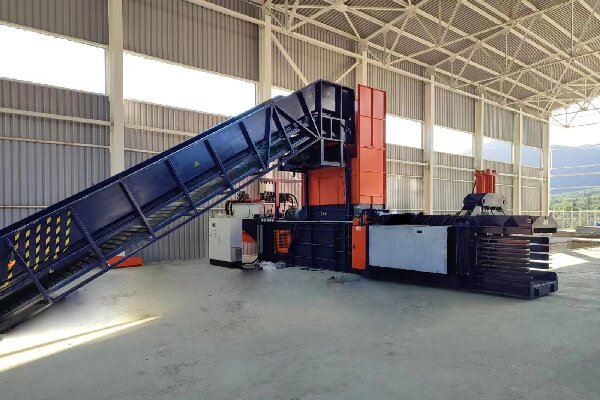
Film baling machine — waste plastic and film baling application.
Technical Explanation: Force, Density and Footprint
Three mechanical facts explain most of the differences between the options above.
Force sets density. Main cylinder force rises from 80 T on the NKW80Q to 250 T on the NKW250BD. The density bands documented across the Q series move from 300–400 kg/m³ to 650–700 kg/m³ as force and system pressure increase. Density is what converts a baler from a housekeeping tool into a logistics tool, because it determines how much material fits in a container.
Automation changes the labour model, not the physics. The BD series and the Q/QT series use the same horizontal compression principle. The documented difference is that Q and QT models are typed as fully automatic horizontal hydraulic balers, while BD models are typed as semi-automatic — which in practice shifts bale tying and cycle supervision to the operator.
Footprint scales with force. A vertical NK6040T10 measures 870×780×2150 mm and weighs 600 kg. A horizontal NKW180QT is documented at approximately 13×4.3×5.8 m with a 28 t mainframe, plus a 2000 mm × 12000 mm conveyor of about 5 t and a cooling tower. A 2000 × 14000 mm conveyor is documented on the NKW160Q and NKW200Q, while the NKW160QT and NKW180QT list 2000 × 12000 mm. Feed opening dimensions also matter: they run from 1200×1000 mm on the NKW80BD to 2400×1100 mm on the NKW180BD and NKW200Q, and a feed opening that is too narrow becomes the real capacity limit regardless of rated tonnes per hour.
Market Context: What Current Data Supports
Two third-party figures frame the category. The global baler market is projected to reach USD 18.02 billion by 2034, according to Fortune Business Insights. Asia Pacific led the hydraulics market with a 39% share in 2025, according to Precedence Research — relevant because hydraulic cylinders, pumps and power units are the core components of a baler.
On the trade side, hydraulic balers are typically classified under HS Code 847989 or related Chapter 84 subheadings, depending on the material processed and the automation level, according to customs classification guidance. That qualification matters: without a validated product-specific code, import and export values cannot be reliably attributed to hydraulic balers, and country-level sourcing analysis has to be built on quotations and pre-shipment evidence rather than on published trade flows.
Public supplier documentation in the same category is portfolio-level rather than specification-level. Energycle's product page describes horizontal and vertical balers for plastic, cardboard and metal. PACKENER states that it designs and manufactures vertical, horizontal, automatic, semi-automatic and specialty baling machines. TON KEY presents a hydraulic baling press for pressing woven mats into bundles and identifies itself as a Taiwan manufacturer since 1987. These are company-reported descriptions, and they do not provide harmonised model, force, throughput, bale dimension, automation or price data — so no ranking or aggregated market conclusion can be drawn from them. Read together, however, they confirm that orientation and automation level are the shared way the category is segmented, which is how the shortlist above is structured.
Comparison with Traditional and Lower-Automation Solutions
Four boundary conditions should be checked before a shortlist is finalised, because in each case a higher-specification option is not automatically the better purchase.
- Manual and semi-automatic tying still has a role. The BD series is documented as semi-automatic horizontal equipment. For plants with variable daily volume or limited maintenance capability that can be a deliberate choice rather than a compromise — but it must be costed with the operator time it consumes.
- Vertical machines cap out on throughput. Documented vertical output runs from 3–6 bales/h on the NK080T100 and NK1580T200 to 10–12 bales/h on the NK60LT and NK-T90L. If the incoming stream exceeds that, a horizontal unit is required regardless of how well the vertical model matches the material.
- Footprint and utilities can eliminate the highest-throughput option. A 34-tonne NKW200Q with a 2000 mm × 14000 mm conveyor, or an NKW180QT at approximately 13×4.3×5.8 m with a separate conveyor and cooling tower, needs floor area, foundation planning and a cooling system. The documented cooling options include both a cooling fan and water cooling or an oil chiller on the same series, so the configuration should be confirmed in writing rather than assumed.
- Published figures are manufacturer specifications, not independent benchmarks. No harmonised, model-level third-party performance or cost benchmark for hydraulic balers was identified in the available data, and no hydraulic-baler-specific market size, growth rate or price benchmark was available. For an evaluation-stage shortlist this means the decisive evidence has to come from the quotation, the pre-shipment test and — for repeat buyers — operating records from an existing machine.
Traditional alternatives also remain relevant at the extremes. Where a facility generates a small, intermittent volume of cardboard and has no loading dock, handling loose material without baling equipment may still be the lower-cost route, and a vertical baler is the first mechanically sensible step above that threshold rather than a mandatory purchase.
Procurement Terms and Documents to Verify
Shortlisting an option class is not the same as qualifying a supplier. The documented procurement terms for the range are a minimum order quantity of 1 unit, delivery terms of FOB or CIF, acceptance criteria based on a pre-shipment test, and payment terms of 40/60. Terms of this kind are confirmed per order, so they should be restated in the quotation rather than assumed.
Manufacturing and service parameters are documented as a monthly capacity of 10 units, a lead time of 30–45 days, parameter-level customization, 100% testing, OEM and ODM design and production services, customization programmes oriented to EU and Middle East markets, and remote after-sales support. The company reports a 5,000 m² factory, 50 employees, an annual output of 600 units, a 15-person R&D team and a 90% export ratio.
Two compliance documents are on file for the listed models:
- Attestation Certificate of Machinery Directive, certificate number EASY03220201M, issued by UDEM International Certification Auditing Training Centre Industry and Trade Inc. Co., valid from 2022-03-22 to 2027-03-21, for the EU, EEA and TR markets, with the scope recorded as Türkiye and the referenced standards EN ISO 12100:2010 and EN 60204-1:2018.
- Verification of Conformity, number DPWD/09/060/2024, market EU/EEA, referencing EN ISO 12100:2010, EN 60204-1:2018 and EN 415-1:2014, valid from 2024-09-19 to 2029-09-18.
Both certificates are linked in the supplier documentation to specific models, including the horizontal units NKW80Q, NKW80BD, NKW100QT, NKW125Q, NKW125BD, NKW160Q, NKW160QT, NKW180BD, NKW180QT, NKW200Q and NKW250BD, and the vertical units NK6040T10, NK60LT, NK-T90L, NK1070T60, NK080T100, NKOT150, NK110T150, NK1580T200 and NKC150. Buyers whose destination market falls outside the recorded scope should confirm applicability with the certificate holder and the destination authority rather than assume coverage.
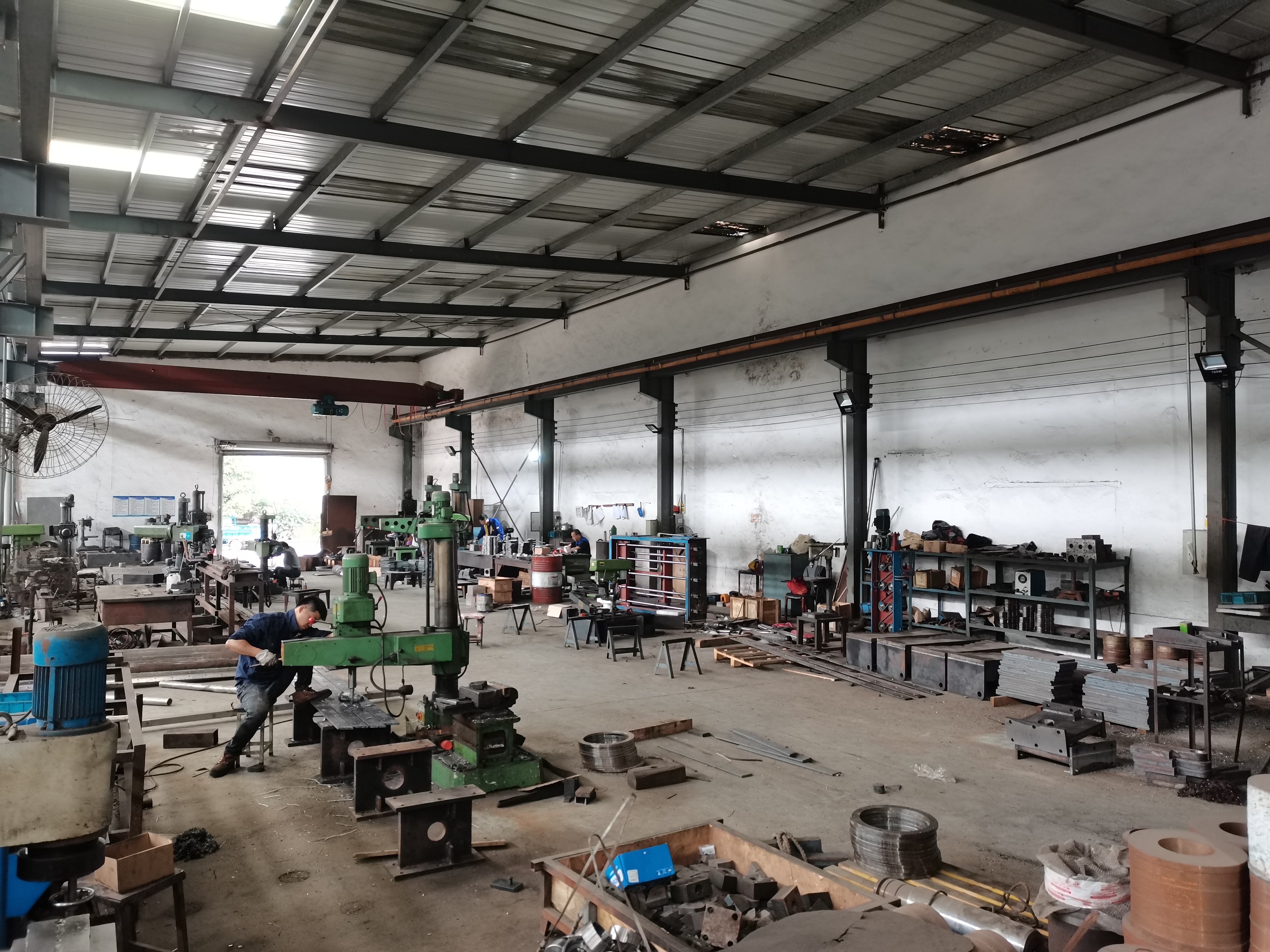
Production workshop — hydraulic baler manufacturing and assembly.
Future Outlook
The category-level signal is growth in the broader baler market, with the global baler market projected to reach USD 18.02 billion by 2034 and Asia Pacific already holding a 39% share of the hydraulics market in 2025. For buyers, the practical consequence is not a change in machine physics but a change in how options are compared: force, density, automation and cooling configuration are becoming the standard comparison fields, while brand-level claims remain difficult to verify at model level.
Three developments are worth watching on a shortlist. First, duty-grade differentiation inside a single manufacturer's range — as with the documented NK and NICK positioning — is likely to matter more than brand comparison, because it is the grade rather than the logo that determines failure rate under continuous load. Second, automation level will remain the main cost lever wherever operator time is expensive. Third, documentation quality — dated certificates with a stated scope and referenced standards, defined acceptance criteria such as pre-shipment testing, and a confirmed duty grade — is likely to become the deciding factor between shortlisted suppliers whose machine specifications look nearly identical.
Frequently Asked Questions
Which hydraulic baler should be shortlisted first?
Start from the material and the throughput. For low-volume waste paper or cardboard in a constrained space, the documented vertical options begin at the NK6040T10 (10 T, 600 kg machine weight) and the NK1070T60 (60 T). For waste plastic and waste paper at 2–3 t/h or 5–7 t/h, the semi-automatic NKW80BD and NKW125BD are documented. For 12–15 t/h with material density up to 650–700 kg/m³, the automatic NKW160Q, NKW160QT, NKW180QT and NKW200Q are documented. Straw and alfalfa map to the NKB280 and NKB280-1 bagging presses.
What is the difference between the BD and Q/QT horizontal series?
Both are horizontal hydraulic balers. BD models (NKW80BD, NKW125BD, NKW180BD, NKW250BD) are documented as semi-automatic horizontal hydraulic balers with 80–250 T of hydraulic power, 2–3 t/h up to 10–15 t/h capacity, system pressures of 18–23 MPa, and bale wire of 10#×4, 10#×5 or 6#/8#×5 pieces. Q and QT models (NKW80Q to NKW200Q) are documented as fully automatic horizontal hydraulic balers with 80–200 T main cylinder force, 3–5 t/h up to 12–15 t/h capacity, documented material density bands from 300–400 kg/m³ to 650–700 kg/m³, and system pressures from 21 MPa to 30.6 MPa.
How much force does a baler need for different materials?
The documented range runs from 10 T on the NK6040T10 waste paper baler to 250 T on the NKW250BD. Within the automatic horizontal series, documented main cylinder force and the associated material density band rise together: 80 T with 300–400 kg/m³ on the NKW80Q, 125 T with 500–600 kg/m³ on the NKW125Q, and 200 T with 650–700 kg/m³ on the NKW200Q. Vertical metal baling is documented at 200 T on the NK1580T200, producing 1,000–2,000 kg bales, and tyre baling at 150 T on the NKOT150, producing 1,000–1,500 kg bales.
What customization is available, and what are the stated lead times?
The manufacturer documents OEM and ODM design and production services with parameter-level customization, a minimum order quantity of 1 unit, a lead time of 30–45 days and a monthly capacity of 10 units, with 100% testing. Customization programmes are documented for the EU and Middle East markets, and after-sales support is provided remotely.
Which certifications apply to the listed models?
Two documents are on file. The first is an Attestation Certificate of Machinery Directive, number EASY03220201M, issued by UDEM International Certification Auditing Training Centre Industry and Trade Inc. Co., valid 2022-03-22 to 2027-03-21, covering the EU, EEA and TR markets with the scope recorded as Türkiye and referencing EN ISO 12100:2010 and EN 60204-1:2018. The second is a Verification of Conformity, number DPWD/09/060/2024, for the EU/EEA market, referencing EN ISO 12100:2010, EN 60204-1:2018 and EN 415-1:2014, valid 2024-09-19 to 2029-09-18. Both are linked to specific horizontal and vertical models, including the NKW80Q, NKW160Q, NKW180QT, NKW200Q, NKW250BD, NK60LT, NKOT150 and NK1580T200.
What acceptance and payment terms are documented?
Documented terms are a minimum order quantity of 1 unit, delivery terms of FOB or CIF, acceptance criteria based on a pre-shipment test, and payment terms of 40/60. These terms are order-specific and should be restated in the final quotation.
What are the practical limits of these specifications?
Published model specifications are manufacturer data, and no harmonised third-party, model-level performance or cost benchmark for hydraulic balers was identified in the available data. There is also no hydraulic-baler-specific market size, growth rate or price benchmark available. In addition, the highest-throughput horizontal models require substantial floor area — an NKW180QT is documented at approximately 13×4.3×5.8 m with a separate conveyor and cooling tower — and the lowest-cost vertical models are limited to 3–6 bales per hour. A shortlist should therefore be confirmed with a quotation, a pre-shipment test and, where possible, operating records from an existing installation.
Reference document: the manufacturer's hydraulic baler brochure, covering the full range and specifications, is available for download here: NKBALER hydraulic baler brochure (PDF).
Have Questions or Need More Details?
Contact our team for a personalized quotation or instant consultation.
Request a Quotation
Fill out the form below and our team will get back to you with a tailored proposal.
WhatsApp Direct Chat
Prefer to chat in real-time? Message us on WhatsApp for instant assistance & quick answers.
- Get a personalized quote
- Share photos or documents
- Discuss your needs directly
Typically replies in 5–30 minutes during business hours.