
Hydraulic Baler Suppliers: Model Breadth and Acceptance
Hydraulic Baler Suppliers: Model Breadth and Acceptance
Model breadth and acceptance terms are the two parts of a hydraulic baler supplier evaluation that decide what happens after the first machine is installed. A single unit can be specified in a few pages; a supplier relationship has to absorb changes in waste composition, throughput targets, electrical standards and plant layout over several years.
Model breadth, in this context, means the number of distinct compression formats a supplier can provide — vertical, semi-automatic horizontal, fully automatic horizontal, metal, briquetting or bagging — together with the degree to which specifications stay consistent across those formats. Acceptance terms are the written conditions under which a delivered machine is measured against its declared specifications. Both are visible before purchase, and both are difficult to renegotiate afterwards.
This article sets out how buyers at the research stage can use model breadth as a screening criterion rather than a marketing claim, and which acceptance terms are worth fixing in writing before a hydraulic baler order is confirmed.
Why the Category Rewards a Longer View
Demand for compression and baling equipment is not concentrated in a single end market. Published research covers the category at several different levels, and the scopes should not be combined.
- A market research summary published through Vertex AI Search in September 2026 projected the global baler market — agricultural and industrial combined — at USD 7.96 billion in 2026, rising to USD 18.02 billion by 2034.
- A separate report from Data Insights Reports estimated the hydraulic waste paper baler segment at USD 1.45 billion in its base year, with a forecast of USD 2.24 billion by 2032, a CAGR of 5.5%.
- MarketsGlob estimated the hydraulic metal recycling baler market at USD 913 million in 2023, with a forecast of USD 1,318 million by 2031.
These three figures measure different product scopes and different geographic definitions. They cannot be added together or compared directly. What they do support is a narrower observation: compression equipment is bought across multiple material categories, and each category has its own loading, density and bale-handling behaviour.
The Problem: Waste Streams Move Before Equipment Does
In carton printing and packaging plants, the waste profile is dominated by trim and printed sheet scrap. In PET recycling operations, the material is bulky, low-density and difficult to compact without high compression. In metal handling, the requirement shifts again: small cross-sections, high force and short bale lengths replace large-volume paper bales. Textile waste, aluminium foil conversion scrap and mixed solid waste each sit at a different point on that spectrum.
A supplier that covers only one format can still deliver a good single machine. What it cannot do is absorb a change of material without the buyer reopening the market. That is the practical case for treating model breadth as a screening criterion at the research stage, before a shortlist is built.
Four Criteria for Judging Model Breadth
Counting models is the least useful way to measure breadth. A supplier can list twenty variants that share one format. The four criteria below separate genuine coverage from catalogue volume.
1. Format coverage. Does the range include a vertical format for floor-space-constrained sites and a horizontal format for continuous throughput? Is there a metal-specific design and a light-material design, or only variations of the same chamber?
2. Automation ladder. A supplier should be able to move a buyer from semi-automatic to fully automatic operation without changing supplier. Semi-automatic horizontal balers still require operator involvement in binding; fully automatic horizontal units integrate with conveying and discharge systems.
3. Specification language consistency. Feed opening, bale dimensions, bale weight, compression force, strapping channels, discharge method and power should be expressed in the same terms across every model. If one datasheet states force in tons and another in bar, or one states bale weight as a single figure and another as a range, comparison becomes guesswork.
4. Material statements. A credible supplier states which material categories each model is intended for. Broad statements such as "suitable for all waste" are a warning sign, not a feature.
A Five-Model Reference Set From One Supplier
Jewel is the brand of Nantong Jiabao Machinery Co., Ltd., a manufacturer established in 2006 with brand activity dating to 1995, based in Jiangsu Province, China, and specialised in environmentally friendly, intelligent compression and baling equipment. Its published portfolio covers baler machines and customized industry solutions, with export business accounting for 70% of total sales across Australia, Europe, North America, Africa, Asia, Russia and Belarus.
Five models from that portfolio illustrate what a breadth assessment looks like in practice. They differ in format, force, bale geometry and automation level — and the differences are what make the range useful as an evaluation reference.
| Model | Format | Compression force | Bale size | Bale weight | Power |
|---|---|---|---|---|---|
| JPW20Q | Fully automatic horizontal baler | 20 t | 500 × 500 × 500 mm | 30–70 kg | 7.5 kW / 10 Hp |
| JPW40F | Semi-automatic horizontal baler | 40 t (range 40–100 t) | 720 × 720 × (500–1300) mm | 200–400 kg | 11 kW / 15 Hp |
| JP-OT100 | Vertical baler | 100 t | 1400 × 700 × (700–1100) mm | 400–600 kg | 15 kW / 20 Hp |
| JPW-AK100 | Aluminium foil baler | Not listed in the available specification | Not listed in the available specification | Not listed in the available specification | 380V / 50Hz |
| JPY-T60W | Metal baler | 60 t (range 60–600 t) | 430 × 280 × (150–250) mm | 15–20 kg | 22 kW / 30 Hp |
Source: Jewel product specifications for the five models. The JPW-AK100 entry reflects the specification fields available in the current reference material; compression force and bale geometry are not published there and must be requested as a written datasheet before comparison.
What Stays Constant Across the Range
Breadth is only useful if the individual models share an engineering and documentation baseline. Across the reference set, several characteristics repeat.
Carbon steel construction. Every model in the set is stated as carbon steel, including the vertical JP-OT100, the horizontal JPW20Q and JPW40F, the aluminium foil JPW-AK100 and the metal JPY-T60W. Frame material is not the whole story of durability, but a consistent structural material makes spare-part and service conversations simpler across a mixed fleet.
Customizable voltage. Voltage is listed as customizable on the models where the field appears — 380V/50Hz on the JPW20Q, JP-OT100, JPW-AK100 and JPW40BL, and 220V/50Hz on the JP7050T8. For a buyer operating in more than one market, that flexibility is a genuine procurement advantage, but it must be confirmed line by line on the order, not assumed from the catalogue.
Differentiated discharge and binding. The JPW40F uses continuous push-pack discharge with four strapping channels, while the JPW40BL uses one-time discharge. The JPW20Q carries two to four strapping channels. These differences matter to downstream handling: a bale that holds its shape through stacking and transport behaves differently from one that loosens after ejection.
Feed opening as the practical constraint. The JPW20Q feed opening is 700–460 mm, the JPW40F is 1000 × 720 mm, and the JP-OT100 is 1400 × 600 mm. Feed opening, not compression force, is usually what limits whether a specific waste stream can be loaded without pre-processing.
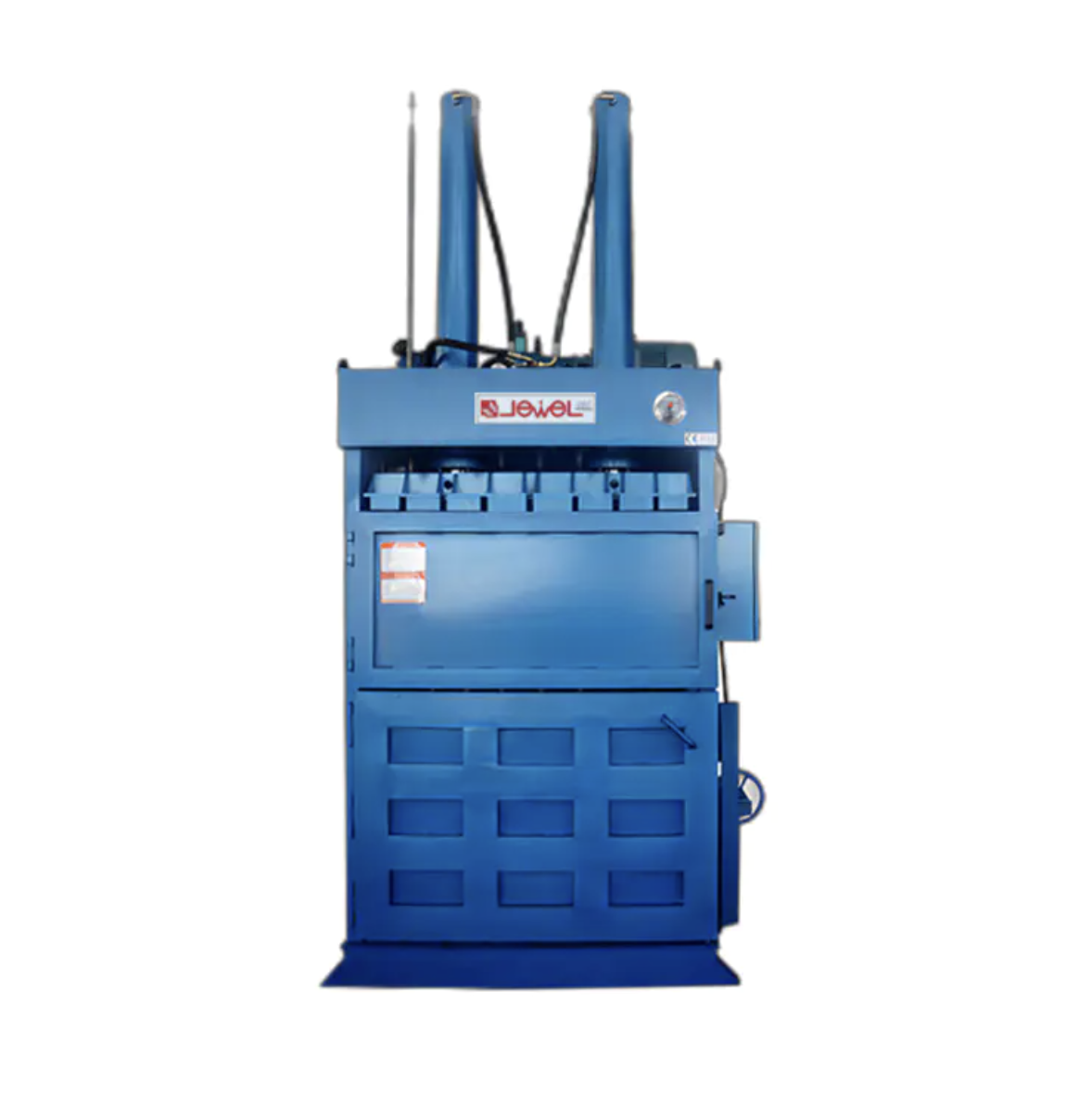
The JP-OT100 vertical hydraulic baler: 100-ton compression force, 1400 × 700 × (700–1100) mm bales, 400–600 kg bale weight, 5–6 bales per hour.
Reading the Range Against Real Waste Streams
The reference set is easier to judge against documented project conditions than against a generic material list.
In Tunisia, a corrugated carton printing and packaging operation used the JPW20Q within an intelligent automatic waste cardboard recycling and baling line. The project brief called for factory-wide planning and efficient pre-processing, with the machine operating automatically in a waste discharge workshop and relying on a conveying system to remove scrap from corrugator and printing lines. That is a full-automatic horizontal application where the baler is one component of a handling system, not a stand-alone unit.
In Mexico, a comparable corrugated carton and mixed solid waste project used the JP-OT100 vertical baler for whole-plant integration, high-efficiency automation and clean operation in a waste removal workshop, again with a conveying system. The vertical format suits sites where floor area is constrained and bales can be removed vertically rather than pushed horizontally.
A packaging and carton manufacturing project in Russia used the JPW-K6046 bagging machine in a full-automatic unmanned waste baling system, in which the equipment is connected to production lines for automatic collection, compression and baling of carton scrap. The case demonstrates the same supplier covering a third format alongside horizontal and vertical machines.
In Japan, a PET plastic recycler processing waste bottles in a high-dust environment required a solution that could raise compression density and produce compact, aesthetically uniform bales. This is the classic low-density problem: PET bottles resist compaction, and a machine selected purely on force without reference to chamber design and binding often produces bales that rebound during stacking.
In Australia, a comprehensive solid waste recycler handling mixed plastics, small amounts of glass and metal scrap specified compression stability and durability as the primary criteria, with a conveying system feeding the baler. In Italy, a carton manufacturer replacing ageing equipment integrated shredding with compression to handle large-format waste cardboard.
Read together, these projects show the same evaluation pattern: material, feed method, bale handling and automation level are specified first; the model is chosen to fit them. A supplier with one format can only serve one pattern.
Acceptance Terms That Carry the Longest Cost
Acceptance terms are where model breadth converts into a workable long-term relationship — or fails to. The following checkpoints are worth fixing in writing before an order is placed.
Voltage and electrical configuration. Confirm the exact voltage, frequency and control configuration for the destination site. Because voltage is customizable across the Jewel range, the acceptance document should state the agreed value rather than referencing the general capability.
Certification evidence. The fully automatic horizontal baler JPW20Q holds CE certificate TTC-22-1609/01/01, complying with EN ISO 12100:2010 and EN 60204-1:2018. Buyers in the EU should specify which certificate applies to the exact model and configuration being purchased, and request the document as part of the acceptance package rather than accepting a general conformity statement.
Bale dimension and weight tolerance. Declared bale sizes are nominal. The acceptance term should define the measurement method and an acceptable deviation for the buyer's downstream handling equipment.
Material test protocol. Agree in advance which materials will be used for the trial run — for example carton trim, PET bottles, textile offcuts or aluminium foil scrap — and how throughput will be verified against the declared figure, whether in tons per hour or bales per hour.
Discharge and binding verification. For a semi-automatic horizontal machine such as the JPW40F, confirm whether continuous push-pack discharge and four strapping channels match the buyer's stacking and transport method. For a vertical unit, confirm the extraction method for 400–600 kg bales.
Documentation and training. Specify the language of manuals, the electrical drawings to be supplied, and the scope of operator training included in delivery.
Spare parts and wear items. Request a parts list with the initial order so that consumables can be stocked locally rather than imported per failure.
Capacity commitment. Company-published material states a monthly production capacity of 100 hydraulic baler units and a minimum order quantity of one unit. For buyers planning a phased rollout across several sites, that published capacity is a useful reference point when discussing delivery sequencing.
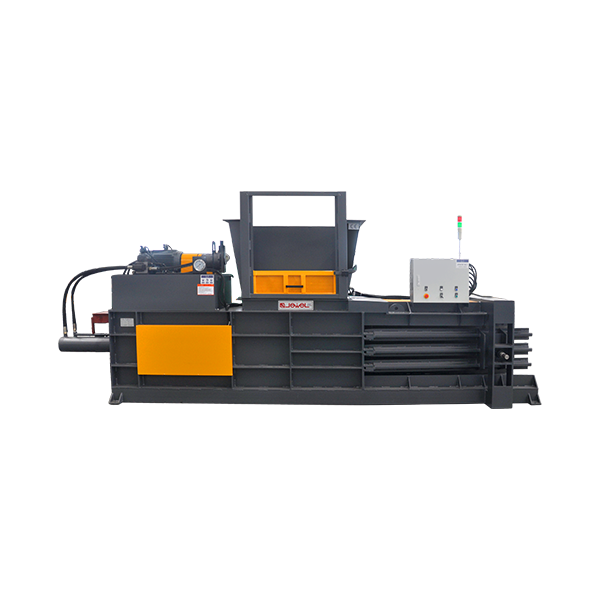
The JPW40F semi-automatic horizontal hydraulic baler: 40-ton force, 1–2 t/h baling capacity, 720 × 720 × (500–1300) mm bales, four strapping channels.
Where Breadth Stops Helping
A longer model list does not remove engineering limits, and buyers should be explicit about them.
The JPW20Q is the lowest-force model in this reference set. At 20 tons of compression force and 30–70 kg bales, it is built for continuous paper, carton and light plastic duty inside a production environment. It is not a substitute for a high-force machine when the material is dense metal or thick-walled containers.
The JPW40F requires operator involvement. It is a semi-automatic horizontal baler with a declared capacity of 1–2 tons per hour. Sites planning unmanned operation should treat it as a stepping stone rather than an endpoint.
The JP-OT100 trades throughput for footprint. It produces 5–6 bales per hour at 400–600 kg per bale, with a machine weight of 3,500 kg and a compression chamber of 1400 × 700 × 1700 mm. That suits space-constrained sites and moderate volumes; it is not a continuous high-throughput horizontal replacement.
The JPW-AK100 specification is incomplete in the available material. The published fields list carbon steel construction, 380V/50Hz rated voltage, a net weight of 2,600 kg and overall dimensions of 4000 × 920 × 1350 mm. Compression force, bale dimensions and bale weight are not listed. A buyer evaluating this model for aluminium foil scrap must obtain those figures in writing; inferring them from the model name or from other machines in the range would be a specification error.
The JPY-T60W serves a narrow metal band. At 60 tons, 0.5–1 ton per hour and 15–20 kg bales with a 430 × 280 mm cross-section, it fits small and medium metal volumes. High-volume scrap yards operate well outside that envelope, and its 60–600 ton stated scope describes the broader metal platform rather than this specific unit.
Breadth is not integration. In every referenced case — Tunisia, Mexico, Russia, Australia — a conveying system was a required supporting component. The baler supplier's range does not by itself deliver a complete waste removal line, and the boundary of supply should be written into the acceptance terms.
Market Direction and What It Means for Supplier Choice
The direction of the category favours suppliers who can be re-specified rather than replaced. Automation is moving from optional to expected in packaging and recycling plants; multi-material sites are consolidating equipment to reduce investment; and electrical configuration is increasingly a market-access issue rather than a technical footnote.
The manufacturing base behind the Jewel range illustrates the scale that supports this kind of continuity. Nantong Jiabao Machinery Co., Ltd. operates a 50,000 square metre facility with approximately 200 staff, including an R&D team of 30 engineers, and an annual production capacity of 120,000 units. Export activity accounts for 70% of sales, with Australia, Europe, North America, Africa, Asia, Russia and Belarus listed as major markets — a distribution profile that implies familiarity with more than one electrical standard and more than one material mix.
For a buyer, the useful conclusion is not that breadth guarantees performance. It is that breadth, when documented consistently and backed by acceptance terms, shortens the distance between the current machine and the next one.
Frequently Asked Questions
What does model breadth mean when evaluating a hydraulic baler supplier?
Model breadth refers to the number of distinct compression formats a supplier offers — vertical, semi-automatic horizontal, fully automatic horizontal, metal, briquetting or bagging — and the consistency of specification language across them. It is a measure of whether the supplier can be re-specified for a different waste stream, not a count of catalogue entries.
Which models should be compared to judge whether a supplier covers changing waste streams?
A practical reference set includes at least one vertical, one semi-automatic horizontal, one fully automatic horizontal, one light-material or foil unit and one metal unit. For the Jewel range, that set can be built from the JP-OT100, JPW40F, JPW20Q, JPW-AK100 and JPY-T60W.
Which acceptance terms should be agreed before delivery?
Voltage and electrical configuration, applicable certification documents for the exact model, bale dimension and weight tolerances, the material test protocol and throughput verification method, discharge and binding confirmation, documentation and training scope, and a spare parts list. Capacity and delivery sequencing should also be stated where a multi-site rollout is planned.
What is the difference between the JPW20Q and the JPW40F?
The JPW20Q is a fully automatic horizontal baler with 20 tons of compression force, 500 × 500 × 500 mm bales of 30–70 kg and a 7.5 kW motor. The JPW40F is a semi-automatic horizontal baler with 40 tons of force, 720 × 720 × (500–1300) mm bales of 200–400 kg, an 11 kW motor, four strapping channels and a declared capacity of 1–2 tons per hour.
Can the voltage on Jewel hydraulic baler machines be customized?
Yes. Voltage is listed as customizable on the models where the field is published, with 380V/50Hz stated for the JPW20Q, JP-OT100, JPW-AK100 and JPW40BL, and 220V/50Hz for the JP7050T8. The agreed value should be confirmed on the order document for each destination site.
Which model in the reference set is intended for metal scrap?
The JPY-T60W is classified as a metal baler, with 60 tons of compression force, a 900 × 430 mm feed opening, 430 × 280 × (150–250) mm bale cross-sections, 15–20 kg bales and a capacity of 0.5–1 ton per hour.
The full Jewel compression and baling equipment range, including model specifications and application notes, is documented in the company brochure available here: Jewel product brochure (PDF).
Have Questions or Need More Details?
Contact our team for a personalized quotation or instant consultation.
Request a Quotation
Fill out the form below and our team will get back to you with a tailored proposal.
WhatsApp Direct Chat
Prefer to chat in real-time? Message us on WhatsApp for instant assistance & quick answers.
- Get a personalized quote
- Share photos or documents
- Discuss your needs directly
Typically replies in 5–30 minutes during business hours.