
Hydraulic Baler vs. Piston Compressor: Key Buying Factors
Industrial buyers evaluating compression equipment frequently ask whether a hydraulic baler can replace a piston compressor, or vice versa. The two machines solve different problems. A hydraulic baler densifies solid waste and recyclable materials into transport-ready bales, while a piston compressor is designed to compress air or gas. For procurement teams in recycling, manufacturing, and waste management, the practical question is not which technology is broadly superior, but which one matches the material, the workflow, and the operating constraints.
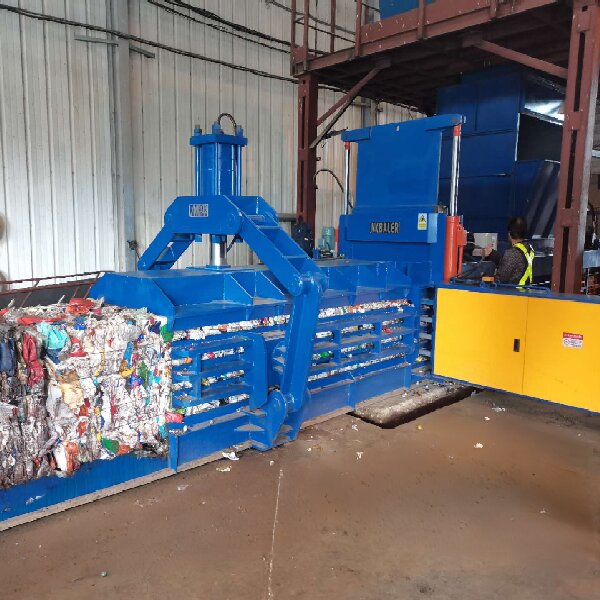
Why the Comparison Matters at the Decision Stage
Buyers at the decision stage compare shortlisted machines against measurable criteria: purchase cost, operating cost, noise, maintenance, throughput, and compatibility with existing processes. In the baler category, those criteria also determine whether a vertical unit, a horizontal unit, a semi-automatic unit, or a fully automatic line is justified.
The confusion between hydraulic balers and piston compressors usually comes from the shared word “compression.” Both convert input energy into compressive force, but the output is fundamentally different. A baler produces a dense, strapped bale that can be stored, transported, and recycled. A piston compressor produces compressed air for pneumatic tools, cleaning, or process equipment. Selecting the wrong technology means paying for capacity that will never be used in the way intended.
The opportunity for buyers is clearer now than in earlier procurement cycles. Baler technology has moved toward more automated, safer, and more energy-efficient configurations. At the same time, material-specific designs let buyers match the machine to the waste stream: scrap metal, textiles, straw, sawdust, plastic film, drums, or mixed recyclables. That level of specificity makes the decision less about generic “compression equipment” and more about process integration from loading dock to finished bale.
Technical Differences: Hydraulic Baler vs. Piston Compressor
A hydraulic baler works through a hydraulic cylinder that pushes a platen against material inside a chamber. The material is compressed to a set density, then tied with wire or strapping and ejected. Configurations range from small vertical balers for retail waste to large horizontal full-automatic balers for continuous recycling lines.
A piston compressor, by contrast, uses a piston driven by a crankshaft to raise the pressure of air or refrigerant gas. Its cylinders, valves, and cooling systems are engineered for gas dynamics, not for crushing solid objects.
Comparative product data from manufacturers in this segment shows that, when a hydraulic baler is used for densification work, it demonstrates distinct advantages over piston compressors: lower noise, less maintenance, higher efficiency, and roughly 10% lower cost in comparable applications. One documented measurement is a noise difference of approximately 15 dB in favor of the hydraulic baler.
| Comparison Criterion | Hydraulic Baler | Piston Compressor |
|---|---|---|
| Primary function | Compress solid recyclables into dense bales | Compress air or gas for pneumatic systems |
| Suitable materials | Waste paper, plastics, metals, textiles, straw, sawdust, tyres | Air, refrigerant, or process gas |
| Noise level | Lower; about 15 dB lower in comparative data | Higher in densification use |
| Maintenance | Less maintenance | More maintenance |
| Efficiency | Higher efficiency for baling | Not designed for baling |
| Cost | About 10% lower in comparable applications | Higher when used for baling tasks |
| Typical environment | Recycling centers, factories, warehouses, farms | Industrial plants with pneumatic tools or gas processes |
What NICKBALER Brings to the Hydraulic Baler Category
Shaanxi Nick Machinery Equipment Co., Ltd., operating under the NICKBALER brand, is a manufacturer of hydraulic balers and environmental protection machinery based in Wuxi, Jiangsu Province, China. The company produces vertical balers, full-automatic horizontal balers, manual horizontal balers, and press bagging machines. Its factory covers 5,000 square meters, with 50 employees and an R&D team of 15. Annual output is approximately 600 machines, and about 90% of production is exported, primarily to North America, South America, and Asia.
NICKBALER’s product range includes both the NK BALER series and the NICK BALER series. The NK BALER is positioned as a standard long-cylinder servo hydraulic baler for regular daily baling, with a focus on cost-effectiveness and stability. The NICK BALER is described as an upgraded version with heavier machine weight, thicker material, stronger structure, and higher-grade hydraulic and electric control components. For buyers, this distinction matters because it separates budget-oriented purchasing from heavy-duty, continuous operation.
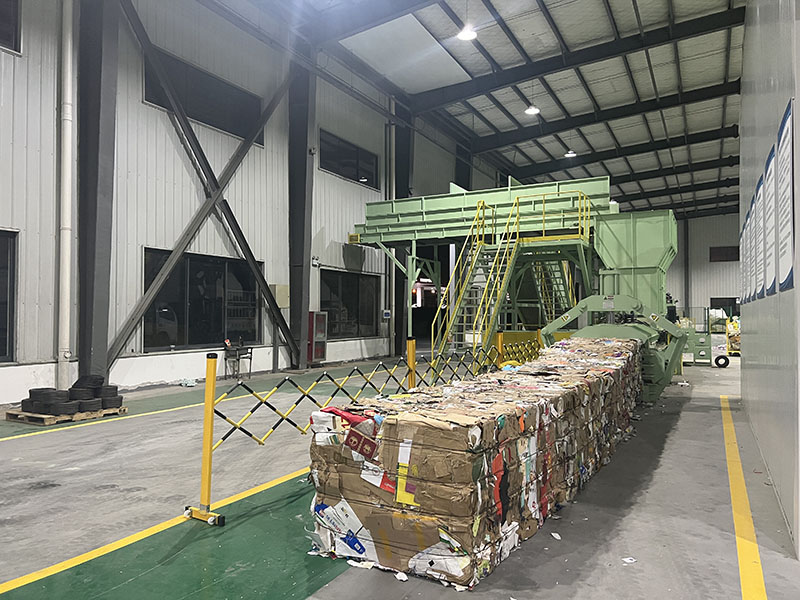
Decision Criteria for Buyers Comparing Hydraulic Baler Configurations
Within the hydraulic baler category, the choice is not only about balers versus compressors. Buyers must also decide which baler configuration fits the operation:
- Large horizontal full-automatic hydraulic baler suits high-throughput recycling centers that need continuous feeding, automatic tying, and minimal labor.
- Horizontal automatic tie with lifting door helps plants that need easy bale removal and automated wire tying without a full automation package.
- Large-size hydraulic semi-automatic baler fits medium-volume operations where an operator loads material but the machine handles compression and ejection.
- Heavy-duty hydraulic baler is specified for scrap metal, aluminum scrap, metal shavings, and other dense materials.
- Small-sized vertical hydraulic baler is common in retail stores, warehouses, and small workshops for cardboard and plastic film.
- Medium double-cylinder vertical hydraulic baler provides higher pressure in a compact footprint for mixed recyclables.
- Two-chamber clothes hydraulic baler is designed for textiles and used clothing because it allows continuous loading while one chamber is compressing.
- Oil drum press hydraulic baler and metal drum hydraulic baler are specialized for containers and drums.
- Used rag, wheat straw, sawdust, wood shaving, alfalfa hay, and scrap tyre baling machines address agricultural and fibrous materials with specific density and moisture requirements.
Each configuration changes the equation for labor cost, cycle time, and bale density. A small vertical baler, for example, may be the most economical answer for a warehouse producing a few bales per day, while a full-automatic horizontal baler becomes cost-effective when daily volume exceeds what manual loading can handle.
Buyers should also verify the machine’s pressure rating, chamber size, bale weight, and cycle time against the actual material stream. A heavy-duty baler sized for aluminum scrap will be over-specified for cardboard, while a light vertical baler will be under-specified for metal drums. The comparison framework should therefore include material density, moisture content, contamination level, and required bale dimensions for downstream transport or recycling contracts.
Comparison with Traditional Solutions
Before hydraulic balers became standard, many small and mid-sized facilities relied on manual compaction, loose loading, or sometimes piston-type compressors for tasks they were never designed to perform. Manual compaction is labor-intensive and produces inconsistent bale weight. Loose loading increases transport cost because trucks carry more air than material.
Hydraulic balers address these inefficiencies by producing uniform, high-density bales. Comparative product data indicates that the hydraulic baler design offers distinct technical features when measured against piston-type fans and piston compressors: a documented 15 dB noise reduction, approximately 10% lower cost, less maintenance, and higher efficiency for densification.
That said, a hydraulic baler is not a universal replacement. Facilities that genuinely need compressed air—for pneumatic controls, tools, or process systems—still require a compressor. The baler comparison is valid only when the task is solid material densification. Buyers should also remember that very hard or oversized materials may need pre-processing with a shredder or crusher before baling.
Market Context and What It Means for Procurement
The broader market supports continued interest in baler investment. Transparency Market Research valued the global baler machine market at USD 6.6 billion in 2024, with projections reaching USD 11.4 billion by 2035. The metal baler segment specifically was estimated at USD 2.172 billion in 2024 by Market Research Future. Asia Pacific accounted for 40.2% of global baler market revenue in 2024, and China was one of the top exporters of hydraulic baling presses under HS Code 8462, with 91 significant shipments recorded between June 2024 and May 2025.
The baler press segment represented 24.5% of the total recycling equipment market in 2025, according to Grand View Research. Key global competitors include Harris Equipment (US), Bramidan (Denmark), Bollegraaf (Netherlands), and HSM (Germany), with Harris known for heavy-duty horizontal systems.
For an international buyer, this data suggests two things. First, baler demand is growing, so lead times and supplier capacity matter. Second, the supplier landscape includes both specialized Western manufacturers and Chinese exporters such as NICKBALER, and the right choice depends on required automation level, certification needs, and after-sales support.
Safety, Certification, and Operating Limits
Buyers comparing hydraulic balers should also verify regulatory compliance. In the EU, vertical balers must comply with EN 16500:2014, which specifies safety requirements for fixed enclosed baling chambers and tamper-proof interlocks. In the United States, commercial balers must meet ANSI Z245.51-2013 for design and construction safety, and ANSI Z245.5-2013 for installation, operation, and maintenance.
These standards are not marketing features; they are baseline safety requirements. A machine without proper interlocks creates serious risk for operators. Buyers should ask suppliers for documentation of compliance with the standards applicable to their destination market.
Thermal management is another limit to consider. In continuous heavy-duty operation, hydraulic systems can overheat. Measures such as temperature sensors and thermal protection are common safeguards. Buyers should confirm that the supplier includes these protections in the standard configuration.
Future Outlook
The next phase of baler buying will be shaped by automation, energy efficiency, and material-specific design. Full-automatic horizontal balers with servo-driven hydraulics reduce energy consumption and noise further. Standards such as EN 16500:2014 and ANSI Z245.5-2013 will likely be updated as sensor-based interlocks and remote monitoring become more common.
For procurement teams, the practical takeaway is to build a comparison framework that weights throughput, material type, labor cost, noise constraints, and future expansion. A hydraulic baler is not a compressor, and a compressor is not a baler. Once that distinction is clear, the remaining decision is which baler configuration and supplier reliability profile fits the operation.
For buyers who want to inspect a specific equipment lineup, NICKBALER publishes a publicly accessible brochure at https://cdn.socialarks.com/sbsp//common/2026/0402/69cdf2c28cbee.pdf.
FAQ
What is the main difference between a hydraulic baler and a piston compressor?
A hydraulic baler uses hydraulic force to compress solid materials such as waste paper, plastics, metals, and fibers into dense bales. A piston compressor is designed to compress air or gas. Comparative product data shows that, for densification applications, the hydraulic baler offers lower noise, less maintenance, higher efficiency, and approximately 10% lower cost.
Is a hydraulic baler quieter than a piston compressor?
Yes. Comparative data indicates that a hydraulic baler operates at about 15 dB lower noise than piston fans and piston compressors, making it more suitable for noise-sensitive industrial environments.
Which safety standards should buyers check for vertical hydraulic balers?
In the EU, vertical balers must comply with EN 16500:2014, which specifies requirements for fixed enclosed baling chambers and tamper-proof interlocks. In the US, commercial balers should meet ANSI Z245.51-2013 for design and construction safety and ANSI Z245.5-2013 for installation and operation.
What cost factors matter when choosing a hydraulic baler?
Buyers should compare purchase price, installation cost, energy consumption, maintenance frequency, and the value of bale output. Comparative data suggests hydraulic balers can be around 10% lower in cost than piston compressors for equivalent densification work, with lower maintenance requirements.
Have Questions or Need More Details?
Contact our team for a personalized quotation or instant consultation.
Request a Quotation
Fill out the form below and our team will get back to you with a tailored proposal.
WhatsApp Direct Chat
Prefer to chat in real-time? Message us on WhatsApp for instant assistance & quick answers.
- Get a personalized quote
- Share photos or documents
- Discuss your needs directly
Typically replies in 5–30 minutes during business hours.