
Hydraulic Cylinder Shortlist for Dump Trailers, Tippers and Hoists
Mobile hydraulic applications, including construction and agricultural equipment, account for 51.8% of global hydraulic cylinder demand. Inside that demand sits a familiar engineering decision: a dump trailer, tipper truck or hoist system is only as reliable as the cylinder matched to its body geometry, load curve and available installation space.
This reference shortlists seven cylinder options that appear repeatedly in trailer, tipper and hoist projects - underbody telescopic, front-end telescopic, single-acting telescopic for dump trucks, inverted telescopic, scissor hoist kits, 12K hydraulic trailer jack kits and roll-off hoist cylinders - and explains how each is matched to motion requirements, load profiles and installation constraints. Apex Hydraulic Co., Ltd., a Chinese hydraulic cylinder and power unit manufacturer established in 2009, operates a 50,000 m2 facility with an annual output of 100,000 cylinders and a 25-engineer R&D team; the catalogue ranges below are drawn from its documented product data.
Why the Cylinder Defines the Tipping System
A tipping or hoisting cylinder is not a standalone part. It sets the working stroke, the retracted length that must fit under or in front of the body, the force curve across the lifting cycle, the mounting interface and the maintenance path. Change the cylinder family and the body structure, hinge position, hose routing and power unit usually change with it.
The duty environment is part of the specification too. An underbody telescopic cylinder on a tipping trailer operates where installation space is limited and is exposed to mud, moisture, dust, vibration and road contamination; it requires a compact closed length and resistance to mud, water, fertilizer, road salt and agricultural chemicals. A roll-off hoist cylinder faces a different regime: frequent extension and retraction under shock loads and pressure spikes, with resistance to side loading caused by uneven container alignment.
Neither environment is served by choosing a cylinder on rated capacity alone. The shortlist below is therefore organised by application geometry first, then by load and installation data.
The Shortlist: Seven Options for Dump Trailers, Tippers and Hoists
The table summarises documented catalogue ranges for each option family. Ranges describe coverage, not a selection: final selection must be verified against trailer dimensions, payload and mounting position.
| Option | Motion type | Typical position | Documented range | Best-fit equipment |
|---|---|---|---|---|
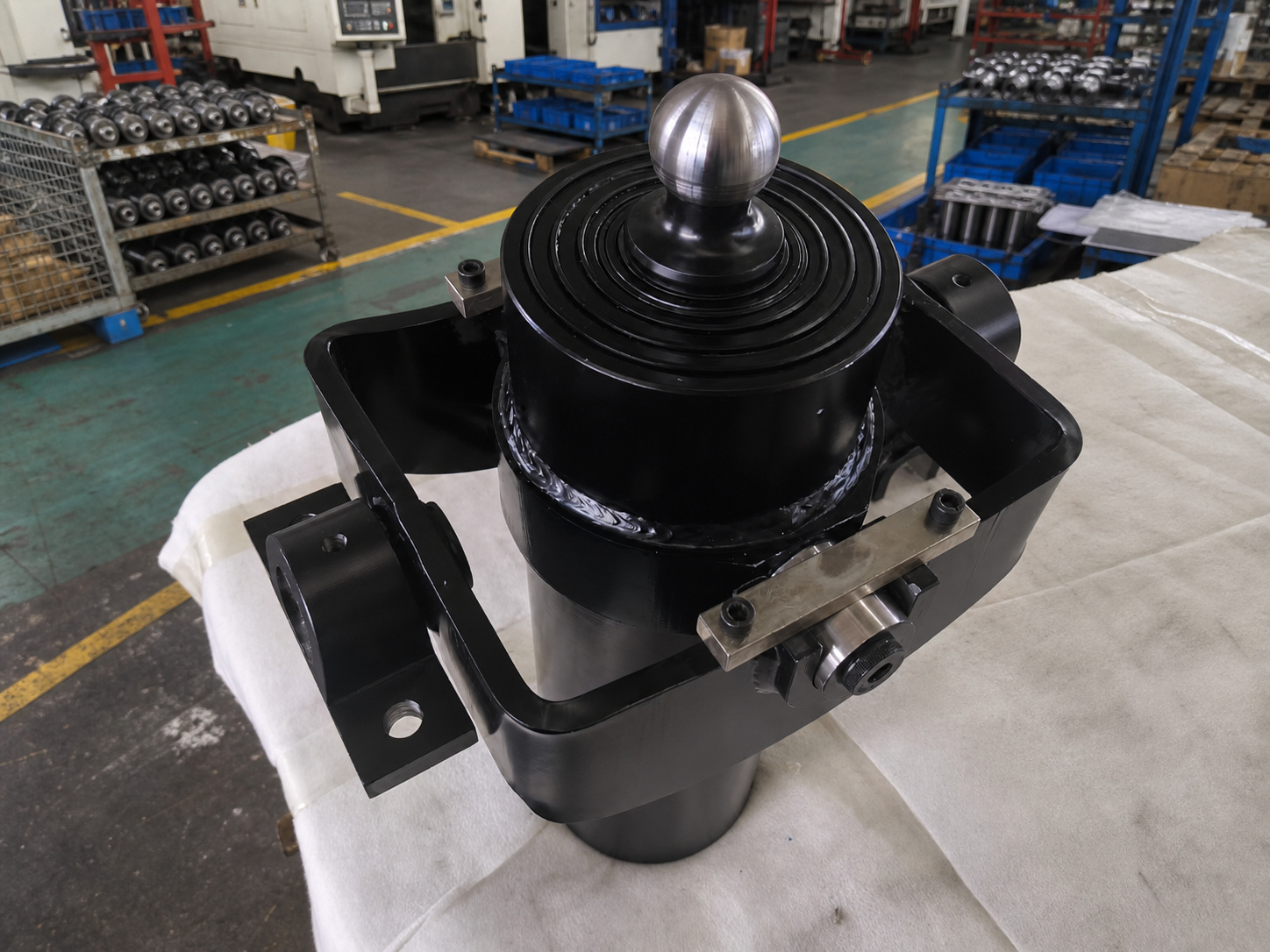
| Underbody telescopic cylinder (L120 / L105 / L90 / L75) | Single acting, gravity return, hydraulic extension | Under the trailer body, transverse pivot / trunnion | 3-6 stages; stroke 676-2,057 mm; 200-220 bar; tipping capacity 4-21 t; closed length 367-598 mm | Dump trailers, agricultural tipping trailers, landscaping trailers |
| Front-end telescopic cylinder (FC / FE / FEE Alpha) | Single acting, gravity and body-load return | Front of the tipper body | 3-6 stages; first-stage diameter 118-191 mm; FC stroke 3,880-8,130 mm; up to 250 bar; catalogue lifting capacity 5-100 t | Tipper trucks, tipper semi-trailers, aggregate haulers |
| Single-acting telescopic dump truck cylinder (S Series) | Single acting, gravity or external load return | Pin-mounted base and plunger end | 2-5 stages; sleeve diameter 1.75-14.00 in; general stroke 36-500 in; 2,000 PSI nominal; dump angle 45-57 degrees | North American dump trucks, quarry and aggregate hauling |
| Inverted telescopic cylinder (HTC-compatible) | Single acting, gravity return | Front-mounted between trailer frame and body | 7 t / 12 t; stroke 78-144 in; retracted 34.75-48.75 in; 3,000 PSI; oil capacity 1.6-3.8 US gal | North American dump trailers |
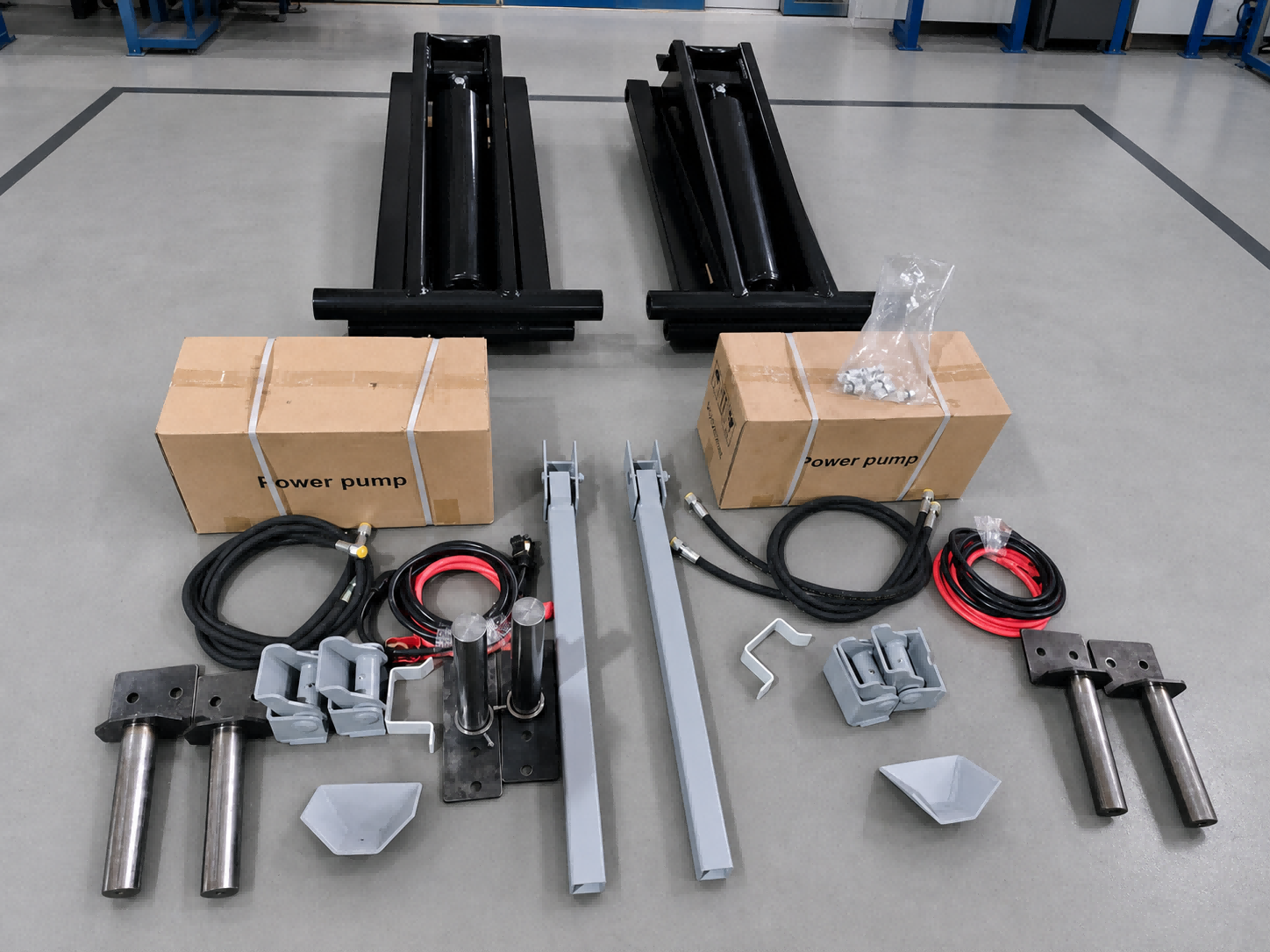
| Hydraulic scissor hoist kit (PH310 to PH625) | Double acting | Underbody scissor frame with rear hinge | 3-12 t (6,000-26,000 lb); 8-24 ft bodies; cylinder 3.5-6.5 in; stroke 10-30 in | Dump trailers, dump-bed conversions, equipment rental fleets |
| 12K hydraulic trailer jack kit (PJS / PJD) | Double acting, powered raise and lower | Trailer-frame-mounted landing leg | 12,000 lb per jack; 20 in travel; 3,200 PSI maximum; 12 VDC; 3/8 in BSPP ports | Gooseneck, flatbed, equipment and livestock trailers |
| Roll-off hoist cylinder | Double acting | Pin-eye or pivot mounting on the hoist frame | Bore 3-7 in; stroke 17-74 in; rod 1.5-2.5 in; lift/dump 4-7 in bore, 52.38-74 in stroke | Cable-hoist and hooklift roll-off trucks, waste containers |
Matching Each Option to Motion Requirements
Return method decides the hydraulic circuit
Four of the shortlisted options are single acting and retract by gravity or external load: the underbody telescopic family, the front-end telescopic family, the S Series dump truck cylinder and the inverted telescopic cylinder. Retraction occurs when the directional valve releases oil and the body's own weight returns the cylinder. This simplifies the circuit but makes the return dependent on body weight, hinge geometry and correct valve operation.
The remaining three are double acting. Scissor hoist kits can be configured power-up/power-down or power-up/gravity-down depending on the power unit; the 12K trailer jack provides powered raising and powered lowering through a double-acting hydraulic power unit; and roll-off hoist cylinders are double acting with counterbalance valve configurations available for lift, dump, jib and tilt functions.
Stroke and closed length set the installation envelope
- Underbody telescopic cylinders deliver 676-2,057 mm of power stroke from a closed length of 367-598 mm, which is why they suit trailers with limited underbody space.
- Front-end telescopic cylinders deliver much longer strokes - 3,880-8,130 mm for the listed FC reference models and 3,880-7,130 mm for the listed FE models - because the cylinder works in front of the body rather than beneath it.
- Inverted telescopic cylinders cover 78-144 in of stroke with a retracted length of 34.75-48.75 in for front-mounted trailer installation.
- S Series dump truck cylinders use 2-5 moving stages, with 72-265 in of stroke in current stocking models within a general 36-500 in stroke range.
Stage sequence and stability
Telescopic cylinders extend largest stage first and retract smallest stage first. Each stage's output force is calculated separately, and the load curve has to be evaluated across the complete tipping cycle rather than at a single point. Stage overlap is engineered to maintain structural stability and guide support - a design detail that matters because telescopic cylinders must be protected from excessive side loading.
Matching the Load Profile, Not Only the Rated Capacity
Rated capacity is a starting point, not a selection. For scissor hoist kits, capacity is not the same as trailer payload capacity: final selection must consider dump-body length, rear overhang, hinge location, desired dump angle, hoist mounting position, hydraulic pressure, trailer GVWR, axle rating, tire rating and frame strength.
The same discipline applies to telescopic options. The L Series spans 4-21 t of tipping capacity across four families: L120 at 7-21 t, L105 at 5-18 t, L90 at 4-14 t and L75 at 4-9 t. Front-end telescopic cylinders are quoted at 33-79 t for the listed FC models and 30-61 t for the listed FE models, within an overall front-end catalogue range of 5-100 t.
Roll-off hoist cylinders illustrate why system pressure must be confirmed rather than assumed. Published references in the documented product data include 1,850 PSI for the Galbreath U5-OX system and 4,200 PSI for the Stellar Shuttle32 system - a wide spread that means working pressure must be verified for each hoist model and cylinder function before production.
Installation Constraints That Usually Decide the Shortlist
Geometry filters the shortlist faster than capacity does.
- Underbody space. Transverse pivot or trunnion mounting under the body requires clearance from axles, chassis members and hydraulic hoses. An articulated upper ball allows up to 30 degrees of angular movement during tipping, and a rod eye with pin is available as an alternative connection.
- Front-end mounting style. FC cylinders use a cover-type or trunnion-type arrangement, typically with a straight headboard; FE and FEE cylinders use eye-type and pin-type connections, typically with a slanted headboard.
- Jack mounting. The 12K trailer jack is designed for trailer-frame-mounted landing leg installation, with a maximum permitted distance of 8 in between the ground and the bottom of the trailer frame, a mounting plate of approximately 5.53 in x 5.53 in, and hydraulic ports of 3/8 in BSPP.
- Roll-off interchangeability. Mounting pin diameter, mounting width, port type and port position are reproduced from the confirmed equipment configuration, with an approved production drawing required before manufacturing.
Application Evidence from Trailer and Tipper Programs
Two documented projects show how the shortlist translates into volume production. For a dump trailer manufacturer in Canada, 1,200 sets of HTC-series telescopic cylinders and 500 sets of hydraulic power units were supplied over a one-year project for front-mounted trailer lifting systems used in construction materials, agriculture, landscaping and bulk material transportation. Reported outcomes were smooth lifting performance, a stable dumping angle and reduced service downtime.
For a heavy-duty dump truck OEM in Indonesia, 180 multi-stage telescopic cylinders were supplied over a two-year project for trucks working in construction, mining and aggregate transportation. The cylinders addressed reliable lifting and operation under heavy loads, with durability reported under continuous heavy-load working conditions.
Where the Market Is Moving
Several published indicators explain why this shortlist keeps growing in relevance.
- The global hydraulic cylinder market was valued at USD 15.7 billion in 2024 and is projected to reach USD 24.7 billion by 2034 (Global Market Insights).
- Welded hydraulic cylinders held a 53.6% share of the product market in 2025, reflecting their use in heavy-duty applications (Grand View Research).
- Double-acting cylinders account for 71.6% of the function segment, while the telescopic cylinder segment generated USD 2,225.1 million in 2024 with a projected 5.9% CAGR.
- Mobile applications, including construction and agriculture, represent 51.8% of demand, and bore sizes up to 150 mm accounted for 61.6% of the market in 2025.
- Customisation and OEM services are described as a growing segment as industries shift toward specialised machinery.
Interchangeability standards continue to anchor procurement. ISO 6022:2006 defines mounting dimensions for 250 bar single-rod cylinders, ISO 6020-2:2015 covers 160 bar compact cylinder mounting dimensions, and NFPA/T3.6.7 R3-2009 (R2024) remains the North American reference for square-head industrial cylinder mounting dimensions. These standards matter when a trailer builder is matching a replacement cylinder to an existing structure.
Comparing the Options - and Where Each One Stops Working
Each option on the shortlist has a boundary condition worth stating before selection.
- Underbody telescopic vs scissor hoist. Telescopic cylinders suit trailers where geometry allows a vertical lifting arrangement and space beneath the floor is tight; scissor hoists suit 8-24 ft bodies and rely on a linkage that adds mounting brackets, hinges and pivot points to the system. The telescopic option introduces fewer moving assemblies; the scissor option provides mechanical leverage from a low-profile underbody installation.
- Front-end telescopic vs inverted telescopic. Front-end cylinders deliver the longest strokes and are positioned in front of the body, which requires headboard space and a suitable front bracket. Inverted telescopic cylinders suit North American dump trailers at 7-12 t with 78-144 in strokes, but their capacity ceiling is lower.
- Single acting vs double acting. Single-acting cylinders cannot power the retraction stroke; lowering depends on body weight, gravity and correct valve release. Where the mechanism must be driven down, held under load or controlled against gravity, a double-acting option such as a scissor hoist, trailer jack or roll-off cylinder is required.
- Rated capacity vs actual payload. A 12-ton hoist rating is not a 12-ton payload rating. Selection must account for GVWR, axle and tire ratings, rear overhang, hinge position and frame strength.
- Documented dimensions vs assumed dimensions. Roll-off hoist replacement work requires the original hoist model, part number, bore, rod, stroke, closed length, pin diameter, mounting width and port configuration; where a drawing or sample is unavailable, verification work is required before production.
Sourcing the Shortlisted Options
Supply terms matter as much as technical fit when a trailer line or fleet programme is being scheduled. For the ranges described here, standard products are quoted at 7-20 days delivery and customized products at 25-45 days, with large OEM project schedules agreed individually. The minimum order quantity for standard products is one piece; OEM and customized quantities are negotiable according to project requirements.
Manufacturing capacity is quoted at more than 8,000 hydraulic cylinders and more than 1,500 hydraulic power units per month across OEM manufacturing, ODM development, custom design and hydraulic engineering services. Quality control covers incoming material inspection, in-process quality control, final quality inspection, pressure testing, leakage testing, dimensional inspection, welding inspection, surface finish inspection and functional testing, with 100% final inspection before shipment. After-sales support includes technical consultation, engineering support, installation guidance, product documentation, spare parts supply and warranty support.
Future Outlook
The shortlist is unlikely to shrink. Mobile equipment demand continues to dominate cylinder consumption, telescopic cylinder demand is projected to grow at roughly 5.9% annually, and customisation is increasingly part of standard procurement rather than an exception. For trailer and tipper builders, the practical implication is that cylinder selection keeps moving earlier in the design process - matched to body geometry, hinge position and power unit configuration rather than treated as a catalogue substitution. Replacement and fleet programmes will continue to depend on verified dimensions, documented pressure ratings and traceable inspection, because those are the inputs that make an interchange decision defensible.
FAQ
How do I choose between an underbody telescopic cylinder and a scissor hoist kit for a dump trailer?
Start with the installation envelope. Underbody telescopic cylinders are designed for under-body installation with transverse pivot or trunnion mounting and provide 676-2,057 mm of stroke from a closed length of 367-598 mm, with tipping capacity from 4 to 21 tons across the L75 to L120 families. Scissor hoist kits are rated from 3 to 12 tons for dump bodies of 8-24 ft and convert cylinder force into body rotation through a linkage. Final selection must be verified against trailer dimensions, payload, hinge position and mounting space.
What is the difference between a front-end telescopic cylinder and an inverted telescopic cylinder?
Front-end telescopic cylinders mount at the front of the tipper body and are listed in FC, FE and FEE configurations with 3-6 stages, first-stage diameters of 118-191 mm and strokes up to 8,130 mm for the listed FC reference models, within an overall catalogue lifting capacity range of 5-100 metric tons. Inverted telescopic cylinders are front-mounted between the trailer frame and the dump body, rated at 7 or 12 tons with 78-144 in of stroke and a retracted length of 34.75-48.75 in. The two families serve different trailer classes rather than acting as direct alternatives.
Can a single-acting telescopic cylinder be used where powered lowering is required?
No. Single-acting telescopic cylinders extend hydraulically and retract by gravity or external load when the directional valve releases oil and the body weight returns the cylinder. Applications that require powered retraction, load holding or driven lowering need a double-acting arrangement such as a scissor hoist kit, a double-acting trailer jack or a double-acting roll-off hoist cylinder with an appropriate valve configuration.
What information is needed before a replacement roll-off hoist cylinder can be manufactured?
The documented requirement set includes the hoist manufacturer and complete hoist model, hoist serial number, original cylinder part number, cylinder function, photographs of the nameplate, cylinder, rod-end and base-end mounting, counterbalance valve and hydraulic port, plus bore diameter, rod diameter, stroke, closed and extended pin-to-pin lengths, mounting pin diameter, mounting width and port type and position. An original technical drawing or a physical sample shortens verification. Ranges may be quoted only from verified references, and an approved production drawing is required before manufacturing.
What lead time and minimum order quantity apply to standard and custom hydraulic cylinders?
Standard products are quoted at 7-20 days delivery and customized products at 25-45 days, with large OEM project schedules defined by the project. The minimum order quantity for standard products is one piece, while OEM and customized order quantities are negotiable according to project requirements.
Additional cylinder and power unit specifications, including model codes and dimensional data for each family, are compiled in the Apex Hydraulic main product catalog. Company information is available at www.hydraulicapex.com.
Have Questions or Need More Details?
Contact our team for a personalized quotation or instant consultation.
Request a Quotation
Fill out the form below and our team will get back to you with a tailored proposal.
WhatsApp Direct Chat
Prefer to chat in real-time? Message us on WhatsApp for instant assistance & quick answers.
- Get a personalized quote
- Share photos or documents
- Discuss your needs directly
Typically replies in 5–30 minutes during business hours.