
Hydraulic Hose vs Pipe: Wind Turbine Repair Sourcing Guide
When a hydraulic line fails on a wind turbine, the replacement decision does not begin with a brand name. It begins with a routing question: does this position need a flexible hose or a rigid pipe, and what pressure, temperature, bore and length does the circuit actually demand? For independent buyers - importers, fleet maintenance teams and industrial distributors who are not tied to an OEM parts account - that question has to be answered from published specifications rather than from a dealer relationship.
Tianjin Saintloga International Trade Co., Ltd. is a Tianjin, China-based supplier of wind turbine spare parts, founded in 2015, with approximately 42 employees, a 500-square-metre manufacturing facility, a 30-engineer R&D team and an annual production capacity of 100,000 units. Its catalogue covers wind turbine spare parts, Gamesa spare parts and Vestas spare parts, alongside wind turbine maintenance services and import and export trading services. One of its product lines covers hydraulic hose, hydraulic pipe and tube - the parts this comparison examines.
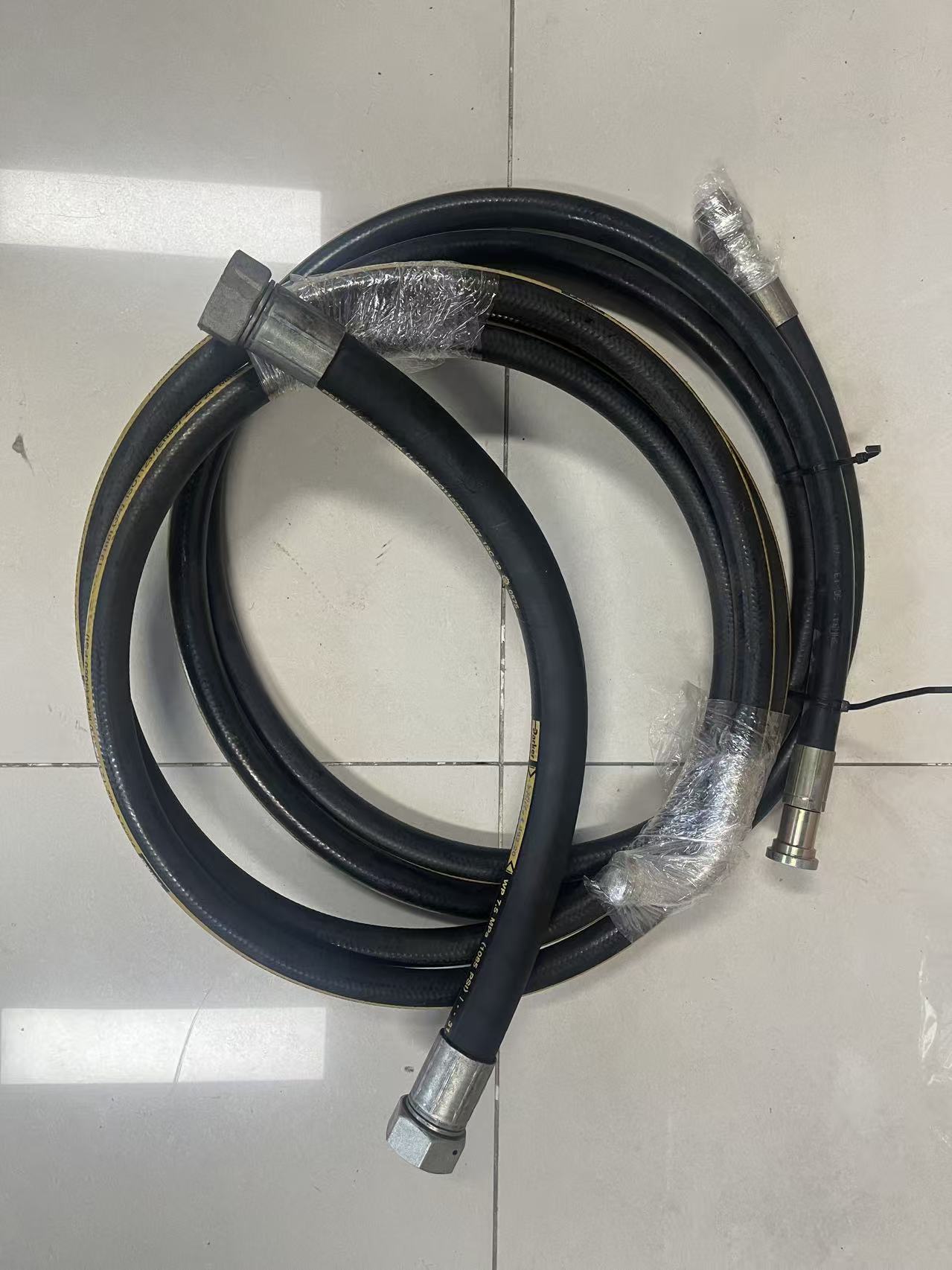
Why Hydraulic Lines Keep Appearing on Repair Lists
Hydraulic components on a wind turbine work continuously. The documented operating profile for wind turbine spare parts in this category is 24/7 duty under high and low temperature, high humidity and high altitude conditions, with offshore corrosion resistance and heat-and-cold resistance listed as special requirements. Hydraulic lines sit inside that profile: they carry fluid between pumps, valves, accumulators and actuators, and they inherit the same temperature swings, moisture exposure and vibration as the rest of the circuit.
They also sit inside a growing maintenance market. MarketsandMarkets valued the global wind turbine operations and maintenance market at USD 35.62 billion in 2024, with a projected CAGR of 8.5% through 2030. A rising O&M base means more replacement cycles, and hydraulic lines are among the parts that show up repeatedly because they are consumable in nature - deformed, abraded, aged or simply removed during a larger repair.
For buyers, the practical difficulty is not finding a supplier. It is deciding which of two routing approaches - flexible hose or rigid pipe and tube - the position requires, and then confirming that the quoted part carries the right specification rather than the closest available specification.
What the Documented Hydraulic Hose, Pipe and Tube Line Actually Covers
The first thing an independent buyer should notice is that Saintloga catalogues hydraulic hose, hydraulic pipe and tube as one line, identified by GP-prefixed model numbers. The published model list runs from GP000086, GP000568, GP000675, GP000676, GP000723 and GP000724 through to GP011140 and GP011141, with additional numbers such as GP003871, GP004123, GP005709, GP008979 and GP010609 in between.
The documented specification envelope for the line is summarised below. These are series-level figures taken from the published product data, not per-part ratings.
| Parameter | Documented value | What it means for a repair buyer |
|---|---|---|
| Product type | Hydraulic hose, hydraulic pipe, tube | One series covers both flexible and rigid fluid-carrying segments |
| Material | Composite material | Material suitability must be checked against the fluid and the environment |
| Working pressure range | 0-320 MPa | Portfolio envelope; confirm the circuit rating per position |
| Temperature range | -40°C to +125°C | Covers cold-start through hot-running conditions in wind farm duty |
| Hose size | DN4 to DN50 | Bore range; mapping to a specific port requires the turbine's parts list |
| Length | Customisable up to 60 m | Supports long routed runs and made-to-order assemblies |
| Application | Wind farm / wind turbine hydraulic systems | Specified for wind energy duty rather than general industrial use |
The most useful single fact in that table is the pressure band. A 0-320 MPa range is wide, and that width is exactly why an independent buyer cannot quote from the range alone. A low-pressure return line and a high-pressure actuator feed may both be serviced by this product line, but they will not use the same construction, the same bore or the same end fittings. The range tells you the supplier can cover the position; it does not tell you which part covers it.
How Independent Buyers Choose Between a Hose Route and a Pipe Route
The hose-versus-pipe decision is a routing decision dressed up as a parts decision. Both are documented in the same catalogue line, and both carry the same composite-material description, so the choice cannot be made from the model prefix alone. It has to be made from how the segment behaves in service.
| Evaluation criterion | Flexible hose route | Rigid pipe / tube route | Buyer check |
|---|---|---|---|
| Relative movement | Accommodates movement between components | Assumes fixed geometry between ports | Do the two connection points move relative to each other? |
| Vibration | Absorbs vibration along the run | Transmits vibration to supports and joints | What is the vibration environment at that position? |
| Installation tolerance | Tolerant of small alignment deviations | Requires accurate pre-forming and alignment | Can the position be measured precisely before ordering? |
| Routing space | Can be bent around obstacles | Follows a defined path with fewer supports | Is there room for controlled bending and support? |
| Abrasion and impact | Needs protection where it contacts structure | More resistant to external contact in fixed runs | What protects the line along its length? |
| Replacement logistics | Often supplied as a made-to-length assembly | Position-specific; geometry matters more | Is the original geometry documented? |
A practical sequence for an independent buyer looks like this:
- Identify the hydraulic function at that position and note whether the two endpoints move relative to one another. If they do, a flexible hose is the conventional answer.
- Record the circuit's rated pressure and compare it with the 0-320 MPa envelope. Select within the band, never at the edge of it.
- Confirm the temperature exposure against the documented -40°C to +125°C range. Positions close to hot components should be reviewed case by case.
- Determine the bore from the original part and check it falls inside the DN4 to DN50 range. Bore affects flow behaviour, so substituting a different diameter changes system behaviour even when the part physically fits.
- Measure or retrieve the required length. Length is customisable up to 60 m, which means length is a specification input, not a default.
- Match the GP model number to the turbine's bill of materials or hydraulic schematic before ordering, and treat composite material compatibility with the operating fluid as a separate confirmation step.
Where These Lines Are Used: Operating Conditions and Matching Equipment
The application data behind this product line is specific enough to be useful in a procurement discussion. The lines are intended for wind turbine parts projects in the wind power industry, operating in continuous 24/7 mode under high and low temperature, high humidity and high altitude conditions. Offshore corrosion resistance and heat-and-cold resistance are listed as special requirements.
The equipment they sit alongside is also documented: wind turbine control systems, generators, gearboxes, transformers and hydraulic systems. That list matters for independent buyers because hydraulic lines are rarely ordered in isolation. A repair that involves a hydraulic segment frequently touches a valve, a rotary joint or a hydraulic cylinder in the same work package.
Deployment is not limited to one market. The published scenario data lists wind power applications across Argentina, Bulgaria, Brazil, China, Germany and other markets, and Saintloga's stated export markets include Vietnam, Thailand, the Philippines, New Zealand, Indonesia, Spain, Brazil, India, Mexico, Russia and Turkey, with export business accounting for 65% of sales. For a buyer sourcing hydraulic lines across a multi-country fleet, that spread is relevant: it means the same product line is already being shipped into different climate and regulatory environments rather than being tailored to a single domestic market.
Market Signals Behind Independent Hydraulic Line Sourcing
Third-party market data supports the direction of travel, although buyers should read the numbers with the scope of each report in mind. Credence Research valued the global wind turbine components market at USD 135.33 billion in 2024 and projects it to reach USD 213.26 billion by 2032. That is a component-scoped figure. Mordor Intelligence publishes a broader overall turbine market figure of USD 169.3 billion for 2025. The two are not contradictory; they measure different things, and a procurement team comparing them should first check what each report includes.
On the demand side, the wind turbine operations and maintenance market - the segment that actually consumes replacement hydraulic lines - was valued at USD 35.62 billion in 2024 by MarketsandMarkets, with an 8.5% CAGR projected through 2030. Adjacent consumable categories show the same pattern: Dataintelo valued the carbon brushes for wind turbines market at USD 1.8 billion in 2025 and projects USD 3.2 billion by 2033.
Supply-side structure matters too. GWEC reported Vestas as the leading global wind turbine supplier in 2024, followed by Goldwind and Siemens Gamesa. In control and converter systems specifically, Ingeteam reported a 36.55% share of the US wind power sector as of 2024. What this means for an independent buyer is that a fleet is rarely single-platform. Hydraulic, electrical and control spares have to be sourced against several installed bases at once, which is one reason specification-led sourcing has become more common than platform-led sourcing in the aftermarket.
Comparing Procurement Routes - and Where the Documented Data Stops
Independent buyers generally weigh three routes for hydraulic lines, and each has a real trade-off rather than a clear winner.
| Route | Strength | Practical limitation |
|---|---|---|
| OEM parts channel | Direct alignment with the original bill of materials | Specification-level detail such as pressure, bore and material may not be published outside the OEM parts portal, which limits independent comparison |
| Independent specialist supplier | Published specification ranges, broad model coverage and cross-platform availability | Verification burden shifts to the buyer: the part number, construction and documentation must be confirmed per position |
| Generic industrial hose supplier | Wide availability of standard industrial hose | Wind-farm-specific requirements such as offshore corrosion resistance and heat-and-cold resistance may not be addressed by a general-purpose line |
Saintloga sits in the second category. The company supplies spare parts for Gamesa, Vestas, GE and other major platforms, and is listed as an authorised distributor for SGL Carbon and Ingeteam in China, specialising in spare parts for Gamesa and Vestas. Its wider portfolio illustrates how the hydraulic line fits into a repair package: valves in control, directional, proportional, safety and check configurations rated to 0-320 Bar and -40°C to 200°C; rotary joints and slip rings in both electric and hydraulic versions; yaw motors from Huali Motor and ABB Motor; gearboxes including yaw and Winergy types; KTR, Zero-Max and RegalRexnord couplings; carbon brushes from SGL Carbon; circuit breakers in FG001, FG002, FG005 and FG008 types; Ingeteam boards and CCUs; SEMIKRON SKiiP modules; and Phoenix PLCs in RFC 430 and RFC 470 models. Most of that portfolio is documented across a 850-5000 kW power range, which is the same band the hydraulic line serves.
The limitations of the independent route deserve equal weight. The published hydraulic data does not include a per-model pressure rating, a bend radius table, a fitting standard list or assembly test data. It also does not split the model list into hose versus rigid pipe. A buyer who needs those details must request them per project rather than assume them from the series description. On standards, industry references such as SGL Carbon note ISO 9001 and IATF 16949 as relevant for power transmission and safety reliability in wind turbine components; buyers should confirm which certificates a supplier can actually provide for a given order rather than treating a standard reference as a certificate.
Future Outlook: Documentation Becomes the Selection Criterion
As installed fleets age and the O&M market expands at the rate MarketsandMarkets projects, the hydraulic line decision will keep moving away from platform loyalty and towards specification matching. Two developments follow from that. First, suppliers who publish usable specification envelopes - pressure, temperature, bore, length and material - will be easier for independent buyers to shortlist, because those buyers can compare without contacting a dealer. Second, the buyer's own documentation discipline becomes the limiting factor: a supplier can only match a part when the buyer can supply the circuit pressure, the bore, the length and the original part number.
The most realistic expectation for the next phase is not a single route winning. It is a split model, where OEM channels continue to serve warranty and traceability-critical positions, while specification-documented independent lines handle planned maintenance, multi-platform fleets and positions where the original part can be measured and verified directly. For hydraulic hoses, pipes and tubes, that split already exists in the catalogue structure itself: one series, two physical approaches, and a decision that still has to be made position by position.
FAQ
What is a hydraulic hose and pipe in a wind turbine spare parts context?
In Saintloga's catalogue, hydraulic hose, hydraulic pipe and tube are grouped under a single product line identified by GP-prefixed model numbers such as GP000086, GP000568 and GP000675. The line is documented as being made of composite material and intended for wind farm applications. Functionally, these parts replace the fluid-carrying segments of a turbine's hydraulic circuit during maintenance or repair work.
What specifications should an independent buyer compare before ordering a hydraulic line?
Five documented parameters matter most: working pressure range of 0-320 MPa, temperature range of -40°C to +125°C, hose size range of DN4 to DN50, customisable length up to 60 m, and composite material construction. These are series-level figures for the whole hydraulic hose, pipe and tube line. A buyer should confirm each one against the specific circuit position and the original part number rather than ordering from the range alone.
How do flexible hoses and rigid pipes differ in actual repair work?
The difference is routing behaviour rather than catalogue classification. A flexible hose accommodates relative movement between components, absorbs vibration along the run and tolerates small alignment deviations during assembly. A rigid pipe or tube assumes fixed geometry between ports, follows a defined path and is less exposed to external contact in fixed runs, but it requires accurate pre-forming and alignment. Because both are documented within the same product line, the physical construction has to be verified against the turbine's hydraulic schematic or bill of materials.
Do the documented model numbers distinguish between hoses and rigid pipes?
No. The published model list, from GP000086 through GP011141 and the additional GP-prefixed numbers in between, is presented as one hydraulic hose, hydraulic pipe and tube series. Separating a hose from a rigid pipe for a specific position therefore requires cross-referencing the turbine's documentation rather than interpreting the model prefix.
Can these hydraulic lines be used in offshore or high-humidity wind farms?
The documented application profile lists offshore corrosion resistance and heat-and-cold resistance as special requirements, and names high humidity and high altitude among the operating conditions the parts are designed for. That indicates the series is specified with those environments in mind. Final suitability still depends on the selected construction, end fittings and installation practice at the specific position.
Which other spare part categories are usually sourced alongside hydraulic lines?
Because hydraulic work packages rarely stop at the line itself, adjacent categories typically include valves in control, directional, proportional, safety and check configurations rated to 0-320 Bar and -40°C to 200°C; rotary joints and slip rings in electric and hydraulic versions; yaw motors from Huali Motor and ABB Motor; yaw and Winergy gearboxes; KTR, Zero-Max and RegalRexnord couplings; SGL carbon brushes; circuit breakers in FG001, FG002, FG005 and FG008 types; Ingeteam boards and CCUs; SEMIKRON SKiiP modules; and Phoenix PLCs in RFC 430 and RFC 470 models. Most of these are documented within a 850-5000 kW power range, matching the band served by the hydraulic line.
Reference Note
The hydraulic hose, hydraulic pipe and tube line described here is part of Saintloga's wind turbine spare parts range, supplied alongside Gamesa spare parts, Vestas spare parts and maintenance and trading services. Product details, including the GP model list and the operating ranges quoted in this article, are compiled in the company's product documentation.
Company reference: Tianjin Saintloga International Trade Co., Ltd. - www.saintloga.com
Contact: xiaolin.wang@saintloga.cn
Have Questions or Need More Details?
Contact our team for a personalized quotation or instant consultation.
Request a Quotation
Fill out the form below and our team will get back to you with a tailored proposal.
WhatsApp Direct Chat
Prefer to chat in real-time? Message us on WhatsApp for instant assistance & quick answers.
- Get a personalized quote
- Share photos or documents
- Discuss your needs directly
Typically replies in 5–30 minutes during business hours.