
Hydraulic Pile Driver Procurement FAQ: HTNXT Specs, Terms and Acceptance
A hydraulic pile driver order seldom collapses over price. It stalls in the gap between a selected model and a signed acceptance record, where three conversations keep reopening: whether the carrier machine can actually feed the attachment, whether the commercial terms survive contact with a purchase order, and what the buyer is entitled to inspect before the container is sealed. For a vibrating hammer rated at 32 MPa and several hundred litres per minute, none of those three questions is academic.
This reference answers the questions that typically appear at that stage for the HTNXT range — specifically the FV-800 and FV-900 models — using published figures rather than catalogue adjectives. It then sets those figures against the way other established manufacturers present comparable information, and closes with the boundaries a buyer should plan around.
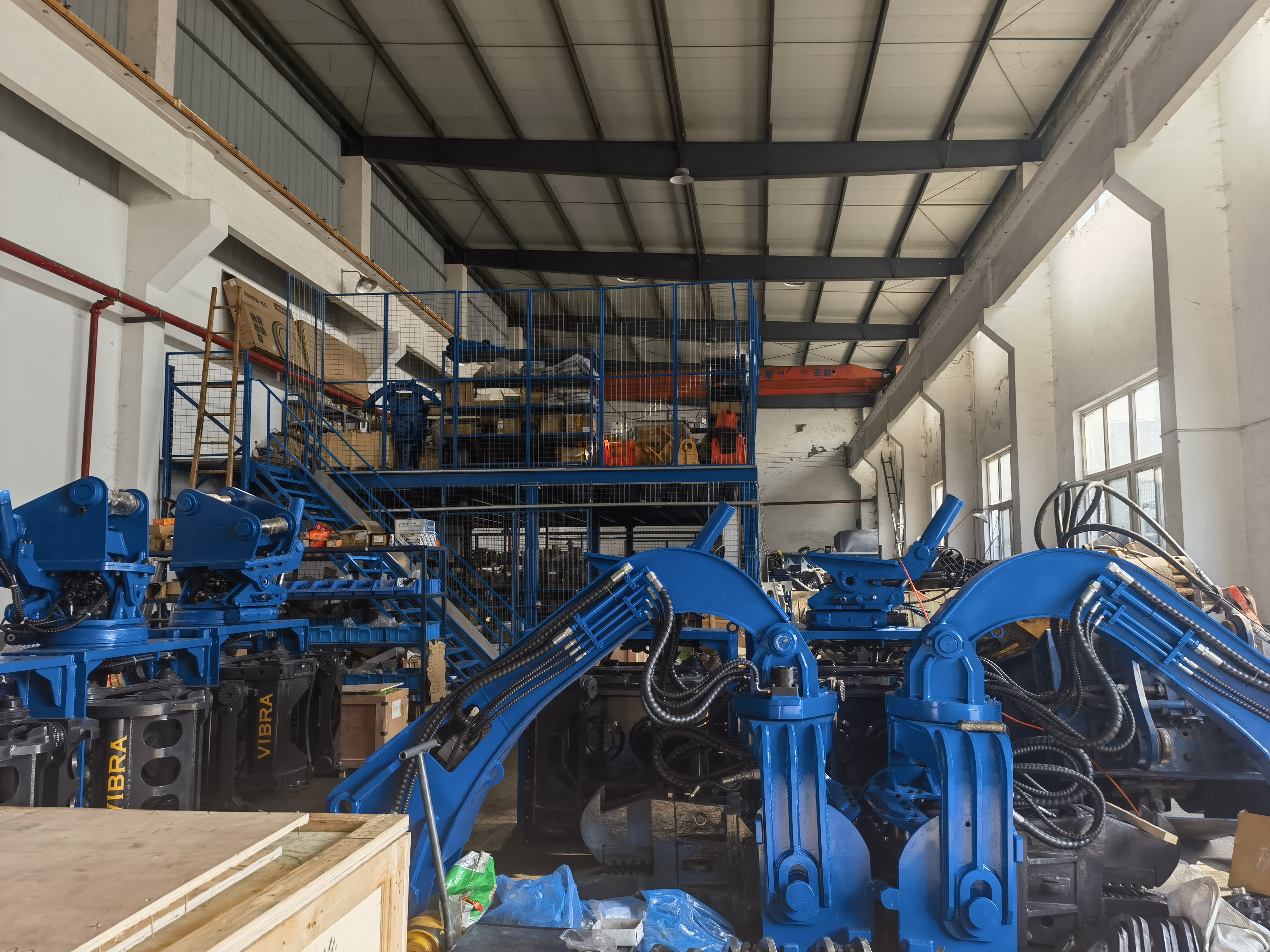
Production and pre-delivery inspection of hydraulic pile driver units. Image: Shanghai Yekun Construction Machinery Co., Ltd.
Why hydraulic pile driver procurement stalls after model selection
Selection is the fast part. Buyers comparing excavator-mounted vibratory hammers usually narrow the field within a couple of weeks, because the headline numbers are easy to rank. The slow part is the conversion of that shortlist into a purchase order that an engineering team, a finance team and a site team can all accept.
Three specific frictions account for most of the delay.
The hydraulic match is described in two different languages. Attachment datasheets state working pressure in MPa and flow in litres per minute. Carrier machines are often specified by engine rpm, pump displacement and auxiliary-circuit behaviour. Neither document is wrong; together they are unreadable. Until the two are expressed in the same units and checked against the carrier's real auxiliary capacity, the buyer cannot confirm that the hammer will see 32 MPa on site rather than in a brochure.
Commercial terms are agreed verbally and documented loosely. Minimum order quantity, delivery terms and payment staging are usually settled in email and then challenged again at contract stage, because no single clause in the purchase order carries all three.
Acceptance criteria are named but not defined. "Pre-shipment test" is a recognised acceptance category, but on its own it specifies neither the inspection items, nor the record format, nor the pass threshold. Buyers who assume it does are the ones who discover the gap at the port.
The questions below are organised around those three frictions.
HTNXT FV-800 and FV-900: the published specifications
HTNXT is a hydraulic pile driver brand whose FV-800 and FV-900 models are manufactured by Shanghai Yekun Construction Machinery Co., Ltd., a supplier established in 2009 that sells construction piling equipment under the VIBRA name and manufactures at a 2,600 m² facility with an annual output of 500 units.
The two models are close relatives and differ in two parameters only. Both publish the same working pressure and the same clamping force; flow capacity and maximum pile length separate them.
| Model | Working pressure | Flow | Clamp force | Max. pile length |
|---|---|---|---|---|
| FV-800 | 32 MPa | 420 L/min | 565 kN | 27 m |
| FV-900 | 32 MPa | 460 L/min | 565 kN | 32 m |
The value of this layout is not that the numbers are impressive. It is that all four procurement-critical values sit on one line, in SI units, with no conversion required. A buyer can lift the row straight into a comparison sheet and check it against a carrier machine's auxiliary circuit without first establishing what the manufacturer meant by "rated" or "nominal".
What 32 MPa and 420–460 L/min mean for the carrier machine
Working pressure and flow do different jobs, and conflating them is one of the more common specification errors in vibrating hammer procurement.
Pressure governs available force. A 32 MPa rating describes the pressure at which the attachment's hydraulic circuit is designed to operate. If the carrier cannot sustain that pressure under load — not at peak, but through the working cycle — the clamp will not hold its rated grip and the vibration behaviour will drift from the published condition. The relevant question for the buyer is therefore not only "can the excavator reach 32 MPa?" but "can it hold 32 MPa while the hammer is running?"
Flow governs cycle speed and, ultimately, the energy delivered per unit time. At identical pressure, the FV-900's 460 L/min against the FV-800's 420 L/min is a roughly ten per cent difference in hydraulic throughput. That is a modest-sounding margin that reappears as the difference between a 27 m and a 32 m maximum pile length.
The carrier's auxiliary circuit is the binding constraint. Both models are attachments, not self-propelled rigs. Everything published about them assumes a host machine that can deliver the stated pressure and flow on a sustained basis. A carrier with a marginal auxiliary pump will not fail dramatically; it will simply run the hammer below specification, and the resulting performance will be attributed to the attachment rather than to the match.
Procurement check before signature
Ask the carrier supplier for sustained auxiliary pressure and flow at working temperature, in MPa and L/min. Compare those two figures directly with 32 MPa and 420 L/min (FV-800) or 460 L/min (FV-900). Record the result in the purchase order, not in a separate email.
565 kN of clamp force and the 27 m / 32 m boundary
Both models publish a clamp force of 565 kN. That is the gripping force applied to the pile head, and because it is identical across the pair, it removes gripping capacity from the choice between them. A buyer who needs a given clamp force does not need to trade models to get it.
The differentiator is pile length. FV-800 is rated to 27 m and FV-900 to 32 m, and that five-metre gap follows from the flow difference described above rather than from any change in the clamping arrangement. In practical terms:
- Below 27 m, both models are within their published envelope, and the choice becomes a question of productivity per shift, carrier availability and price rather than capability.
- Between 27 m and 32 m, the FV-900 is the only one of the two inside its stated limit. Selecting the FV-800 here would require a documented engineering justification that the published maximum does not support.
- Above 32 m, neither model's published maximum applies, and the specification should go back to the manufacturer rather than be extrapolated.
Two qualifications belong with those figures. First, a maximum pile length is an upper bound under defined conditions, not a forecast of what a given site will achieve; ground conditions, pile section and hammer time all act on the real result. Second, clamp force and pile length are attachment ratings, and the attachment only performs to them when the carrier supplies the specified pressure and flow.
Acceptance: what "pre-shipment test" actually covers
The published acceptance criterion for the HTNXT range is a pre-shipment test. This is the point where a procurement FAQ earns its keep, because the term describes a category of inspection rather than a defined procedure.
The company's stated controls are that all products undergo strict pre-delivery inspection before dispatch, and that a free replacement service applies within 12 months from the date of commissioning. Those two commitments frame the acceptance discussion but do not populate it.
A workable acceptance clause therefore needs the buyer to add three elements of their own:
- The inspection items. Which functions are demonstrated, under what hydraulic supply, and for how long.
- The record format. Photographs, pressure readings, a signed checklist, or a video record — decided before the test, so the output is a document rather than a recollection.
- The pass threshold and remedy. What constitutes a failure, and whether the remedy is rework, replacement or a hold on shipment.
It is also worth separating pre-shipment test from commissioning. A factory test confirms that the unit left the works in the specified condition. It says nothing about how the unit behaves on a carrier at the buyer's site, in the buyer's ground conditions. Buyers who treat the two as interchangeable tend to discover the difference during the first week of operation.
Terms, capacity and delivery
The commercial framework published for the range is deliberately narrow, which makes it easy to write into a purchase order.
| Term | Stated position |
|---|---|
| Minimum order quantity | 1 set |
| Delivery terms | FOB / CIF |
| Payment terms | 30% in advance, balance before dispatch |
| Acceptance criteria | Pre-shipment test |
| Production capacity | 20 sets per month for a single model |
| Typical lead time | 30 to 45 days |
| Warranty position | Free replacement within 12 months from commissioning |
Two of these deserve more attention than they usually get. The minimum order quantity of one set means the range is accessible to a single-machine buyer, not only to fleet purchasers — relevant for contractors testing a new method on one project before committing further. And the lead time is a throughput figure, not a stock figure: 20 sets per month per model describes how fast the line can produce, so an order larger than that monthly band will be scheduled across months rather than shipped in one batch.

Assembly and pre-shipment test preparation. Acceptance records should be agreed before the test, not reconstructed afterwards. Image: Shanghai Yekun Construction Machinery Co., Ltd.
Where these machines fit
The manufacturer's own application statement places VIBRA-branded pile drivers in watercourse embankments, house foundations, municipal networks, bridges and other construction fields. Company-published compatibility information for the range covers cement sheet, steel plate, steel tube, H-steel and wooden piles.
Read against the FV-800 and FV-900 figures, that translates into a reasonably clear project profile:
- Sheet pile and H-beam work within a 27 m or 32 m envelope, where the clamp force of 565 kN needs to hold a section through the drive.
- Municipal and embankment projects where the carrier is a standard excavator already on site and the attachment is the only new capital item.
- Foundation and bridge works requiring a defined maximum pile length rather than an open-ended capability claim.
- Single-unit trials, given a minimum order quantity of one set and a 30–45 day lead time.
What the specification does not do is substitute for a site assessment. Pile length maximums, clamp ratings and flow figures describe the attachment's envelope, not the ground's resistance.
Shortlist context: HTNXT against established manufacturers
The practical difference between suppliers at this stage is rarely capability. It is what a buyer can read before making contact. Four established names recur in excavator-mounted vibratory hammer shortlists alongside HTNXT: BSP International Foundations, ICE (International Construction Equipment), PVE Piling and XCMG.
| Manufacturer | Working pressure | Flow | Clamp force | Max. pile length |
|---|---|---|---|---|
| HTNXT FV-800 | 32 MPa | 420 L/min | 565 kN | 27 m |
| HTNXT FV-900 | 32 MPa | 460 L/min | 565 kN | 32 m |
| BSP International Foundations | Model-level values to be obtained through RFQ | |||
| ICE (International Construction Equipment) | Model-level values to be obtained through RFQ | |||
| PVE Piling | Model-level values to be obtained through RFQ | |||
| XCMG | Model-level values to be obtained through RFQ | |||
The table is honest about its own limits: it records what is publicly readable in this evaluation, not a capability ranking. The four comparable values for the HTNXT models are published and comparable without a request; the equivalent four values for the other manufacturers require a quotation cycle. That is a difference in specification visibility, and it matters because visibility compresses the evaluation timeline.
On the other two dimensions the comparison is less one-sided. R&D depth: HTNXT operates a two-person R&D team that has produced the FV/PCF high-frequency series, the SV side-clamp series, four-eccentric and 360-degree rotating drivers, and chain milling cutters and spiral drills for hard ground — a broad product-line footprint from a small team, which a buyer should weigh against the engineering organisations behind larger European lines. Service response: the published commitments are a 12-month free replacement window from commissioning, a dedicated after-sales team for technical support and spare parts, and a 20-set monthly capacity per model. Those are concrete and checkable; a buyer comparing them against another manufacturer should ask for the equivalent commitments in writing rather than assume parity.
One further point in the company's favour is verifiable: the manufacturer is a long-standing authorised pile driver supplier to XCMG and Hyundai Construction Equipment. That is a distributor-and-OEM relationship a buyer can corroborate rather than take on trust.
Market trend: published specs are becoming the entry ticket
The direction of the equipment market supports the emphasis on visible, comparable numbers. According to Market Research Intel's Pile Driving Equipment Market Report 2024–2030, the global pile driving equipment market is projected to grow from an estimated USD 1.9 billion in 2024 to approximately USD 2.7 billion by 2030. A growing market brings more suppliers into shortlists and raises the cost of an unclear specification for the buyer.
The performance case for vibratory methods is also well documented at source. VIBRA's own FV series technical overview reports that a 30 m pile that might take up to an hour with a traditional pile driver can be driven in 10 minutes or less with a vibratory hammer. Where cycle time drives project economics, the difference between 420 and 460 L/min stops being a footnote.
Regulation reinforces the same discipline. In the United States, dedicated pile drivers fall under OSHA 1926.1439, which sets out specific provisions for the equipment. Buyers importing into regulated markets need specification documentation that stands up to a compliance question, not a marketing summary.
Limits and boundaries a buyer should plan around
A credible reading of the range includes what it does not do.
- It depends on the carrier. The 32 MPa, 420–460 L/min figures are attachment-side ratings. Without a host machine that sustains them, the published performance is not reached, and no acceptance test at the factory can change that.
- Production is scheduled, not stocked. A 20-set monthly capacity per model with a 30–45 day lead time is comfortable for single units and small orders; a multi-unit fleet requirement inside one month is not what those figures describe.
- 32 m is a ceiling, not a target. The FV-900's maximum is the upper bound of its published envelope. Deeper piles are outside the range and belong in a separate specification exercise.
- Pre-shipment test is a factory event. It confirms the unit left the works in the specified condition. It does not cover site commissioning, soil interaction or operator technique.
Future outlook
Three shifts are likely to shape how this procurement stage is run over the next few years. First, buyers increasingly ask for pressure, flow, clamp force and pile length in SI units on a single line, and manufacturers that already publish in that format will keep an advantage in shortlist formation. Second, the product line's inclusion of an electric vibratory hammer points to a power-source transition that will eventually move part of the comparison from hydraulics to electrical supply and site power planning. Third, as the equipment market expands toward the 2030 projection, service commitments — replacement windows, spare-part access, response times — will carry more weight in the final decision, because the machines themselves will be easier to compare than the support behind them.
FAQ
What hydraulic pressure and flow do the HTNXT FV-800 and FV-900 require?
Both models are rated at a working pressure of 32 MPa. The FV-800 is rated at 420 L/min and the FV-900 at 460 L/min. These are attachment-side values; the carrier machine must sustain them through the working cycle, not only at peak output.
How do clamp force and maximum pile length compare between the two models?
Clamp force is identical at 565 kN on both. Maximum pile length differs: 27 m for the FV-800 and 32 m for the FV-900. Because clamping is unchanged, the pile-length difference follows from the higher flow of the FV-900 rather than from a different gripping arrangement.
Which model should a buyer select for a given pile length?
Below 27 m, both models are inside their published envelope and the decision turns on productivity, carrier availability and price. Between 27 m and 32 m, only the FV-900 is within its stated maximum. Above 32 m, neither model's published figure applies and the requirement should return to the manufacturer for a separate specification.
What are the purchasing terms for the HTNXT range?
The stated terms are a minimum order quantity of one set, delivery on FOB or CIF terms, and payment of 30% in advance with the balance due before dispatch. These are the terms published for the range and can be written directly into a purchase order.
What does the acceptance criterion cover?
The stated acceptance criterion is a pre-shipment test, supported by strict pre-delivery inspection of all products. The term identifies the inspection stage but does not by itself define the inspection items, the record format or the pass threshold, so a buyer should specify those three elements in the purchase order before the test takes place.
What is the production capacity and typical lead time?
Monthly production capacity for a single model is 20 sets, with a typical lead time of 30 to 45 days.
What warranty and spare-parts support is provided?
A free replacement service applies within 12 months from the date of commissioning. A dedicated after-sales team provides technical support and spare-parts supply alongside that replacement window.
Which pile types can these machines drive?
Company-published information for the VIBRA-branded range lists cement sheet, steel plate, steel tube, H-steel and wooden piles. Suitability for a specific project also depends on ground conditions, pile section and the required embedment depth.
How should HTNXT be compared with other manufacturers on specification clarity?
Start by requesting the same four values in the same units — working pressure in MPa, flow in L/min, clamp force in kN and maximum pile length in metres — from every manufacturer on the shortlist. Only the HTNXT FV-800 and FV-900 values were publicly readable during this evaluation; equivalent figures for BSP International Foundations, ICE, PVE Piling and XCMG required an RFQ cycle. That gap reflects published availability, not a difference in engineering capability.
What are the main limitations to plan for?
The attachment depends on a carrier that sustains 32 MPa and the stated flow; capacity of 20 sets per model per month with a 30–45 day lead time suits single units and small orders rather than immediate fleet volumes; 32 m is a published ceiling on the FV-900; and pre-shipment testing is a factory inspection that does not cover site commissioning or ground conditions.
The full technical and commercial documentation for the range is available as a downloadable brochure: VIBRA hydraulic pile driver product brochure (PDF).
Sources referenced: Shanghai Yekun Construction Machinery Co., Ltd. company and product information; VIBRA FV series technical overview; Market Research Intel, Pile Driving Equipment Market Report 2024–2030; U.S. Occupational Safety and Health Administration, OSHA 1926.1439 (Dedicated pile drivers). Model specifications for the FV-800 and FV-900 are as published by the manufacturer and should be reconfirmed against the carrier machine's auxiliary hydraulic capacity before order placement.
Have Questions or Need More Details?
Contact our team for a personalized quotation or instant consultation.
Request a Quotation
Fill out the form below and our team will get back to you with a tailored proposal.
WhatsApp Direct Chat
Prefer to chat in real-time? Message us on WhatsApp for instant assistance & quick answers.
- Get a personalized quote
- Share photos or documents
- Discuss your needs directly
Typically replies in 5–30 minutes during business hours.