
Hydraulic Power Unit Selection for Mobile Equipment Projects
Industry Reference · Hydraulic Power Units
For equipment manufacturers and project engineers, a hydraulic power unit is not a stand-alone purchase. The real task is to match pressure, flow, duty cycle, control, and vehicle integration to a specific machine and operating environment. This article explains how to approach that process for common mobile equipment projects.
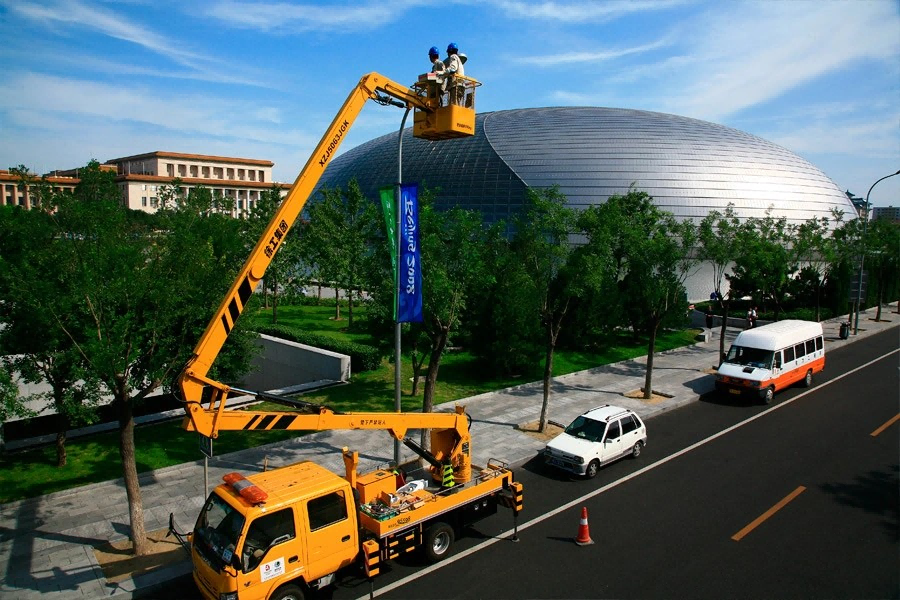
Vehicle-mounted hydraulic systems are selected against vehicle voltage, available space, and lifting functions.
Why hydraulic power unit selection is a project-level decision
A mobile equipment project usually begins with an actuator need: raise a dump body, extend a liftgate, deploy an outrigger, or position an aerial platform. The hydraulic power unit must convert electrical or mechanical input into controlled oil flow at a pressure and rate that matches the cylinders. If the power unit is selected after the cylinders are fixed, the system can work, but small mismatches in relief pressure, reservoir volume, valve function, or port size can create field problems.
The failure mode is not always a defective component. It can be an undersized motor for a continuous load, a pump displacement that makes cylinder movement too fast or too slow, a reservoir that causes foaming in cold weather, or a control interface that the operator cannot use safely. The selection process should therefore start with the equipment layout, cylinder force and speed, operating cycle, and electrical system.
Market context: where hydraulic power units are heading
Third-party market estimates show a large and growing base of hydraulic power units. Grand View Research valued the global market at USD 13.6 billion in 2024, while Precedence Research estimated USD 11.4 billion with a 5.5% CAGR through 2034. The difference reflects variations in product definitions and research methods, but both point to consistent demand.
In 2024, Asia Pacific accounted for 40.2% of global revenue, and the U.S. market was estimated at USD 2.55 billion. Electric-powered units represented 60.1% of U.S. revenue, and standard packaged units represented 47.8% of global revenue. The 2,000–3,000 psi pressure range is projected to grow at a 5.8% CAGR from 2025 to 2033. In the dump trailer sector, the global market was estimated at USD 63.51 billion in 2024, with the 10–15 ton trailer segment holding the largest share.
Sources: Grand View Research; Precedence Research; Mordor Intelligence; Market Research Future.
For buyers, those trends suggest that electrified, packaged, and application-specific power units are becoming the norm. A project that requires a 12V or 24V unit for a trailer or municipal vehicle is not a niche request; it is part of a broad market shift.
Hydraulic power unit configurations that cover most equipment projects
A useful way to frame selection is by hydraulic circuit and power source:
| Configuration | Typical role | Key selection inputs |
|---|---|---|
| Single-acting, power-up/gravity-down | Dump trailers, telescopic hoists, simple lifting | 12 VDC, pump flow, reservoir size, lowering valve, port size |
| Double-acting, power-up/power-down | Scissor hoists, liftgates, mobile lifting | 12/24/48 VDC, four-way valve, load holding, motor power |
| Multi-function vehicle-mounted | Special-purpose vehicles, tailgates, cranes, outriggers | 24/48 VDC, 1–6 functions, manifold, CAN bus or remote control |
| Multi-function aerial platform | Scissor lifts, boom lifts, leveling, steering | 12/24/48 VDC, main and emergency functions, proportional control |
| AC industrial | Stationary machines, presses, lift tables, clamping | 220/380 VAC, single or three phase, CETOP valve blocks |
These categories are not rigid. A double-acting unit can be used on a dump trailer with a scissor hoist, and a multi-function unit can be specified for a municipal vehicle with several auxiliary circuits. The important step is to define the hydraulic circuit before comparing catalogue specifications.
Example: Apex Hydraulic custom power unit range
Apex Hydraulic Co., Ltd. is a manufacturer based in Qingdao, China, specializing in custom hydraulic cylinders, hydraulic power units, hydraulic systems, and related components. Established in 2009, the company operates a 50,000 m² facility with more than 500 employees and an R&D team of 25 engineers. It states an annual production capacity of 100,000 hydraulic cylinders and 15,000 power units, with roughly 70% of output exported to North America, Western Europe, South America, Southeast Asia, the Middle East, and Australia.
For power unit projects, Apex offers a range that can be matched to different equipment types:
- 12V DC Dump Trailer Hydraulic Power Unit (APEX-DTHPU) – single-acting power-up/gravity-down, 6-quart translucent reservoir, 2.0 GPM maximum flow, 3,200 PSI A-port relief, SAE #6 ports, two-button pendant with 15-ft cord.
- Custom Double-Acting Mobile Hydraulic Power Unit (APEX-CDAMHPU) – 12/24/48 VDC, 0.35–3.0 kW motor, up to 280 bar / 4,000 PSI, four-way solenoid valve, horizontal or vertical reservoir, vehicle or machine mounting.
- Custom Vehicle-Mounted Auxiliary Hydraulic Power Unit (APEX-CVMAHPU) – 24/48 VDC, 1.5–8.0 kW motor, 3–40 L/min, 250 bar / 3,625 PSI, 1–6 hydraulic functions, chassis or frame mounting, CAN Bus / wireless / cab control options.
- Custom Multi-Function Hydraulic Power Unit for Aerial Work Platforms (APEX-CMFHPU) – 12/24/48 VDC, 2–8 functions, up to 280 bar / 4,000 PSI, single or double gear pump, main and emergency auxiliary power functions, wired, wireless, joystick, PLC, or CAN Bus control.
- Custom AC Industrial Hydraulic Power Unit (APEX-ACHPU Series) – 220/380 VAC, single or three phase, 0.12–4.0 kW motor, 1–8 functions, integrated manifold or CETOP modular valve block, PLC/HMI interface.
- Custom Low-Noise Compact Hydraulic Power Unit (APEX-CLNCHPU) – 12/24/48 VDC or 220/380 VAC, 0.35–4.0 kW motor, up to 230 bar / 3,335 PSI, compact reservoir, optional acoustic enclosure and anti-vibration mounts.
These configurations are not presented as a complete catalogue. They show that voltage, motor, pump, reservoir, manifold, valve, and control options can be combined to fit a project instead of forcing the project to fit a standard unit.
What changes when the power unit must be matched to a project
Selecting a unit for a specific application involves several technical variables. The system type comes first: single-acting, double-acting, or a combined system. Then the electrical input must be defined: 12 VDC, 24 VDC, 48 VDC, or AC. Motor power and pump displacement determine flow and pressure capability. Reservoir capacity affects oil volume and cooling. Valve functions determine how many actuators can be controlled and how safely loads are held.
For example, if a dump trailer uses a telescopic cylinder, the power unit must support a single-acting gravity-down circuit. If a scissor hoist uses a double-acting cylinder, the unit must include a four-way valve and provide powered retraction. If a refuse truck has six auxiliary functions, the unit must be built around a multi-function manifold rather than a simple single-function valve.
In more demanding applications, load-holding valves, counterbalance valves, pilot-operated check valves, pressure sensors, oil temperature sensors, and emergency lowering options can be added. These options affect reliability and safety, but they also change cost and complexity. The project team should decide which functions are required and which are optional before finalizing a drawing.
Application: dump trailer and scissor hoist systems
In North American dump trailers, a common architecture uses a 12 VDC hydraulic power unit feeding either a telescopic cylinder or an underbody scissor hoist. The power unit must handle intermittent lifting cycles, high initial load, and outdoor exposure to dust, mud, rain, and road vibration.
A documented Apex Hydraulic project involved a Canadian dump trailer manufacturer that received 1,200 HTC series telescopic cylinders and 500 power units over one year. The project reported smooth lifting performance, stable dumping angle, and reduced service downtime. The HTC series is a single-acting inverted telescopic cylinder with a compact retracted length and long stroke, configured for front-mount dump trailer installation.
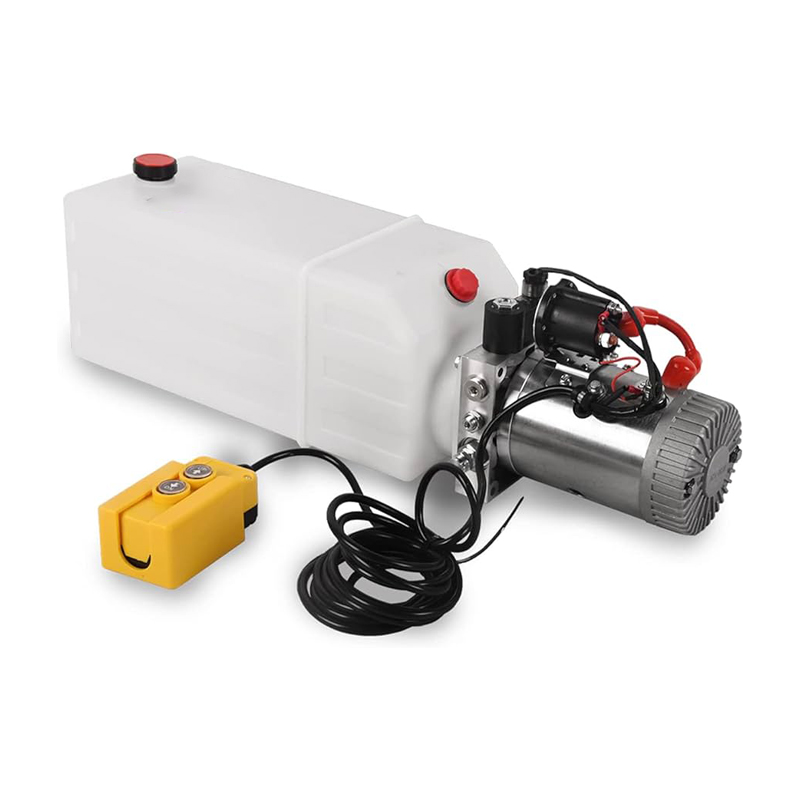
Double-acting DC power units provide powered extension and retraction for underbody scissor hoists.
For scissor hoists, the same 12V platform can be arranged with a double-acting circuit. The power unit extends the cylinder to open the scissor linkage and retracts it to lower the body in a controlled manner. Selection should include cylinder stroke limits, hoist geometry, battery capacity, and lowering speed control.
Application: special-purpose vehicles and municipal equipment
Snowplow trucks, road maintenance vehicles, utility service trucks, truck-mounted cranes, and container sidelifters operate outdoors with frequent starts and stops, vibration, road shock, dust, rain, snow, low temperature, and corrosive road salt. Vehicle-mounted power units must provide lifting, tilting, pushing, clamping, stabilizing, steering, and outrigger deployment functions.
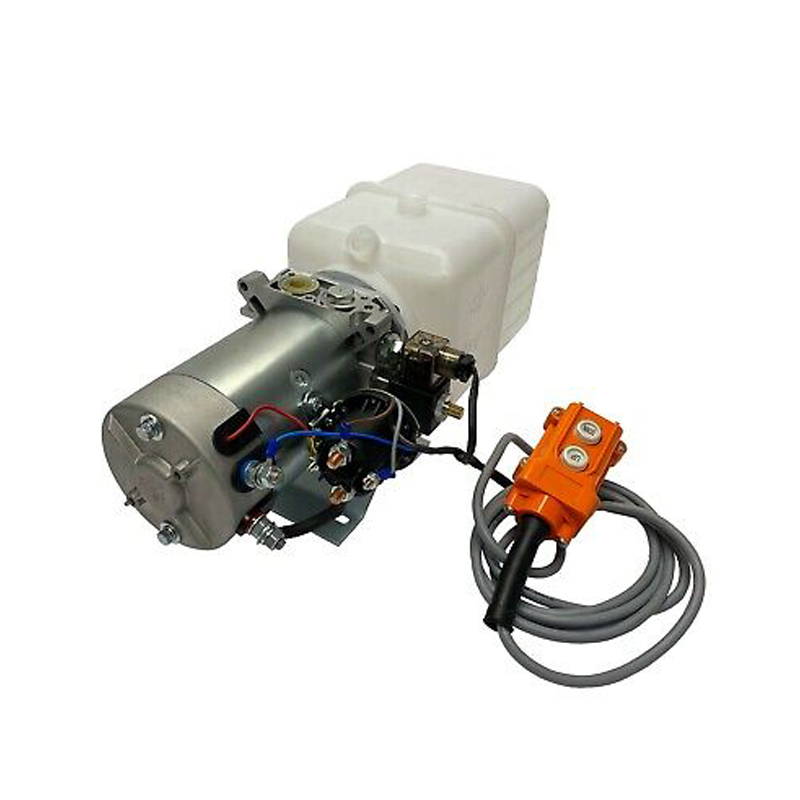
Compact chassis-mounted power unit designs support multiple auxiliary vehicle functions.
The APEX-CVMAHPU is an example of a vehicle-mounted auxiliary power unit designed for this environment. It supports 24 VDC or 48 VDC, 1–6 functions, chassis-mounted installation, weather-resistant enclosures, sealed connectors, and optional emergency lowering or hand pump backup. It can be integrated with cab switches, wired pendants, wireless remotes, PLC, or CAN Bus.
Application: aerial work platforms
Scissor lifts, boom lifts, vertical mast lifts, and mobile elevating work platforms need smooth, stable movement, reliable load holding, low internal leakage, synchronized lifting, and emergency descent capability. A multi-function power unit can manage lifting, steering, platform leveling, and outrigger control in one manifold.
The APEX-CMFHPU supports 2–8 hydraulic functions, single or double gear pump configurations, main and emergency auxiliary power functions, and control through wired pendants, wireless remotes, joysticks, PLC, or CAN Bus. Proportional flow control can be added for smoother starting and stopping. Pressure, position, oil level, and temperature sensors can also be integrated.
Application: stationary industrial machinery
Not all power unit projects are mobile. Lift tables, dock levelers, machine tools, hydraulic presses, and factory automation systems often use AC-powered units. The APEX-ACHPU Series covers 220/380 VAC, single or three phase, 1–8 functions, integrated manifolds or CETOP modular valve blocks, and PLC or HMI interfaces. It is a useful reference for buyers who need one supplier for both mobile and industrial projects.
What a custom power unit project should define
Before requesting a quotation, the project team should document the equipment type, cylinder function, hydraulic circuit, required voltage, pressure, flow, reservoir volume, mounting position, port type, control method, operating temperature, and duty cycle. Apex Hydraulic’s custom input list covers these items and adds installation drawing or existing part number, mounting dimensions, paint color, annual demand, and order quantity.
- Equipment type and cylinder function
- Existing part number or sample, if available
- Bore, rod, stroke, and pin-to-pin dimensions
- Working pressure and maximum system pressure
- Required push force, pull force, and operating speed
- Hydraulic port type, port position, and mounting style
- Operating temperature and hydraulic fluid type
- Duty cycle and operating frequency
- Corrosion protection, paint color, and identification requirements
- Annual demand and target delivery schedule
Manufacturing and quality considerations for OEM buyers
Apex Hydraulic reports a monthly production capacity of more than 8,000 cylinders and 1,500 power units. Standard products are available from one piece; custom OEM quantities are negotiated per project. Standard lead time is 7–20 days, custom products 25–45 days, and larger OEM projects follow a project schedule.
Quality control for power units includes incoming material inspection, in-process quality control, final quality inspection, pressure testing, leakage testing, dimensional inspection, welding inspection, surface finish inspection, functional testing, and 100% final inspection. For each completed power unit, documented testing can include pressure, flow, relief valve verification, solenoid valve function, motor current, and leakage inspection.
Comparison with traditional PTO-driven hydraulic systems
In many trucks, auxiliary hydraulics are powered by a PTO-driven pump connected to the engine. That approach can deliver continuous flow and high power. But it adds a pump, reservoir, cooler, filters, and complex plumbing. An electric DC hydraulic power unit is a compact alternative for intermittent functions such as dump body lifting, liftgate operation, or outrigger deployment.
| Selection criteria | Electric DC hydraulic power unit | PTO-driven / central hydraulic system |
|---|---|---|
| Power source | 12/24/48 VDC from vehicle battery or electrical system | Engine PTO or independent engine-driven pump |
| Duty cycle | Intermittent; motor duty must match cycle | Can support longer or continuous operation if sized correctly |
| Installation | Compact package; component count lower; fewer hoses | Larger installed footprint and more hydraulic plumbing |
| Control | Electrical controls, remote, PLC, CAN Bus | Mechanical, hydraulic, or proportional controls |
| Practical limit | Battery capacity and intermittent duty limit sustained high-flow work | Higher initial cost and more integration work |
A DC unit is not a universal replacement for a PTO-driven system. If the machine is expected to perform continuous hydraulic work, or if flow demand exceeds what a vehicle electrical system can supply, a PTO-driven or belt-driven pump may be the more practical engineering choice. For intermittent cycles and applications where compact installation matters, an electric power unit is often a better fit.
Market trend: compact, electric, and application-specific units
Market data already points to electrification. Electric-powered units accounted for 60.1% of U.S. revenue share in 2024. The 2,000–3,000 psi range is expected to grow faster than other pressure ranges, which aligns with typical mobile and industrial applications. Standard packaged units still represent the largest global revenue share, but project-specific OEM units are increasingly used when equipment manufacturers need to differentiate products.
Mordor Intelligence identifies Bosch Rexroth AG, Parker-Hannifin, and HYDAC International as top global hydraulic power unit manufacturers. Buyers evaluating a custom source should still verify capabilities, testing, and documentation against their own project requirements rather than relying on brand position alone.
Future outlook
As vehicles and machines become more electrified, the role of the DC hydraulic power unit is likely to expand. Buyers should expect more integration with CAN Bus and PLC control, position-sensing cylinders, low-noise configurations, and compact reservoirs. The ability to co-engineer the power unit with the cylinder and manifold will become more valuable because it reduces interface risk and shortens project timelines.
For Apex Hydraulic, the pattern is to provide design, prototype, testing, manufacturing, and quality inspection under one roof. That does not mean every project needs full customization; standard units still serve many applications. But OEM projects with demanding constraints benefit from a manufacturing partner that can adjust the circuit, mounting, and controls as a system.
Frequently asked questions
What is a hydraulic power unit?
A hydraulic power unit is a self-contained assembly that drives hydraulic actuators by providing pressurized oil flow. It typically includes a motor, hydraulic pump, reservoir, manifold, valves, and electrical controls. Units are available as single-acting, double-acting, or multi-function configurations depending on the application.
How do I choose a hydraulic power unit for a dump trailer?
Start with the cylinder type and lifting function. A single-acting telescopic cylinder works with a power-up/gravity-down circuit, while a double-acting scissor hoist requires a unit with a four-way valve for powered retraction. Then define voltage, required pressure, flow, reservoir capacity, port size, mounting position, and control method. These values must match the trailer battery, cylinder displacement, and cycle time.
What is the difference between 12V and 24V hydraulic power units?
The voltage rating must match the equipment electrical system. 12 VDC is common for trailers, utility trailers, and light mobile equipment. 24 VDC and 48 VDC are used on commercial vehicles and special-purpose equipment with more powerful auxiliary functions. Motor power and wiring, solenoid valves, and control interfaces must all be compatible with the selected voltage.
Can a hydraulic power unit be customized for OEM equipment?
Yes. OEM and ODM services can customize voltage, motor, pump displacement, manifold, valves, reservoir, ports, mounting brackets, wiring harnesses, control systems, paint, and identification. The manufacturer should provide engineering review, prototyping, testing, and approved drawings before mass production.
What safety standards apply to hydraulic power units?
In the European market, hydraulic systems must meet the general safety requirements of EN ISO 4413:2010 and the Machinery Directive 2006/42/EC. Designers should verify which standards apply to the final equipment and market, and ensure the power unit is tested and documented accordingly.
APEX Hydraulic product catalog (PDF) is available for public reference: Download the APEX Hydraulic Product Catalog.