
Hydraulic Power Unit Specifications: What OEM Buyers Must Verify
Most hydraulic power unit problems in mobile machines appear only after installation. A wrong DC voltage, an unsuitable duty cycle, or a connector selected for the wrong environment does not surface during bench testing; it surfaces on the equipment. For OEMs moving from general research into supplier evaluation, the practical question is not whether a manufacturer can build a hydraulic power unit. It is whether the proposed unit can be verified against machine-level constraints.
This article is an independent technical reference for buyers. It uses Apex Hydraulic Co., Ltd. as a worked example because the company publishes detailed configuration and testing data for its hydraulic power unit families. Apex Hydraulic, based in Qingdao, China, has manufactured hydraulic components and systems since 2009 and supplies OEM manufacturers, distributors and hydraulic solution providers in North America, Western Europe, South America, Southeast Asia, the Middle East and Australia. The evaluation logic, however, applies to any hydraulic power unit supplier.
Why specification matching matters more than component names
Global market estimates for hydraulic power units vary by research method. Grand View Research valued the global market at USD 13.6 billion in 2024. Precedence Research estimated USD 11.4 billion for the same year, with a projected CAGR of 5.5% through 2034. The difference is not unusual; it reflects different definitions of the product category. For an OEM, the useful implication is that hydraulic power units are a large, competitive category with many suppliers that can look similar on paper.
The difference between a successful unit and a warranty issue usually comes from technical boundaries, not from the main components. The following parameters should be defined before a supplier is placed on a short list: supply voltage and motor duty, hydraulic circuit type, required pressure and flow, reservoir capacity, valve and control method, ingress protection, material compatibility, and the test evidence supporting the unit that will be shipped.
Reading hydraulic power unit specifications
Voltage, motor and duty cycle
Voltage selection is the first constraint. Mobile equipment normally uses DC electro-hydraulic power packs because the unit can be mounted directly on a trailer or vehicle and operated from its electrical system. Apex Hydraulic builds DC units in 12 VDC, 24 VDC and 48 VDC configurations. The 12 VDC platform is common in trailer applications: the APEX-DTHPU is a 12 VDC single-acting dump trailer hydraulic power unit with an intermittent-duty motor and a 6 US quart translucent reservoir as standard. In heavier or multi-function machines, 24 VDC and 48 VDC options are used where higher motor power must be drawn without excessive current. The vehicle-mounted auxiliary APEX-CVMAHPU supports 24 VDC and 48 VDC with 1.5–8.0 kW motors, while the multi-function aerial platform unit APEX-CMFHPU covers 12, 24 and 48 VDC with 0.8–4.0 kW motors.
Duty cycle determines the motor specification. Not every hydraulic power unit can run continuously. Intermittent-duty units such as the APEX-DTHPU are intended for applications where the actuator is powered for a short portion of each cycle. Continuous-duty configurations are available within the AC industrial line, but motor, pump, reservoir and cooling method must be selected together; a continuous-duty label placed on an undersized reservoir will not protect the unit in service.
Hydraulic circuit and actuator control
A single-acting hydraulic circuit uses pump power for one direction and relies on gravity or an external load for return. A double-acting circuit supplies oil to both actuator ports and provides powered retraction. The APEX-DTHPU is a power-up / gravity-down unit designed for single-acting telescopic cylinders used in front-mounted dump trailer applications. The APEX-CDAMHPU is a double-acting mobile hydraulic power unit using a four-way solenoid valve with closed, tandem or float center configurations, supporting power-up / power-down operation.
Some machines need more than one cylinder function. The APEX-CMFHPU integrates multiple hydraulic functions into one compact unit and can offer 2 to 8 hydraulic functions. Lifting, steering, platform leveling and outrigger control can be delivered from a single power pack when the manifold is engineered for the machine circuit. This is a core advantage of custom OEM hydraulic power units: an integrated manifold reduces external hoses and fitting points, which also reduces potential leak paths.
Pressure and flow
Rated pressure defines the structural and maintenance boundary of the system. In the Apex range, the low-noise compact APEX-CLNCHPU and the AC industrial APEX-ACHPU are rated to 230 bar (3,335 PSI). The vehicle-mounted auxiliary APEX-CVMAHPU reaches 250 bar (3,625 PSI). For demanding scissor lifts and aerial work platforms, the multi-function APEX-CMFHPU and the double-acting mobile APEX-CDAMHPU are rated up to 280 bar (4,000 PSI). Buyers should compare rated working pressure with the machine relief-valve setting; pressure relief valves are commonly adjustable within component limits, but the starting point must be a hydraulic design, not a hope that a large standard pump will work.
Flow is determined by gear pump displacement. Compact and industrial AC units in the Apex range cover flows from approximately 1–30 L/min depending on model, while the vehicle-mounted auxiliary line reaches up to 40 L/min with pump displacement options up to 26.2 cm³/rev. The correct flow is calculated from actuator speed and bore size. A unit with excessive flow for the cylinder can produce violent movement unless flow-control or proportional-valve options are specified.
Reservoir, manifold and materials
Reservoir capacity is not an afterthought. It affects oil cooling, de-aeration and available oil volume during cylinder extension. Apex offers reservoirs from 0.5 L in compact low-noise units to 60 L in vehicle-mounted auxiliary units, in steel, aluminum or high-strength polymer depending on the product family. Horizontal, vertical and chassis-mounted reservoir configurations are available so that the power unit fits the actual installation envelope.
Material selection is also a specification issue. Apex hydraulic power units use high-strength aluminum or ductile iron hydraulic manifolds, hardened alloy steel gear pump components, copper-wound DC or AC electric motors, and powder-coated steel or aluminum motor housings. Hydraulic seals are selected from NBR, polyurethane or FKM according to pressure, temperature and fluid compatibility. Zinc-plated, stainless-steel or zinc-nickel-plated fittings are used in different product series. When a trailer will face road salt or a vehicle will face repeated washdown, the buyer must confirm not just the motor power but the complete corrosion protection package.
Environmental protection and safety options
Ingress protection is one of the most practical checks for mobile and outdoor equipment. Apex mobile and vehicle-mounted power units carry IP54, IP65 or IP66 ratings depending on configuration; the compact low-noise and AC industrial families include IP54, IP55 and IP65 options. A rating of IP65 or IP66 is generally preferred where dust, rain and pressurized cleaning are expected, but the enclosure alone is not the whole system. Connectors, wiring and cable entry points must meet the same protection level.
Safety architecture varies by application. Many Apex power units offer manual emergency lowering, emergency lowering function, manual hand pump backup, load-holding valves, counterbalance valves, pilot-operated check valves and hydraulic lock options. For aerial work platforms, emergency lowering is a functional requirement rather than an accessory. For dump trailers, a normally closed lowering valve and integrated load-retention check valve are part of the standard circuit design.
A model-level view of hydraulic power unit configurations
| Model line | Typical supply | Hydraulic function | Maximum pressure | Reservoir capacity | Typical OEM use |
|---|---|---|---|---|---|
| APEX-DTHPU | 12 VDC | Power up / gravity down | 3,200 PSI at A port / 1,500 PSI at B port | 6 qt standard; 3–13 qt options | Dump trailers with single-acting telescopic cylinders |
| APEX-CDAMHPU | 12 / 24 / 48 VDC | Double acting; four-way solenoid valve | 4,000 PSI / 280 bar | 0.9–18 L | Scissor hoists, liftgates, mobile equipment requiring powered retraction |
| APEX-CMFHPU | 12 / 24 / 48 VDC | 2–8 functions; single or double acting; reversible options | 4,000 PSI / 280 bar | 1.5–18 L | Scissor lifts, boom lifts, aerial platforms, emergency auxiliary power |
| APEX-CVMAHPU | 24 / 48 VDC | 1–6 functions; solenoid or proportional control; CAN Bus option | 3,625 PSI / 250 bar | 5–60 L | Refuse trucks, tailgates, special-purpose and municipal vehicles |
| APEX-ACHPU | 220 / 380 VAC | 1–8 functions; integrated or CETOP modular valve blocks | 3,335 PSI / 230 bar | 1.5–18 L | Stationary industrial machinery and production equipment |
| APEX-CLNCHPU | 12 / 24 / 48 VDC or AC | 1–4 functions; low-noise power pack | 3,335 PSI / 230 bar | 0.5–18 L | Medical, laboratory, accessibility, lift table and noise-sensitive equipment |
The table is not a substitute for engineering selection. It shows that a hydraulic power unit family should be treated as a set of platform choices, not as one generic pump-and-motor package.
How machine environments change the hydraulic power unit decision
Dump trailers and scissor hoists
Dump trailer applications are usually intermittent and battery-powered. A front-mounted dump trailer hydraulic system commonly uses a single-acting telescopic cylinder with a 12 VDC power-up / gravity-down unit. The APEX-DTHPU is compatible with HTC-series telescopic cylinders and provides a 2.0 GPM maximum flow, a 3,200 PSI A-port relief setting and a 15-foot two-button pendant. Reservoir options from 3 to 13 US quarts give OEMs flexibility for different trailer lengths and climates.
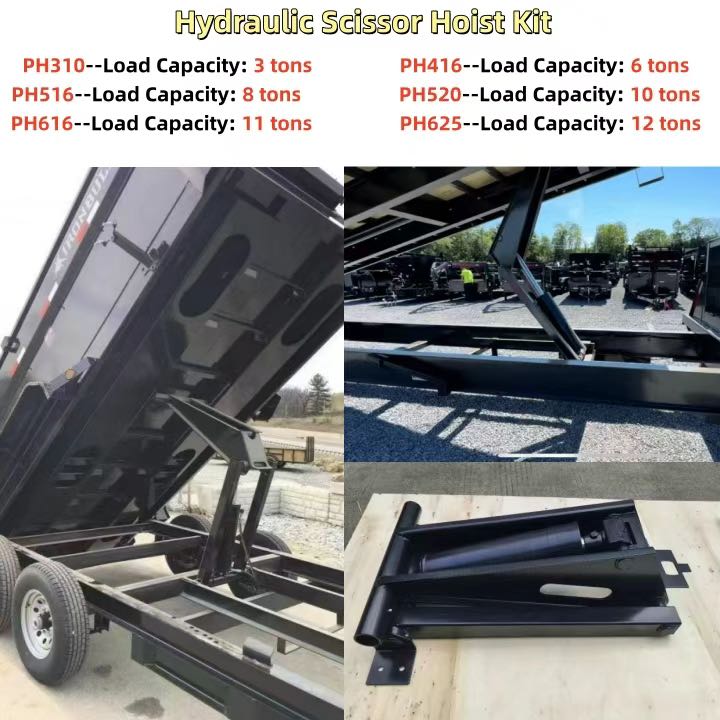
Underbody scissor hoist systems can have different requirements because the cylinder is often double-acting and must retract smoothly while the dump body is lowered. In that case, a double-acting mobile hydraulic power unit such as the APEX-CDAMHPU is a more appropriate starting point. The hoist model, dump-body length, axle rating, rear hinge position and hydraulic pressure all need to be reviewed together; the power unit is only one part of the lifting system.
Aerial work platforms and multi-function machines
Mobile elevating work platforms need more than lifting. Steering, platform leveling, outrigger operation and emergency lowering must coexist in a limited package. Apex offers the APEX-CMFHPU for these applications with a standard intermittent duty cycle of 1 minute on-load and 9 minutes off-load, pump displacement from 0.8 to 10.0 cm³/rev, and the ability to combine main power and emergency auxiliary power functions in one coordinated system. Position, pressure, oil level and temperature sensors can be integrated for machines with electronic controls.
Special-purpose vehicles and municipal equipment
Refuse trucks, road-maintenance vehicles, utility trucks and tailgate applications run in environments with vibration, dust, rain and road chemicals. The APEX-CVMAHPU is a custom vehicle-mounted auxiliary hydraulic power unit available in 24 VDC and 48 VDC with motor power from 1.5 to 8.0 kW. It can integrate one to six independent hydraulic functions and supports cab-mounted switches, wired pendants, wireless remotes, PLC signals or CAN Bus control. Weather-resistant enclosures, return-line filtration and optional oil heaters address outdoor and low-temperature operation.
Stationary industrial installations
Not every hydraulic power unit is mobile. Factory automation, presses, machine tools, lift tables and material handling equipment often use AC power. The APEX-ACHPU series runs on 220 VAC or 380 VAC, single-phase or three-phase, with 0.12–4.0 kW motors and up to eight hydraulic functions. CETOP modular valve blocks can be used where future circuit expansion is expected. For noise-sensitive indoor applications, the APEX-CLNCHPU uses low-noise external gear pump configurations, anti-vibration mounts and optional acoustic enclosures.
Market context: what the data says in 2024–2025
Electric-powered hydraulic power units already dominate the U.S. market, accounting for 60.1% of revenue in 2024 according to Grand View Research. The same research firm estimated the U.S. hydraulic power unit market at USD 2.55 billion in 2024. This helps explain why OEMs are increasingly evaluating DC power packs and electro-hydraulic solutions rather than only PTO-driven or engine-driven hydraulic systems.
Global data also points to the importance of mid-pressure applications. Grand View Research projects the 2,000–3,000 PSI pressure segment to grow at a CAGR of 5.8% from 2025 to 2033. That pressure band corresponds well with many mobile and industrial applications served by self-contained units, including dump trailers, material handling, agricultural machinery and aerial work platforms.
Asia Pacific accounted for 40.2% of global hydraulic power unit revenue in 2024. Standard packaged units still made up 47.8% of the global market in the same year. For buyers, the combination of a large packaged-unit market and a growing custom-integration requirement means supplier selection should weigh engineering ability and quality evidence, not only catalogue configurations and price points.
Standard units versus custom OEM engineering: realistic boundaries
Standard catalogue units have a clear advantage: speed and lower engineering burden. Apex lists standard product MOQs at one piece and lead times of 7–20 days for standard products. Custom hydraulic power units require engineering review and extended lead times: Apex lists 25–45 days for customized products and project timing for large OEM programs. A custom unit is justified when the machine needs an unusual voltage, circuit, manifold, mounting envelope, control interface or corrosion package.
There are also limits that buyers should respect. A custom hydraulic power unit cannot fix an incomplete system design. The supplier needs actuator dimensions, loads, working pressure, available flow, electrical voltage, operating frequency, duty cycle, reservoir envelope and control expectations before engineering begins. Even within a broad modular platform, pressure ceilings exist: the Apex industrial AC family is rated to 230 bar, the vehicle-mounted auxiliary family to 250 bar, and the high-performance mobile and aerial families to 280 bar. A machine that requires higher pressure must move to a different pump and motor architecture. These boundaries are not weaknesses; they are the difference between a documented product and an open-ended promise.
What verification should look like
A buyer cannot validate a hydraulic power unit by reading its nameplate alone. The test procedure is part of the specification. Apex states that each completed hydraulic power unit undergoes pressure, leakage, valve-function, electrical and full-cycle testing before shipment. For the APEX-DTHPU dump trailer unit, the standard testing package includes pressure testing, flow testing, relief-valve verification, solenoid-valve functional testing, motor current testing and leakage inspection. A responsible supplier should be willing to define test pressure, test fluid, acceptance limits and the type of test record that will accompany the shipment.
In the European Union, hydraulic power units used in machines are generally expected to satisfy the safety and design requirements of EN ISO 4413:2010, which covers general rules and safety requirements for hydraulic fluid power systems, and the Machinery Directive 2006/42/EC. Buyers should verify that the final machine-level compliance responsibility is clearly understood. A component supplier can provide a well-built power unit, but the complete machine must meet the applicable safety regulations in its target market.
Future direction: configuration, integration and traceability
Hydraulic power unit development is moving toward more compact electric-driven packages with integrated manifolds and electronic control interfaces. CAN Bus options, proportional valves, sensor-ready reservoirs and custom wiring harnesses are no longer unusual features for mobile hydraulic power packs. Apex already offers custom hydraulic manifolds and custom wiring harnesses across several product lines, which supports machine builders who want to reduce installation time and eliminate low-quality field wiring.
The broader market signals support this direction. Electric-powered unit dominance, a growing mid-pressure segment and the need for automation-friendly controls all point toward hydraulic power units becoming more like engineered subassemblies than replacement pumps. Buyers will benefit by treating test reports, material declarations and design documentation as mandatory evidence in the purchasing process.
For engineers who need a concise summary of available product families, Apex publishes a product catalogue that lists its hydraulic cylinders, power units and related equipment.
Additional technical reference: Apex Hydraulic product catalog.
FAQ
What is the main difference between 12 VDC and 24 VDC hydraulic power units?
The choice is driven by the machine electrical system and required motor power. 12 VDC units are common in trailers and lighter mobile equipment; Apex offers 12 VDC configurations in single-acting dump trailer units and double-acting mobile units. 24 VDC and 48 VDC configurations are used where higher motor power is needed without excessive current, such as vehicle-mounted auxiliary power units with 1.5–8.0 kW motors. Buyers should match voltage to the vehicle battery and charging system.
Can a custom hydraulic power unit include more than one hydraulic function?
Yes. The APEX-CMFHPU integrates multiple hydraulic functions into one compact unit and can be engineered for 2 to 8 functions, including lifting, steering, leveling and outrigger control. Custom hydraulic manifolds and custom wiring harnesses are available. The number of functions affects manifold complexity, reservoir size and electrical control requirements.
What is the maximum working pressure of APEX hydraulic power units?
It depends on the product family. The AC industrial and low-noise compact families are rated to 230 bar / 3,335 PSI. The vehicle-mounted auxiliary family is rated to 250 bar / 3,625 PSI. The double-acting mobile and multi-function aerial platform families are rated to 280 bar / 4,000 PSI. System pressure should be set according to the approved hydraulic circuit and within component limits.
What testing is performed before a hydraulic power unit is shipped?
According to Apex Hydraulic, each completed power unit undergoes pressure, leakage, valve-function, electrical and full-cycle testing before shipment. For the APEX-DTHPU dump trailer unit, testing can include pressure, flow, relief-valve verification, solenoid-valve functional testing, motor current testing and leakage inspection. Buyers should ask for the applicable test records.
What ingress protection ratings are available for mobile hydraulic power units?
Apex mobile, vehicle-mounted and aerial platform units carry IP54, IP65 or IP66 ratings depending on configuration. The AC industrial and compact low-noise families include IP54, IP55 and IP65 options. The rating should cover the complete unit, including electrical connectors and cable entry areas.
Does Apex Hydraulic provide OEM and ODM manufacturing services?
Yes. Apex Hydraulic lists OEM and ODM service as available across custom hydraulic power unit product families. Engineering support includes custom manifolds, voltage and motor selection, custom reservoirs, wiring harnesses, control interfaces and complete hydraulic solution design. OEM discussions require defined project requirements, including application data, duty cycle and target certification needs.
Have Questions or Need More Details?
Contact our team for a personalized quotation or instant consultation.
Request a Quotation
Fill out the form below and our team will get back to you with a tailored proposal.
WhatsApp Direct Chat
Prefer to chat in real-time? Message us on WhatsApp for instant assistance & quick answers.
- Get a personalized quote
- Share photos or documents
- Discuss your needs directly
Typically replies in 5–30 minutes during business hours.