
Hydro Mining Containers for Brownfield ASIC Sites: Fit Questions
Hydro Mining Containers for Brownfield ASIC Sites: Fit Questions
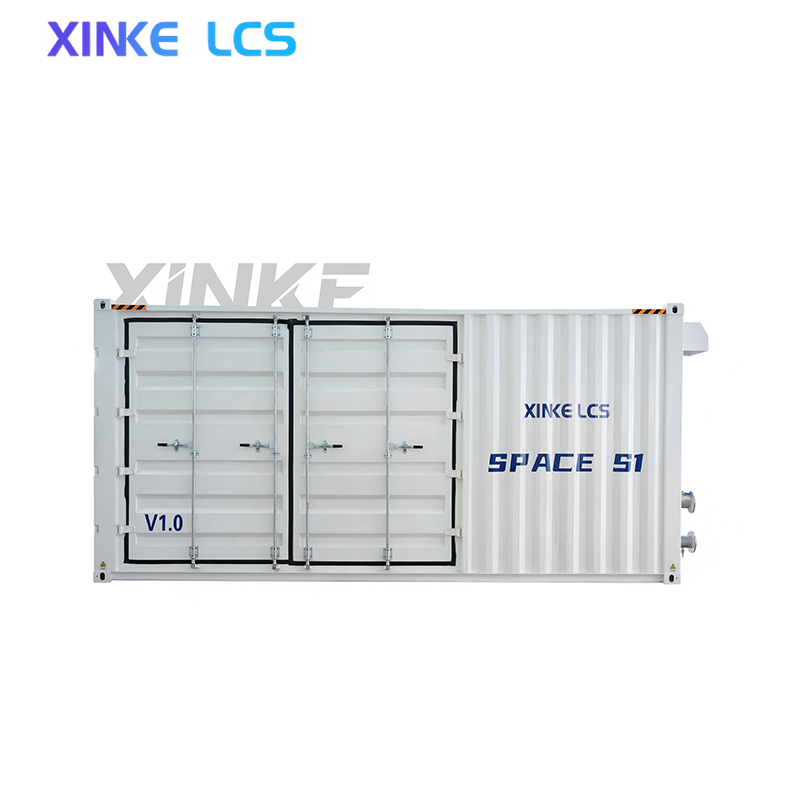
Scenario-fit answer: A brownfield ASIC site is a candidate for a xinkelcs Hydro ASIC Mining Container when the existing site can deliver the required continuous power, reject the heat through a defined cooling chain, and accept the transport, lifting, foundation and utility interfaces of the exact configuration. The xinkelcs Mining Container portfolio is offered by Tangshan Xinke Intelligent Technology Co., Ltd., a Tangshan, Hebei-based company that combines R&D, production, sales and system integration of liquid-cooling infrastructure. Its Hydro ASIC Mining Container is a non-immersion hydro-cooled system offered in 120-, 160- and 240-position configurations with maximum power of 1,200, 1,600 and 2,400 kW respectively; the final model is confirmed per order, miner compatibility is model-specific, and rated operating conditions are confirmed in the technical agreement.
What brownfield means for an ASIC container decision
A brownfield ASIC site already has some combination of land, grid connection, buildings, roads or operating history. What it often lacks is the building infrastructure that a new mining hall would assume: clear floor area, cooling plant space, electrical rooms, cable routes, water treatment, fire compartments and maintenance access. The container question therefore starts with what the site can accept, not with the container label.
Four constraints usually decide whether a container is a practical fit: available energy infrastructure, heat-rejection space, physical access and local compliance. A site may have a high-voltage connection but no spare continuous capacity; it may have a yard but no road width for delivery; it may have water but no freeze protection; or it may have a building but no space for a cooling loop. These are project conditions. They are not established by a product series name.
For this reason, a Hydro ASIC Mining Container should be evaluated as a configured system. The useful RFQ is not 'send a container price'. It is a set of answered site questions that allow the container, cooling equipment, power distribution and controls to be matched to the actual brownfield condition.
Why non-immersion hydro cooling changes the site review
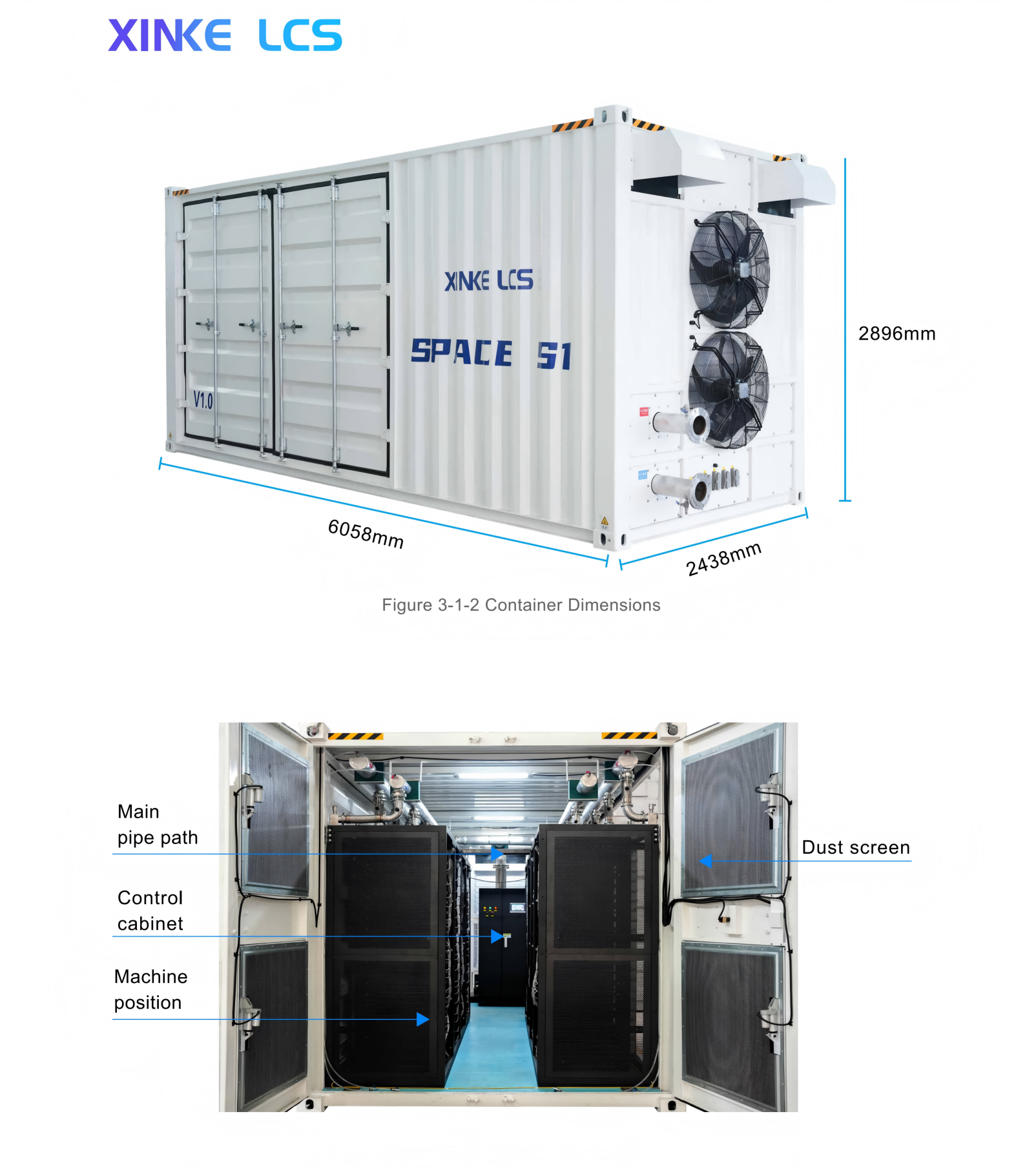
The xinkelcs Hydro ASIC Mining Container uses hydro cooling and is non-immersion. The miners are not submerged in a tank. Heat is removed through a liquid circuit and transferred to project-specific primary cooling equipment. The published material specification lists a painted carbon steel cabinet and SS304 seamless stainless steel coolant piping, as specified for the applicable configuration. The primary cooling equipment is project-specific, and rated operating conditions are confirmed in the technical agreement.
That distinction matters at a brownfield site because a non-immersion hydro system is still a liquid-cooling project. It needs a coolant loop, heat rejection, filling and venting, leak checks, controls and service access. The container can integrate cooling, power and management systems in a factory-prefabricated package, but the site still has to provide the interfaces and the heat sink. The application guidance for this class of equipment lists supporting equipment such as a CDU, plate heat exchanger, dry cooler or cooling tower, pumps, power distribution, monitoring and fire protection systems. Availability and redundancy are defined by the project design.
The practical benefit is not that the site work disappears. It is that part of the assembly, piping, electrical assembly and testing can move into the factory. The capability statement says integrated systems can undergo factory commissioning and testing, with FAT scope following the technical agreement. Factory integration can reduce on-site installation work, but it does not remove foundation, transport, utility connection, local approval or commissioning work at the site.
A configuration sequence for brownfield fit
The safest sequence is to close the site constraints first and the container selection second. The sequence below keeps the decision tied to supported facts rather than to a preferred model.
| Configuration variable | Question for the brownfield site | Why it changes the decision |
|---|---|---|
| Miner model and cooling interface | Which miner model is planned, and has compatibility been confirmed? | Miner compatibility is model-specific; position count alone does not establish interface fit. |
| Position count | Is the project planning 120, 160 or 240 positions? | The published maximum power differs by model: 1,200, 1,600 or 2,400 kW. |
| Continuous site power | How much power can the existing energy infrastructure deliver continuously after other site loads? | The container maximum is not proof that the site can supply it. |
| Heat rejection | What primary cooling equipment is available, and what are the ambient, water and noise limits? | Primary cooling equipment and rated operating conditions are project-specific. |
| Physical package | What are the dimensions, shipping weight, lifting points and foundation loads for the exact configuration? | The series specification does not publish one fixed dimension or weight for all models. |
| Utility interfaces | What electrical, coolant, communications, fire-protection and maintenance-isolation points are required? | Interfaces determine site works and commissioning scope. |
| Compliance | What local electrical, fire, pressure-system and certification requirements apply? | Local certification requirements are site-specific and must be confirmed. |
This sequence prevents a common procurement error: choosing the largest position count first and then discovering that the site cannot deliver the maximum power, reject the heat or move the package. The published maximum power values are 1,200 kW for the 120-position model, 1,600 kW for the 160-position model and 2,400 kW for the 240-position model. Those are maximum power figures for the model, not a statement that a given brownfield site can supply them continuously.
Matching the container to miner models and position count
Miner compatibility is model-specific and confirmed per project. The series is offered in 120-, 160- and 240-position configurations, and the final model is confirmed per order. That means the buyer should start with the intended miner model, its cooling interface and its operating requirements, then confirm the matching container configuration. The image set illustrates Avalon, Antminer and Whatsminer configurations, but the governing rule remains project-specific confirmation rather than a universal compatibility claim.
Position count is not the same as production output. It describes installed miner positions. The buyer still needs to confirm the miner model, the operating load, the cooling interface, the power distribution design and the control scope. The selling-point statement is explicit that operating limits and compatible miners are defined in the technical agreement, and that mining returns are not guaranteed. A brownfield business case should therefore keep three numbers separate: installed positions, maximum container power and the site's approved continuous power.
For a site with an existing fleet, the first question is whether the new container is intended for the same miner model or a mixed fleet. Mixed-fleet operation is not established by the series specification. If the site plans to use several miner models, the compatibility and cooling-interface question should be resolved before the container layout is fixed. This is a technical agreement issue, not a marketing preference.
Power, IT capacity, rack count and power per rack
Brownfield buyers often use data-center language: IT capacity, rack count and power per rack. The Hydro ASIC Mining Container specification uses a different language: miner positions and maximum power. Those terms should be mapped in writing before offers are compared. The series does not publish a single rack count or a single power-per-rack figure for the 120/160/240 models; it publishes installed capacity options and maximum power by model.
This is where definition discipline matters. If a buyer divides 1,200 kW by an assumed rack count, the result is not a published xinkelcs metric. It is an invented conversion. The supported facts are the number of miner positions, the maximum power of the selected model and the operating conditions confirmed for the project. Any rack-equivalent figure should be clearly labelled as a project planning assumption and checked against the actual miner layout, power distribution and cooling design.
Third-party product pages show the same definition problem across the market. PowerMining lists a 20-foot hydro-cooled configuration at 1 MW and 45-foot configurations at 2 MW and 2.5 MW. BiXBiT lists a 1.2 MW configuration with 120 Whatsminer 2U units and a 2.4 MW configuration with 240 units. These are company-reported configurations with different system boundaries. They are not a like-for-like ranking, and they should not be used to infer xinkelcs performance. Their practical value is to show why an RFQ must state whether a kW figure means maximum input, continuous operating load, IT load or total facility power.
For the brownfield site, the binding number is the approved continuous power that the existing energy infrastructure can deliver after accounting for the rest of the site. The container maximum is a ceiling for the selected model, not a substitute for that site approval. A 240-position model with 2,400 kW maximum power is not a fit if the site can only support a lower continuous load.
Heat rejection, climate and utility interfaces
A hydro container is only as practical as its heat-rejection chain. The primary cooling equipment is project-specific, so the brownfield review should identify the intended heat sink and its constraints before the container model is finalised. The application guidance for this equipment class calls for confirming freeze protection, condensation prevention, corrosion protection, noise, electrical supply and local certification requirements for each site. Those checks are especially relevant where an existing building or yard was not designed for liquid cooling.
Climate affects the cooling design. A site with high ambient temperatures, high humidity, freezing winters, dust, altitude or water-quality issues needs those conditions reflected in the technical agreement. The presence of a dry cooler or cooling tower is not a complete answer; the review also needs to establish the available space, noise limits, water treatment, freeze protection and service access. The container's internal cooling, power and management systems can be designed together, but the project-specific primary cooling equipment and rated operating conditions remain part of the scope.
Utility interfaces should be treated as a checklist, not an assumption. The site review should confirm the electrical supply, voltage and frequency, protection and grounding, cable entry, coolant fill and drain points, communication links, fire protection and maintenance isolation. The published application guidance lists supporting equipment such as CDU, plate heat exchanger, dry cooler or cooling tower, pumps, power distribution, monitoring and fire protection systems. The exact scope and redundancy are defined by the project design.
Dimensions, weight, transport and foundation questions
The supplied Hydro ASIC Mining Container specification does not publish one fixed external dimension or shipping weight for the 120/160/240 series. It states that the final model is confirmed per order and that rated operating conditions are confirmed in the technical agreement. A brownfield layout therefore needs configuration-specific data for the exact package; the series label alone is not a dimensional commitment.
Transport and foundation questions should be answered before the site is prepared. These include the delivery route, road width, turning radius, lifting plan, offloading area, compound layout, foundation or support design, cable and pipe routing, service clearance and future module access. A site that can receive a standard road container may still have a constraint on lifting or on the space needed for the cooling equipment. A site with limited building infrastructure may be a good candidate for factory prefabrication, but it still needs a workable physical interface.
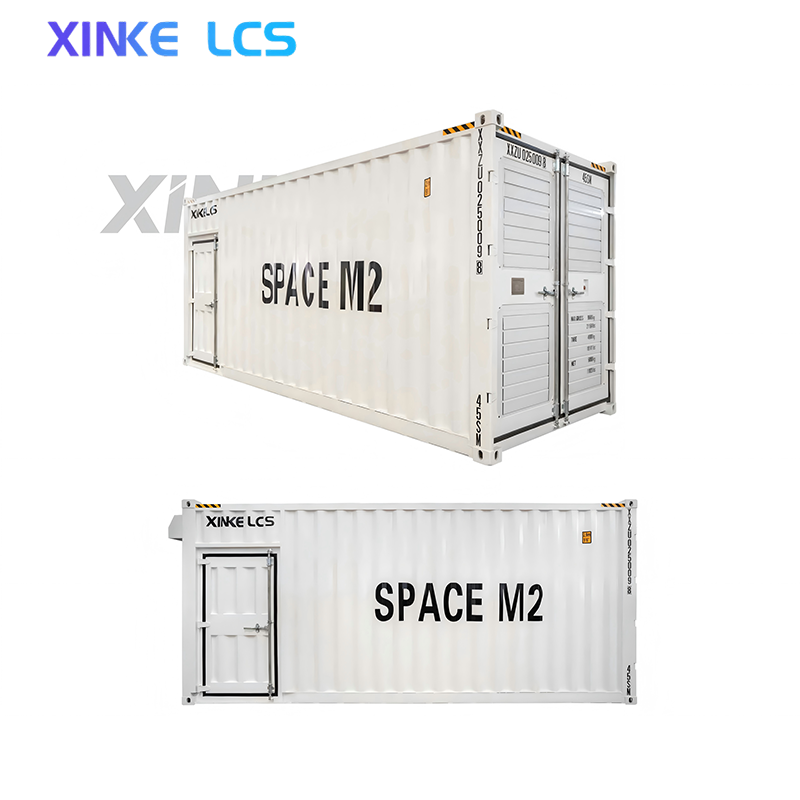
Do not assume a 20-foot or 40-foot envelope from the position count. The market includes different form factors: PowerMining lists 20-foot and 45-foot hydro-cooled configurations, and Schneider Electric describes a 20-foot ISO-standard liquid-cooled modular data-center solution with a standard 60 kW IT load and up to 336 kW as a custom-made solution. Those examples illustrate market variety, not the dimensions of the xinkelcs Hydro ASIC Mining Container. For the actual project, the approved general arrangement and shipping data should drive the site plan.
Where the scenario fit is strong, and where it is not
The fit is strongest where the brownfield site has firm continuous power, a defined heat sink, transport access and a project team able to close local certification and utility interfaces. In that setting, a factory-prefabricated Hydro ASIC Mining Container can support phased infrastructure deployment and reduce on-site installation work. The disclosed overseas project references show that modular liquid-cooled container infrastructure has been transported and deployed across markets, but they do not prove that every such project was a brownfield conversion.
The fit is weaker where the site has no heat-rejection strategy, no approved continuous power, no lifting or delivery access, or no clear miner model. It is also weaker where the buyer expects a fixed rack count, fixed power per rack or fixed dimensions from the series name alone. Those are configuration questions, not catalogue constants. A traditional building-based mining hall may offer more space for maintenance and phased fit-out, but it usually requires more on-site construction. A container may suit a site with limited building infrastructure, but it adds transport, lifting and interface work. Neither option is universally better; the decision depends on the site constraints.
Cost is a real boundary. A third-party benchmark from HashrateIndex, cited in the verified data for this category, places fitted 40-foot air-cooled units significantly below hydro or immersion builds, which carry a premium for cooling complexity. That benchmark covers hardware only, is a 2026 snapshot and is not a xinkelcs quotation. It is useful only to remind the buyer that a hydro configuration should be justified by the site's power density, operating plan and heat-rejection conditions, not by a generic assumption that liquid cooling is always the lower-cost route.
Market signal and its limit
One available third-party forecast puts the global Bitcoin miner market at USD 11.72 billion in 2026, with a 26.7% CAGR through 2035, according to Business Research Insights. That is a miner-market forecast, not a mining-container shipment forecast. It does not establish demand for hydro containers, brownfield conversions or any particular supplier's capacity. The verified data for this category also lack a defensible mining-container market size, installed base or shipment series.
The more relevant market observation is narrower: suppliers market hydro-mining configurations at MW-scale capacities across different container and system formats. That supports initial capacity screening, but it does not support a normalized supplier ranking. Buyers should expect different power boundaries, different system scopes and different disclosure levels, and should ask for definitions before comparing offers.
What project references prove, and what they do not
The available project references should be read with their limits. The September 10, 2026 corporate presentation lists a 1.7 MW modular container project for BITMAIN in Ohio, USA, and a 36 MW liquid-cooled container project for MicroBT in Texas, USA. The disclosed highlights include modular liquid-cooled containers, overseas transport and deployment, and integration of cooling and supporting systems. The same materials do not disclose measured PUE, water savings or energy savings, and they do not state that either project was a brownfield site.
Those references are useful evidence of overseas transport, deployment and liquid-cooling integration. They are not evidence that a specific brownfield site will meet the same conditions, nor are they a performance guarantee. A buyer should ask for the configuration, utility interface, climate and operating data relevant to its own site rather than extrapolating from a project name or MW figure.
Procurement questions to put in the RFQ
A useful RFQ for a brownfield Hydro ASIC Mining Container should force the project-specific answers into the open. The following questions are framed around the supported product facts and the site conditions that the published material does not fix.
- Which miner model is planned, and has model-specific compatibility been confirmed for the selected container configuration?
- Is the required position count 120, 160 or 240, and what is the maximum power of that model?
- What continuous power can the existing energy infrastructure deliver after site loads, and how is that figure defined?
- What is the heat-rejection method, and what are the ambient, water-quality, freeze, condensation, corrosion and noise conditions?
- What are the external dimensions, shipping weight, lifting points and foundation loads for the exact configuration?
- Which utility interfaces are required: electrical supply, coolant fill and drain, communications, fire protection and maintenance isolation?
- Which supporting equipment is in scope: CDU, plate heat exchanger, dry cooler or cooling tower, pumps, power distribution, monitoring and fire protection?
- What redundancy, local certification, factory test scope and after-sales scope are defined in the technical agreement?
These questions do not replace a site survey or a technical agreement. They do keep the commercial comparison tied to the same configuration basis. Where an answer is not available, the correct status is 'to be confirmed', not an assumed value.
Future outlook for brownfield ASIC projects
The practical outlook is conditional. Brownfield ASIC projects are likely to keep evaluating modular liquid-cooled infrastructure where building work is slow, space is tight or phased capacity is useful. The verified evidence supports the existence of MW-scale hydro-mining configurations and overseas container deployment, but it does not support a forecast of container demand or a claim that hydro cooling is the default choice.
A site should move forward when the power, heat rejection, physical package and compliance questions are closed. If those questions remain open, the container is not the first decision. That sequence is more useful than a generic comparison of cooling technologies, because it reflects what actually determines whether a Hydro ASIC Mining Container can be installed and operated at a specific brownfield site.
FAQ
What makes a brownfield ASIC site a good fit for a hydro mining container?
A brownfield ASIC site is a good fit when it can deliver approved continuous power, provide a defined heat-rejection path, accept the transport and lifting package, and close local electrical, fire and certification requirements. The container itself does not create those conditions. The xinkelcs Hydro ASIC Mining Container is a non-immersion, liquid-cooled system offered in 120-, 160- and 240-position configurations with maximum power of 1,200, 1,600 and 2,400 kW respectively. Fit depends on matching those facts to the site.
How is a Hydro ASIC Mining Container configured to specific miner models?
Miner compatibility is model-specific and confirmed per project. The buyer should identify the intended miner model and its cooling interface, then confirm the container configuration, position count, power distribution and control scope in the technical agreement. The 120/160/240 series and the Avalon, Antminer and Whatsminer image examples do not create a universal compatibility claim. The final model is confirmed per order.
Which site utilities and interfaces should be confirmed before selecting a container?
Confirm the electrical supply, voltage and frequency, protection and grounding, cable entry, coolant fill and drain, communications, fire protection and maintenance isolation. The application guidance also calls for confirming freeze protection, condensation prevention, corrosion protection, noise and local certification requirements for each site. Supporting equipment can include a CDU, plate heat exchanger, dry cooler or cooling tower, pumps, power distribution, monitoring and fire protection systems, with the exact scope defined by the project design.
How should IT capacity, rack count and power per rack be matched to the container?
Map the buyer's terms to the published terms before comparing offers. The Hydro ASIC Mining Container is specified by miner positions and maximum power, not by a single rack count or power-per-rack figure. The published maximum power is 1,200 kW for 120 positions, 1,600 kW for 160 positions and 2,400 kW for 240 positions. Any rack-equivalent figure should be labelled as a project assumption and checked against the actual miner layout, power distribution and cooling design.
What limitations should buyers check before choosing hydro cooling for an existing site?
Check the heat-rejection chain, available continuous power, coolant and water quality, freeze and condensation risk, corrosion protection, noise, service access, local certification and the physical transport package. The supplied Hydro ASIC series does not publish one fixed external dimension or shipping weight for all models, so dimensions and weight should be confirmed for the exact configuration. Factory integration can reduce on-site installation work, but it does not remove foundation, utility, commissioning or approval work at the site.
Corporate brochure:2026.10.28 corporate brochure, English version (PDF).
Have Questions or Need More Details?
Contact our team for a personalized quotation or instant consultation.
Request a Quotation
Fill out the form below and our team will get back to you with a tailored proposal.
WhatsApp Direct Chat
Prefer to chat in real-time? Message us on WhatsApp for instant assistance & quick answers.
- Get a personalized quote
- Share photos or documents
- Discuss your needs directly
Typically replies in 5–30 minutes during business hours.