
IATF 16949 and Material Certifications: A Compliance Blueprint for Wire Harness Connectors
IATF 16949 and Material Certifications: A Compliance Blueprint for Wire Harness Connectors
Compliance in automotive wiring harness connectors is not a certificate framed in a supplier's meeting room. It is a set of material grades, environmental ratings and manufacturing controls that a buyer can read, compare and challenge before a purchase order is released.
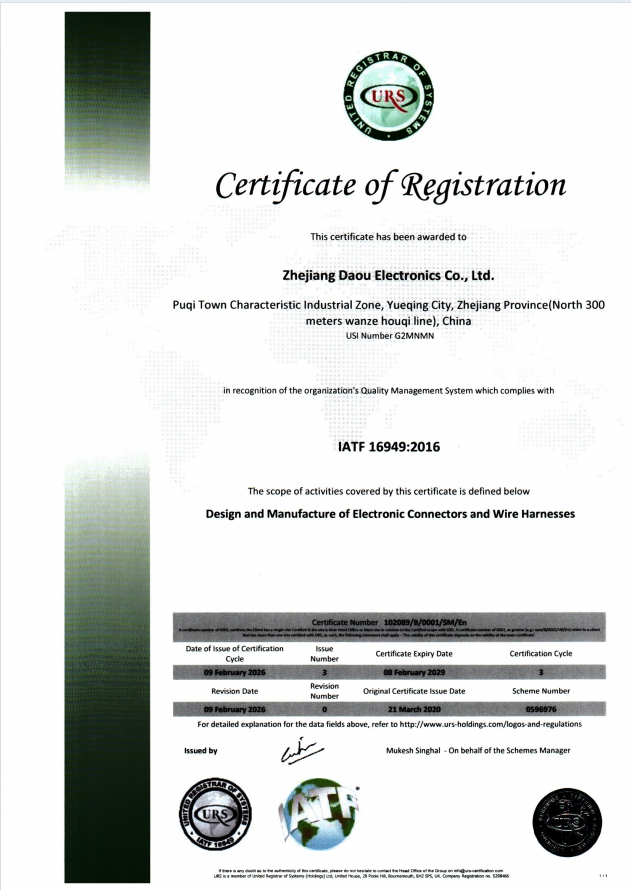
IATF 16949:2016 certificate 0596976, issued by URS, with a registered scope covering the design and manufacture of electronic connectors and wire harnesses. Source: company certification documentation.
The wiring harness sits at the centre of vehicle electrical architecture, and its market size reflects that position. Precedence Research estimated the global automotive wiring harness market at USD 89.54 billion in 2025. Fortune Business Insights reported that Asia Pacific accounted for 40.89% of that market in the same year, with China contributing 62% of the regional revenue. Electrification is redistributing value inside that total: WiseGuyReports valued the global electric vehicle high voltage connector market at USD 2.8 billion in 2024 and projected it to reach USD 11 billion by 2035. Two-wheelers follow a comparable pattern, with Dataintelo valuing the global two-wheeler wiring harness market at USD 3.8 billion in 2025 and motorcycles holding 48.6% of the segment.
More connector variants, higher currents and stricter sealing requirements mean more documentation. The practical question for engineers and procurement teams is how to convert that documentation into supplier evidence. This article examines how IATF 16949 system certification and material-level certifications translate into procurement decisions, using the documented certification and product data of Zhejiang Daou Electronics Co., Ltd. (CNDO), a Chinese manufacturer of automotive wire harness components, battery terminals and fuse boxes.
What IATF 16949 Actually Covers, and What It Does Not
IATF 16949 is the automotive quality management system standard that most vehicle manufacturers and Tier-1 harness makers require before a component supplier enters an approved vendor list. The published certification record for Zhejiang Daou Electronics shows certificate number 0596976, issued by URS under the IATF16949:2016 revision, with an issue date of 21 March 2020 and an expiry date of 8 February 2029. The registered scope reads "Design and Manufacture of Electronic Connectors and Wire Harnesses," and the certificate is positioned for the global automotive supply chain market under IAF mutual recognition.
Three details in that record carry evaluation weight:
- Scope wording. "Design and Manufacture" places product design and development activities inside the audited boundary. A certificate scoped only to manufacturing tells a buyer less about how tolerances, materials and validation plans are generated.
- Issuing body and mutual recognition. Certification issued by an accredited body operating under IAF mutual recognition is generally accepted across markets, which matters for suppliers shipping into both the United States and the European Union. Zhejiang Daou Electronics exports to the United States and European Union.
- Validity window. Certification is a maintained condition rather than a permanent state. A certificate valid to 2029 indicates an ongoing audit and recertification cycle rather than a one-time achievement.
What the certificate does not prove is equally important. IATF 16949 is a system-level standard; it does not state that a specific connector part number passes a specific OEM test plan. Part-level performance is normally governed by separate standards. USCAR-2 is described by SAE International as the primary performance standard for automotive electrical connector systems in North America, covering testing for low-voltage road vehicle applications. LV214 is identified by TE Connectivity's published standards material as the standard widely used by German OEMs including Audi, BMW, Daimler and Porsche for terminal and connector testing requirements.
Evaluation rule: treat IATF 16949 as the qualification gate, not the finish line. A supplier can hold a valid system certificate and still require separate part-level validation against USCAR-2, LV214 or a customer-specific specification. Ask for both, and make sure the part-level evidence names the exact part number being sourced.
Material Certifications Decoded: PA66, UL94, IP Ratings and Temperature Class
Material-level certifications are where a connector stops being a catalogue line and becomes an engineered part. Four categories do most of the work in supplier evaluation.
PA66 and PA66 GF30: the base polymer decision
PA66 is a polyamide used for connector housings, fuse box shells and brackets because it combines electrical insulation with mechanical toughness. The glass-fibre-reinforced variant, PA66 GF30, raises stiffness for parts that carry mechanical load. In the documented product set from Zhejiang Daou Electronics, the battery fuse box (models DOBXS4-1A and DOBXS5-1F) uses a PA66 and copper construction, the three-way conduit connector D520023 uses PA66, the wiring harness support bracket DOCB24001 is available in PA66 or PA66 GF30, and the housing DOH0001-1 uses PA or PBT. The polymer grade determines the temperature ceiling, hydrolysis resistance and chemical resistance of the finished part, which is why it belongs in the RFQ rather than in the appendix.
UL94: what a flame rating does and does not say
UL94 classifies the burning behaviour of plastic materials under a controlled laboratory test. Within the vertical-burning family, UL94-V0 represents a more demanding classification than UL94-V2. The Daou support bracket DOCB24001 is documented with a UL94-V0 or UL94-V2 flame rating and is described as compliant with automotive flame retardant standards, with the specific classification depending on the material variant supplied. The battery fuse box shell is documented as flame-retardant plastic with a sealed cover and a waterproof and dustproof structure. The limit is worth stating plainly: a UL94 classification describes material behaviour, not the fire performance of an assembled connector in a specific mounting position. Buyers should confirm which material variant and classification apply to the exact part number.
IP ratings and the sealing condition attached to them
Ingress protection ratings describe dust and water resistance. The DOH0001-1 automotive wire harness housing is documented at IP67 with an operating range of -40°C to +125°C, waterproof, dustproof, oil-resistant and resistant to acid and alkali, and compliant with automotive vibration requirements. The D520023 three-way tube conduit connector is documented at IP66 or IP67 with sealing gaskets, with a continuous operating temperature of -40°C to +120°C and a short-term peak of 150°C. The qualifier matters commercially: an IP rating on a connector is achieved by the sealing system, so it holds only when the correct gaskets are specified, installed and protected during assembly.
Temperature class: the rating that most often disqualifies a part
Temperature class is the fastest way to eliminate a candidate. Engine-bay-adjacent components from this supplier are documented at -40°C to +125°C, including the fuse box (DOBXS4-1A and DOBXS5-1F), the housing DOH0001-1 and the support bracket DOCB24001, which can withstand higher transient temperatures in engine bay versions. The conduit connector D520023 is rated slightly lower in continuous terms at -40°C to +120°C but documents a 150°C short-term peak. A buyer who compares the rating against the actual mounting zone, rather than against the vehicle's general specification, avoids both over-specification and field failure.
| Standard or rating | Layer it addresses | What it covers | Where it appears |
|---|---|---|---|
| IATF 16949:2016 | Quality management system | Design and manufacture processes, quality control discipline | Daou certificate 0596976, issued by URS, scope covering electronic connectors and wire harnesses, valid to 8 February 2029 |
| UL94 (V-0 / V-2) | Material flammability | Burning behaviour of plastic materials under controlled test | Support bracket DOCB24001, documented UL94-V0 or UL94-V2 and compliant with automotive flame retardant standards |
| IP66 / IP67 | Environmental sealing | Dust and water ingress protection | Housing DOH0001-1 at IP67; conduit connector D520023 at IP66 or IP67 with sealing gaskets |
| USCAR-2 | Connector system performance | Testing for low-voltage road vehicle applications in North America | Cited by SAE International as the primary performance standard for automotive electrical connector systems |
| LV214 | Terminal and connector testing | European OEM test requirements | Identified by TE Connectivity as widely used by Audi, BMW, Daimler and Porsche |
A Component-Level Compliance Map
Compliance claims become useful when they attach to a part number. The table below maps documented specifications to the evaluation question each one answers.
| Model | Component | Material | Documented specification | Evaluation question it answers |
|---|---|---|---|---|
| DOBXS4-1A / DOBXS5-1F | Battery fuse box | PA66 / copper | 12V DC or 24V DC working voltage; high conductivity copper or brass busbar with tin, nickel or zinc plating; bolt-type mega fuse main fuse; blade auxiliary fuses rated 5A, 10A, 15A, 20A or 30A; flame retardant plastic shell with sealed cover; -40°C to +125°C; fixed mounting holes with direct battery positive connection | Does the power distribution component cover the required voltage class, current paths and engine-bay temperature range without unsealed exposure? |
| DOBP22001 / DOBN22006-D5 | Battery terminal | Brass, tin-plated | SAE top post, 12V automotive; positive post diameter 19.05 mm, negative 17.46 mm, tapered; M8 thread; maximum current 500A; tightening torque 8 N·m | Are current capacity and torque limits defined tightly enough to prevent loosening and heating at the battery interface? |
| DOCB24001 | Wiring harness support bracket | PA66 / PA66 GF30 | -40°C to +125°C with higher transient capability in engine bay versions; UL94-V0 or UL94-V2 flame rating; UV, aging, salt spray, engine oil, coolant and cleaning agent resistance; vehicle vibration durability compliance | Can the routing hardware survive the chemical and vibration environment of the mounting zone? |
| DOH0001-1 | Automotive wire harness housing | PA / PBT | -40°C to +125°C; IP67; waterproof, dustproof, oil-resistant, acid and alkali resistant; automotive vibration compliant; described against IATF 16949 standards | Is the interface sealed to the level the installation position demands? |
| D520023 | Three-way tube conduit connector | PA66 | -40°C to +120°C continuous, 150°C short-term peak; IP66 or IP67 with sealing gaskets; resistance to engine oil, mineral oil, grease, weak acid and alkali and partial solvents; UV, hydrolysis and aging resistant; non-conductive insulating material | Does the branching point of the harness tolerate fluids and short thermal peaks? |
| DOE24022 | Wire harness terminal | Pure copper, red copper, copper alloy, tin-plated, nickel-plated or gold-plated copper | 12V or 24V DC rated, up to 48V DC for special models; rated current varies by size across 5A, 10A, 20A, 50A, 100A and 200A; low contact resistance; high insulation resistance on insulated versions | Is the current rating matched to the circuit and is the plating choice suited to the mating environment? |
Read together, these entries show a component family designed around three environmental variables: temperature, fluid exposure and vibration. The fuse box and battery terminal address the high-current end of the harness, where torque values (8 N·m) and maximum current (500A) matter as much as the polymer grade. The housing and conduit connector address the sealed interface, where the IP rating is a property of the sealing system rather than of the plastic alone. The terminal range addresses the signal and power distribution end, where plating choice and rated current determine long-term contact stability.
A Five-Tier Compliance Evidence Hierarchy for Supplier Evaluation
Evaluation-stage buyers rarely lack documentation; they lack a way to rank it. The following hierarchy orders evidence by how much it narrows a shortlist, from the easiest layer to compare to the hardest layer to replicate.
- Tier 1 — Accredited system certification with a matching scope. A valid IATF 16949 certificate with a scope that names connectors and wire harnesses, issued by a recognised body and traceable by certificate number. At this level, Daou documents certificate 0596976 from URS, covering design and manufacture, valid to 8 February 2029.
- Tier 2 — Material-level classifications. Polymer grade identification (PA66, PA66 GF30) and flammability classification (UL94-V0 or UL94-V2). These narrow the field quickly because they are specified early in design.
- Tier 3 — Part-level electrical and environmental ratings. Ingress protection (IP67 on the DOH0001-1 housing; IP66 or IP67 on D520023 with sealing gaskets), temperature class (-40°C to +125°C across the fuse box, housing and bracket), maximum current (500A on the battery terminal) and tightening torque (8 N·m). This is the layer that most directly determines whether the part survives the application.
- Tier 4 — Manufacturing and process controls. Documented monthly production capacity of 750,000 units, lead time of 7 to 15 days, minimum order quantity of 2 units and IATF 16949-based quality control. This tier answers whether the supplier can hold the specification at volume.
- Tier 5 — Program history and post-delivery support. A documented eight-year engagement with automotive OEM customers in China, exports to the United States and European Union, and after-sales provisions covering remote technical guidance, spare parts supply, product parameter documents and factory audit coordination.
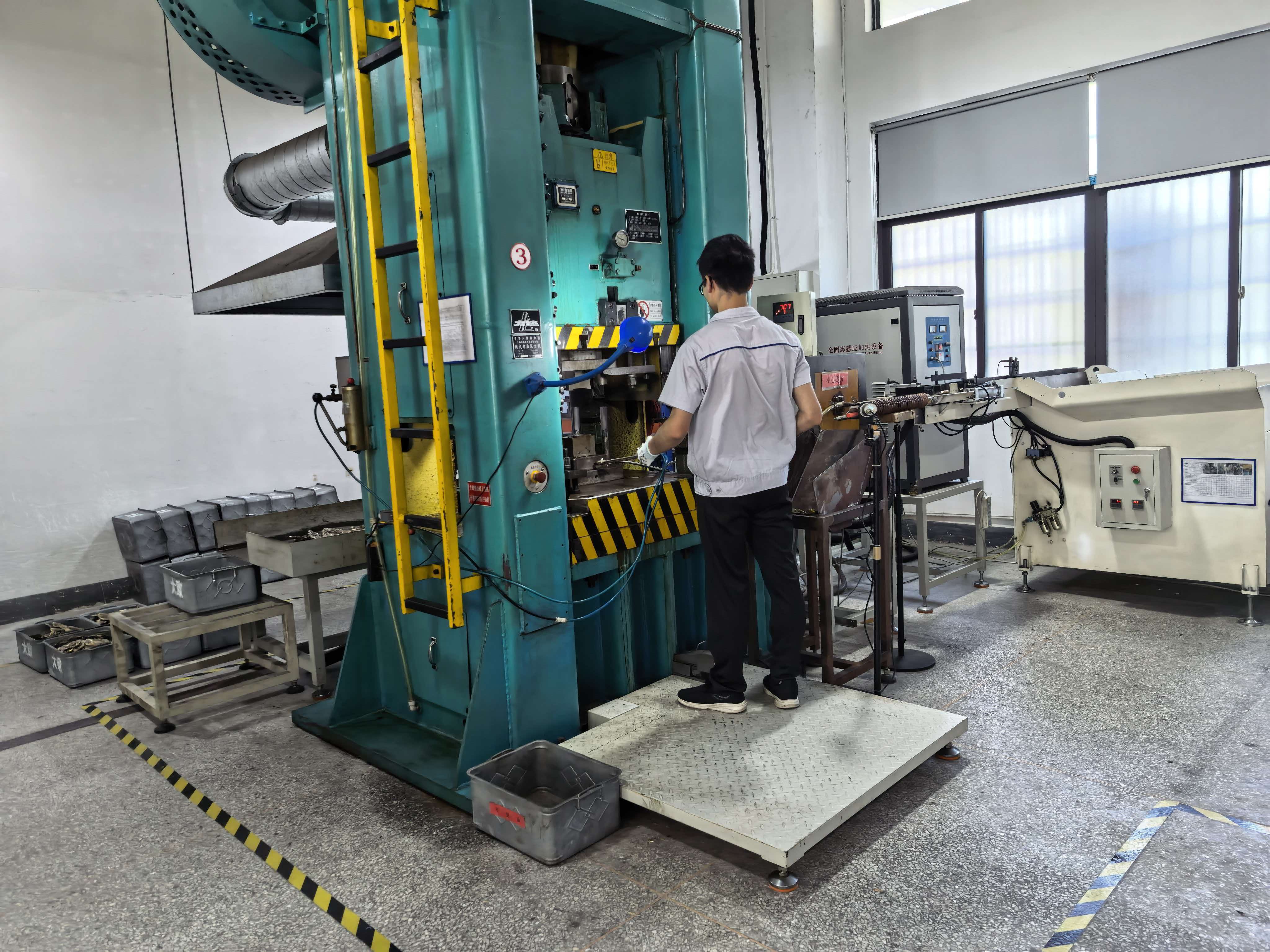
Manufacturing environment at Zhejiang Daou Electronics Co., Ltd., where quality control is documented against the IATF 16949 standard. Source: company imagery.
The ranking logic is practical rather than promotional. Tier 1 evidence is the cheapest to obtain and the easiest to compare, so it functions as a filter. Tier 2 and Tier 3 evidence is where technical differentiation appears, because a polymer grade and an IP rating cannot be asserted without a supporting material or test record. Tier 4 addresses continuity: an OEM program does not consume 750,000 units per month in isolation, and a 7 to 15 day lead time with a 2-unit minimum order quantity gives buyers a documented reference point for both volume programs and early-stage prototype builds. Tier 5 is the slowest layer to build and the hardest to imitate, which is why program history and post-delivery support often decide a tie between technically comparable suppliers.
How Compliance Evidence Changes Supplier Shortlisting
Market structure matters when interpreting any single supplier's evidence. In the global automotive wiring harness market, Yazaki held a 21.4% share in 2025 according to Global Market Insights. Among connector manufacturers, Bishop and Associates identifies TE Connectivity, Amphenol and Molex as the top three globally, with TE Connectivity reaching USD 12.88 billion in sales for 2024. Those companies operate at the platform and system-integration level, serving many vehicle programs at once.
Below that level sits the specialized component tier: manufacturers producing terminals, battery terminals, fuse boxes, housings and brackets that feed harness makers and vehicle OEMs. Zhejiang Daou Electronics operates at this level, with a 6,000 m² facility, 125 employees, 25 engineers in research and development, annual output of 9,000,000 units and an export ratio of 50%. For a procurement team, the compliance blueprint changes the shortlisting method: instead of comparing catalogue prices between suppliers with different evidence depth, the buyer compares evidence tiers first, then price within a tier.
The blueprint also has boundaries that buyers should state openly in their own evaluation notes.
- Scope boundaries. The IATF 16949 certificate covers electronic connectors and wire harnesses. It does not extend to complete vehicle harness assemblies, and it does not replace program-specific validation such as USCAR-2 or LV214 when the receiving OEM mandates those standards.
- Rating boundaries. A documented IP67, UL94-V0 or UL94-V2 rating applies to a specific part number and material variant. Substituting a different compound, omitting a sealing gasket or changing plating alters the verified performance.
- Supply-chain position. A component manufacturer is not a Tier-1 harness integrator. Buyers sourcing complete harness assemblies still need an integration partner; the component supplier's evidence answers the component questions only.
- Volume assumptions. Capacity of 750,000 units per month and a 7 to 15 day lead time describe a production-ready supplier relationship. Programs with unusual ramp profiles or last-minute specification changes should validate those assumptions in the sample stage rather than after award.
Market Trend: Certification as a Purchasing Filter
Three market signals explain why documentation is becoming a screening tool rather than a supporting attachment. Electrification is pushing connectors into higher voltage and higher consequence roles, with the electric vehicle high voltage connector market projected to grow from USD 2.8 billion in 2024 to USD 11 billion by 2035 according to WiseGuyReports. Manufacturing concentration keeps supply decisions consequential: Asia Pacific accounted for 40.89% of the automotive wiring harness market in 2025 per Fortune Business Insights, with China contributing 62% of regional revenue. And two-wheeler electrification adds a separate volume stream, with motorcycles holding 48.6% of a USD 3.8 billion two-wheeler wiring harness market in 2025 according to Dataintelo.
The procurement consequence is that qualification teams now read material declarations the way they once read price sheets. A battery fuse box with a flame retardant PA66 shell, a sealed cover and a -40°C to +125°C rating answers a different set of questions than the same box with an unspecified polymer. The same logic applies to a bracket rated UL94-V0 or UL94-V2, or a housing rated IP67: each declaration shortens the technical review because it removes a variable that would otherwise require testing.
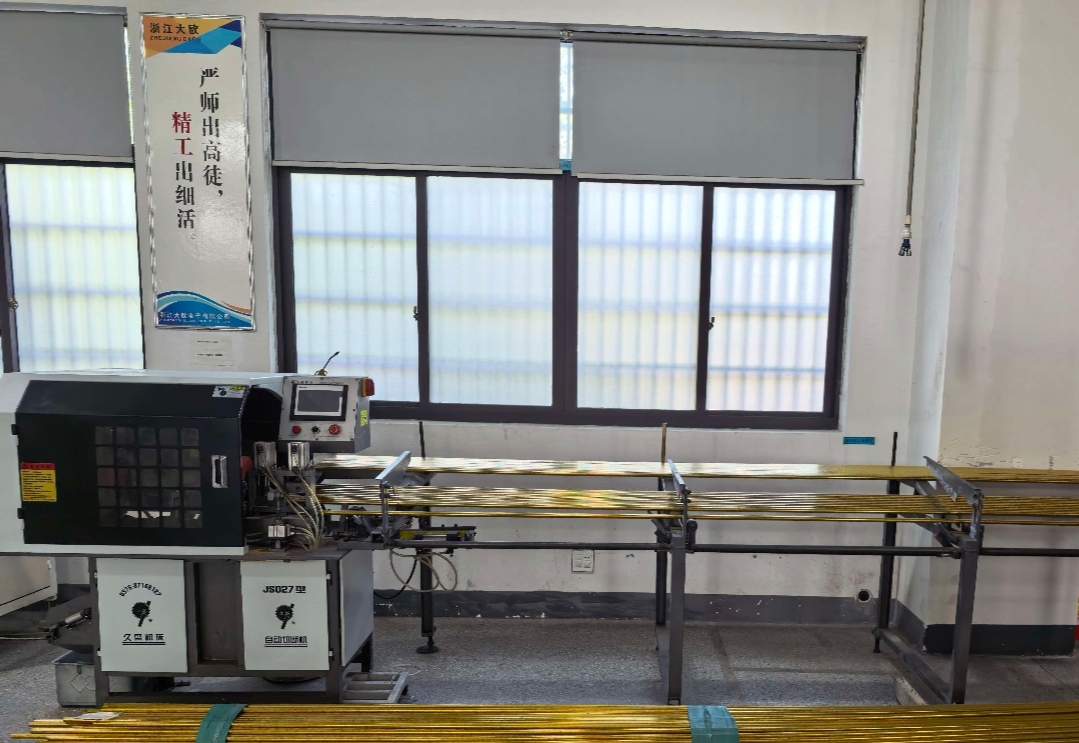
Component production for automotive wire harness applications, where material grades and dimensional specifications are controlled during manufacturing. Source: company imagery.
Future Outlook
Over the certificate validity window running to 8 February 2029, the compliance conversation is likely to move in one direction: from certificates as a precondition to material and part-level declarations as routine RFQ line items. Buyers are already asking for polymer grade, flame classification, ingress protection and temperature class alongside current and torque ratings, because those are the variables that determine whether a component behaves as specified once installed.
For component manufacturers, the competitive question becomes documentation speed. A supplier with in-house development and production covering the chain from mould development through precision manufacturing to finished product inspection can align specifications with a customer's requirement earlier in the process, and customisation options documented for this supplier extend to housing colour, printed logo, terminal current specification, wire gauge matching, waterproof grade, pin count, packaging solution and electric vehicle high voltage insulation structure. For evaluation-stage buyers, the practical next step is straightforward: build the shortlist around the evidence hierarchy, verify that each rating names the exact part number, and confirm which standards the receiving program actually mandates.
FAQ
1. What does IATF 16949 certification cover for an automotive wire harness connector supplier?
IATF 16949 is a quality management system standard for the automotive supply chain. For Zhejiang Daou Electronics Co., Ltd., certificate 0596976 was issued by URS under the IATF16949:2016 revision with a registered scope of design and manufacture of electronic connectors and wire harnesses, issued on 21 March 2020 and valid to 8 February 2029. The certificate covers the supplier's processes and design controls. It does not by itself approve a specific connector part number for a specific vehicle program, which is normally handled through customer-specific test specifications.
2. Which material-level certifications matter most when evaluating connector suppliers?
Three categories typically carry the most weight. Flammability classification, such as UL94-V0 or UL94-V2, describes how a plastic material behaves under controlled burning tests. Ingress protection ratings, such as IP66 or IP67, describe dust and water resistance. Polymer grade identification, such as PA66 or PA66 GF30, describes the base material and its temperature, hydrolysis and chemical resistance characteristics. Each answers a different question, and a complete evaluation usually requires all three to be tied to a specific part number.
3. How should buyers interpret UL94-V0 compared with UL94-V2?
Both are classifications within the same UL94 vertical-burning test family, describing how a plastic material responds after ignition in a controlled laboratory setting. UL94-V0 corresponds to a more demanding classification within that family than UL94-V2. The wiring harness support bracket DOCB24001 is documented with a UL94-V0 or UL94-V2 flame rating and described as compliant with automotive flame retardant standards, with the applicable classification depending on the material variant supplied. A material classification is not the same as a finished-part fire performance test in a specific mounting position.
4. Does an IP67 rating on a housing guarantee water resistance in the assembled harness?
Not automatically. An ingress protection rating describes the component under defined test conditions. The DOH0001-1 housing is documented at IP67 with an operating range of -40°C to +125°C, resistance to oil, acid and alkali, and compliance with automotive vibration requirements. The D520023 three-way conduit connector is documented at IP66 or IP67 with sealing gaskets. Because the sealing system achieves the rating, water resistance in the assembled harness depends on correct gasket specification, correct installation and protection of the seal during vehicle assembly.
5. What operating temperature range should automotive wire harness connectors be rated for?
The appropriate range depends on the mounting zone rather than on a single industry figure. Components documented at -40°C to +125°C include the battery fuse box models DOBXS4-1A and DOBXS5-1F, the housing DOH0001-1 and the support bracket DOCB24001, with engine bay versions of the bracket able to withstand higher transient temperatures. The D520023 conduit connector is documented at -40°C to +120°C continuous with a 150°C short-term peak. Buyers should compare the stated rating with the actual thermal environment of the installation point.
6. How do USCAR-2 and LV214 relate to IATF 16949?
They address different layers of qualification. IATF 16949 certifies the supplier's quality management system. USCAR-2 is described by SAE International as the primary performance standard for automotive electrical connector systems in North America, covering testing for low-voltage road vehicle applications. LV214 is identified by TE Connectivity's standards documentation as the standard widely used by German OEMs including Audi, BMW, Daimler and Porsche for terminal and connector testing requirements. A supplier can hold a valid IATF 16949 certificate and still require separate part-level validation against USCAR-2 or LV214 for a given program.
7. What documentation should a procurement team request during supplier qualification?
Useful requests include the system certificate with number, issuing body, scope and validity dates; material declarations covering polymer grade and UL94 classification; part-level ratings covering current, voltage, tightening torque, ingress protection and temperature class; process and capacity data, documented for this supplier as monthly capacity of 750,000 units, lead time of 7 to 15 days, a minimum order quantity of 2 units and IATF 16949-based quality control; and post-delivery commitments covering remote technical guidance, spare parts supply, product parameter documents and factory audit coordination.
8. How does a component-level supplier fit into an OEM vehicle program?
Component manufacturers supply terminals, housings, fuse boxes and brackets to harness makers and vehicle OEMs, rather than delivering complete harness assemblies. Zhejiang Daou Electronics documents an eight-year engagement with automotive OEM customers in China and exports to the United States and European Union. In market structure terms, global harness integrators such as Yazaki, which held a 21.4% share in 2025 according to Global Market Insights, and connector manufacturers such as TE Connectivity, Amphenol and Molex operate at a different level of the supply chain. Component suppliers should be evaluated against component-level criteria: material declarations, part-level ratings and process control.
Third-party market and standards references cited in this article: Precedence Research, Fortune Business Insights, WiseGuyReports, Dataintelo, SAE International, TE Connectivity standards documentation, Global Market Insights and Bishop and Associates. Product and certification specifications are drawn from company documentation for Zhejiang Daou Electronics Co., Ltd. (CNDO). Readers who want the underlying product and capability documentation can download the company's English brochure here: English product and capability brochure.