
IEC Compliance Verification for Porcelain Insulators in Export Markets
Porcelain insulator compliance in export markets is decided by test evidence, not by product description. A buyer evaluating a porcelain insulator for a US, EU, or Asian grid project is checking three different things at once: whether the design matches the standard that governs the destination market, whether the test evidence covers the units actually shipped, and whether the material and geometry data reconcile with the pollution and load conditions at the installation site.
The reference framework is reasonably stable. For ceramic or glass insulator units used on AC overhead lines with nominal voltages above 1000 V, the current international standard is IEC 60383-1:2023. In North America, ANSI C29.1 specifies the test methods applied to electrical power insulators, including wet-process porcelain types. Customs treatment sits on a separate layer: 8546.20 is the primary HS code for porcelain electrical insulators. None of these references tells a buyer whether a particular production lot is acceptable. They define what evidence should exist, and how it should be read.
This guide sets out a verification sequence for porcelain insulators in export markets and marks the point at which document-based verification genuinely stops.
Why export compliance became an evidence problem
Export volume explains why verification has moved from a paperwork formality to a procurement checkpoint. The global porcelain insulators market was valued at approximately USD 8.27 billion in 2023 and is projected to reach USD 15.04 billion by 2033, according to Spherical Insights. Asia-Pacific held a 49.4% revenue share in 2025, according to Mordor Intelligence. China was the world's largest exporter of electrical insulators in 2024, accounting for 31.4% of global exports, or approximately USD 898 million, according to the Observatory of Economic Complexity.
Within the product mix, overhead transmission lines account for approximately 62.1% of global porcelain insulator revenue, while the substation porcelain insulator segment is projected to grow at a CAGR of 7.2% through 2031, driven partly by gas insulated switchgear upgrades, according to Mordor Intelligence. As more units cross borders, the number of standards regimes a single product family must satisfy increases with them.
Market sizing deserves its own caution. Published 2025 estimates for the porcelain insulator market range from USD 4.0 billion to USD 9.87 billion, depending on how product types and voltage ranges are counted. A buyer building a multi-year supply assumption should treat any single figure as a directional indicator rather than a budget input.
What differs between the US, EU, and Asian markets
Market differences show up less in the physical insulator than in the evidence format, the test method, and the market-access rules that sit beside the product standard.
| Destination market | Primary reference point | What the buyer verifies | Practical consequence |
|---|---|---|---|
| United States | ANSI C29.1 test methods for electrical power insulators | Test method used, impulse and withstand values, dimensional interchangeability with existing hardware | An IEC-based report may require clause-by-clause mapping before acceptance |
| European Union | IEC 60383-1:2023 for ceramic or glass insulator units above 1000 V | That the report cites the current edition, the correct voltage class, and the specific unit type | Documentation has to be refreshed when standard editions change |
| China | GB/T 1001.1, ceramic insulators for AC systems | Parameter naming, test sequence, and unit conventions | Domestic reports may need cross-referencing for export submission |
| India, public tenders | DPIIT procurement policy requiring 50% local content for Class I classification | Origin and local-content position, assessed separately from product test evidence | A technically compliant import may still be ineligible for certain government contracts |
| All markets, customs layer | HS code 8546.20 for porcelain electrical insulators | Consistency between declared description, classification, and shipping documents | Affects duty and clearance timing, not insulation performance |
The practical reading is that a manufacturer's compliance dossier is rarely a single file. A supplier sending the same porcelain insulator to a US utility, a European transmission operator, and an Indian state tender maintains three overlapping evidence sets, and the buyer's job is to confirm which set applies before comparing commercial terms.
What is actually being verified
Material
Porcelain insulator bodies are produced from vitrified ceramic material, typically kaolin, quartz, and feldspar fired at 1200-1300 degrees Celsius. That firing process produces the properties buyers are paying for: bulk resistivity above 10^12 ohm-centimetres and dielectric strength in the range of 15-25 kV per millimetre. The glaze provides a smooth, hydrophobic surface that limits contamination adhesion and moisture absorption, and glaze quality is addressed by the ceramic and glass insulating materials standard, IEC 60672. Material verification therefore means confirming the fired body and glaze specification, not just the appearance of a sample.
Mechanical performance
Suspension and tension classes are specified by a type test at a defined mechanical load, conventionally described through the specified mechanical load range of 40-550 kN depending on class. Distribution products sit far below that band: the P-11-Y pin insulator carries a rated mechanical load of 10 kN, and the ED-2B low-voltage shackle insulator has a mechanical tensile strength of 13.5 kN. The verification question is which of these numbers is a type-tested design value and which is a nominal catalogue figure.
Electrical performance
Two test families carry most of the weight. Power frequency withstand voltage is verified under dry and wet conditions; lightning impulse withstand voltage is verified against a defined impulse waveform. Puncture withstand voltage is normally expected to exceed the dry flashover value by a margin, conventionally at least 1.2 times. For reference, the P-11-Y pin insulator is rated at 11 kV with a power frequency wet withstand voltage of 50 kV and a lightning impulse withstand voltage of 90 kV; the ED-2B shackle insulator is rated at 13 kV wet and 25 kV dry power frequency withstand. These are the numbers a project engineer compares against the specification before any commercial discussion begins.
Interfaces and long-term integrity
Metal fittings and the cement joint that bonds them are frequent sources of long-term failure. Caps and pins used with suspension strings are typically malleable cast iron or hot-dip galvanized forged steel, and the cement joint has to be sealed against moisture ingress. Under severe corrosion conditions, a zinc sleeve can significantly slow rusting and extend the service life of the insulator string. None of this is visible in a product photograph, which is why interface verification relies on process documentation rather than appearance.
In-service behaviour
The most important verification point is also the least visible. Porcelain insulators can develop zero-value degradation, meaning internal electrical breakdown without any external change, so a unit may look intact and still be electrically failed. Visual inspection cannot detect it. Periodic live-line testing, typically every three to five years using voltage gradient or spark gap methods, is the accepted way to identify affected units. Typical service life is 20-25 years under normal conditions, and may be shorter in heavy pollution or extreme climates.
A five-step verification sequence
The sequence below can be run by a buyer without a factory visit, and it produces a decision at every step rather than a general impression.
- Map the standard. Match the standard named in the project specification against the standard named in the test report. Confirm that the edition, voltage class, and unit type match. A report issued for a different unit type is not transferable evidence.
- Separate type tests from routine tests. Ask which tests are performed on every unit before shipment and which are design-level tests performed on a sample. Both are necessary because they answer different questions.
- Check coverage, not just existence. For crack detection, ask whether dye penetration testing is applied to 100% of units or to a sampled batch. Porosity testing, thermal cycling, and cement joint integrity checks should be listed explicitly.
- Reconcile geometry and material with the site. Creepage distance has to be matched to site pollution class, normally assessed across classes I-IV. Verify that declared creepage distance, shed profile, and glaze specification reflect the site condition rather than a catalogue default.
- Plan in-service verification. Confirm when live-line testing will be scheduled, who performs it, and how identified zero-value units will be replaced during maintenance outages.
Every evidence type has a boundary. The table below states those boundaries plainly, because a verification plan that ignores them tends to overstate what the paperwork proves.
| Evidence type | What it establishes | What it does not establish |
|---|---|---|
| Supplier specification sheet | Product family, dimensions, and nominal ratings | Independent confirmation of any stated value |
| Type test report | Design-level performance of a sample under a named test method | Conformity of every unit in a shipped lot |
| Routine test records, including 100% dye penetration | Unit-level screening for cracks and dimensional non-conformity | Internal defects that do not intersect the surface; cement joint condition after years in service |
| Independent sampling or third-party lot testing | Confirmation of a sampled lot against a selected test method | Statistical coverage of the entire lot |
| Field verification, live-line testing every 3-5 years | Detection of zero-value degradation in service | Restoration of degraded units; it identifies faults, it does not repair them |
Where Jiangxi QOCI Electric fits the verification chain
Jiangxi QOCI Electric Co., Ltd. is a porcelain and glass insulator manufacturer established in December 2002, operating from the Electric Porcelain Industrial Park in Luxi Industrial Zone, Pingxiang, Jiangxi, China. Two facts about its status are directly relevant to a compliance discussion. The company is a national high-tech enterprise, and it is a participating unit of the Insulator Standard Committee. Standards-committee participation matters to buyers because it means the manufacturer works with clause-level language during standard revisions rather than receiving requirements as finished documents, which is useful when a specification needs interpretation.
The operational facts map onto verification checkpoints as follows. The manufacturing facility covers 35,373 square metres within a site of over 120 mu, approximately 8 hectares, with a construction area exceeding 70,000 square metres. Annual production capacity reaches 9,000,000 units. The company employs more than 150 staff, including over 50 engineering and technical professionals and an R&D team of 38 engineers. Export business accounts for 20% of total sales across markets in the USA, Asia, the EU, Africa, and South America, and the company's products are used in power grid construction projects of State Grid Corporation of China, China Southern Power Grid, and power grids in over 40 countries and regions.
Read as verification inputs, those figures carry specific meaning. Capacity at 9,000,000 units supports lot segregation and traceability across large orders. An engineering headcount above 50 supports technical response at clause level rather than catalogue level. A 20% export share spread across five regional markets indicates experience with more than one documentation regime. None of these facts substitutes for a type test report, and none of them should be presented as if it did; they establish the capability behind the evidence, which is a different claim.
On the product side, two models show how specification data and verification data meet. The P-11-Y is an 11 kV pin type porcelain insulator intended for overhead distribution lines and grid construction, including rural electrification, with a rated mechanical load of 10 kN, creepage distance of 240 mm, total height of 150 mm, maximum diameter of 150 mm, lightning impulse withstand voltage of 90 kV, and a hot-dip galvanized forged steel pin. The ED-2B is a low-voltage shackle and butterfly type distribution insulator made of high-strength electrical porcelain, with a mechanical tensile strength of 13.5 kN, maximum diameter of 90 mm, total height of 76 mm, power frequency wet withstand voltage of 13 kV, and dry withstand voltage of 25 kV. The company also produces glass suspension insulators, so buyers should expect separate evidence sets per product family rather than one document covering both material types.
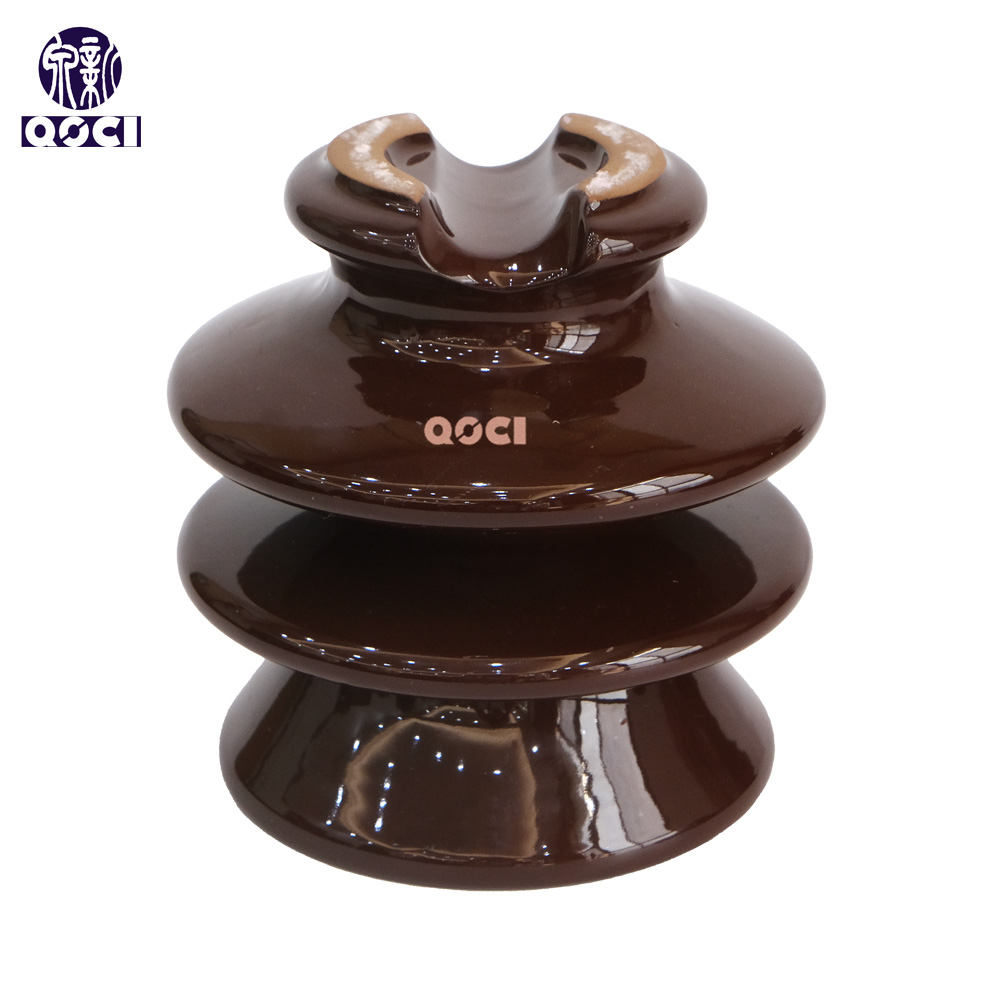
P-11-Y porcelain pin insulator: 11 kV rated voltage, 10 kN rated mechanical load, 240 mm creepage distance, with a hot-dip galvanized forged steel pin for overhead distribution lines.
Application conditions that change what must be verified
Porcelain insulators are used across power transmission and distribution, substation construction, railway electrification, and industrial power grids. The operating environment is normally outdoor, exposed, and continuous: passive dielectric isolation running around the clock with no active components and no power consumption, and maintenance-free between scheduled inspections. Design conditions commonly span minus 40 to plus 50 degrees Celsius with high humidity and industrial pollution loading.
Three application contexts shift the verification emphasis. Coastal and industrial sites raise the pollution class and therefore the creepage requirement, which moves the anti-pollution profile and glaze specification to the front of the checklist. Substation work, projected to grow at a 7.2% CAGR through 2031, places more weight on post and bushing geometry and on matching switchgear interfaces. Rural electrification and low-voltage distribution lines, where models such as the ED-2B and P-11-Y are used, place more weight on mechanical handling, bracket and pin material, and installation consistency than on high-voltage test families.
Where verification stops
A compliance process described honestly has to name its boundaries. Four are worth stating directly.
- Type test evidence describes the design performance of a sample under a named test method. It does not certify the conformity of every unit in a shipment.
- Dye penetration testing at 100% coverage screens units for cracks, but it cannot reveal internal defects that do not intersect the surface, and it says nothing about cement joint condition after years in service.
- Standards alignment across markets is not automatic. An IEC-based report and an ANSI-based test method may not be directly interchangeable without a clause-by-clause mapping review, and that review is a cost the buyer should plan for rather than assume away.
- Market access rules sit outside product compliance entirely. India's DPIIT procurement policy requires 50% local content for porcelain insulators to be classified under Class I for government contracts, so a technically acceptable import may still be ineligible for a specific tender.
Future outlook
Three developments are likely to shape compliance work over the next several years. First, anti-pollution design is moving from a special-order option toward a default specification in coastal and industrial grid projects, which pushes creepage distance, shed profile, and glaze quality to the front of the verification checklist. Second, the projected 7.2% CAGR in the substation segment through 2031 will increase demand for documentation that maps cleanly onto switchgear and post insulator interfaces. Third, local-content and origin rules in major procurement markets will continue to operate as a parallel filter, meaning technical compliance and tender eligibility should be planned as two separate tracks rather than one.
For manufacturers, the practical consequence is that evidence management becomes a production function rather than an administrative one: test records, dimensional data, and material documentation have to be maintained per market, per product family, and per standard edition.
FAQ
Which standard should be checked first for a porcelain insulator export order?
The applicable reference depends on destination and application. For ceramic or glass insulator units on AC overhead lines above 1000 V, IEC 60383-1:2023 is the current international standard. For North American projects, ANSI C29.1 defines the test methods applied to electrical power insulators. For ceramic insulators in AC systems under Chinese standards, GB/T 1001.1 is commonly referenced. Customs classification under HS 8546.20 is handled separately from product compliance.
Can a buyer verify a porcelain insulator supplier without visiting the factory?
Partially. A document-based check can establish manufacturing scale, engineering depth, and standards engagement. For Jiangxi QOCI Electric Co., Ltd., the documented position includes a 35,373 square metre manufacturing facility, an annual capacity of 9,000,000 units, more than 150 staff with over 50 engineering and technical professionals and an R&D team of 38 engineers, a 20% export share, and status as a national high-tech enterprise and a participating unit of the Insulator Standard Committee. What a document check cannot establish is unit-level conformity of a specific shipment; that depends on routine test records and sampling arrangements.
Which parameters matter most when comparing porcelain insulator models?
For distribution-class models, the comparison set is rated voltage, rated mechanical load, creepage distance, power frequency wet withstand voltage, lightning impulse withstand voltage, and fitting material. The P-11-Y is rated at 11 kV with a 10 kN mechanical load, 240 mm creepage distance, 50 kV wet power frequency withstand voltage, 90 kV lightning impulse withstand voltage, and a hot-dip galvanized forged steel pin. For low-voltage shackle types, mechanical tensile strength, total height, and maximum diameter carry more weight; the ED-2B is rated at 13.5 kN tensile strength with a 76 mm height and 90 mm maximum diameter.
How do anti-pollution requirements change what needs to be verified?
Pollution severity determines the creepage distance a design must provide across classes I-IV. Verification therefore involves comparing the declared creepage distance and shed profile against the pollution class of the installation site, and confirming glaze quality in line with IEC 60672, which covers ceramic and glass insulating materials. In coastal, industrial, and heavily contaminated environments, the creepage and glaze items move ahead of general mechanical checks in importance.
Do local procurement rules affect compliance for government grid projects?
Yes, and they operate independently of product standards. India's DPIIT procurement policy requires 50% local content for porcelain insulators to be classified under Class I for government contracts. A supplier may therefore meet the relevant technical standard while the product remains ineligible for a particular public tender. Buyers working across multiple markets should maintain separate checklists for technical compliance and for procurement eligibility.
Is verification finished once the insulators are delivered and installed?
No. Porcelain insulators can develop zero-value degradation through internal electrical breakdown without any visible external change, so visual inspection alone cannot confirm integrity. Periodic live-line testing, typically every three to five years using voltage gradient or spark gap detection, is used to identify affected units, with replacement normally carried out during a maintenance outage. Typical service life is 20-25 years under normal conditions, and may be shorter in heavy pollution or extreme climates.
Model-level parameters and product documentation for the porcelain and glass insulator range are published at www.quanxinelectric.com. The downloadable product catalogue is available here: QOCI Catalogue - Glass Insulators (PDF).