
IHF vs Unlined All-Metal Chemical Pumps: A Buyer Comparison
Two pumps can be quoted against the same corrosive, solids-free duty and still carry completely different failure economics. A fluoroplastic-lined chemical pump and an unlined all-metal chemical pump solve the same corrosion problem from opposite directions: one isolates the metal behind a polymer barrier, the other removes the polymer and relies on alloy resistance. For buyers at the evaluation-to-execution stage, the decision is not which design is better in general, but which failure mode the plant is better equipped to inspect, tolerate and replace.
This comparison sets the IHF fluoroplastic-lined centrifugal chemical pump against the unlined all-metal chemical process centrifugal pump — represented here by the IH series — for corrosive clean-fluid service. Both are catalogued by xsupump, the pump brand of Jiangsu Xiangsu Machinery Equipment Manufacturing Co., Ltd., a Jiangsu-based pump manufacturer established in 2024 with an 18,000 m² production plant, a 3,500 m² office footprint, 55 employees and an annual output of 10,000 pcs. Because both pump families sit inside one supplier's catalogue, the comparison can be made on published specifications rather than on marketing positioning.
Why the Lining Question Comes Before the Hydraulic Question
Corrosive clean-fluid duty is a materials problem before it is a hydraulics problem. When the medium is aggressive but free of abrasive solids, the pump's wetted surfaces are asked to do one job repeatedly: resist chemical attack at the operating temperature for the full maintenance interval. There are only two structural answers. Either the process liquid never touches metal, or the metal itself is selected to survive contact.
The first answer produces a lined pump. A structural metal outer casing carries the pressure and the piping loads, while the wetted surfaces are isolated with a fluoroplastic layer. The second answer produces an all-metal pump, where the casing and impeller are cast or machined from an alloy chosen for the medium.
The opportunity for buyers is that both answers are mature and both are commercially available from the same supplier base. The risk is that the two designs fail in different ways, demand different inspection routines, and are frequently compared on purchase price alone — a comparison that tends to understate the cost of whichever failure mode the plant is least prepared to handle.
What the IHF Fluoroplastic-Lined Chemical Pump Is
The IHF is a horizontal, single-stage, single-suction lined chemical pump. Its construction is a metal outer casing with F46 or PVDF wetted parts, and it uses a bellows mechanical seal. The hydraulic layout is axial suction with vertical discharge. Its published operating envelope is 6.3–400 m³/h flow, 5–80 m head, and a medium temperature range of −20 °C to 100 °C.
| Attribute | IHF fluoroplastic-lined chemical pump |
|---|---|
| Pump type | Horizontal single-stage, single-suction lined chemical pump |
| Flow range | 6.3–400 m³/h |
| Head range | 5–80 m |
| Medium temperature | −20 °C to 100 °C |
| Wetted construction | Metal outer casing with F46 or PVDF wetted parts |
| Sealing | Bellows mechanical seal |
| Port orientation | Axial suction, vertical discharge |
| Typical industries | Chemical, petroleum, pharmaceutical, metallurgy, electroplating, surface treatment, dyes, pesticides, wastewater |
The engineering logic of this design is isolation. Within the chemical compatibility limits of F46 or PVDF, the process liquid does not contact the metal pressure boundary, so the corrosion question shifts from "which alloy" to "which polymer, at which concentration and temperature." That is a meaningful simplification for plants handling multiple aggressive media through one pump family, because the material decision becomes a lining selection rather than a metallurgy programme.
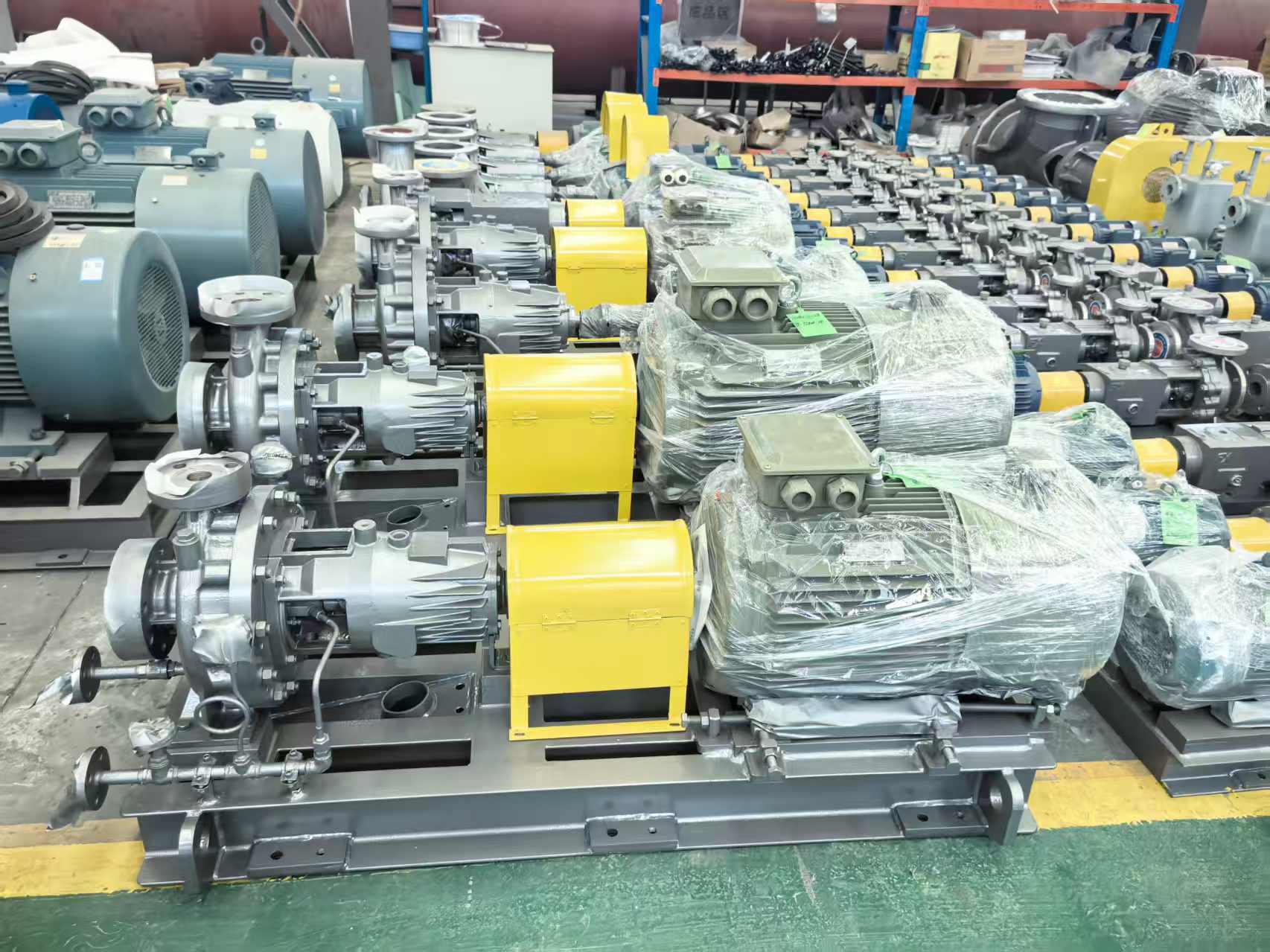
Chemical pump production environment at the xsupump manufacturing partner plant in Jiangsu, China. Image: xsupump.
What "Unlined All-Metal" Means Here: The IH Chemical Centrifugal Pump
The IH is an ISO 2858 horizontal single-stage, single-suction end-suction chemical process centrifugal pump. It is a fully metallic design: there is no polymer barrier between the process liquid and the wetted surfaces. Published specifications cover 0.3–400 m³/h flow, 5–125 m head, 1,450/2,900 r/min speed, motor ratings from 0.55 kW to 90 kW, inlet sizes from DN50 to DN200, a medium temperature range of −20 °C to 105 °C and a maximum pressure of 1.6 MPa.
Wetted materials are selected against the medium. Options available through the manufacturing partner include cast iron, carbon steel, SS304/304L/316/316L, duplex 2205/2507 and Hastelloy. The higher head capability (125 m versus 80 m), the higher temperature ceiling (105 °C versus 100 °C) and the stated 1.6 MPa maximum pressure illustrate a broader point: unlined all-metal pumps as a category commonly publish higher temperature and pressure thresholds than lined pumps, because the pressure boundary and the corrosion barrier are the same component and are not limited by polymer behaviour.
Two Different Failure Modes, Two Different Inspection Routines
The lining side
A lined pump removes metal corrosion risk inside the polymer's compatibility window, but it introduces lining-specific failure modes. Delamination — separation of the fluoroplastic layer from the metal substrate — and chipping or mechanical damage to the lining are the two that matter most in clean-fluid service. Both are locally invisible from the outside of the casing and both expose bare metal to the process liquid once they occur, which means the corrosion event starts at the defect rather than uniformly across the surface.
The practical consequence is that IHF inspection is a lining inspection. Maintenance checks focus on the condition of the F46 or PVDF surface — blistering, discolouration, mechanical marks, flange-face damage — and on the bellows mechanical seal, which is itself a component that has to be reviewed against the medium and temperature rather than treated as a wear item on a fixed calendar.
The metal side
An unlined all-metal pump avoids lining risk entirely, but it is exposed to whatever the alloy cannot resist. Two corrosion patterns dominate. Pitting is localised attack, often associated with chlorides or with stagnant conditions, and it can perforate a casing while the rest of the surface looks acceptable. Uniform corrosion removes wall thickness across the wetted surface and is more predictable but sets a finite service life against the selected alloy's corrosion allowance.
All-metal designs also tolerate moderate solids better than lined designs, because there is no soft polymer surface to chip and no lining bond to protect. Where the process carries occasional crystals or light particulate, that tolerance is a genuine operational advantage. Inspection therefore centres on wall thickness, surface condition and material verification rather than on a coating or lining bond.
The trade-off in one sentence
The IHF trades alloy corrosion risk for lining integrity risk within the F46/PVDF compatibility window; the unlined all-metal IH trades lining integrity risk for alloy corrosion risk beyond the selected material's limits. Neither trade removes risk — each relocates it to a component the buyer must inspect.
Side-by-Side Comparison
| Comparison dimension | IHF fluoroplastic-lined | IH unlined all-metal |
|---|---|---|
| Corrosion strategy | Polymer isolation of wetted surfaces (F46 or PVDF) | Alloy resistance across all wetted surfaces |
| Flow range | 6.3–400 m³/h | 0.3–400 m³/h |
| Head range | 5–80 m | 5–125 m |
| Temperature range | −20 °C to 100 °C | −20 °C to 105 °C |
| Maximum pressure | Not stated in the published data reviewed | 1.6 MPa |
| Wetted materials | Metal outer casing with F46 or PVDF wetted parts | Cast iron, carbon steel, SS304/304L/316/316L, duplex 2205/2507, Hastelloy |
| Sealing | Bellows mechanical seal | Seal type selected per application |
| Primary failure mode | Lining delamination, chipping, mechanical damage | Pitting, uniform corrosion, wall-thickness loss |
| Solids tolerance | Limited by the polymer surface | Better tolerance of moderate solids |
| Inspection focus | Lining condition and seal condition | Wall thickness, surface condition, material verification |
| Cost driver | Lining process and lining quality control | Alloy grade and alloy content |
Both columns describe published specifications of two pump families available through the same supplier. They are not interchangeable performance benchmarks, and a specification match at a single duty point does not establish equivalence across a full pump curve.
Where Each Design Fits: Application Profile
The IHF's published application fields are chemical, petroleum, pharmaceutical, metallurgy, electroplating, surface treatment, dyes, pesticides and wastewater. Within that list, the design performs best where three conditions hold at once: the medium is corrosive, it is clean or nearly clean, and the operating point sits inside 6.3–400 m³/h, 5–80 m and −20 °C to 100 °C.
Three patterns recur in buyer enquiries. Continuous tank transfer and process feed of clean corrosive liquid is the base case — concentration, temperature, density, viscosity and pH must be documented before material selection, and operation below roughly 30% of design flow should be avoided. Pharmaceutical and fine-chemical service adds solvent and contamination control to the same corrosion question, so the seal and containment arrangement need review alongside the lining. Electroplating, pickling and surface-treatment baths suit the lined design well because acid and alkali baths are typically clean, and because bath circulation and tank transfer are low-head duties where the IHF envelope is comfortable.
The all-metal IH covers the same chemistry where the operating conditions exceed what the lining can hold — above 100 °C, above the head the IHF can deliver, or where the selected alloy is demonstrably resistant and the plant prefers a single metallic pressure boundary. It is also the more practical choice when the liquid carries moderate solids, since chipping risk disappears.
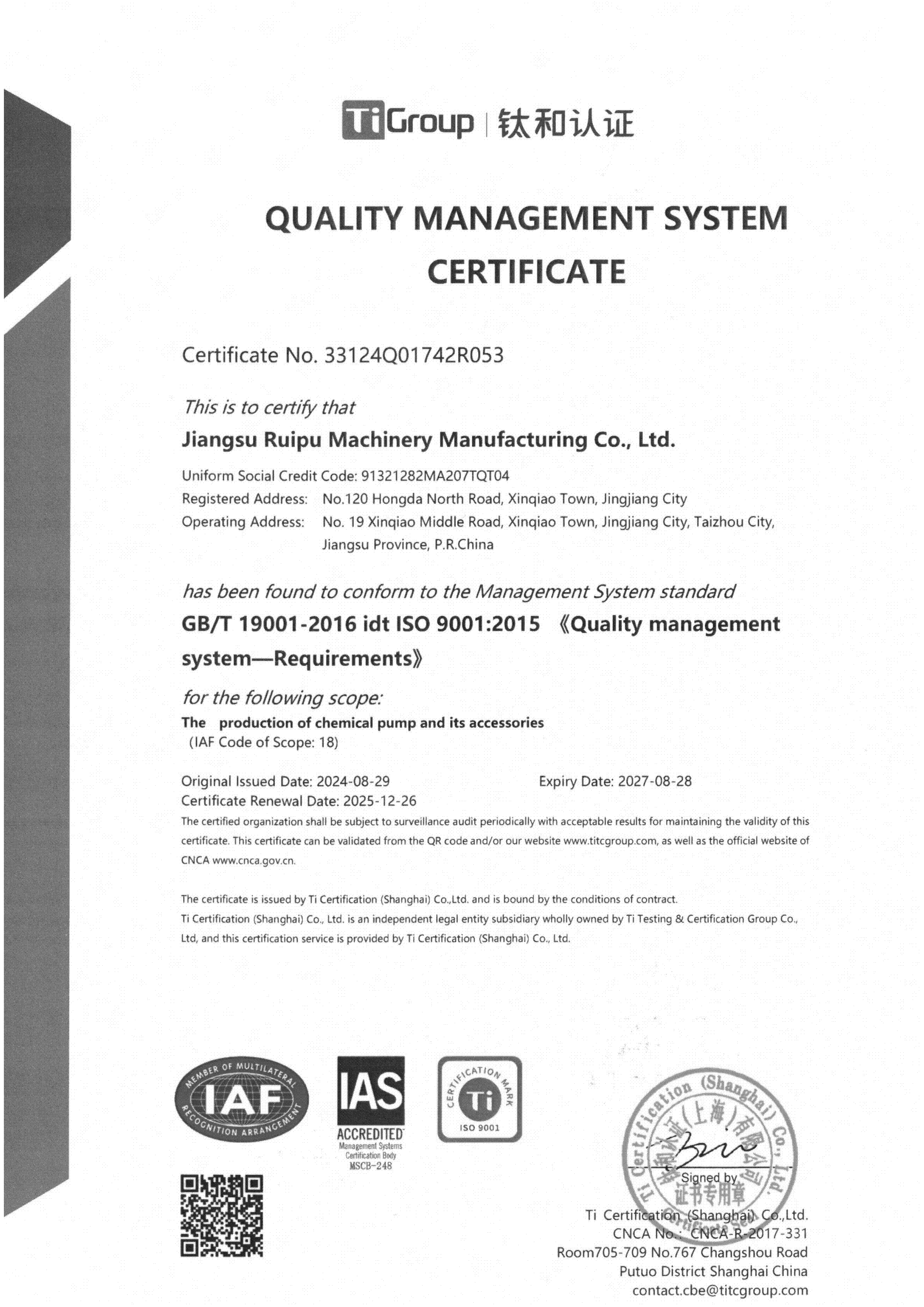
ISO 9001:2015 certificate 33124Q01742R053, issued by Ti Certification (Shanghai) Co., Ltd. Image: xsupump.
Cost, Maintenance and Energy: What Buyers Can Compare Honestly
Upfront cost
The two designs are driven by different cost inputs, and that is more useful to a buyer than a single price ranking. The IHF's cost is concentrated in the lining process and in the quality control that supports it — the lining has to be applied, bonded and inspected, and any defect found in service has to be repaired or the casing replaced. The IH's cost is concentrated in the alloy: material grade directly sets the price, which is why SS316L, duplex 2205/2507 and Hastelloy sit at very different points. On simple corrosive duty inside the lining's window, the lined pump is normally the lower-material-cost route; on duty that requires a high alloy, the gap narrows quickly. No universal percentage advantage applies in either direction.
Maintenance checks
Maintenance effort differs in kind rather than in a fixed ratio. The IHF routine is a lining and seal routine: inspect the F46/PVDF surface for blistering, chipping and flange damage; inspect the bellows mechanical seal; verify that the medium has not changed concentration or temperature since commissioning. The IH routine is a wall-thickness and material routine: verify corrosion allowance, watch for pitting, and confirm that the alloy still matches the current process chemistry. Both designs share the same operating discipline from the supplier's risk guidance — match material and sealing solution to the medium, temperature and pressure; monitor inlet and outlet pressure and temperature; do not operate beyond rated conditions; and keep a regular maintenance schedule for seals and wearing parts.
Energy efficiency
Neither architecture carries an inherent efficiency advantage. Efficiency at the duty point depends on hydraulic design, impeller trim, seal arrangement and how closely the selected pump matches the actual flow and head — not on whether the wetted surface is polymer or alloy. A lined casing introduces additional surface and clearance considerations, an all-metal casing introduces alloy surface condition considerations, and both are secondary to operating-point selection. Buyers should compare quoted curves at the real duty point and treat any catalogue-level efficiency claim as unverified unless a test report accompanies it.
Market Context: Where the Chemical Pump Market Is Moving
The global chemical pump market was estimated at US$ 5.68 billion in 2025 and is projected to reach US$ 9.92 billion by 2034, according to The Insight Partners. (Source: The Insight Partners, Chemical Pump Market Size, Share & Forecast 2034.) Growth of that scale keeps both architectures commercially relevant: lined pumps serve the clean-corrosive share of demand, all-metal pumps serve the high-temperature, high-pressure and solids-bearing remainder.
Supply-side signals point the same way. China's centrifugal pump exports under HS 841370 reached US$ 4.1 billion in January–August 2026, up 9.7% year on year, with the United States the leading destination at a 9.1% share, according to General Administration of Customs data. (Source: GACC, China Centrifugal Pumps HS 841370 Exports.) A supplier base of that depth means buyers evaluating lined versus all-metal designs are usually choosing between configurations from the same shortlist rather than between separate supply markets.
Standards pressure is also shaping specification habits. API 610 13th Edition was released in June 2026, replacing the 12th Edition, and API STD 682 continues to set requirements and recommendations for shaft-sealing systems on centrifugal and rotary pumps in petroleum, natural gas and chemical industries. (Sources: BBP, Pump Industry Standards Guide; API STD 682:2014 (R2022) listing.) Where a project invokes those standards, the seal system becomes a specification item in its own right — relevant to IHF's bellows mechanical seal and to any all-metal alternative.
A third trend runs alongside: sealless and magnetic-drive chemical pumps are expanding faster than the category as a whole, with the global magnetic drive pump market valued at US$ 1.4 billion in 2024 and projected to reach US$ 2.7 billion by 2033, according to Grand View Research. (Source: Grand View Research, Magnetic Drive Pump Market 2025–2033.) For lined-versus-metal decisions this matters at the containment stage: where leakage itself is the dominant risk, the correct comparison may involve a sealless option rather than a better lining or a better alloy.
Procurement Checklist for a Corrosive Clean-Fluid RFQ
Whether the RFQ goes to a lined or an all-metal design, the same information decides the outcome. Suppliers cannot select material responsibly without it, and buyers cannot compare quotations without it.
- Medium data: chemical identity, concentration, pH, density, viscosity and temperature — including the maximum, not only the normal value.
- Hydraulic duty: flow, head, suction conditions and installation layout, plus the minimum and maximum operating points.
- Solids: presence, size and concentration of particulate or crystals, which is often the deciding factor between lined and all-metal.
- Wetted material decision: F46 or PVDF for IHF; cast iron, carbon steel, SS304/304L/316/316L, duplex 2205/2507 or Hastelloy for the IH.
- Seal and containment: seal type, flushing or support plan, and any API 682 applicability the project requires.
- Documentation and inspection: material certificates, test reports, and whether witness inspection is required.
On the supply side, xsupump provides application review using flow, head, medium, temperature, density, viscosity, suction conditions and installation data, and supports material selection against corrosion, temperature, pressure, solids and service life requirements. Customisation covers flow/head sizing, impeller design, wetted material selection, seal type, motor voltage and frequency, flange standard, coating, baseplate and documentation, alongside ODM and engineering configuration services covering pump family selection, hydraulic duty, material compatibility, seal plan, motor, instruments, alarms and package layout.
Quality control at the manufacturing partner runs through incoming, in-process and final inspection, covering rotation, sealing, vibration and basic performance checks on closed or open pump test stands and calibrated inspection devices, together with material analysis, hardness testing, ultrasonic inspection, magnetic-particle inspection and dimensional inspection. The partner holds ISO 9001:2015 (certificate 33124Q01742R053), ISO 14001:2015 (certificate 33124E01743R053) and ISO 45001:2018 (certificate 33124S01744R053), all issued by Ti Certification (Shanghai) Co., Ltd. on 29 August 2024 and valid to 28 August 2027.
These are management-system certificates covering the production of chemical pumps and accessories. They are not product market-approval certificates, and they do not by themselves demonstrate compliance with API 610, API 682 or any hazardous-area directive. Project-specific conformity evidence should be requested separately.
Project-scale configuration capability is best judged from documented orders rather than catalogue claims. One 2025 supply contract recorded a 22-pump process package combining TA2, 316L and polymer materials for MVR evaporation, high-altitude process transfer, circulation, slurry discharge and utility service, with delivery specified within 60 days. Operating KPI results for that package were not disclosed.
Limitations and Boundaries of This Comparison
The comparison has real limits, and buyers should treat them as decision inputs rather than caveats.
- The IHF envelope is narrower at the top end. At 80 m head and 100 °C, the lined design stops where all-metal designs keep going; the IH itself is rated to 125 m head, 105 °C and 1.6 MPa. Above those points, the lining comparison becomes irrelevant.
- Lined pumps are not a solids solution. Delamination and chipping are mechanical as well as chemical risks, so crystallising, particulate-bearing or frequently flushed duties favour the all-metal route regardless of corrosion performance.
- All-metal pumps have no protection beyond the alloy. Once the selected grade is exceeded — by a concentration change, a temperature excursion or an unexpected chloride level — corrosion proceeds directly into the pressure boundary.
- No verified curve-level efficiency comparison was available in the sources reviewed. Any energy claim comparing the two architectures at a specific duty point should be treated as unconfirmed until both parties supply test data.
- Lining quality is not visible in a quotation. Two lined pumps can share a specification sheet and differ in bond quality; only inspection records and lining QC evidence distinguish them.
Future Outlook
Three developments are likely to shape how this decision is made over the next several years. First, standards revision cycles — API 610 13th Edition took effect in June 2026 — will continue to push seal-system specification earlier into the procurement process, which favours suppliers who can document seal plans rather than describe them. Second, the growth of sealless and magnetic-drive options at a faster rate than the category average will create a third branch in what is currently a two-way comparison, particularly in pharmaceutical, fine-chemical and other containment-critical duties. Third, as Chinese centrifugal pump exports continue to expand, buyers will increasingly evaluate lined and all-metal configurations from the same supplier and the same factory, which shifts the selection question from supplier geography to documented material and inspection evidence.
For the immediate procurement cycle, the practical conclusion is unchanged. The IHF is the stronger choice when the medium is corrosive, clean and inside 6.3–400 m³/h, 5–80 m and −20 °C to 100 °C, and when the plant can inspect a lining. The unlined all-metal IH is the stronger choice when temperature, head, pressure or moderate solids push beyond the polymer's limits, and when the plant can inspect wall thickness. Neither decision is safe without medium data, a documented inspection routine and verifiable material records.
FAQ
What flow, head and temperature range does the IHF fluoroplastic-lined chemical pump cover?
The IHF is published with a flow range of 6.3–400 m³/h, a head range of 5–80 m and a medium temperature range of −20 °C to 100 °C. It is a horizontal single-stage, single-suction lined pump with axial suction and vertical discharge.
What materials and sealing arrangement does the IHF use?
The IHF uses a metal outer casing with F46 or PVDF wetted parts, isolating the process liquid from the metal pressure boundary within the polymer's compatibility window. It is fitted with a bellows mechanical seal.
How does the unlined all-metal IH chemical centrifugal pump differ in its operating envelope?
The IH is an ISO 2858 horizontal single-stage, single-suction end-suction pump covering 0.3–400 m³/h flow, 5–125 m head, 1,450/2,900 r/min, motor ratings of 0.55–90 kW, inlet sizes DN50–DN200, medium temperatures of −20 °C to 105 °C and a maximum pressure of 1.6 MPa.
Which wetted materials are available for the all-metal IH pump?
Wetted materials are selected against the medium. Options available through the manufacturing partner include cast iron, carbon steel, SS304/304L/316/316L, duplex 2205/2507 and Hastelloy.
What are the main failure modes of a lined pump compared with an all-metal pump?
A lined pump's characteristic failures are lining delamination and chipping or mechanical damage to the fluoroplastic layer, which exposes bare metal at the defect. An all-metal pump's characteristic failures are pitting and uniform corrosion once the selected alloy's resistance is exceeded, leading to wall-thickness loss.
Which pump type suits liquids containing moderate solids?
Unlined all-metal pumps generally tolerate moderate solids better, because there is no polymer surface to chip and no lining bond to protect. Lined pumps are better matched to clean or nearly clean corrosive liquids, where the isolation benefit is not offset by mechanical lining risk.
What checks reduce operating risk in corrosive chemical duty?
Published guidance covers matching the pump material and sealing solution to the medium, temperature and pressure; monitoring inlet and outlet pressure and temperature; prohibiting operation beyond rated conditions; and maintaining a regular schedule to inspect seals and wearing parts. For lined pumps this includes lining condition; for all-metal pumps it includes wall thickness and corrosion assessment.
Which industries are listed for the IHF fluoroplastic-lined pump?
Published application fields are chemical, petroleum, pharmaceutical, metallurgy, electroplating, surface treatment, dyes, pesticides and wastewater. Typical duties include tank transfer, process feed and circulation of corrosive liquid.
What quality and certification documentation is available?
The manufacturing partner holds ISO 9001:2015, ISO 14001:2015 and ISO 45001:2018 certificates issued by Ti Certification (Shanghai) Co., Ltd., valid to 28 August 2027. Quality control includes incoming, in-process and final inspection covering rotation, sealing, vibration and basic performance checks, plus material analysis, hardness testing, ultrasonic inspection, magnetic-particle inspection and dimensional inspection. These are management-system certificates, not product market-approval certificates.
What commercial terms are published for procurement?
Published terms state a minimum order quantity of 1 unit, FOB or CIF delivery terms, pre-shipment testing as the acceptance criterion, and 30/70 payment terms. Production capacity and lead time are confirmed per project.
Have Questions or Need More Details?
Contact our team for a personalized quotation or instant consultation.
Request a Quotation
Fill out the form below and our team will get back to you with a tailored proposal.
WhatsApp Direct Chat
Prefer to chat in real-time? Message us on WhatsApp for instant assistance & quick answers.
- Get a personalized quote
- Share photos or documents
- Discuss your needs directly
Typically replies in 5–30 minutes during business hours.