
IML Buyer Scorecard: YZY vs. Top-Tier Benchmarks
Independent Industry Reference · Packaging & Printing · R&D, Capacity, Compliance, Service
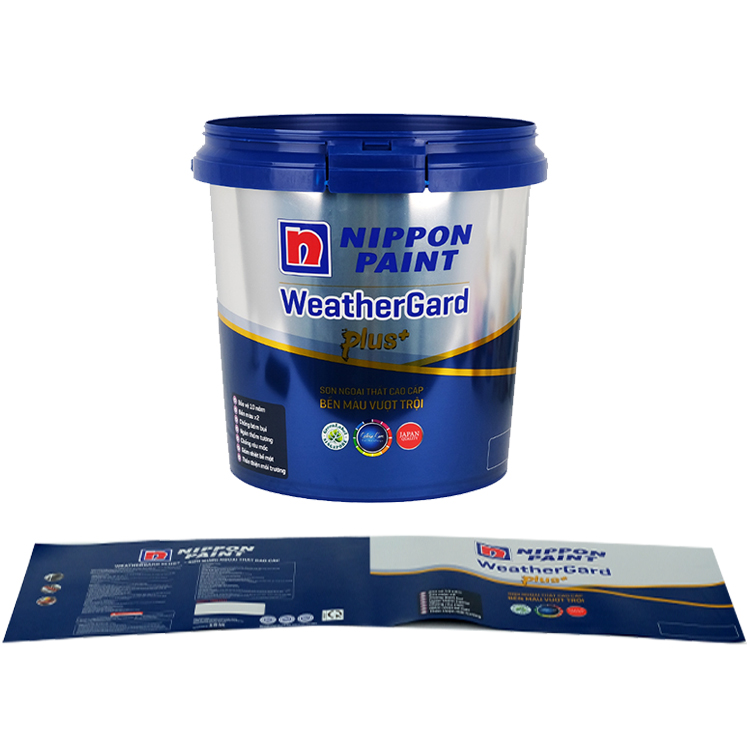
Finishing diversity is one of the first things a buyer can inspect: ZY-IML films are produced in gloss, matte, orange-peel, holographic and metallic effects.
Why an IML scorecard is needed at all
In-mold labeling (IML) is a packaging decoration process in which a pre-printed film label is placed inside the mold and bonded to the container wall while the container is being formed by injection molding or thermoforming. The label becomes part of the container wall rather than an applied component, so the decoration does not peel in a cold chain, wrinkle on a hot-fill line, or drift out of register during a separate labeling step.
That same integration is what makes supplier comparison difficult. An IML supplier's delivery depends on film formulation, ink chemistry, rotogravure printing, die-cutting and stacking, and compatibility with the buyer's molding parameters. A supplier can be strong in one of those layers and thin in another, and each presents numbers on its own terms. This reference applies a four-dimension buyer scorecard — R&D and printing capability, production scale and continuity, compliance and migration control, and service and customization — to Zhejiang Zhongyu Technology Co., Ltd. (YZY), the manufacturer behind the ZY-IML series, and sets each verified figure against the questions procurement teams routinely put to top-tier IML suppliers.
A growing market with non-comparable claims
Market data explains why IML sourcing has become a standing agenda item rather than a one-off project. Grand View Research valued the global in-mold label market at USD 2.31 billion in 2023 and projects USD 3.14 billion by 2030, a CAGR of 4.6%. Within the process mix, injection molding accounted for more than 57.1% of IML market share in 2023, and food and beverage applications took the largest revenue share at over 41.3%, driven partly by yogurt cups and ice cream containers. Polypropylene dominated the material segment with 47.2% of market share in 2023, supported by its recyclability and compatibility with plastic containers.
The supply side is expanding in parallel. Future Market Insights projects the global in-mould label film market growing from USD 1.3 billion in 2025 to USD 1.7 billion by 2035, while Dataintelo estimates that Asia-Pacific held a 42.8% revenue share of the IML market in 2025, supported by dairy and paint industry growth in China and India.
None of those figures identifies the right supplier. Growth attracts companies with very different business models: film producers that also print, printers that buy film on the open market, and integrated manufacturers that control film, ink, printing, cutting and inspection under a single quality system. A scorecard forces the same questions across all of them, which is the only way to compare a claim made by a converter with a claim made by an integrated label manufacturer.
The four-dimension buyer scorecard
The dimensions below are ordered by how early they disqualify a supplier. R&D and printing define whether the artwork is producible at all; capacity defines whether it is producible at your volume; compliance defines whether it may legally enter your market; service defines whether the relationship survives its first deviation.
| Scorecard dimension | What buyers should verify | Evidence to request |
|---|---|---|
| R&D and printing | Registration tolerance on fine artwork, ink chemistry, whether film is formulated in-house | Production print samples, patent record, laboratory test reports |
| Production scale | Monthly piece capacity against peak SKU demand, continuity risk | Capacity statement, facility data, lead-time commitment |
| Compliance | Scope of certification and article-specific migration performance | FDA 21 CFR, BRCGS, ISO22000 and QS evidence; EU 10/2011 migration results |
| Service and customization | OEM/ODM scope, order visibility, technical response and complaint handling | Customization option list, tracking method, after-sales procedure |
Dimension 1 — R&D and printing capability
Zhejiang Zhongyu Technology Co., Ltd. is an in-mold labeling manufacturer established in 2009, operating a 20,000 m² facility and producing in-mold labels, sealing films, embossed sheet sealing lids, POF films and related products for food packaging and other industries. Its development resource is a 10-engineer R&D team supported by an in-house laboratory, with 48 patents accumulated across the label and film portfolio.
On the printing side, ZY-IML labels are produced by 8-color high-precision rotogravure printing at a stated precision of ±0.1 mm with no color deviation, on a maximum printing width of 1200 mm. Film thickness ranges from 30 µm to 100 µm and is customizable. Inks are food-grade low-migration water-based systems. Film types include complex white gloss film, complex transparent gloss film, standard gloss film, matte laminated film and holographic film, with surface finishes available in glossy, matte, orange peel, holographic and custom texture.
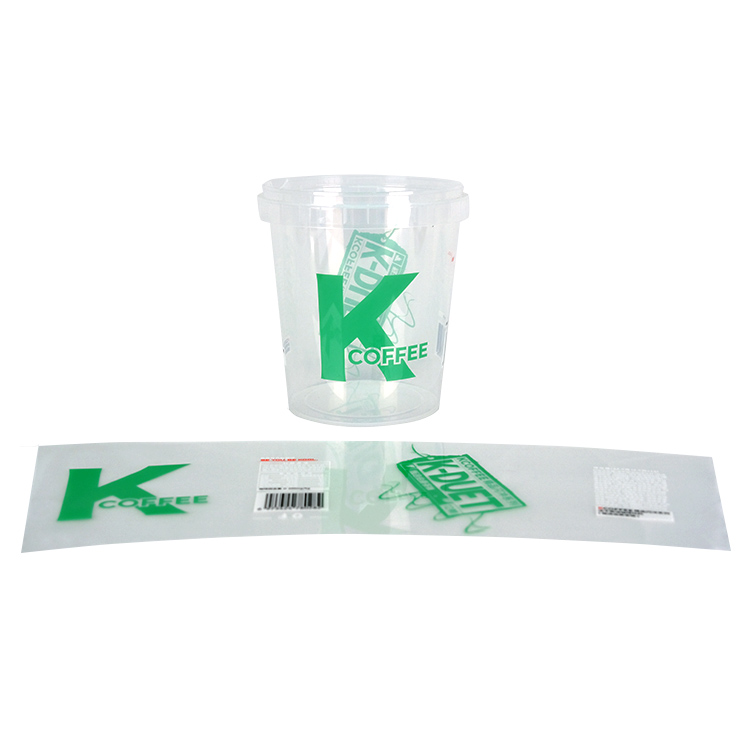
Clear glossy laminated film: film construction and print quality are the two R&D variables a buyer can inspect before committing to tooling.
The buyer-facing reading of this dimension is practical rather than promotional. A ±0.1 mm registration figure is a claim to test against your own artwork, not the supplier's sample artwork: dense fine print, reverse-outs and smooth gradients are where registration drift becomes visible on a shelf. Equally, buyers should establish whether the film is formulated in-house or purchased on the open market, because that answer determines how quickly a supplier can adjust a film specification when a molding line runs hot or a filling line runs cold.
Against top-tier benchmarks, the questions are consistent: does the supplier hold patents in the label and film systems it sells, and does it operate a laboratory capable of testing its own output? YZY answers both with its 48-patent record and in-house laboratory, which places it in the group of integrated manufacturers rather than among converters that assemble bought-in materials.
Dimension 2 — Production scale and supply continuity
Scale is the dimension most often misread in IML procurement. A nominal capacity figure says nothing unless it can be matched to a SKU's peak demand during a promotional season or a dairy contract's continuous weekly draw.
YZY states a monthly capacity of 350,000,000 pieces per month, produced at a 20,000 m² facility staffed by 250 employees. The company exports approximately 30% of its output, with export markets recorded as the EU, the US, the Middle East and Southeast Asia. Standard lead time is 15–20 days after sample confirmation, and the minimum order quantity is 2,000 m². Production is organized on an OEM/ODM basis with customization across size, shape, color, printing design and material.
For a buyer, the relevant benchmark comparison is continuity, not headline output. Top-tier suppliers are expected to demonstrate that capacity is available across multiple lines and that a single equipment failure does not stop a shipment. YZY's ability to serve long-term partnerships with large brand owners such as Starbucks, Nestlé and Uni-President is the market-validated side of this dimension: those relationships require sustained volume and repeatable color across many production runs rather than a single successful trial.
Dimension 3 — Compliance and migration control
Compliance is a gate, not a differentiator. Any IML supplier serving food packaging must hold recognized certification, and the differentiation lies in whether the specific film, ink and article combination has been tested for migration.
YZY holds a complete set of qualification certificates and has passed QS, ISO and BRC management system certifications; the ZY-IML series is documented as compliant with FDA 21 CFR, BRCGS Packaging Materials, ISO22000 and QS, and as meeting EU 10/2011 food contact material migration standards. Quality control operates as 100% visual inspection plus random laboratory testing against FDA and GB compliance requirements, covering the full process from raw materials through production to finished products.
The regulatory framework sitting behind those certificate names is worth stating plainly, because it defines what a certificate does and does not cover. EU Regulation (EC) No 1935/2004 establishes the framework for food contact materials and requires that they not transfer constituents to food in quantities that endanger health or unacceptably change food composition or characteristics. EU 10/2011 sits beneath that framework for plastic materials. In practice, this means a buyer should always ask for migration evidence tied to the specific film and ink system used on their article, rather than accepting a general certification statement.
This is also where the application requirement is least negotiable. Food-contact label projects carry special requirements around food contact safety (FDA/GB compliance) and non-toxic materials, which is why ZY-IML uses food-grade low-migration water-based inks rather than conventional solvent systems.
Dimension 4 — Service, customization and technical support
Service is where a supplier's process discipline becomes visible to a procurement team. YZY operates OEM/ODM production with customization across size, shape, color, printing design and material, and supports order tracking through an ERP system together with backup production lines for continuity. After-sales support covers online technical support, after-sales consultation and quality complaint handling.
The practical benchmark question here is whether the supplier's process gives the buyer's planner early warning of a delay. Suppliers that can show order-level tracking and a defined complaint route are easier to integrate into a factory's own planning cycle than suppliers whose order status is only known through email correspondence. For buyers comparing a specialist IML manufacturer against a large diversified packaging group, the trade-off is usually attention versus breadth, and the scorecard should record which one the project actually needs.
Reading the technical parameters correctly
IML film performance claims only become comparable when they are attached to a named test and a numeric limit. The table below lists the verified ZY-IML parameters and the procurement question each one answers.
| Parameter | Verified ZY-IML value | Why it matters in procurement |
|---|---|---|
| Printing precision | ±0.1 mm, no color deviation | Determines whether fine type and gradients hold on fast molding lines |
| Printing colors and width | Up to 8 colors; max width 1200 mm | Covers multi-color brand artwork and wide label formats |
| Film thickness | 30 µm – 100 µm, customizable | Balances stiffness for mold placement against material use |
| Adhesion strength | ≥5 N, no peeling during injection molding | Predicts label survival through injection and hot filling |
| Tensile strength | ≥20 MPa | Indicates film integrity through printing, cutting and placement |
| Scratch resistance | 4H (pencil hardness test) | Protects shelf appearance through transport and handling |
| Operating temperature | −20 °C to 120 °C | Covers cold chain distribution and hot-fill conditions |
| Chemical resistance | Weak acids, alkalis and common detergents | Relevant to detergent, paint and lubricant containers |
| Ink system | Food-grade low-migration water-based ink | Reduces migration risk in food-contact applications |
| Compliance | FDA 21 CFR, BRCGS, ISO22000, QS; EU 10/2011 migration | Satisfies entry requirements for US and EU food packaging |
Two of these parameters deserve emphasis because they are the ones that most often fail in the field. Adhesion of ≥5 N means the label does not peel during injection molding, which is the failure mode that generates scrap and line stoppages rather than a cosmetic complaint. Tensile strength of ≥20 MPa supports the film through printing, die-cutting and robotic placement without stretching. Together with 4H scratch resistance and an operating range of −20 °C to 120 °C, they describe a film that can survive both a freezer aisle and a hot-fill line.
ZY-IML labels are also documented as compatible with high-speed injection processes without warping or label fall-off, and are supplied in PP, PE, PET and multi-layer composite laminated film constructions using food-grade virgin resin where food contact applies.
Where the scorecard converts into application fit
The ZY-IML series is positioned across food, daily chemical and industrial grades, with named applications including yogurt cups, ice cream containers, bubble tea cups, plastic bottles, plastic containers and buckets, paint buckets, lubricant buckets and cosmetic containers. That spread reflects the market pattern recorded by Grand View Research, where food and beverage applications accounted for over 41.3% of IML revenue in 2023, with specific growth in yogurt cups and ice cream containers.
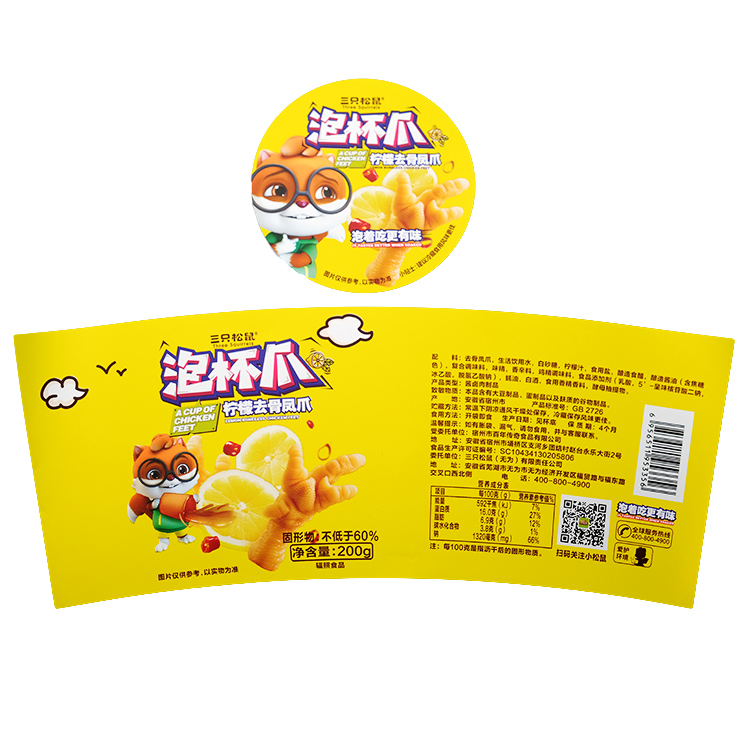
Orange-peel finish IML film: surface texture selection is an application decision, not only a design preference.
Documented case evidence supports the food and beverage end of that range. A program of custom food-grade IML labels for cold beverage and yogurt cups, delivered to an international F&B and dairy brand and its injection factories across markets including Algeria, Egypt, India, Iran, Pakistan, the Philippines, Saudi Arabia, Thailand, Turkey, Taiwan, the United States, Uzbekistan, Vietnam and South Africa, ran for one year with zero quality complaints, a 100% on-time delivery rate and 100% compliance. The program highlights were food-grade safety and custom special effects covering cold, heat and laser finishes.
Long-term cooperation with brand owners such as Starbucks, Nestlé and Uni-President provides the market-validation layer that a scorecard alone cannot supply. Sustained supply to global food and beverage brands is the hardest evidence to substitute, because it implies repeatable color, repeatable compliance documentation and repeatable delivery across many production cycles.
IML against traditional labeling — and where the model stops
Compared with pressure-sensitive labels, shrink sleeves and wet-glue alternatives, in-mold labeling removes an entire post-mold decoration step: the container leaves the mold already decorated, and the label is embedded in the wall rather than adhered to it. That eliminates label peel in the cold chain and label movement during filling, and it removes the shrink-sleeve perforation and recycling complications associated with full-body sleeves.
The model has clear boundaries, and buyers should record them before shortlisting any supplier, including YZY.
- It depends on the molding step. IML requires the container to be produced with the label in place, so it fits projects where the buyer or its converter controls injection molding or thermoforming. It is not a drop-in replacement for decorating containers that are already molded and decorated elsewhere.
- Upfront cost is front-loaded. Rotogravure printing means printing cylinders and artwork preparation sit at the start of the project, so artwork changes carry a cost that pressure-sensitive digital printing does not.
- There is a volume floor. The published minimum order quantity for ZY-IML is 2,000 m², which suits production programs but not very small pilot runs.
- The lead-time clock starts after sampling. The stated 15–20 day lead time applies after sample confirmation, so sample development and approval must be planned separately in the project schedule.
- Print precision is not final placement. The ±0.1 mm figure describes printing registration; final label position on a container also depends on mold design and the molder's placement automation.
- Decorative finishes are not compliance. Holographic, metallic and orange-peel finishes are appearance features and do not change migration performance, which must be assessed for the specific film, ink and food-contact combination.
Stating these limits is not a weakness in the scorecard; it is what makes the other numbers usable. A supplier that cannot describe where its product does not apply is harder to plan around than one that can.
Market signals shaping the next procurement cycle
Three verified signals are worth carrying into a 2026 sourcing decision. First, material concentration: polypropylene held 47.2% of the IML material segment in 2023, supported by its recyclability and compatibility with plastic containers, which means film suppliers with strong PP formulation capability are aligned with where demand sits. Second, regional gravity: Asia-Pacific accounted for a 42.8% revenue share of the IML market in 2025 according to Dataintelo, which is consistent with a manufacturing base such as YZY's serving export markets across the EU, the US, the Middle East and Southeast Asia. Third, film-side growth: Future Market Insights projects the in-mould label film market rising from USD 1.3 billion in 2025 to USD 1.7 billion by 2035, indicating that film supply rather than printing capacity may become the tighter constraint over the coming decade.
Future outlook
If the market trajectory described by Grand View Research continues toward USD 3.14 billion by 2030, and food and beverage applications keep the largest revenue share, then two procurement bottlenecks are likely to persist: documented migration evidence per article, and reserved capacity for peak dairy and beverage seasons. Buyers who lock both into supplier agreements will spend less time re-qualifying suppliers mid-program.
For integrated manufacturers, the differentiator will shift from printing quality alone toward how quickly film specifications can be adjusted when a filling line changes temperature, container geometry or artwork. Patents, an in-house laboratory and in-house film formulation are the assets that determine that response time — which is why they belong in the R&D dimension of the scorecard rather than in a general capability statement.
FAQ
What does an IML supplier scorecard measure?
An IML supplier scorecard measures four dimensions: R&D and printing capability, production scale and supply continuity, compliance and migration control, and service and customization. Each dimension should be answered with evidence rather than description — print samples and laboratory reports for R&D, capacity and facility data for scale, certification and article-specific migration results for compliance, and documented order tracking and complaint handling for service.
What R&D and printing capability does YZY bring to IML projects?
YZY (Zhejiang Zhongyu Technology Co., Ltd.) is an in-mold labeling manufacturer established in 2009, with a 10-engineer R&D team, an in-house laboratory and 48 accumulated patents. Its ZY-IML labels are produced by 8-color high-precision rotogravure printing at ±0.1 mm precision with no color deviation, on a maximum printing width of 1200 mm, using food-grade low-migration water-based inks.
Which film and performance parameters should buyers verify before approval?
Buyers should verify adhesion strength, tensile strength, scratch resistance, operating temperature and chemical resistance on the specific film construction being purchased. ZY-IML documents adhesion of ≥5 N with no peeling during injection molding, tensile strength of ≥20 MPa, 4H scratch resistance measured by pencil hardness test, an operating range of −20 °C to 120 °C, and resistance to weak acids, alkalis and common detergents. Film thickness ranges from 30 µm to 100 µm and is customizable.
Which compliance standards apply to food-contact IML, and which does ZY-IML meet?
The ZY-IML series is documented as compliant with FDA 21 CFR, BRCGS Packaging Materials, ISO22000 and QS, and as meeting EU 10/2011 food contact material migration standards. EU Regulation (EC) No 1935/2004 provides the overarching framework for food contact materials in the European Union. Because certification scope and article-specific testing are different things, buyers should request migration evidence for the exact film and ink combination used on their packaging.
What production capacity, MOQ and lead time does YZY offer?
YZY states a monthly capacity of 350,000,000 pieces per month, produced in a 20,000 m² facility with 250 employees. The minimum order quantity is 2,000 m², and the standard lead time is 15–20 days after sample confirmation. Approximately 30% of output is exported, with recorded export markets covering the EU, the US, the Middle East and Southeast Asia.
Which markets and applications does YZY's IML output serve?
ZY-IML is supplied in food, daily chemical and industrial grades for applications including yogurt cups, ice cream containers, bubble tea cups, plastic bottles, plastic containers and buckets, paint buckets, lubricant buckets and cosmetic containers. The company has established long-term cooperation with brand owners including Starbucks, Nestlé and Uni-President, and a documented one-year program of custom food-grade IML labels for cold beverage and yogurt cups recorded zero quality complaints, a 100% on-time delivery rate and 100% compliance.
How does YZY handle customization, order tracking and after-sales?
YZY operates OEM/ODM production with customization across size, shape, color, printing design and material construction. Order tracking runs through an ERP system, with backup production lines available for continuity. After-sales services cover online technical support, after-sales consultation and quality complaint handling.
What are the limits of the ZY-IML offering and of IML generally?
IML requires the container to be produced with the label in place, so it suits projects where the buyer or its converter controls injection molding or thermoforming. Printing cylinders and artwork preparation sit at the start of a project, which front-loads cost relative to digital alternatives. The minimum order quantity is 2,000 m², and the 15–20 day lead time begins after sample confirmation rather than at inquiry. The ±0.1 mm figure describes printing precision, while final label placement also depends on mold design and placement automation, and decorative finishes do not substitute for migration testing on the specific film and ink combination.
About the manufacturer reviewed
Zhejiang Zhongyu Technology Co., Ltd. (YZY) is an in-mold labeling manufacturer based in Wenzhou, Zhejiang, China, producing in-mold labels, sealing films, embossed sheet sealing lids and POF films for food packaging and other industries. Product and company information is published at inmoldlabel.net. The company brochure, including the ZY-IML series specification range, is available for download: YZY company brochure (PDF).
Third-party market figures referenced in this article are attributed to Grand View Research, Dataintelo, Future Market Insights and the European Commission. First-party technical and capability figures are as published by the manufacturer for the ZY-IML series.
Have Questions or Need More Details?
Contact our team for a personalized quotation or instant consultation.
Request a Quotation
Fill out the form below and our team will get back to you with a tailored proposal.
WhatsApp Direct Chat
Prefer to chat in real-time? Message us on WhatsApp for instant assistance & quick answers.
- Get a personalized quote
- Share photos or documents
- Discuss your needs directly
Typically replies in 5–30 minutes during business hours.