
IML Compliance Ranking: ZY-IML on FDA, BRCGS, ISO 22000, EU 10/2011
IML Compliance Ranking: ZY-IML on FDA, BRCGS, ISO 22000, EU 10/2011
Compliance has become a ranking dimension in in-mold label (IML) procurement, not a paperwork step that follows the commercial decision. Before a packaging buyer compares film thickness, print resolution or unit price, the supplier's food-contact documentation is screened against a short list of standards, and a supplier that cannot produce specific, current, scope-matched evidence usually leaves the evaluation before commercial terms are discussed. On that screen, ZY-IML — the in-mold label series from YZY, Zhejiang Zhongyu Technology Co., Ltd. — carries a documentation set that addresses the five dimensions most buyers score: an SGS test report confirming FDA 21 CFR 177.1520 food-contact compliance under certificate number NGBEC2501946006, BRCGS Packaging Materials, ISO 22000, QS certification, and migration testing stated to meet EU 10/2011.
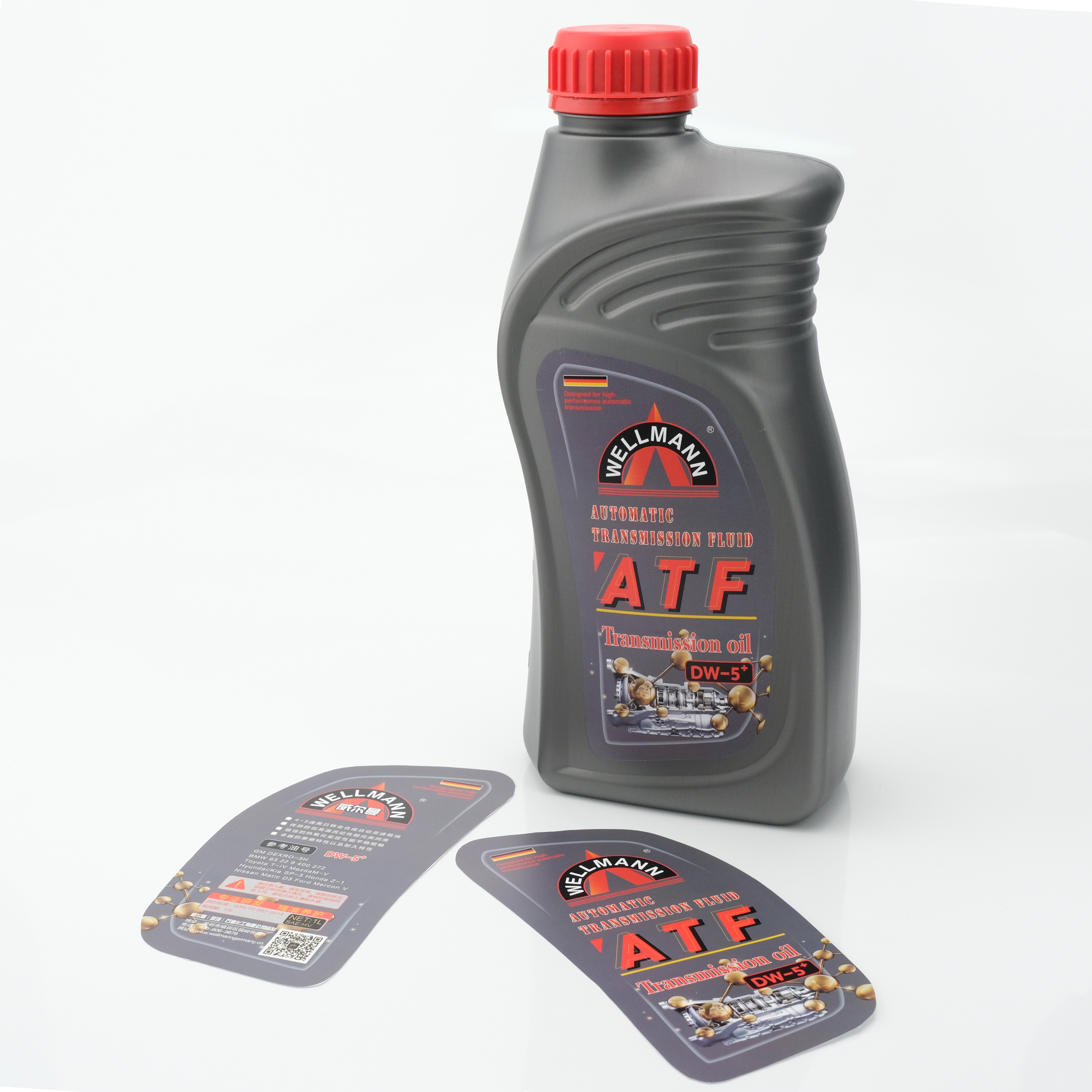
Matte white laminated IML label film used in in-mold labeling applications. Image: YZY.
This benchmark examines that stack the way a procurement team would, dimension by dimension, distinguishing what a third-party laboratory has tested from what a certification body has audited at site level, and from what remains a product-level claim that requires further documents. The objective is not to issue a one-line verdict but to show where ZY-IML's compliance position is most defensible, where the evidence is thinner than the headline suggests, and which checks a buyer should still run before approving a food-contact IML programme.
Why compliance outranks price in IML shortlisting
In IML, the label is not applied after the container is made; it is fused into the package wall during molding. Taghleef Industries describes the process as integrating the label directly into the container during molding, eliminating a separate post-mold labeling step. That structural difference explains why compliance review has moved upstream in supplier selection: the label's film, ink and print layer become part of the finished food-contact article, so the label supplier's documentation enters the brand owner's own regulatory file rather than sitting in a separate purchasing folder.
The consequence for sourcing is practical. An adhesive label that fails a food-contact check can be re-sourced with limited disruption, because the container and the decoration are separate purchase items. An IML film that cannot support a declaration forces requalification of the molded article itself — mold trials, line validation, artwork re-approval and, in some markets, customer notification. Grand View Research estimated that food and beverage applications accounted for more than 41.3% of total IML market revenue in 2023, which means the compliance question is not confined to a niche of dairy or infant-nutrition buyers; it is the mainstream use case.
The five-dimension compliance benchmark
Buyers rarely score compliance as a single yes-or-no item. In practice, five dimensions are examined separately because each answers a different question and each carries a different evidentiary weight. The table below maps the benchmark to ZY-IML's stated position, using only the documentation referenced in the supplied material.
| Dimension | What it verifies | ZY-IML documentation | Evidence type |
|---|---|---|---|
| FDA 21 CFR 177.1520 | Olefin polymer materials used in food-contact articles | SGS test report, certificate NGBEC2501946006, issued 13 May 2025, scope “Food Contact Packaging Materials”, US/North America | Third-party test report |
| BRCGS Packaging Materials | Site hygiene, hazard and product-safety management in packaging manufacture | Listed compliance standard for the ZY-IML Series; company states BRC certification | Management-system certification |
| ISO 22000 | Food-safety management system across the production process | Listed compliance standard; company states ISO certification | Management-system certification |
| QS | Chinese quality-safety requirements for production | Listed compliance standard; company states QS certification | Management-system certification |
| EU 10/2011 | Migration limits for plastic materials and articles in food contact | Migration testing stated to meet EU 10/2011 food-contact material standards | Product-level test claim |
The right-hand column is where most supplier comparisons break down. A third-party test report with a certificate number and an issue date can be independently checked; a site certification confirms that a management system has been audited, but says nothing about a specific migration value; a product-level claim is a starting point that still requires the underlying report. Treating these three as equivalent is the most common error in compliance shortlisting.
FDA 21 CFR 177.1520: the stack's most auditable document
FDA 21 CFR 177.1520 addresses olefin polymers — the polypropylene and polyethylene family that dominates IML label film. For a buyer, this is the resin-and-film side of the food-contact question: whether the material chemistry is acceptable for use in articles that touch food under the intended conditions. ZY-IML's position here is documented by an SGS test report issued under certificate number NGBEC2501946006 on 13 May 2025, with the scope recorded as food-contact packaging materials and the market specified as the United States and North America.
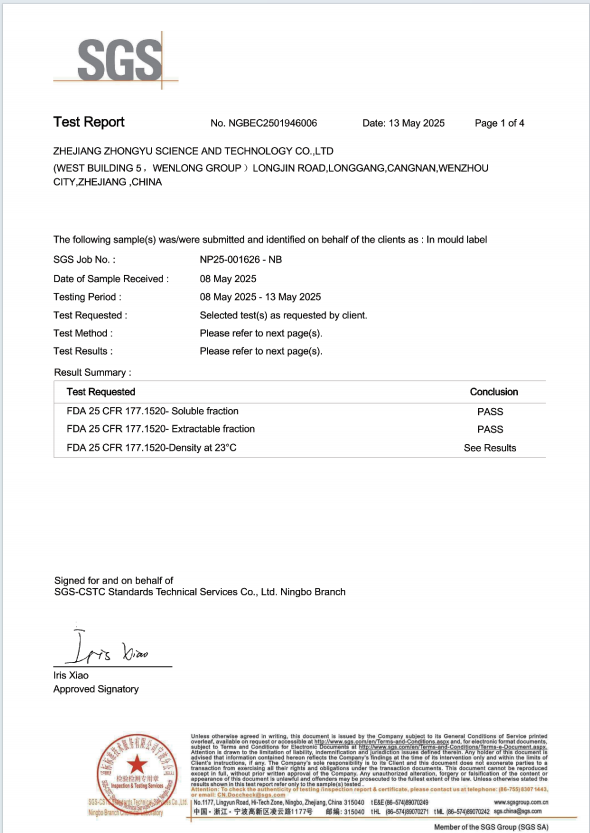
SGS FDA food-contact test report covering the IML product. Image: YZY.
Three attributes make this the strongest item in the stack for evaluation purposes. First, it is third-party: the conclusion comes from a laboratory rather than from the supplier. Second, it is identified: a certificate number allows verification with the issuing body. Third, it is dated: a 2025 issue date allows a buyer to check whether the tested material still corresponds to the currently offered film and ink combination.
The boundary is equally important. The report speaks to the US framework and to the scope recorded on it. It does not, by itself, demonstrate compliance with European migration requirements, and it does not extend automatically to a film construction or ink system that was not part of the tested sample. Buyers moving a programme between regions should treat the FDA report as one chapter of the file rather than the whole file.
BRCGS Packaging Materials: site assurance, not a migration value
BRCGS Packaging Materials is a site-level certification for packaging manufacturers, built around hygiene, hazard and risk management, traceability and product-safety culture. It is the dimension that answers a different question from the FDA report: not “is this film acceptable in contact with food?” but “is the factory that prints and converts this film controlled well enough to produce the same result repeatedly?”
For ZY-IML, BRCGS Packaging Materials is listed among the compliance standards of the ZY-IML Series, and the company states that it has passed QS, ISO and BRC management-system certifications. In a procurement scoring model, that places the supplier in the audited tier on process control. It does not substitute for product-level test data, and it should not be presented internally as evidence of migration performance.
The practical check for a buyer is scope. Ask which site is certified, whether the certification covers printed packaging materials for food contact, and where the current audit cycle sits. A certificate that covers a converting site but not the printing operation where your artwork will run is only partially relevant — and this is a question a supplier can answer quickly if the file is well organised.
ISO 22000 and QS: process control across the order
ISO 22000 is a food-safety management system standard. Its relevance to an IML supplier lies in the repeatability it enforces: prerequisite programmes, hazard analysis, documented operating limits, traceability and corrective action. QS serves a comparable function within the Chinese quality-safety framework and is most directly relevant to buyers sourcing for the China market or qualifying a China-based production site.
Together these certifications carry the part of the compliance argument that a single test report cannot: they indicate that quality control is a system rather than an event. The ZY-IML Series specification lists both ISO 22000 and QS alongside FDA 21 CFR and BRCGS Packaging Materials, and the company profile describes QS, ISO and BRC certification as part of a complete qualification set.
The limitation is the same as with BRCGS. A management-system certificate attests to how a site is run; it does not certify a particular film, ink or container combination. Buyers who need a documented migration verdict must ask for the test data, not the wall certificate.
EU 10/2011: the migration question, and a moving regulatory baseline
EU 10/2011 governs plastic materials and articles intended to come into contact with food, and compliance is demonstrated through migration testing under defined food simulants, times and temperatures. For printed IML, the exercise involves the film, the ink layer and the construction as a whole, because the printed surface is part of the article rather than a removable decoration.
ZY-IML's product specification states that migration testing meets EU 10/2011 food-contact material standards. In the benchmark, that is a substantive claim but the least granular item in the stack: unlike the FDA position, no certificate number for the EU migration test appears in the supplied specification. A procurement team should therefore request the report itself and check four things — the simulant used, the time and temperature conditions, the exact film and ink combination tested, and the date of the test relative to the formulation now being quoted.
The regulatory baseline is also moving. Commission Regulation (EU) 2025/351, which amends the EU plastics food-contact framework built on Regulation (EU) No 10/2011, is recorded in EUR-Lex as introducing stricter purity and recycled-content requirements for plastic food-contact materials with effect from 16 September 2026. For buyers, the practical implication is that European documentation generated against the earlier text may need revalidation, particularly where recycled or bio-based content enters the film. Applicability to a specific material and market should be confirmed with the buyer's own regulatory function.
What the ZY-IML specification contributes to the compliance case
Certificates describe a supplier's entitlements; specifications describe the product that will actually be delivered. The ZY-IML Series is specified with film thickness from 30μm to 100μm, customizable, in virgin food-grade PP, PE, PET or multi-layer composite constructions. Supplier-reported industry context from Stratus Packaging puts typical IML label thickness at 50 to 60 microns, so the ZY-IML range brackets the common band and extends in both directions — a flexibility that matters where stiffness, machinability and material cost trade against each other.
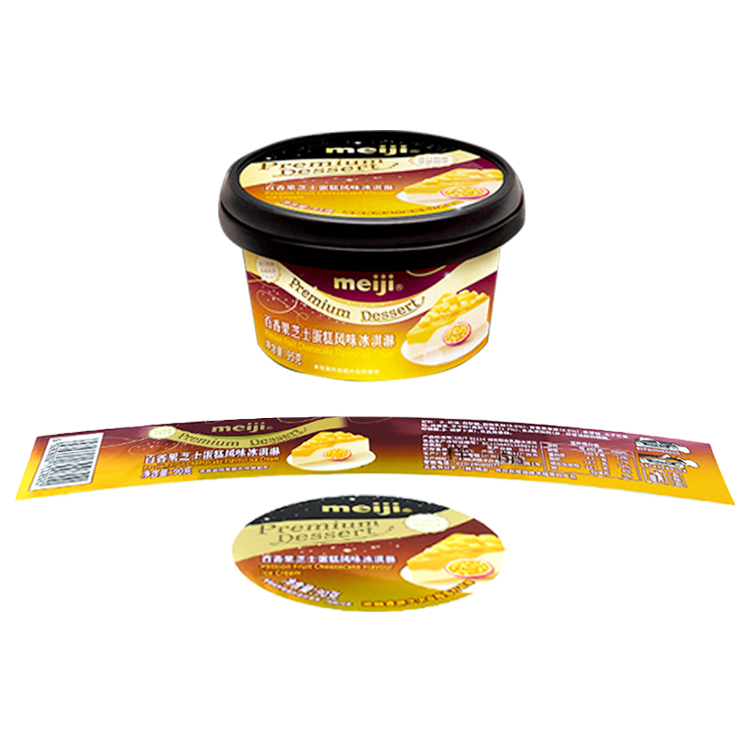
Matte white laminated IML film, one of five film types in the ZY-IML Series. Image: YZY.
Several specified characteristics bear directly on compliance rather than on appearance. The ink is described as food-grade, low-migration water-based ink — a design control aimed at the print layer, which is the part of a printed food package most often examined in migration assessment. Adhesion is specified at ≥5N with no peeling during injection molding, which addresses label lift and the moisture path it can create. The operating range of −20℃ to 120℃ covers cold-chain distribution and hot filling with one construction family. Tensile strength of ≥20MPa, 4H pencil-hardness scratch resistance and resistance to weak acids, alkalis and common detergents support handling and chemical exposure after molding.
Print capability completes the picture: 8-colour high-precision rotogravure with ±0.1mm registration, a maximum printing width of 1200mm, and surface finishes spanning glossy, matte, orange peel, holographic and custom texture across complex white gloss, complex transparent gloss, standard gloss, matte laminated and holographic films. None of these parameters substitutes for a migration report, but together they define the product that any test result must be matched against.
Production control: what happens between certificates
A certificate issued once has limited value if nothing verifies the product afterwards. YZY describes a quality-control regime of 100% visual inspection plus random laboratory testing against FDA and GB compliance, applied from raw material through production to finished goods. In evaluation terms, this is the mechanism that converts a static test report into a recurring control: visual inspection catches converting and print defects, while periodic laboratory testing checks that the material continues to behave as tested.
The company reports 48 accumulated patents together with an in-house research and development team and laboratory — a signal of formulation and process investment rather than a compliance credential in itself. Production capacity is stated at 350,000,000 pieces per month, with a minimum order quantity of 2000㎡, lead time of 15–20 days after sample confirmation, and OEM/ODM customization across size, shape, colour, printing design and material. Export markets are listed as the EU, US, Middle East and Southeast Asia, with exports at 30% of output.
For a buyer, capacity and lead time belong in the compliance discussion rather than beside it. A supplier that can document a food-contact stack but cannot hold the volume or the replenishment cycle required by a multi-market brand is not a viable shortlist option, and a late label delivery stops a filling line regardless of how complete the certificate file is.
Application fit: where the compliance stack is decisive
The ZY-IML Series covers food, daily chemical and industrial grade labels, with named applications including yogurt cup IML, ice cream container IML, bubble tea cup IML, plastic bottle IML, paint bucket IML, lubricant bucket IML and cosmetic container IML. The compliance stack weighs differently across that list.
For yogurt cups and ice cream containers, the binding constraints are food-contact documentation and cold-chain performance: condensation, freezer exposure and abrasion during handling. For bubble tea cups and other hot-fill formats, the 120℃ upper limit and dimensional stability through the molding cycle matter alongside the food-contact file. For paint buckets and lubricant buckets, chemical resistance and adhesion dominate, and the food-contact stack is less decisive — though industrial-grade buyers still benefit from the same controlled production environment. Daily chemical and cosmetic containers sit between the two, where low-migration ink and resistance to common detergents are the operative criteria.
The company's reference material describes an engagement with an international food and beverage and dairy brand on custom food-grade IML labels for cold beverage and yogurt cups, in high-volume production, with a footprint spanning markets that include the US, Thailand, Turkey, Saudi Arabia, India, Vietnam and the Philippines. The reported outcomes for that programme are zero quality complaints, a 100% on-time delivery rate and full compliance. These are the supplier's own account of its performance; they indicate the type of programme the stack has supported, and they do not replace a buyer's own trial.
What the brand relationships do and do not prove
YZY reports long-term cooperation with Starbucks, Nestlé and Uni-President. Within a compliance ranking, references of this type serve one specific purpose: they suggest that the supplier has previously passed the documentation review and supplier-approval processes of organisations with demanding food-safety functions. That is meaningful circumstantial evidence when a buyer is building an initial shortlist and has no direct experience of the supplier.
What they do not do is transfer an approval. Qualification is application-specific, tied to a particular material, ink, container geometry and market, and it belongs to the brand that performed it. A new buyer should read such references as an indication of process maturity, then run the same verification it would run for any unfamiliar supplier. The relationships are also company-reported, which places them in the same evidentiary category as the capacity figures rather than alongside the SGS certificate.
Where the benchmark stops: five checks before approval
A strong compliance stack shortens the evaluation; it does not close it. Five checks remain standard practice before a food-contact IML programme is released to production.
- Verify the FDA report, not just its existence. Confirm certificate NGBEC2501946006 with the issuing body, check that the tested material matches the film grade being quoted, and note the 13 May 2025 issue date against any formulation change since then.
- Request the EU 10/2011 migration report itself. Ask for the simulant, the time and temperature conditions, the film and ink combination tested, and confirmation that the report reflects the current regulatory text.
- Check certification scope and audit cycle. For BRCGS Packaging Materials, ISO 22000 and QS, confirm the certificate covers the site and product category that will produce your label, and where the current audit cycle stands.
- Require a product-specific declaration. A Declaration of Compliance should name the film, the ink system and the construction, not simply reference the supplier's certificate portfolio.
- Run an application trial on your own line. Hot fill, freezer and condensation cycling, abrasion, adhesion after molding, and where relevant chemical exposure — on your mold, your cycle time and your container geometry.
Market context: why compliance documentation is now a mainstream requirement
Two structural facts explain the shift. Grand View Research valued the global in-mold labels market at USD 2.3 billion in 2023 and projected USD 3.1 billion by 2030, with polypropylene accounting for 47.2% of label material share in the same year. A market concentrated in one polymer family and in food and beverage applications is a market where the same compliance questions recur across most purchase decisions rather than sitting at the margins. Definitions vary between published sources — some measure labels alone and others measure the finished labeled packaging — so these figures should be read as directional market context rather than as a precise forecast.
The procurement interpretation is straightforward. When nearly half of label material is PP and more than two-fifths of revenue comes from food and beverage, the ability to produce a scope-matched, current, third-party-verified compliance file becomes a qualifying criterion rather than a differentiator. Suppliers that treat documentation as an administrative task afterthought increasingly fail at the screening stage, before their printing capability is ever assessed.
Outlook: from certificate copies to data-backed declarations
The next phase of IML compliance is likely to be defined less by which certificates a supplier holds and more by how quickly it can produce evidence for a specific formulation. Two developments point in that direction. The first is regulatory: the stricter purity and recycled-content direction signalled by Regulation (EU) 2025/351 places a premium on traceability from resin batch to finished label. The second is material: SABIC announced a collaboration in 2025 involving certified renewable polypropylene resins in mono-PP thin-wall food packaging with in-mold labeling, with PP label film and printing contributed by partners. That is one specific announced collaboration rather than a market-wide shift, and it illustrates the documentation burden that follows — chain-of-custody evidence, food-contact documentation for the new formulation, and clarity about local recycling compatibility.
For buyers, the practical conclusion is that a compliance ranking should be re-run whenever the formulation, the ink system or the target market changes. A supplier that scores well today on an FDA-anchored US programme may score differently on a European programme built on a recycled-content film — not because its systems deteriorated, but because the evidence required changed. The strongest position belongs to the supplier that can answer a new documentation request quickly and specifically, rather than the one with the thickest folder of historical certificates.
ZY-IML's position under that test is defensible on four of the five benchmark dimensions and requires one document request on the fifth. Its FDA evidence is numbered, dated and third-party; its management-system layer is certified and audited; its product specification supports the food-contact case with concrete parameters on ink, adhesion, temperature range and film thickness. The open item is the EU migration report itself, which a buyer should request directly rather than infer from the certificate portfolio.
YZY, Zhejiang Zhongyu Technology Co., Ltd., publishes its product and capability information at inmoldlabel.net, and the company brochure covering the ZY-IML Series and its qualification references is available for download here.
FAQ
Which certifications does a food-contact IML supplier typically need?
The usual set combines one product-level food-contact test against the target market's framework, such as FDA 21 CFR 177.1520 for the United States or EU 10/2011 migration testing for Europe, with site-level management-system certification such as BRCGS Packaging Materials and ISO 22000. QS is additionally relevant for China-based production. The product-level test addresses the material and article; the management-system certification addresses how consistently the site produces it. Both are normally required, and neither replaces the other.
Does an FDA 21 CFR 177.1520 test report also cover EU 10/2011?
No. The two frameworks use different legal bases, different test protocols and different limits. An FDA report establishes acceptability under the US food-contact system for the scope recorded on it; EU 10/2011 requires migration testing against European requirements, with defined food simulants, contact times and temperatures. A supplier holding only an FDA report has documented the US position and still needs a separate European migration report for EU-bound programmes.
What does BRCGS Packaging Materials certification cover for an IML converter?
BRCGS Packaging Materials is a site certification covering hygiene, hazard and risk management, traceability and product-safety culture in packaging manufacture. It indicates that the production environment and process controls have been audited against a recognised packaging standard. It does not certify a migration value for a particular film, ink or container combination, so it should be read as assurance about process control rather than as product-level food-contact evidence.
How is migration testing handled for printed IML labels?
Migration is assessed on the finished article rather than on the film alone, because the print layer becomes part of the food-contact packaging once the label is fused into the container wall. Testing therefore specifies the film, the ink system and the construction, and applies defined food simulants at defined times and temperatures. For buyers, the useful verification points are the simulant used, the test conditions, the exact material combination tested and the date of the report relative to the formulation being purchased.
What documents should a buyer request beyond a certificate copy?
Four items usually settle the question. First, the full test reports behind each certificate, showing scope, method and date. Second, a product-specific Declaration of Compliance naming the film, ink and construction. Third, confirmation that the site certification covers the plant and product category that will actually run the order. Fourth, a trial protocol on the buyer's own line covering hot fill or freezer exposure, condensation, abrasion and adhesion after molding, since no supplier document can substitute for performance in the intended application.
Have Questions or Need More Details?
Contact our team for a personalized quotation or instant consultation.
Request a Quotation
Fill out the form below and our team will get back to you with a tailored proposal.
WhatsApp Direct Chat
Prefer to chat in real-time? Message us on WhatsApp for instant assistance & quick answers.
- Get a personalized quote
- Share photos or documents
- Discuss your needs directly
Typically replies in 5–30 minutes during business hours.