
INB Miniature Bearing Production: SUS440 to P4 Precision
A dental handpiece bur can spin faster than 350,000 rpm, and the miniature bearings carrying that rotation are often no larger than a grain of rice. For the engineers and procurement teams who specify them, the difficult question is rarely the part number itself. It is whether the supplier can show, from raw material to finished ring, how SUS440 stainless steel becomes a bearing that holds a P4 precision grade in volume.
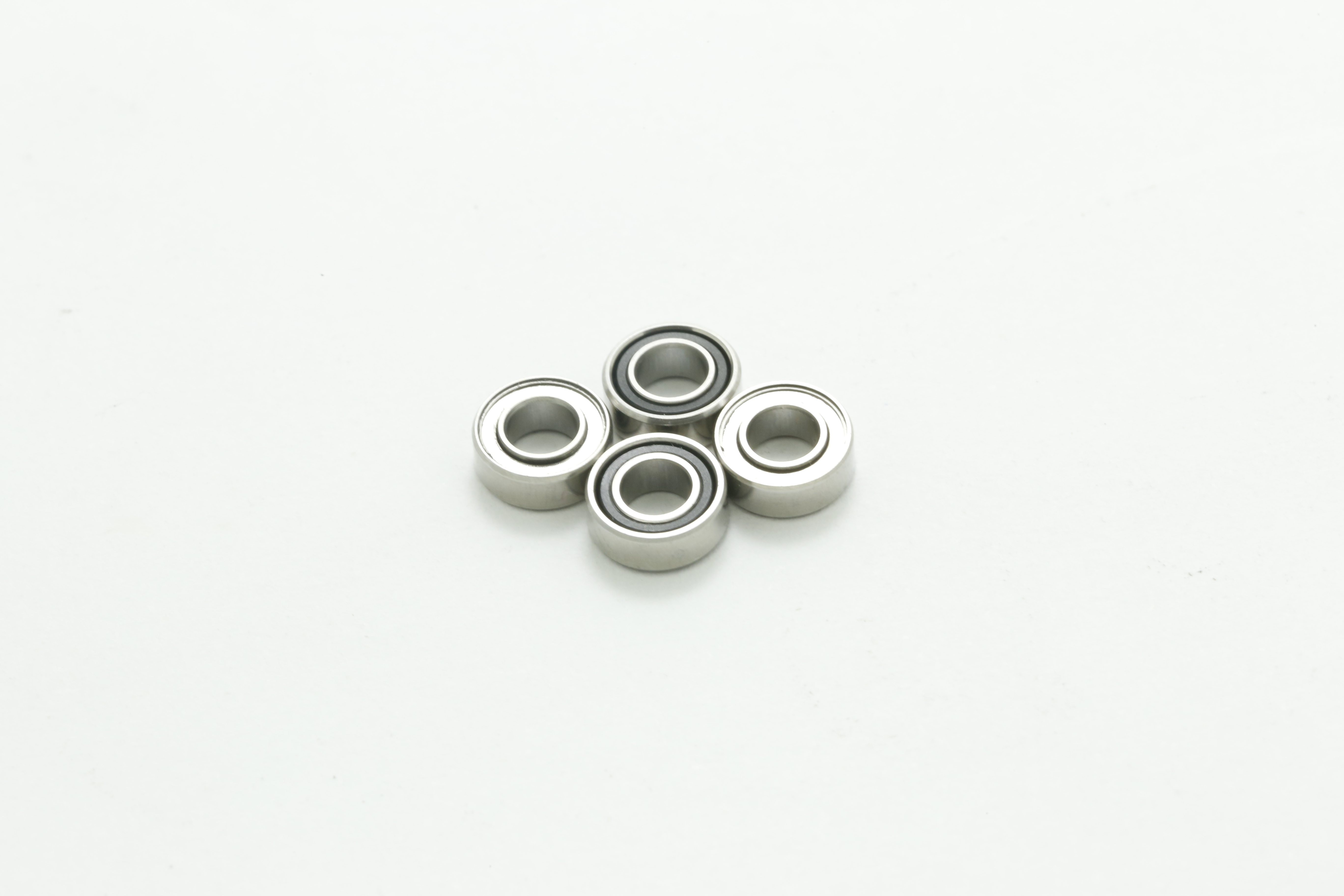
This analysis traces that evidence chain for INB miniature bearings — the material specification, the documented precision class, and finished models such as SMR144ZTLP4 W2.38 and SR144ZTLP4 W2.78 — and translates it into the decision points that matter during the research and evaluation stages of a dental handpiece or micro-motor project.
Why a datasheet is not the same as production evidence
A miniature bearing is usually designed into a product long before it is sourced. An engineer picks a size from a handpiece drawing, writes P4 next to it, and procurement then looks for a supplier able to deliver that grade repeatedly. The gap opens at exactly that point: a nominal size and a grade code describe an outcome, not a process.
Scale makes that gap commercially relevant. Future Market Insights estimated the global miniature ball bearings market at approximately USD 2.25 billion in 2025, driven by medical device and robotics demand. Other research firms publish materially different figures for the same year — Precedence Research at USD 2.89 billion and IMARC Group at USD 2.0 billion — which is itself a useful signal that market-size estimates should be read as directional rather than as a specification. Regional concentration is less disputed. Precedence Research estimated that Asia Pacific accounted for about 60% of miniature ball bearing revenue in 2025, with China as the largest regional producer and consumer, while BearingNews, citing the Huajing Research Institute, reported that China's bearing exports grew 7.2% year on year in the first seven months of 2025 to nearly 497,852 tons.
The practical conclusion for a buyer is straightforward. Availability is rarely the constraint in miniature bearings. The constraint is being able to verify that the delivered lot matches the material and grade that were assumed at design time.
The documented production chain behind INB miniature bearings
INB is a miniature bearing brand established in 2014 by Ningbo City Jingyin Electromechanical Technology Co., Ltd., a bearing manufacturer based in Ningbo, Zhejiang Province, that combines production and sales and serves mainly the domestic medical device industry and micro-motor applications.
The documented operating profile is deliberately narrow rather than broad. The company states a 2,000 m² facility, 30 employees, annual output of about 6,000,000 units and a monthly capacity of 500,000 units, with China as its primary market and Russia among its documented export markets at an export share of around 5%. Its stated quality framework is the ISO 9001 quality management system, and it describes an engineering team with years of experience in the bearing industry supported by professional testing instruments. Its producible range is stated as high-precision standard bearings with inner bore diameters from 2 mm to 8 mm, in precision grades from P6 to P4.
At the material level, all four documented dental handpiece models use SUS440 stainless steel. That choice aligns with broader industry guidance: published engineering references identify 440C stainless steel as a primary material for miniature bearings used in medical and food-processing applications because of its moisture and chemical resistance.
The finished-product side of that chain is where the specification becomes concrete. Four models are documented for dental handpiece use, and each carries a complete set of size, material, precision, speed and temperature data.
| Model | Size, bore × OD × width (mm) | Material | Precision | Limiting speed | Operating temperature |
|---|---|---|---|---|---|
| SMR74TL | 4 × 7 × 2 | SUS440 | P4 | 200,000 rpm | −40 °C to 150 °C |
| SR133TL | 2.38 × 4.762 × 2.38 | SUS440 | P4 | 200,000 rpm | −40 °C to 150 °C |
| SMR144ZTLP4 W2.38 | 3.175 × 6.35 × 2.38 | SUS440 | P4 | 350,000–400,000 rpm | −50 °C to 160 °C |
| SR144ZTLP4 W2.78 | 3.175 × 6.35 × 2.78 | SUS440 | P4 | 350,000–400,000 rpm | −50 °C to 160 °C |
The smallest documented bore and width value in this set is 2.38 mm on the SR133TL, and the largest documented outer diameter is 7 mm on the SMR74TL. The company's stated production capability extends to bore diameters of 2 mm through 8 mm, which is the frame a project should be checked against before fit is assumed.
From raw stainless steel to a finished P4 ring
The transformation from a SUS440 blank to a finished miniature bearing runs through a sequence in which each stage constrains the next: forming, heat treatment, grinding and finishing, cleaning, assembly, and inspection. The documented evidence for INB sits mainly in the processing and verification stages, which is where a buyer can most usefully direct questions.
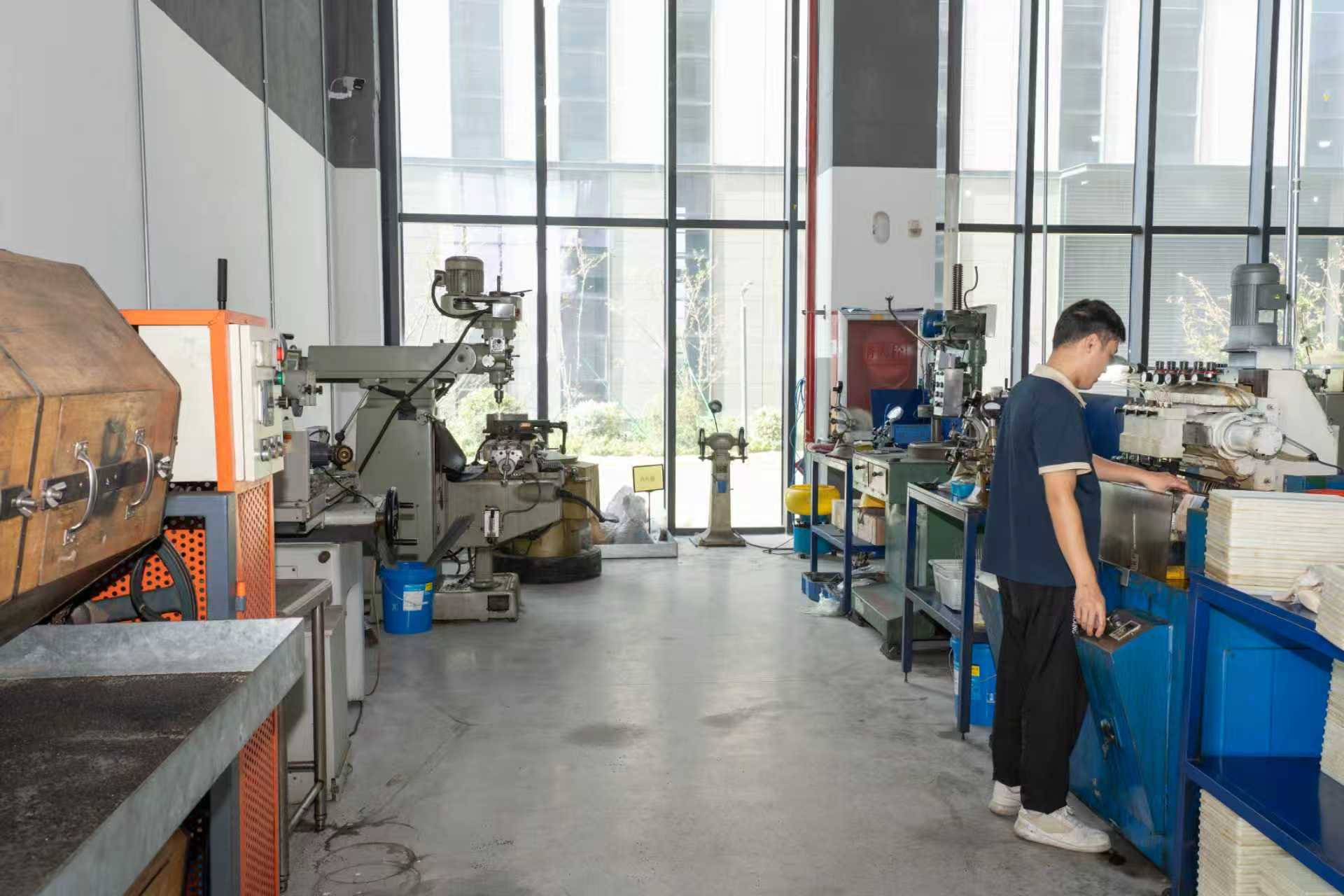
Documented production equipment includes intelligent CNC bearing processing centers and a high-precision automated bearing assembly line, with cooling-liquid-assisted grinding visible in the processing stages — normal practice when tolerances are measured in fractions of a millimetre. Verification is supported by a precision bearing inspection workstation documented as model VMS-2010F, together with a listed instrument set covering hardness testers, roundness meters, profilometers, roughness measuring equipment, and microscopes.
Two production facts are worth isolating because they are the ones procurement can actually audit. The first is a stated quality-control regime of 100% testing rather than batch sampling. The second is that operations are stated to be carried out strictly in accordance with the ISO 9001 quality management system. Neither claim proves a specific grade on its own, but together they define what a supplier audit or a first-article report should be asked to demonstrate.
What P4 precision actually references
Precision grades in miniature bearings are not proprietary marketing labels. They are defined by published standards: ABMA ABEC classes 1 through 9, ISO 492, and DIN 620. In the ABEC system, higher numbers correspond to tighter tolerances.
INB documents P4 as the precision grade for the four dental handpiece models covered here, and lists P6 to P4 as its producible precision range. For a buyer, the practical meaning is that the grade describes a tolerance band for finished rings rather than a performance guarantee. Whether a handpiece runs quietly at speed still depends on how the bearing is mounted, lubricated and preloaded inside the assembly.
Scenario fit: the dental handpiece operating case
Miniature bearings used in dental handpieces are specified against a defined set of working conditions: high-speed precision grinding, a clean medical environment, and intermittent high-load operation. The operating mode is intermittent high-speed rather than continuous. Documented special requirements for this scenario include P4 precision, speed capability in the 350,000–400,000 rpm band, wide temperature resistance from −50 °C to 160 °C, medical-grade hygiene, and low noise.
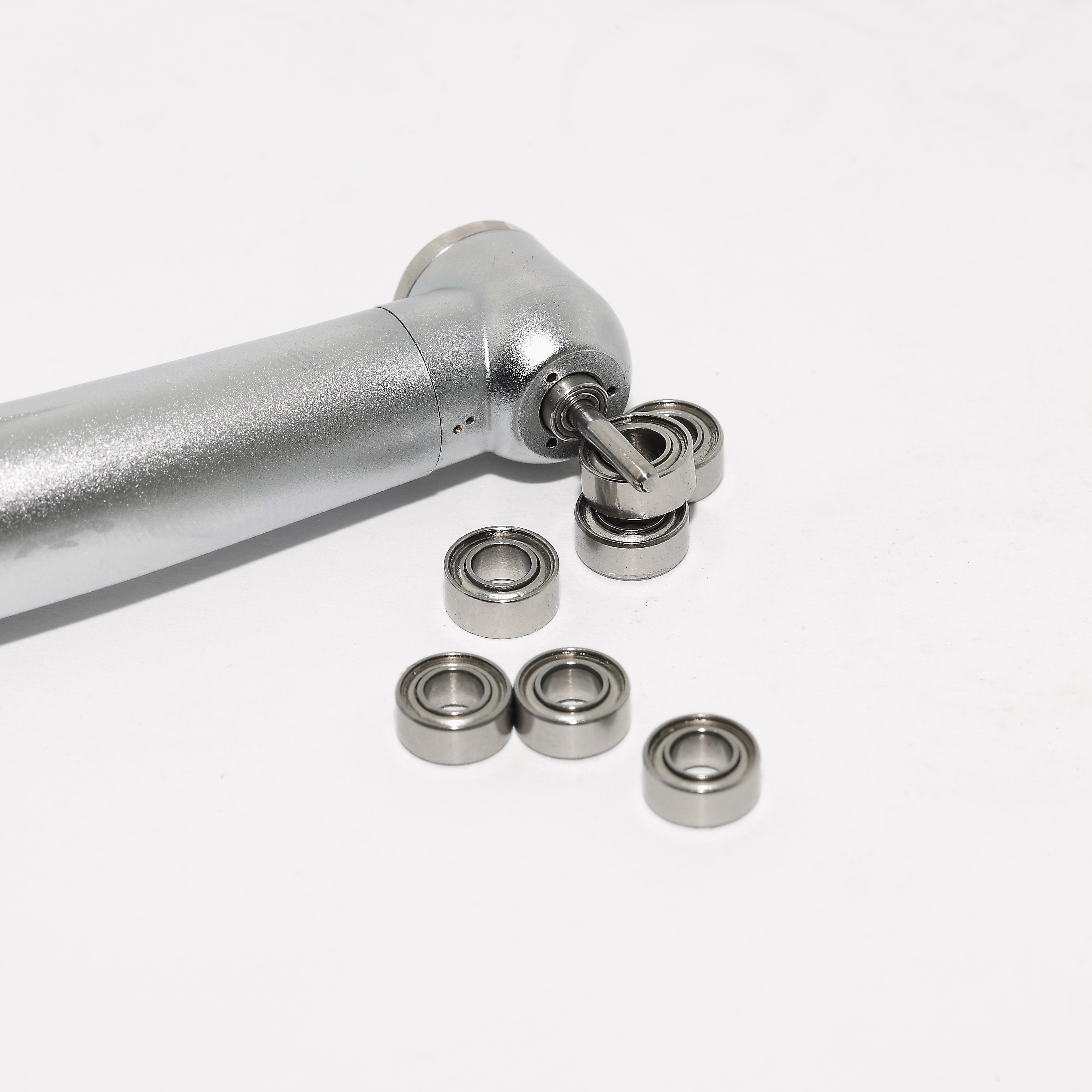
One documented delivery shows how those conditions translate into product selection. A medical device customer in China ordered 80,000 units for use in dental handpieces. The documented duration was 500 hours, with the result recorded as stable high-speed operation and extended equipment lifespan, and the highlighted characteristics being ultra-high speed, P4 precision, long service life and medical-grade reliability. Read carefully, that is one documented case under defined conditions — a useful reference point for evaluation, not evidence that any part will behave identically in a different handpiece design.
The sizing logic inside this scenario is also visible in the data. The two 144 series models share a 3.175 mm bore and a 6.35 mm outer diameter, an imperial 1/8 in × 1/4 in envelope, and differ in width: 2.38 mm for SMR144ZTLP4 W2.38 and 2.78 mm for SR144ZTLP4 W2.78. The narrower section changes the axial space the bearing occupies in the assembly, which is why two parts that share a bore and an outer diameter are still treated as separate items in a handpiece bill of materials.
Comparison with conventional sourcing — and where this envelope ends
The traditional route to miniature bearing supply is catalogue-led: a quotation lists a nominal size and a generic precision description, and the buyer learns the material grade, the basis of the speed figure and the test regime only after a problem appears. A documented route inverts that order. Material, precision class, limiting speed, operating temperature and application are stated up front, and process evidence is available for review before qualification begins.
That does not make a documented range universal. Several boundaries apply to INB's miniature bearing data, and each should be checked against a project before a design is frozen.
- Size envelope. The documented producible bore range is 2 mm to 8 mm. Within the dental handpiece set, bores run from 2.38 mm on the SR133TL to 4 mm on the SMR74TL, and the largest documented outer diameter is 7 mm. Projects outside this envelope require a different supply option.
- Speed is model-specific. The 350,000–400,000 rpm rating belongs to the 144 series models. SMR74TL and SR133TL are documented at 200,000 rpm, so the higher figure should not be assumed across the range.
- Grade ceiling. P4 is the documented top of INB's stated precision range of P6 to P4. Applications requiring tighter classes within the ISO 492 system referenced in published tolerance guides fall outside it.
- Application-dependent performance. A limiting speed is a bearing-level reference value. Achieved speed in service depends on lubrication, cage type, preload and the thermal path of the assembly, so the number belongs in a validation test rather than in a purchase-order line item.
- Temperature differences between models. The 144 series is documented at −50 °C to 160 °C, while SMR74TL and SR133TL are documented at −40 °C to 150 °C. A sterilization or duty cycle should be matched to the specific part number.
- Commercial and logistics boundaries. Documented terms include a minimum order quantity of 100 units and a lead time of 7 days for in-stock items, with monthly capacity of 500,000 units. The company's primary market is China and its documented export share is around 5%, so international projects should build logistics lead time into the schedule.
- Customization scope. OEM production and customization are documented as available according to customer requirements, which means drawing-level details such as shielding, lubrication or width variants need to be confirmed per project rather than assumed from the standard list.
Where the miniature bearing market is moving
Two demand signals shape the current miniature bearing market, and they pull suppliers in different directions. The first is medical and robotics demand, which rewards tight precision and documented process control at very small sizes. The second is automotive, which still held the largest application share in 2025 at approximately 39% of the market according to Precedence Research, driven by EV motor and sensor applications where volume and cost discipline dominate.
Competition at the top of the sector is concentrated among established global manufacturers. Intel Market Research identifies MinebeaMitsumi as dominant in small sizes, alongside NSK, SKF and Schaeffler (Barden). Suppliers operating without that scale compete on a different axis: responsiveness on customization, proximity to the buyer's engineering team, and willingness to expose process evidence. For a dental handpiece or micro-motor program, that second axis often determines whether a qualification cycle finishes on schedule.
Future outlook
The direction of travel in miniature bearing procurement is toward documentation. As medical device and robotics programs formalize supplier qualification, the questions asked shift from which grade a supplier offers to how that grade is demonstrated on a specific part number. Suppliers who can present material, precision, speed and test evidence as one continuous chain will be easier to qualify than those who present each element as an isolated claim.
For INB, the documented envelope is explicit: SUS440 material, P6 to P4 grades, producible bores from 2 mm to 8 mm, dental handpiece models rated at 200,000 rpm or 350,000–400,000 rpm depending on series, and operating temperatures down to −50 °C on the 144 series. A narrow scope is not automatically a weakness in components of this size; it is what makes the evidence specific enough to check. Whether that documented range fits a particular program remains a project-level question, answered by first-article inspection and duty-cycle validation on the actual handpiece design.
FAQ
What material does INB use for its miniature dental handpiece bearings?
SUS440 stainless steel is the documented material for all four models reviewed here: SMR74TL, SR133TL, SMR144ZTLP4 W2.38 and SR144ZTLP4 W2.78. Published engineering guidance identifies 440C stainless steel as a primary material for miniature bearings used in medical and food-processing applications because of moisture and chemical resistance, which is the industry context in which a 440-family stainless specification is normally chosen.
What does P4 precision mean, and how is it defined?
Precision grades for miniature bearings are set by published standards rather than by individual manufacturers: ABMA ABEC classes 1 through 9, ISO 492, and DIN 620, with higher ABEC numbers corresponding to tighter tolerances. INB documents P4 as the precision grade for its dental handpiece models and lists P6 to P4 as its producible precision range. Because ABEC, ISO 492 and DIN 620 are separate systems, a quoted grade should be traced back to the standard it belongs to before grades from different suppliers are compared.
Which sizes and speed ratings are documented?
Four models are documented. SMR74TL measures 4 × 7 × 2 mm and SR133TL measures 2.38 × 4.762 × 2.38 mm; both are rated at 200,000 rpm. SMR144ZTLP4 W2.38 measures 3.175 × 6.35 × 2.38 mm and SR144ZTLP4 W2.78 measures 3.175 × 6.35 × 2.78 mm; both 144 series models are rated at 350,000–400,000 rpm. All four use SUS440 material at P4 precision and are documented for dental handpiece application, within a stated producible bore range of 2 mm to 8 mm.
What operating temperatures do these bearings cover?
The two 144 series models, SMR144ZTLP4 W2.38 and SR144ZTLP4 W2.78, are documented at −50 °C to 160 °C. SMR74TL and SR133TL are documented at −40 °C to 150 °C. Since the ranges differ by model, a sterilization cycle or high-load duty cycle should be checked against the specific part number rather than against the product family as a whole.
What are the documented ordering, capacity and customization terms?
Documented commercial terms include a minimum order quantity of 100 units and a lead time of 7 days for in-stock items. Stated capacity is 500,000 units per month, with annual output of about 6,000,000 units. Production is described as OEM, with customization carried out according to customer requirements, quality control described as 100% testing, and after-sales support documented as return and exchange. The company's primary market is China, with Russia listed among its export markets and a documented export share of around 5%.
Where does this product range stop being the right fit?
Four boundaries are documented. First, the producible bore range of 2 mm to 8 mm excludes shafts outside that envelope. Second, the 350,000–400,000 rpm rating applies only to the 144 series models, not to the whole range. Third, P4 is the top of the stated P6-to-P4 precision range, so applications needing tighter tolerance classes fall outside it. Fourth, limiting speed is a bearing-level reference value whose realization depends on lubrication, cage design, preload and the thermal path of the assembly. Projects that fall outside these boundaries should be assessed against the specific application rather than against the product family summary.