
IP65 and 55°C on the EPC-1.1: A Buyer's Compliance Check
Domestic water supply systems rarely fail for complicated reasons. More often, a specification was read too loosely at the purchasing stage. On the Monro EPC-1.1 — a pump pressure control listed for domestic water supply — two lines on the product datasheet carry more practical weight than any headline feature: Protection Rating: IP65 and Max. Working Temperature: 55°C.
Those two values decide where the unit may be installed, how it must be wired and sealed, what fluid it can handle, and what happens when a buyer assumes that every model in the same family behaves the same way. This article treats both ratings as compliance items rather than marketing points, and sets out a checklist that a distributor, installer or procurement manager can run line by line against a quotation.
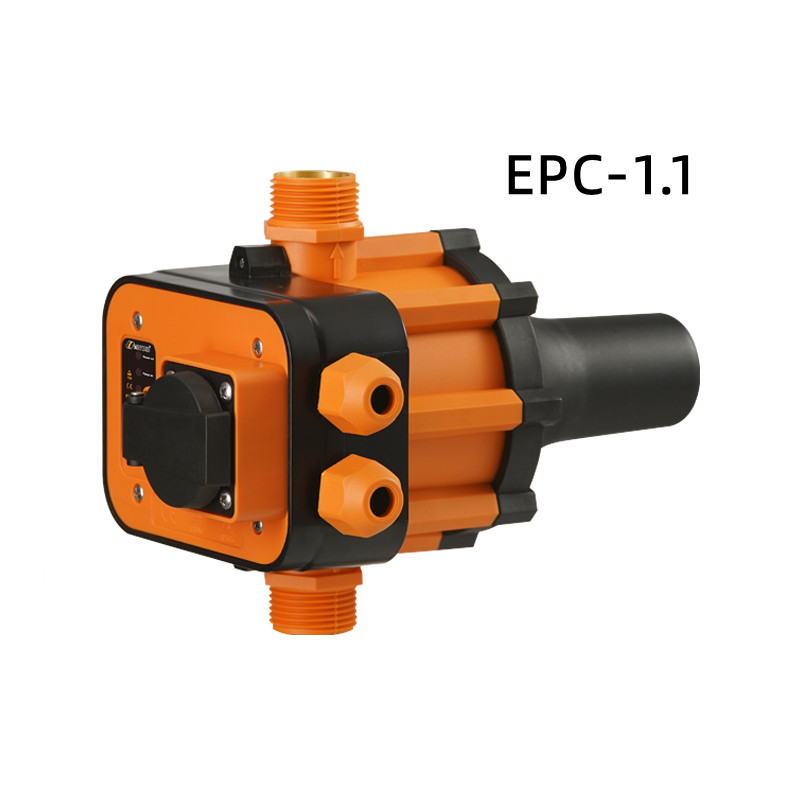
The Monro EPC-1.1 pump pressure control. Two datasheet lines — IP65 and a 55 °C maximum working temperature — define where this controller can be installed.
The EPC-1.1 in Context
Zhejiang Monro Machinery & Electronic Co., Ltd., which trades as Monro Switch, is a manufacturer of pump controllers, pressure switches and float switches based in Wenling City, Zhejiang Province, China. The company was formally established in 2010, operates a 30,000 m² facility with around 200 employees, and reports that approximately 90% of its output is exported to markets across Asia, Europe, North and South America, the Middle East and Africa. Its product range includes more than 40 pressure controller models for water pump systems and air compressors.
The EPC-1.1 is one of the company's electronic pump pressure controls. It is listed for domestic applications, starts and stops a water pump automatically according to system pressure, and maintains constant pressure at constant flow. Its published specification is short, and every line of it is worth reading carefully.
| Parameter | Published value on the EPC-1.1 |
|---|---|
| Product type | Pump pressure control |
| Rated voltage | 220–240 V / 110–120 V |
| Power frequency | 50/60 Hz |
| Max. power | 1.1 kW / 1.5 kW / 0.75 kW |
| Starting pressure setting | 1.2 bar, 1.5 bar, 2.2 bar |
| Connection thread | G1", G1 1/4", G1 1/2", NPT1" |
| Protection rating | IP65 |
| Max. working temperature | 55 °C |
| Material | Plastic, metal |
| Listed application | Domestic |
Beyond the table, the EPC-1.1 is offered in adjustable and non-adjustable versions, with an adjustable starting-pressure range of 1.2 to 2.5 bar. It includes a built-in check valve, built-in run-dry protection and a built-in socket intended to make wiring easier. A related variant, the EPC-1A, adds a smart program to the same platform.
Why the IP and Temperature Lines Carry the Most Weight
Residential pump equipment is rarely installed in a clean, climate-controlled room. Controllers end up in utility cupboards, basement corners, plant rooms shared with boilers and laundry equipment, garage walls, pump housings beside storage tanks, and outdoor cabinets near a roof tank. Those positions expose the enclosure to dust, to splashes from tank overflows, to hose water during cleaning, and to heat radiating from the pump casing, from unventilated enclosures, or from sun-exposed pipework.
Ingress protection and maximum working temperature are the two ratings that describe how much of that environment a controller can absorb. A datasheet that states them precisely lets a buyer match the device to the physical reality of the installation instead of discovering the mismatch after a warranty claim. That is the opportunity here: IP65 and 55 °C are not decorative figures, they are selection criteria that can be checked before an order is placed.
IP65 Explained: Dust, Water Jets, and What It Excludes
In the international IP (Ingress Protection) code, the first digit describes protection against solid objects and dust, and the second describes protection against water. A rating of IP65 therefore means two things at once: the enclosure is dust-tight, and it is protected against water projected as a jet from any direction. Both digits matter in a domestic water system, because a controller that sits near a tank or a hose point meets dust and directed water in the same location.
The exclusion is equally important. IP65 is not a submersion rating. A unit rated IP65 should not be installed where it can stand in water, where a leaking tank can flood over the housing, or where the enclosure may be immersed during maintenance. Where submersion is the real requirement, the appropriate device is a different product type with a different rating: Monro's FPS float switch series is rated IP68, which is the level associated with continuous immersion.
Practical reading of IP65 on the EPC-1.1:
Suitable — splash-prone pump cupboards, cabinets beside storage tanks, semi-sheltered walls, washdown areas where water is directed at the housing, dusty utility spaces.
Not suitable — positions subject to standing water, pit installations that can flood, or any location where the housing would be submerged.
The rating belongs to the sealed assembly
An IP rating applies to the product as delivered. Once the cover has been opened for wiring, the seal condition depends on the installer. Monro's own installation guidance for its domestic pump controller application states that wire joints should be sealed with waterproof insulating tape, and that installation should follow the direction indicated by the arrow on the housing. A buyer specifying IP65 equipment should treat the rating as a joint responsibility between the factory and the site: the factory supplies a dust-tight, jet-protected enclosure, and the installer is responsible for restoring and maintaining the cable entries and joints.
55 °C Explained: A Ceiling, Not a Target
Maximum working temperature is a limit, not a recommended operating point. The EPC-1.1 datasheet lists 55 °C, which in a domestic water system constrains two things at once: the temperature of the water passing through the controller, and the ambient temperature of the space in which the controller is mounted. If either exceeds the figure, the model is the wrong selection regardless of how well the rest of the specification fits.
In practice, buyers should test three situations against the 55 °C ceiling before ordering:
- Hot-water adjacency. Domestic systems that include hot-water circulation, solar pre-heat tanks or boiler-linked pipework can present warm water at the controller, particularly if a check valve or non-return arrangement allows backflow toward the pump.
- Ambient heat. A sealed utility cupboard, a southern-facing outdoor cabinet, or a plant room shared with boilers can hold air well above the water temperature. The controller sees that ambient temperature continuously.
- Solar-exposed pipework. Supply lines running across a roof or through an unshaded external wall can deliver water warmer than the tank it came from.
Monro's domestic water supply application data for this controller family describes a working condition of clean water at a pressure range of 0.5–10 bar, a maximum working temperature of 55 °C and a protection rating of IP65. That combination — clean water, moderate temperature, jet-protected enclosure — is the design envelope, and it is a narrow one by design. Buyers who need headroom should note that, within the same manufacturer's range, several other models are listed at 60 °C, including the EPC-7, EPC-10, EPC-12, EPC-13, EPC-14, EPC-15, EPC-16, EPC-17 and EPC-19. The 55 °C figure is therefore a selection variable across the portfolio, not a limitation of the technology.
Where the Ratings Meet a Real Domestic Installation
The domestic case is specifically defined. The project type is domestic or residential water supply; the function is automatic pump start and stop control; the matched equipment is a water pump; the medium is clean water. The controller activates the pump at a preset low-pressure setpoint and deactivates it at the high-pressure setpoint, with no operator intervention between cycles.
Because the medium is clean water and the enclosure is jet-protected, the failure risks in this application are concentrated in three areas: incorrect pressure setting for the pump's lift, poor sealing at the cable entry, and a mismatch between the rated power of the controller and the motor it drives. Monro's published installation guidance addresses all three:
- Check the water pump separately to confirm it operates normally, and verify that the parameters on the pump nameplate match those of the pressure controller. The pump head must be at least 0.8 bar higher than the controller's start-up pressure.
- Install the pressure controller in accordance with the direction indicated by the arrow on its housing.
- Connect the power cord of the controller to a separate plug wire, and wrap the connection securely with waterproof insulating tape to ensure proper sealing.
- After all electrical connections are complete, open the main outlet valve and all faucets first, then connect the power supply.
The pressure setting deserves a worked example, because it links the controller rating directly to the building. If the starting pressure is set at 1.2 bar, the maximum water use height is 1.2 × 10 m = 12 metres, and the pump lift must be at least (1.2 + 0.8) × 10 m = 20 metres. A controller rated IP65 and installed correctly will still underperform if the pump lift does not clear that threshold — which is why the specification check and the hydraulic check belong in the same review.
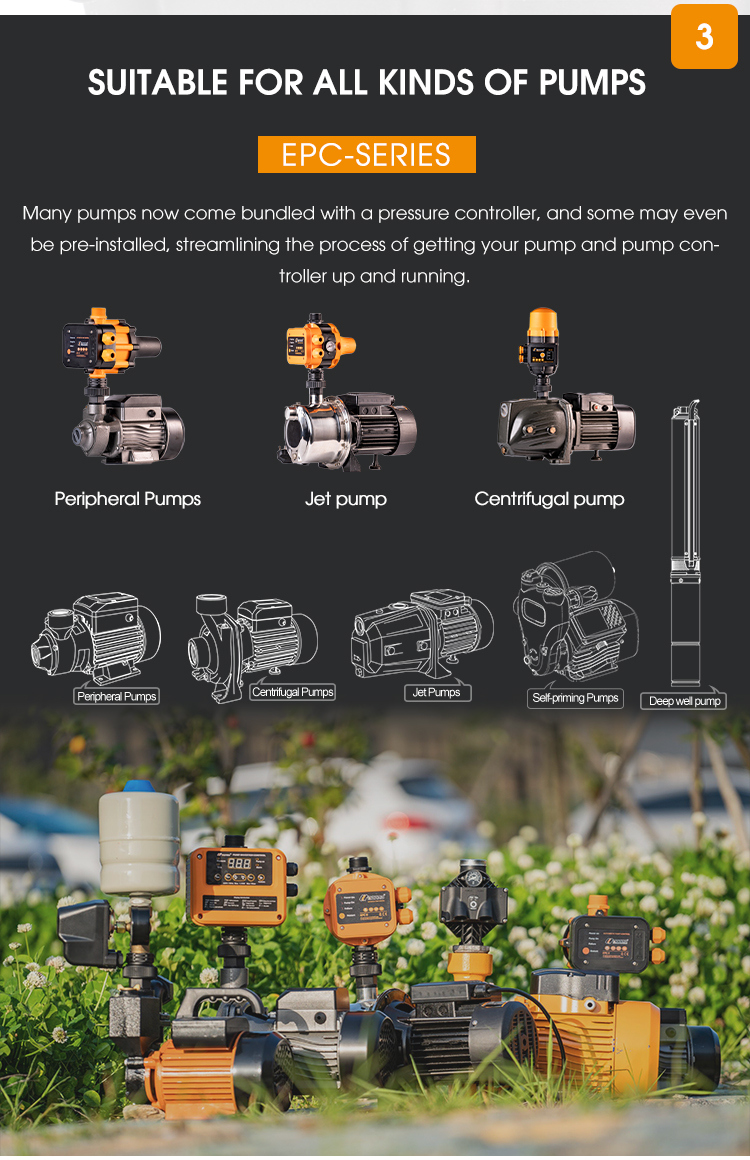
Domestic water supply installation of an EPC-series pump pressure control. Clean water medium, automatic pump start/stop, and a jet-protected enclosure are the defining working conditions.
Protection and Temperature Across the Range: A Model-Level Comparison
Assuming that a whole product family shares one protection rating is one of the most common sourcing errors. Monro's published specifications show three different protection levels and two different temperature ceilings across the pressure control range, and the mechanical KRS series sits at a third level again.
| Model group | Protection rating | Max. working temperature | Notes |
|---|---|---|---|
| EPC-1.1 | IP65 | 55 °C | Domestic application; threads G1", G1 1/4", G1 1/2", NPT1" |
| EPC-1, EPC-2, EPC-3, EPC-3P, EPC-4, EPC-5 | IP65 | 55 °C | Electronic pump pressure controls and switches |
| EPC-2.1, EPC-5.1 | IP44 | 55 °C | Lower ingress protection than the IP65 models |
| EPC-9, EPC-11A | IP54 | 60 °C / 55 °C | Mixed specification within the same series |
| EPC-7, EPC-10, EPC-12, EPC-13, EPC-14, EPC-15, EPC-16, EPC-17, EPC-19 | IP65 | 60 °C | Higher temperature ceiling than the EPC-1.1 |
| KRS-1 to KRS-4 (mechanical) | IP20 | 55 °C | Mechanical pressure controls, screw-adjusted |
| KRS-5 to KRS-8 (mechanical) | IP44 | 55 °C | Mechanical controls with improved enclosure |
| FPS-1 to FPS-4 (float switches) | IP68 | 55 °C | Immersion-rated liquid level devices, a different function |
The table makes one point clearly: an IP65 rating should be quoted with the model number attached. A buyer who drafts a purchase order for "IP65 pressure controllers" without naming the models may receive equipment from a series in which some variants are IP44 or IP54.
A Compliance Checklist for the EPC-1.1
The following items can be verified against the datasheet, the certificate scope and the site survey before an order is confirmed. Each one corresponds to a point where a mismatch would be expensive to correct later.
| Check | What to confirm | EPC-1.1 reference value |
|---|---|---|
| Model identity | The model code on the quotation matches the datasheet being reviewed (EPC-1.1, EPC-1 or EPC-1A are different designations) | EPC-1.1 |
| Ingress protection | Enclosure rating is adequate for dust and directed water at the mounting position | IP65 |
| Temperature ceiling | Both water temperature and ambient temperature stay below the rated maximum | 55 °C |
| Thread interface | Thread standard and size match the pump outlet and pipework | G1", G1 1/4", G1 1/2", NPT1" |
| Electrical supply | Voltage and frequency match the local supply | 220–240 V / 110–120 V, 50/60 Hz |
| Motor compatibility | Pump motor power falls within the listed maximum power options | 0.75 kW, 1.1 kW, 1.5 kW |
| Pressure setting | Starting pressure suits the required water use height and the pump lift | 1.2 bar, 1.5 bar, 2.2 bar (adjustable range 1.2–2.5 bar) |
| Working fluid | Medium is clean water, consistent with the listed application | Clean water, domestic supply |
| Certificate scope | The certificate requested names this exact model, not only a sibling model | Verify with supplier per market |
| Quality system | Manufacturing quality management certification is current and covers pressure switch manufacture | ISO 9001:2015, certificate 20126Q00115R300 |
Two of these checks deserve expansion, because they are the ones buyers most often skip.
Working pressure: ask for the figure explicitly
The published summary data for the EPC-1.1 lists a maximum working temperature but does not carry a separate maximum working pressure value, while the domestic water supply application data for the family states a pressure range of 0.5–10 bar. A buyer specifying this model for a system with an unusually high static head should therefore request the maximum working pressure figure for the exact model in writing, rather than inferring it from the family-level application data. This is a documentation check, not a product defect: it simply reflects the difference between a summary datasheet and a full technical file.
The quality system certificate and what it covers
Monro holds an ISO 9001:2015 quality management system certificate, number 20126Q00115R300, issued by BeiJing ZHONGRUI Unite against the standard GB/T19001-2016/ISO9001:2015. The certificate covers the manufacture of water pump pressure switches and is valid from 30 June 2026 to 29 June 2029. The EPC-1.1 appears in the manufacturer's list of products covered by that certificate. A system certificate of this kind speaks to process control across the factory; it is not the same thing as a product safety certification for a specific model, and buyers should keep the two categories separate in their files.
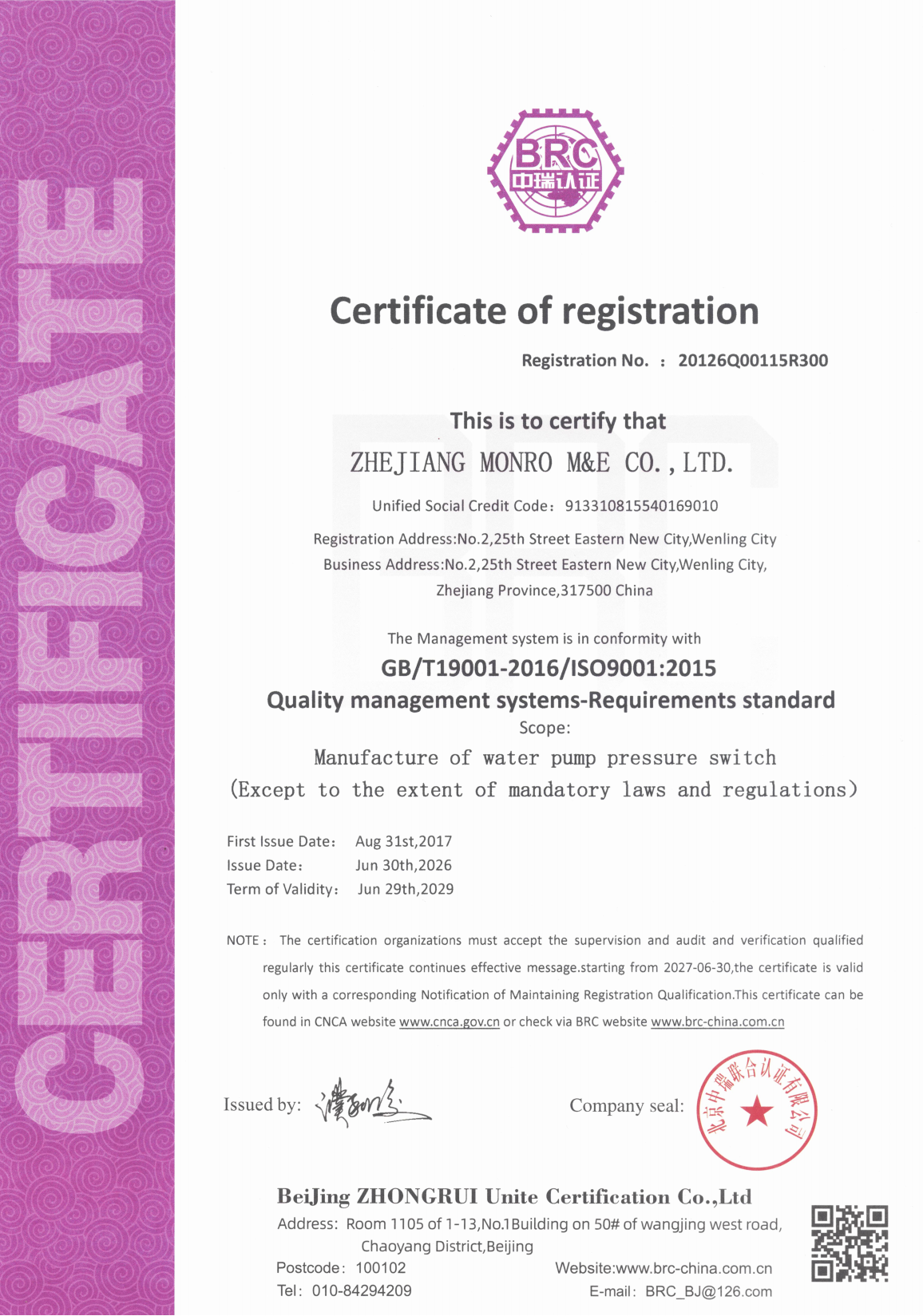
ISO 9001:2015 certificate 20126Q00115R300 covers the manufacture of water pump pressure switches and is valid from 30 June 2026 to 29 June 2029.
Which Certificate Actually Covers Your Model
Certification coverage in this product category is model-specific, and the scope statement on the certificate is the only reliable source. Monro's published certification records illustrate how narrow that scope can be:
- TÜV Rheinland Safety Certification, certificate number R 50175890, issued by TÜV Rheinland LGA Products GmbH, applies to the EU market and names the EPC-10, EPC-12, EPC-14 and EPC-16 control units, assessed against EN 60730-1:2016+A1+A2 and EN 60730-2-6:2016+A1.
- CE-EMC Certificate of Conformity AE 505724390001 names the EPC-1, EPC-2, EPC-2.1, EPC-3, EPC-3P, EPC-4, EPC-5 and EPC-15, cited against EN IEC 55014-1:2021, EN IEC 55014-2:2021, EN 61000-3-2:2019+A1 and EN 61000-3-3:2013+A1+A2.
- A separate CE-EMC Certificate of Conformity, AE 505987560001, applies to the EPC-14.
- UL Listed certification E316396, issued by UL LLC, covers pressure operated switches of model KRS-4 for the North American market.
The EPC-1.1 does not appear by name in those product certification scopes. That is precisely why a buyer should not accept a certificate PDF at face value: the correct question is which certificate names the model being purchased, for which market, and against which standard. Where a specific market requires product-level safety or EMC certification, the buyer should ask the supplier to confirm coverage for the EPC-1.1 in writing, or to propose a model that is already named on the relevant certificate, such as the EPC-10, EPC-12, EPC-14 or EPC-16 for EU safety certification.
For context on the standards themselves, IEC 60730-2-6:2025 is the current international standard for automatic electrical pressure sensing controls for household and similar use, published by the International Electrotechnical Commission. The TÜV certificates above are based on the earlier EN 60730 series, which is the European adoption path for the same family of requirements. Buyers comparing quotations should note which edition a supplier cites.
Market Context: Why Ratings Are Being Read More Closely
Specification scrutiny is rising alongside the size of the category. Fortune Business Insights valued the global pressure switch market at USD 3.2 billion in 2025 and projects growth from USD 3.38 billion in 2026 to USD 5.13 billion by 2034. Market Research Future attributes approximately 62% of the 2024 global market to traditional electromechanical pressure switches and 38% to solid-state electronic pressure switches.
The electromechanical share remains the larger one, which matters for buyers of electronic controllers such as the EPC-1.1: the comparison set is still dominated by screw-adjusted mechanical devices, many of which carry IP20 or IP44 enclosures. The gap between an IP20 mechanical control and an IP65 electronic control is one of the more consequential specification differences in a domestic installation, and it is not always reflected in the price conversation.
Trade documentation reinforces the point that these devices sit in a well-defined customs category: water pump pressure switches are commonly traded under HS Code 853650. Importers preparing documentation should ensure that the model numbers, protection ratings and temperature limits on the commercial invoice match the datasheet, because that consistency is what customs and certification reviewers check first.
Comparison with Mechanical Controls, and the Limits of the EPC-1.1
Mechanical and electronic pressure controls solve the same functional problem — starting and stopping a pump at set pressures — but they sit in different installation envelopes. Monro's mechanical KRS series uses a screw-adjusted pressure setting, carries rated currents from 10(4) A to 20(16) A, and is available with rated voltages of 110–240 V, with some models also listing 400 V. Its protection ratings are IP20 for the KRS-1 to KRS-4 group and IP44 for the KRS-5 to KRS-8 group, with a 55 °C maximum working temperature throughout.
The EPC-1.1 approaches the task differently. It is an electronic control with a built-in check valve, built-in run-dry protection and a built-in socket, rated IP65 and limited to a maximum pump power of 1.5 kW. Neither approach is superior in the abstract; the selection depends on the enclosure, the motor and the site.
Buyers should nevertheless be explicit about the boundaries of the EPC-1.1, because each one has a practical consequence:
- IP65 is not immersion protection. If the mounting position can flood, this is the wrong rating. Monro's immersion-rated devices are float switches in the FPS series, rated IP68, and they perform a different function.
- The 55 °C ceiling rules out warm-water duty. Several models in the same manufacturer's range list 60 °C, including the EPC-7, EPC-10, EPC-12, EPC-13, EPC-14, EPC-15, EPC-16, EPC-17 and EPC-19. Where water or ambient temperature approaches the ceiling, a different model is the correct answer.
- Maximum power is capped at 1.5 kW. Larger pump motors require a different controller; the EPC-10, EPC-12, EPC-17 and EPC-19 list a maximum power of 2.2 kW, and the EPC-7 lists up to 4 kW.
- Product certification coverage must be verified per model. As noted above, the EPC-1.1 is not named on the TÜV Rheinland safety certificate or the CE-EMC certificates held for other models in the range.
- The listed application is domestic. Agricultural irrigation, water treatment and construction duty are the listed applications of other models, not of the EPC-1.1.
None of these points is a defect. Together they form the boundary within which the IP65 and 55 °C ratings are meaningful, and stating them is what makes the datasheet usable as a procurement tool rather than a promotional one.
What to Watch Next
Two trends are likely to change how these ratings are written and read. The first is the shift toward electronic control. With electromechanical devices still holding the larger share of the global market, the transition to solid-state controllers is a gradual one, but each step moves enclosure ratings and temperature limits further into the centre of the buying conversation. The second is the continuing revision of the underlying standards: IEC 60730-2-6:2025 is now the current international reference for automatic electrical pressure sensing controls, and buyers who track which edition a supplier cites will be better placed to compare certificates across markets.
For the EPC-1.1 specifically, the productive habit is a two-line discipline. Before quoting a price, confirm the IP rating against the mounting position, and confirm the 55 °C ceiling against the measured water and ambient temperatures. Everything else on the datasheet — the thread options, the voltage range, the power ceiling, the starting-pressure settings — is straightforward once those two numbers agree with the site.
FAQ
What does the IP65 rating on the EPC-1.1 protect against?
IP65 means the enclosure is dust-tight and protected against water projected as a jet from any direction. It does not mean the unit can be submerged. Positions subject to standing water or flooding require a device with a submersion rating, such as the IP68-rated FPS float switch series, which performs a different function.
Can the EPC-1.1 be installed where water temperature exceeds 55 °C?
No. The datasheet lists a maximum working temperature of 55 °C, and that limit applies to the water and to the surrounding air. Applications involving hot-water circulation or high ambient heat should be reviewed against models in the same range that list a 60 °C ceiling, including the EPC-7, EPC-10, EPC-12, EPC-13, EPC-14, EPC-15, EPC-16, EPC-17 and EPC-19.
Which connection thread should be specified for the EPC-1.1?
The published thread options are G1", G1 1/4", G1 1/2" and NPT1". The correct choice is determined by the pump outlet and the existing pipework, and it should be stated explicitly on the purchase order, because thread type is a mechanical interface that cannot be corrected after delivery.
Which certifications apply to the EPC-1.1, and how should a buyer verify them?
The EPC-1.1 is included in the products covered by Monro's ISO 9001:2015 quality management system certificate, number 20126Q00115R300, issued by BeiJing ZHONGRUI Unite and valid from 30 June 2026 to 29 June 2029. Product-level certificates held for other models in the range have narrower scopes: TÜV Rheinland Safety Certification R 50175890 names the EPC-10, EPC-12, EPC-14 and EPC-16, and CE-EMC certificate AE 505724390001 names the EPC-1, EPC-2, EPC-2.1, EPC-3, EPC-3P, EPC-4, EPC-5 and EPC-15. Buyers should request confirmation of coverage for the exact model and target market in writing, rather than relying on a certificate that names a sibling model.
What pump size can the EPC-1.1 control?
The listed maximum power options are 1.5 kW, 1.1 kW and 0.75 kW, at rated voltages of 220–240 V or 110–120 V and a power frequency of 50/60 Hz. Pumps above that power range require a different controller in the range.
Does the IP65 rating remain valid after the unit has been wired on site?
The rating applies to the enclosure as delivered. Once the cover has been opened for wiring, protection depends on how the cable entries and joints are restored. Monro's installation guidance for its domestic pump controller application instructs installers to seal wire joints with waterproof insulating tape and to fit the controller according to the direction arrow on the housing. The pump head must also be at least 0.8 bar higher than the controller's start-up pressure.
Monro Switch is a manufacturer of pump controllers, pressure switches and float switches based in Wenling City, Zhejiang Province, China.
For full model listings, thread options and protection ratings across the range, the Monro Switch product catalogue is available for download.