
IP68, IP69K & MIL-STD-810G: Compliance Checks for Long-Battery Phones
IP68, IP69K & MIL-STD-810G: Compliance Checks for Long-Battery Phones
A phone can carry IP68, IP69K and MIL-STD-810G on the same specification sheet and still tell a buyer nothing about how long it will run between charges. Those marks describe how an enclosure behaves when dust, water and impact are applied to it. None of them describes the capacity of the cell inside, the efficiency of the platform that drains it, or the number of hours a field technician will get before the battery indicator turns red. For anyone sourcing a long-battery life smartphone, that gap is the difference between a compliant purchase order and a failed field trial, because the two most prominent numbers on a rugged phone listing answer two different questions.
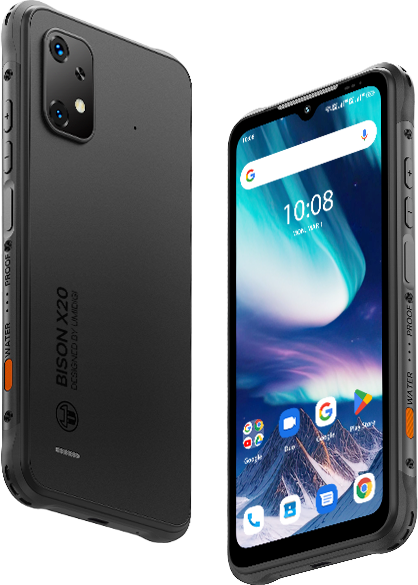
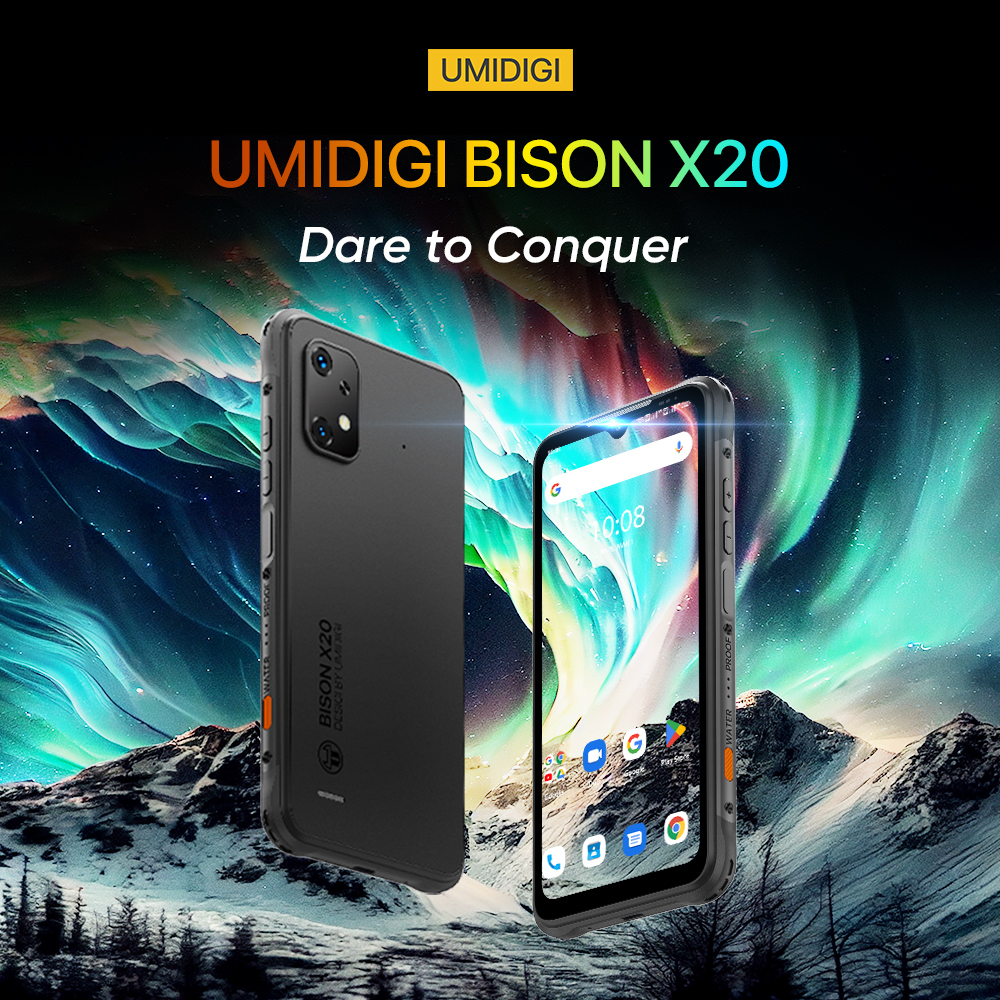
UMIDIGI's own portfolio makes the separation visible. The BISON X20 is specified with IP68 and IP69K dust and water resistance, MIL-STD-810G drop resistance and a 6000mAh battery. The Note 100 5G is specified with IP53 dust and water resistance and a 5000mAh battery. Both are long-battery designs in the sense that matters commercially, and both are sold into overlapping markets, but they are qualified for different conditions and their documentation says different things. The sections below set out what each claim covers, where each claim stops, and which checks belong in an acceptance procedure rather than in a marketing sheet.
Why Protection Ratings and Battery Endurance Are Separate Questions
An ingress protection code and a military test standard both describe the behaviour of a physical enclosure under a defined external condition. Battery endurance is a property of the energy system: cell capacity, discharge behaviour, charging power, and the load created by the display, chipset and software. No ingress test and no shock test measures any of those. A handset can be dust-tight and drain in six hours; another can run for two days and fail after a single drop into a puddle. Nothing in the ratings contradicts anything else, and nothing in them adds up to a single durability score that a procurement team can rank suppliers by.
Three practical consequences follow for buyers.
- A rating describes a tested condition, not a service life. An IP68 result and a MIL-STD-810G result are statements that a sample passed a defined procedure. They are not statements about the condition of the seals after eighteen months of daily use, and they do not extend to a unit whose port cover was left open.
- A rating is attached to a configuration. Seals, port covers, the SIM tray and the front film are part of the assembly that was tested. Replace or remove one of those elements and the basis of the claim no longer applies to the phone in the buyer's hand.
- The exact wording matters more than the impression it creates. UMIDIGI's BISON X20 specification names MIL-STD-810G explicitly, while the UMIDIGI A75 specification uses the phrase "Military-Grade Shock Resistance" alongside IP65. Both may be legitimate descriptions, but they are not the same statement, and a purchase specification should record which wording the supplier actually commits to.
What IP68 Covers, and What IP69K Adds
An IP code carries two digits. The first addresses solids and the second addresses water. In an IP68 rating the first digit indicates a dust-tight enclosure and the second indicates protection against continuous immersion under conditions the manufacturer defines. IP69K extends the water digit to high-pressure, high-temperature jet cleaning of the kind used in washdown environments. A single device can hold both, and the BISON X20 is specified with IP68 and IP69K together, with UMIDIGI's product documentation stating that it is built to withstand 2m submersion.
The important point for a long-battery phone is what those digits do not include. Neither digit references runtime, charge cycles, or the behaviour of the battery when a sealed chassis traps heat during fast charging. The rating answers a question about water and dust entry; the buyer still needs a separate answer about energy.
UMIDIGI's lineup also shows that ingress protection is graded, not binary. The Note 100 5G is specified at IP53, which pairs partial dust protection with protection against water spray — a daily-use classification rather than a submersion or washdown classification. The A75 Pro, A75s, A75x and G100x 5G are specified at IP54, one step further on the water digit. The A75 is specified at IP65. The G100 and G100 5G sit at IP53 with 6000mAh cells, and one model in the supplied documentation, the G9x, lists a 5000mAh battery with no IP rating at all — a useful reminder that a protection claim should be read per model and never carried across a portfolio by assumption.
What MIL-STD-810G Establishes — and What a Specification Line Leaves Out
MIL-STD-810G is a U.S. Department of Defense test-method standard. It defines procedures rather than issuing certificates, and a manufacturer that tests against it selects which methods and severity levels apply to a given product. That structure has a direct consequence for procurement: a "MIL-STD-810G" line on a specification sheet states that testing was carried out against methods within the standard, but the line alone does not tell the buyer which methods, under what conditions, or with what pass criteria. Two suppliers can both print the standard's name while having tested different things.
For a drop-resistance claim in particular, the buyer's questions are narrow and answerable. Which drop orientations were tested? Onto what surface? At what stage of the unit's life? Was the tested sample a production unit or an engineering sample? Was the display and the battery pack verified as functional after the test? UMIDIGI's BISON X20 documentation pairs MIL-STD-810G drop resistance with a rugged TPU and metal structure and describes the intended result as drop and shock performance for harsh working environments. That is a coherent engineering statement, and it is still a statement about the enclosure rather than about runtime.
BISON X20 and Note 100 5G: Two Different Enclosure Strategies, Both Long-Battery
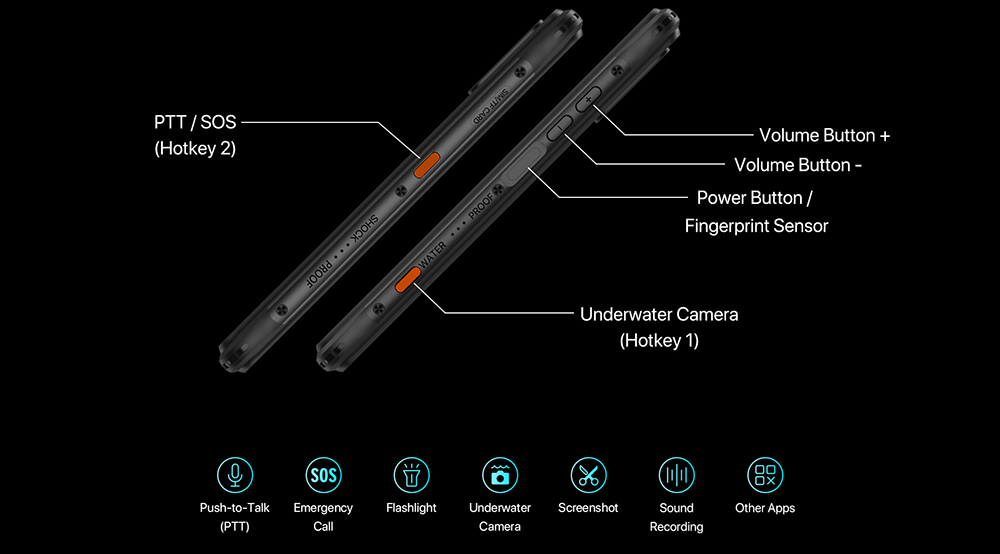
The two models are the clearest illustration of why the certification question and the endurance question have to be asked separately. The BISON X20 carries the heaviest protection package in the lineup — IP68 and IP69K, MIL-STD-810G drop resistance, a TPU and metal structure — alongside a 6000mAh battery, 20W PD fast charging, a 6.53-inch 120Hz HD+ punch-hole display, up to 6+6GB extended RAM, 128GB ROM with 1TB TF expansion, a 20MP ultra-clear triple camera, an 8MP front camera, side fingerprint and AI face unlock, hot keys and NFC. It measures 172.1mm by 83.8mm by 12.9mm and weighs 278g.
The Note 100 5G takes the opposite balance. It is specified at IP53, runs on a UNISOC T765 5G platform with a 6.8-inch 120Hz HD+ punch-hole display, carries a 5000mAh battery with 20W PD fast charging, up to 8+8GB extended RAM and 256GB ROM with 1TB TF expansion, a 50MP ultra-clear triple camera, a 16MP front camera, side fingerprint and AI face unlock and a custom physical hot key. It measures 167.8mm by 77.4mm by 7.7mm and weighs 190g.
Read together, the figures show two different engineering balances rather than one better phone and one worse phone. The rugged model is 5.2mm thicker and 88g heavier while carrying a cell that is 1000mAh larger; the slim model gives up one ingress grade and 1000mAh to sit at 7.7mm and 190g. What the supplied specification does not disclose is how the additional volume in the rugged chassis is divided between sealing, structural reinforcement and the larger cell. That is precisely the kind of detail a buyer should ask for rather than infer, because the answer determines whether the extra mass is buying protection, runtime, or both.
Matching the Protection Class to the Work Environment
The right question is not which rating is highest but which rating matches the conditions the device will actually meet. UMIDIGI's application documentation draws that line itself. The BISON X20 record lists construction and engineering, logistics and warehousing, manufacturing, mining, and oil and gas, with working conditions that include high and low temperature, 24/7 operation, and special requirements of waterproof, dustproof and drop resistance. The daily-use record behind the Note 100 5G, G100, G100 5G, G100x 5G, A75x and G9x specifies normal-temperature operation for daily life and work. Those are different briefs, and the ratings follow them.
| Model | Ingress claim | Shock / drop claim | Battery | Charging | Documented fit |
|---|---|---|---|---|---|
| UMIDIGI BISON X20 | IP68 & IP69K | MIL-STD-810G drop resistance | 6000mAh | 20W PD | Construction, logistics, manufacturing, mining, oil and gas; high and low temperature |
| UMIDIGI A75 | IP65 | Military-Grade Shock Resistance | Up to 6600mAh | Not stated in the supplied spec | Daily work and life |
| UMIDIGI G100 5G | IP53 | Not stated | 6000mAh | 20W PD | Daily work and life |
| UMIDIGI G100 | IP53 | Not stated | 6000mAh | 20W PD | Daily work and life |
| UMIDIGI Note 100 5G | IP53 | Not stated | 5000mAh | 20W PD | Daily life and work |
| UMIDIGI G100x 5G | IP54 | Not stated | 5200mAh | 20W | Daily work and life |
| UMIDIGI A75 Pro / A75s / A75x | IP54 | Not stated | 5000mAh | Not stated in the supplied spec | Daily work and life |
Two readings of that table matter commercially. First, capacity and protection do not track each other: the A75 reaches up to 6600mAh at IP65, while the BISON X20 pairs the highest ingress and drop claims in the lineup with a 6000mAh cell. Second, a higher ingress digit is not automatically the right purchase. An IP69K washdown rating is relevant to a site that hoses equipment down; for an office or retail deployment it adds cost and mass without answering an operating condition that exists. The specification should be built from the environment outward, not from the longest rating inward.
Where CE Fits, and Why a Certificate Number Belongs to One Model
CE marking answers a different question again, and it is the one that most often gets mixed up with ingress ratings during supplier evaluation. CE under the Radio Equipment Directive 2014/53/EU is a market-access requirement covering safety, electromagnetic compatibility and radio spectrum use. It says nothing about dust, water or drop performance, and an IP rating says nothing about EU market access. A purchase file needs both, recorded separately.
UMIDIGI publishes model-specific certificates issued by BACL. The G100 holds an EU Type Examination Certificate, number B2412041, valid until 2099-12-18, under 2014/53/EU RED, with EMC standards including EN 55032 and IEC 61000-3, safety standards including IEC 62368-1 and the EN 50360 series, and radio standards in the ETSI EN 300, EN 301 and EN 303 series. The Note 100 5G is certified to EU CE standards under number B2407121. The A75x is covered by an Attestation of Conformity, number 2601P40188E-RFA1. The G9x holds CE certification number 2501P41324E-RFA1, with EN 55032 for EMC.
Two practical rules follow. The first is that a certificate number belongs to the model and configuration named on it — it cannot be re-used as evidence for a different handset in the same catalogue. A buyer sourcing the BISON X20, whose IP68, IP69K and MIL-STD-810G claims are the strongest in the lineup, should request that model's own compliance documentation rather than accept a sibling's certificate as a substitute. The second is that certificate validity is worth checking against the delivery date, even when the stated expiry is far in the future, because the document must also match the exact model designation on the invoice.
Reading Battery, Enclosure and Charging Figures Together
Endurance comes from four variables that the protection ratings do not touch: cell capacity, charging power, the load created by the display and refresh rate, and the efficiency of the platform and software. The lineup varies all four. The BISON X20 runs a MediaTek Helio P60 with a 6.53-inch 120Hz panel; the G100 and G100 5G pair a 6.9-inch 120Hz display with a 6000mAh cell and 20W PD charging; the G100x 5G pairs the same 6.9-inch 120Hz class of display with 5200mAh and a UNISOC T8200 5G platform; the Note 100 5G pairs a 6.8-inch 120Hz panel with 5000mAh and a UNISOC T765 5G platform. A buyer comparing any two of these is comparing two different energy budgets, and the ingress rating does not help rank them.
The honest position is that capacity and charging figures are documented, while measured runtime under a specific workload is not part of the supplied specification. That is not a gap unique to one supplier; it is normal for a specification sheet. The response is procedural: state the workload — screen-on hours, radio type, camera or scanner use, ambient temperature — and ask for runtime evidence against it, or run a pilot batch under that workload before committing to volume. UMIDIGI's own qualification record shows 100% pre-shipment testing as part of its quality control, which addresses unit-level function at dispatch rather than field runtime, and buyers should treat the two as separate evidence.
Qualifying the Purchase Package Before Acceptance
The accessories supplied with a long-battery phone are part of the qualification, not an afterthought, because several of them interact directly with the protection and charging claims. UMIDIGI's application documentation lists protector film, phone case, power adapter, SIM tray ejector and USB cable as the supporting items for its daily-use models, and lists power charger, USB data cable and protector film for the BISON X20 deployment scenario. Those lists are the basis for an acceptance check.
Package verification before sign-off
- Match the box to the purchase order. Count each listed item and confirm the model designation on the packaging matches the model on the invoice and on the compliance certificate.
- Protector film. Where the documentation specifies the film as applied, confirm it is present, seated and free of lifting at the edges. A lifted film is a fit defect on the delivered unit and should be recorded as such.
- Phone case. Confirm the case is the one specified for that model. A case that obstructs a port or presses on a sealed edge defeats the purpose of the accessory.
- Power adapter. Check the plug type and the marked output against the purchase order for the destination market, and confirm it matches the charging specification of the model — 20W PD fast charging on the BISON X20, G100, G100 5G, Note 100 5G and G100x 5G.
- SIM tray ejector and tray seating. Confirm the ejector is present, then insert and reseat the tray once. On any model with an ingress rating, the tray is one of the openings that rating depends on, so a tray that does not sit flush is a blocking defect rather than a cosmetic one.
- USB cable. Confirm the connector type and that the cable supplied is the one listed for the model, then complete one full charge cycle on a sample unit as part of incoming inspection.
Two further checks belong at the same stage. Inspect the seals, port covers and any gasket surfaces on the first unit received, since an ingress claim depends on those components being intact and correctly seated. And record the acceptance result per batch rather than per shipment, because accessory content and packaging are exactly the variables that drift between production runs.
What the Capacity Trend Does and Does Not Tell You
The market context supports the attention buyers are paying to capacity. Counterpoint Research data records that smartphones with battery capacities of 6000mAh or higher reached 29% of global unit sales in January 2026, up from 10% in early 2025. The Insight Partners figures place the 5000mAh to 6000mAh band at 42.9% of the rugged phone market in 2025. Capacity has become mainstream in both the general and rugged segments, which means capacity alone has stopped being a differentiator and the enclosure and documentation questions now carry more of the decision weight.
A regulatory date sits alongside that trend. Under the EU Batteries Regulation, from 18 February 2027 new smartphones and tablets placed on the EU market must be designed so that end users can remove and replace the battery using standard tools. That requirement is about serviceability, not about ingress protection, and the two can pull in opposite directions: a user-replaceable battery changes the sealing strategy of a chassis. Buyers with EU volume should ask suppliers directly how they intend to meet the date, and should treat an answer as a planning input rather than an assumption.
A Short Decision Framework
- Start from the operating environment, not the rating. Record the actual conditions — dust, spray, washdown, drop height and surface, temperature range, shift length.
- Select the ingress class that matches those conditions. IP53 for daily use, IP54 and IP65 as the exposure increases, IP68 and IP69K where submersion or washdown is real.
- Record the exact wording of any shock or drop claim, and request the test scope behind it in writing.
- Treat battery capacity, charging power, display and platform as a separate evaluation, and ask for runtime evidence against your stated workload.
- Keep CE documentation per model, matched to the invoice designation and the delivery date.
- Verify the packaged items and the seal condition on the first unit of every batch before volume acceptance.
The manufacturer behind these claims, UMIDIGI (Shenzhen Keysmart Technology Co., Ltd.), was founded in 2012 and operates a 10,000m² factory with 400–500 employees, a 30-engineer R&D team and a stated monthly capacity of 300,000 units, with OEM and ODM services covering brand logo, exterior design, packaging design and specifications, a 3,000-unit MOQ, OEM lead times of 60–70 working days and remote technical support. Those figures matter to this topic for one reason: documented qualification is only credible if the supplier can reproduce the same configuration across batches, and capacity and process control are what make that possible.
Outlook
Two directions are reasonable to plan for. First, certification evidence is becoming a line item in the purchase order rather than a line in the brochure, with buyers asking for method scope, laboratory identity and configuration control alongside the rating itself. Second, the 2027 EU serviceability date will force high-capacity designs to reconcile sealed protection with battery access, which will make the distinction between enclosure claims and energy claims even more important to state explicitly. Neither development changes the underlying rule: an ingress or drop rating tells a buyer how the housing was qualified, and only separate evidence tells them how long the phone will run.
Frequently Asked Questions
Does an IP68 or IP69K rating tell you how long a phone's battery will last?
No. IP68 and IP69K describe how an enclosure resists dust and water entry under defined test conditions. They contain no information about cell capacity, charging power or power draw, so they cannot be used to estimate runtime. The BISON X20 carries IP68 and IP69K together with a 6000mAh battery, but the rating and the capacity are two independent specification entries and should be evaluated as such.
What is the practical difference between IP53 and IP68 or IP69K for a long-battery phone?
IP53 combines partial dust protection with protection against water spray, which suits daily use in normal temperature environments. IP68 adds a dust-tight enclosure and protection against continuous immersion under manufacturer-defined conditions, and IP69K adds protection against high-pressure, high-temperature jet cleaning. In UMIDIGI's lineup the Note 100 5G is specified at IP53 while the BISON X20 is specified at IP68 and IP69K and documented as built to withstand 2m submersion.
Is MIL-STD-810G a certificate issued by an independent body?
No. MIL-STD-810G is a U.S. Department of Defense test-method standard that defines environmental test procedures. A manufacturer tests against selected methods within it and declares the result, so the specification line alone does not state which methods, severity levels or pass criteria were applied. Buyers comparing two drop-resistance claims should ask for the tested methods, the surface and orientation used, and whether the sample was a production unit.
Which items should be checked in the box before accepting a rugged long-battery phone?
UMIDIGI's application documentation lists protector film, phone case, power adapter, SIM tray ejector and USB cable as the supporting items for its daily-use models, and power charger, USB data cable and protector film for the BISON X20 scenario. Before acceptance, match each item against the purchase order, confirm the model designation on the packaging, check that the film and case are correctly fitted, verify the adapter plug type and output for the destination market, reseat the SIM tray once, and complete a charge cycle on a sample unit.
Does a CE certificate also cover the IP rating of a phone?
No. CE under 2014/53/EU RED addresses safety, electromagnetic compatibility and radio spectrum use as a market-access requirement, and it does not certify ingress or drop performance. The two belong in separate parts of the purchase file. UMIDIGI's published certificates are model-specific — for example B2412041 for the G100, B2407121 for the Note 100 5G, 2601P40188E-RFA1 for the A75x and 2501P41324E-RFA1 for the G9x, all issued by BACL — and a certificate for one model should not be used as evidence for another.
Readers who need the corporate record behind these specifications — founding year, factory footprint, production capacity and service scope — can consult the UMIDIGI company profile (PDF), and the model pages at UMIDIGI.
Have Questions or Need More Details?
Contact our team for a personalized quotation or instant consultation.
Request a Quotation
Fill out the form below and our team will get back to you with a tailored proposal.
WhatsApp Direct Chat
Prefer to chat in real-time? Message us on WhatsApp for instant assistance & quick answers.
- Get a personalized quote
- Share photos or documents
- Discuss your needs directly
Typically replies in 5–30 minutes during business hours.