
IPC-6012 Class 3, UL94 V-0, UL/IATF 16949, RoHS/REACH: Decoding PCB Compliance Paperwork
A PCB specification sheet is a list of claims, not a compliance record. The three families of claim that appear on it — build standards, certificates and material declarations — are evidenced by three different document types, issued by three different parties, and checked at three different moments in a purchase. Reading them as one block is the most common documentation error in PCB and PCBA sourcing.
Why Compliance Paperwork Breaks Down at the Buyer's Desk
Compliance lines are usually inherited. A phrase such as “IPC Class 3, UL94 V-0, IATF 16949, RoHS” migrates from an automotive programme into an industrial control order, then into a prototype RFQ, without anyone re-reading it. Each element of that phrase belongs to a different evidence family, and each is satisfied by a different document.
The failure mode is rarely a forged certificate. It is a genuine document answering a slightly different question than the one the buyer asked. Three patterns recur:
- A certificate pack that is authentic but scoped to a different product family, a different facility, or a validity period that has lapsed.
- A RoHS or REACH declaration circulated as a PDF, with no referenced test report, no laboratory name and no statement of which material was actually tested.
- A build-standard claim — Class 3, a surface finish, a minimum line width — quoted on a datasheet with no corresponding inspection record for the lot that ships.
The opportunity sits in the same place as the problem. Splitting a compliance line into its three families before the RFQ goes out costs a few minutes of specification work. Discovering the mismatch at goods-in, or during a customer audit, costs considerably more.
The Three Claim Families on a PCB Specification
The table below is the working model for the rest of this article. It maps each claim family to what it actually proves, what it leaves unproven, and the document that closes the gap.
| Claim family | Typical wording on a spec sheet | What it is evidence of | What it does not establish | Document to request |
|---|---|---|---|---|
| Build standard | “IPC-6012 Class 3”, “IPC-A-600H” | The performance and acceptance criteria the board is built and inspected against | That inspection was performed on your lot, to that class, with recorded results | Purchase-order clause citing the standard and its revision; first-article inspection report; microsection; AOI and electrical-test records |
| Flammability rating | “UL94 V-0” | A flammability classification of the base material, normally the laminate | That the specific laminate grade was used in your build, or that the board construction itself is UL recognized | Laminate supplier’s UL yellow card showing the grade and its V-0 classification; laminate lot traceability |
| Certificate | “IATF 16949:2016”, “ISO 9001”, “UL Recognized, File No. E519316”, “CQC” | That a management system, a construction, or a market-access requirement has been assessed by a competent body | That any individual order conforms | Current certificate showing issuing body, number, scope statement, site address and expiry; UL card extract |
| Material declaration | “RoHS compliant”, “REACH”, “SGS report available” | That declared substances in declared materials sit within stated limits | Electrical, thermal or mechanical performance of the finished board | Signed and dated declaration naming the part and material; test report with report number, laboratory, sample description and test method |
What “IPC-6012 Class 3” Actually Commits the Supplier To
IPC’s own standards overview identifies IPC-6011, IPC-6012 and IPC-6013 as qualification and performance specifications for printed boards — generic, rigid, and flexible respectively. IPC-6012 is therefore the rigid-board performance document. IPC-A-600 is a separate reference: it is the acceptance document used when printed circuit boards are inspected.
Buyers routinely write these as a single shorthand, sometimes as “IPC-A-6012”, which reads as one document but is in fact two: one defines what the board must be capable of, the other defines what is acceptable at inspection. A Class 3 clause sits on top of both, and tightens the acceptance threshold rather than changing the material.
The practical consequence is worth stating plainly. According to IPC-A-600, Class 2 is suitable for general automotive electronic parts, while Class 3 is recommended for high-reliability safety components such as BMS and ADAS to lower failure risk. Class 3 is therefore a decision about consequence of failure, not a marketing tier. Requesting Class 3 on an industrial control board that will never sit in a safety path adds inspection cost without adding protection; requesting Class 2 on an ADAS module removes the evidence trail that the class was designed to create.
Three things make a Class 3 line enforceable rather than aspirational:
- The revision is named. “IPC-6012 Class 3” without a revision is ambiguous, because the current revision must be verified against the official standard before it enters a contract.
- The acceptance document is named alongside it, so both the performance target and the inspection criteria are fixed.
- Inspection records are attached per lot or lot family — first-article report, microsection, AOI results, electrical test data.
The material side has its own references. IPC-4101F covers base materials for rigid and multilayer printed boards, and IPC-4204C covers flexible metal-clad dielectrics for flexible board fabrication. When a specification names a laminate but not a material standard, the laminate grade is a description rather than a controlled requirement.
UL94 V-0 Is a Material Rating, Not a Board Certificate
UL94 V-0 is a flammability classification demonstrated on the material, and in PCB fabrication the material in question is normally the laminate. The rating is recorded on the laminate manufacturer’s UL yellow card. Board-level UL recognition — historically associated with UL 796 for printed wiring boards — is a separate recognition of a construction and the facility that builds it.
That separation matters because a specification line reading “UL94 V-0” is satisfied two levels down the supply chain. A supplier can meet it truthfully while the buyer holds no document that proves it. The request therefore has three parts:
- The laminate supplier’s yellow card, showing the grade designation and its V-0 classification.
- A UL card extract covering the board construction and the facility that produced it.
- Material lot traceability linking the laminate actually consumed to the grade declared.
Bare-board and assembly recognitions are also separate scopes. Where a supplier’s documentation set cites listing references such as PCB-10 for bare boards and PCBA-999 for assembled boards, the two cover different things: an assembly listing does not extend to a bare-board order, and a bare-board listing does not cover the assembly process. Buyers ordering both should ask for both card extracts rather than a single certificate page.
Certificate-Based Claims: UL, IATF 16949, CQC and ISO
Certificates are the easiest documents to collect and the easiest to misread, because each one certifies something different.
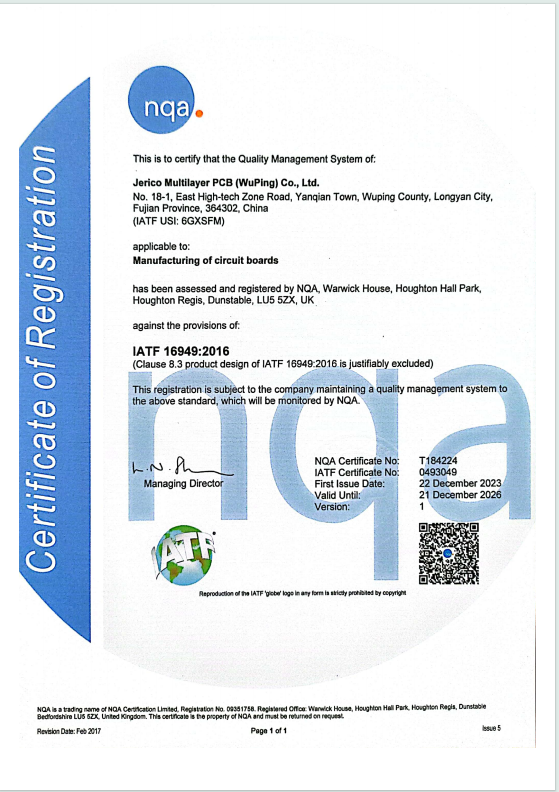
IATF 16949:2016 certifies an automotive quality management system at a named site. What it enables is the surrounding apparatus: production traceability, APQP and PPAP-style output, corrective and preventive action discipline. What it does not do is certify a board. A supplier holding IATF 16949 can still ship a non-conforming lot; the certificate describes the system intended to prevent that.
ISO 9001 and ISO 14001 certify quality and environmental management systems respectively. Both are management-system statements, and both are frequently quoted where a buyer actually needed a product-level document.
CQC is the China Compulsory Certification mark, relevant to market access for covered products in China. It is a regulatory statement, not a performance statement.
UL recognition is product- and construction-specific and carries a file number, which makes it the most verifiable of the four — provided the buyer checks that the file, the construction and the producing facility all match the order.
Five fields should be verified on every certificate before it enters a supplier file: issuing body, certificate number, scope statement, site address, and expiry date. A certificate with an unreadable scope statement is decorative.
Material Declarations: RoHS, REACH and Test Reports
RoHS and REACH are declarations about restricted substances. RoHS addresses hazardous substances in electrical and electronic equipment; REACH addresses the registration, evaluation and communication obligations attached to chemical substances. Neither is a performance standard, and neither says anything about impedance, thermal cycling or via reliability.
The distinction that matters in procurement is declaration versus test report. A declaration is a supplier statement about declared materials. A test report is a laboratory result on a sample, with a report number, a laboratory name, a sample description and a test method. The first is cheap to issue and cheap to inherit from a material supplier; the second is traceable.
Three questions turn a declaration into something usable:
- Which laboratory issued the supporting report, and what is the report number?
- Which materials were sampled — the laminate, the surface finish chemistry, the solder mask?
- Does the report date precede or follow the material lot used on this order?
In practice, most PCB fabricators pass through declarations received from their laminate and chemistry suppliers. That is normal and acceptable, provided the chain of custody is visible. A declaration that cannot say who tested what is a statement of intent, not evidence.
Where Product Sheets Stop Short: Finish and Line Width Without a Report Number
This is the most frequent gap in real specifications. A product sheet states “immersion gold” or “minimum trace and spacing 3/2.8 mil” and stops there. Both are process descriptions. Neither is a measurement until somebody records a measurement against a method.
For a surface finish, the missing items are the measurement method and the recorded thickness result. For line width, the missing items are the inspection method and the sampling plan. For controlled impedance, the missing item is a test coupon report — a stated tolerance without a coupon measurement is a capability claim, not a result.
What to ask for, by claim type:
| Claim on the datasheet | Document that closes it |
|---|---|
| Surface finish type (ENIG, ENEPIG, HASL, OSP, immersion tin or silver) | Finish thickness measurement record with method and sampling basis |
| Minimum trace width and spacing | Inspection record with method and sampling plan; AOI output where applicable |
| Controlled impedance tolerance | Impedance test coupon report from the production panel |
| Class 3 acceptability | First-article inspection report plus microsection for plating and via geometry |
| Laminate grade and flammability | Laminate yellow card plus material lot traceability |
| RoHS / REACH compliance | Dated declaration plus laboratory report number and sampled material list |
How One Supplier Structures the Documentation Set
Shenzhen Jerico Multilayer PCB Co., Ltd. (Jerico) is a PCB fabrication and partial PCB assembly supplier founded in 2009, operating a manufacturing site in Wuping, Fujian and a business centre in Shenzhen, Guangdong, with a 20,000 ㎡ plant area and roughly 40% of output exported to the EU and USA.
Its certificate set is a useful worked example of the three-family model. Management-system and regulatory certificates cover ISO 9001, ISO 14001, IATF 16949:2016 and CQC, with UL recognized status under File No. E519316. Material documentation is handled separately, with RoHS and REACH material declarations and SGS compliance test reports available on request. Production is stated to comply with IPC-A-600H, IPC-6012, UL-796 and IATF 16949 — which is to say the shop floor works to both the performance specification and the acceptance document, rather than treating them as one.
On the capability side, the relevant facts for a compliance conversation are the ones that generate records: minimum trace width and spacing down to 3/2.8 mil, impedance tolerance of ±10% in mass production, a minimum laser-cut blind via of 0.10 mm in mass production, and a finish range spanning ENIG, ENEPIG, selective gold plating, OSP, immersion tin, immersion silver and HASL. The product range includes rigid multilayer boards, heavy-copper boards, HDI with buried and blind vias, high-frequency boards and metal-core boards, serving communication, automotive electronics, industrial control, smart home, consumer 3C, medical equipment and power energy applications.
The quality chain that produces the paperwork runs from IQC incoming inspection through IPQC in-process control, AOI full inspection and FQC final inspection to laboratory reliability validation covering salt spray, high-voltage and metallographic tests. Complaint response is committed within 24 hours, with a corrective and preventive report available within 72 hours. Engineering support includes 7×24 technical response, one-on-one FAE collaboration and a human DFM review after Gerber processing.
One service detail has a direct documentation consequence: sample lead time is 3–10 days, and samples run on the same production line as mass production. For a buyer building a qualification file, that means the process record attached to an approved sample reflects the route the volume order will actually take, rather than a separate prototype line with different equipment and different operators.
Application: Which Documents Matter for Which End Market
The correct document set is a function of the end market, not of the supplier’s certificate folder.
Automotive electronics. For BMS, ADAS and safety-path modules, the working set is a Class 3 acceptance clause, an IATF 16949 site certificate, lot traceability and automotive-grade project output. Where the design uses HDI boards with buried and blind vias for compact sensors with dense routing, the microsection record for via geometry becomes part of the qualification evidence. Where controlled impedance is specified for CAN/LIN or radar circuits, the coupon report is the only document that demonstrates signal integrity was measured rather than assumed.
Industrial control. General industrial boards typically sit at Class 2 acceptance against IPC-A-600, supported by ISO 9001 and a RoHS declaration. Heavy-copper constructions add a plating-thickness record to the request list, because copper weight is a process outcome rather than a design input.
Medical equipment and power energy. Here the declaration family carries more weight, and reliability laboratory output — salt spray, high-voltage, metallographic — is the evidence buyers ask for alongside RoHS and REACH documentation.
Market Context: Why Documentation Is Becoming a Purchasing Variable
Prismark reports the bare-board PCB market at $85.8 billion in 2025 and projects roughly $95.8 billion in 2026, with China’s share of global PCB production projected to reach approximately 60% by 2026. Business Research Insights places multilayer PCBs at approximately 52% of total global production volume.
The procurement implication is indirect but real. As volume concentrates in a smaller number of large fabrication clusters, the number of suppliers a buyer can physically audit does not scale with it. Documentation becomes the audit proxy: the buyer inspects records instead of factories. That shift raises the value of a supplier whose certificate scope, lot traceability and test reporting are already organized, and penalises one whose compliance pack is a merged PDF assembled per request.
Claim-Tiered Documentation Versus the Traditional Certificate Pack
The conventional approach is the certificate pack: the supplier sends every certificate it holds, the buyer files the bundle, and the file is reopened only when something goes wrong. It is fast, familiar, and weak exactly where it matters — nothing in the bundle is tied to the order.
The alternative is claim-tiered documentation, where each compliance line on the specification is mapped to a document category, and each document carries an identifier: a report number, a certificate number, a lot number. It answers a narrower question — did this specific order satisfy this specific clause — and it answers it in minutes rather than days.
The trade-off is honest and should be stated. Claim-tiered documentation increases RFQ administration on both sides, requires the buyer to maintain a document register per supplier, and adds a review step before purchase-order release. It also does not verify anything by itself: certificate scope, validity and issuing body still have to be checked against the original, and lot records still have to be sampled. For a first prototype order with no regulatory exposure, the certificate pack is usually sufficient. The tiered approach earns its cost at the point where a failed board triggers a customer audit.
Limits and Boundaries Buyers Should Expect
Any documentation framework has edges, and three are worth naming for this supplier specifically.
- Certificate details — issuing body, certificate number, validity period and exact scope — must be confirmed against the original documents and, where possible, the issuer’s registry. A public profile page is not a substitute for the certificate itself.
- Stated capability ranges are company-reported. Layer counts, minimum feature sizes and finish ranges describe what the supplier says it can build; they have not been independently audited in a published third-party record.
- A Class 3 clause is only as good as the lot record behind it. If first-article and microsection data are not attached to the shipment, the clause remains an intention regardless of which class the drawing names.
Documentation discipline also cannot rescue a marginal design. If the stack-up, impedance target or thermal path is wrong, complete paperwork simply documents the failure more thoroughly.
Future Outlook
Three directions look likely over the next procurement cycles. First, lot-level documentation will move from paper to structured data, because buyers increasingly want to query test results rather than read them. Second, material declarations will be expected to carry laboratory traceability by default, not on request — the declaration-versus-report gap is already visible to auditors. Third, Class 3 and equivalent high-reliability clauses will keep migrating from automotive into adjacent markets, which will make the distinction between a build standard and a certificate more, not less, important for general industrial buyers.
None of this replaces judgement. It just moves the judgement earlier — to the moment a specification line is written, rather than the moment a shipment is rejected.
Frequently Asked Questions
What is the difference between IPC-6012 and IPC-A-600?
IPC-6012 is a qualification and performance specification for rigid printed boards, defining what the board must be capable of. IPC-A-600 is the acceptance document used when printed circuit boards are inspected, defining what is acceptable. A specification that names only one of them leaves either the performance target or the inspection criteria undefined. IPC-A-600 also sets the class framework: Class 2 suits general automotive electronic parts, while Class 3 is recommended for high-reliability safety components such as BMS and ADAS to lower failure risk.
Does UL94 V-0 mean the finished PCB is UL recognized?
No. UL94 V-0 is a flammability classification of the base material, normally demonstrated on the laminate and recorded on the laminate manufacturer’s UL yellow card. UL recognition of a printed wiring board is a separate recognition of a construction and the facility that builds it, identified by a file number. A specification citing V-0 without a laminate yellow card, and a UL claim without a card extract covering the specific construction, are two different evidence gaps.
What does an IATF 16949 certificate prove about a PCB supplier?
It certifies that an automotive quality management system has been assessed at a named site. It supports the apparatus around the product — traceability, APQP and PPAP-style output, corrective and preventive action — and is a standard requirement in automotive PCB evaluation criteria alongside RoHS, REACH and UL compliance. It does not certify an individual board, and it does not by itself demonstrate that a given lot conformed.
Is a RoHS or REACH declaration the same as a test report?
No. A declaration is a supplier statement about declared materials. A test report is a laboratory result on a defined sample, carrying a report number, laboratory name, sample description and test method. Declarations are frequently passed down from laminate and chemistry suppliers, which is normal, but the chain should remain visible: which laboratory, which materials were sampled, and whether the report predates or follows the lot in question.
Which documents should a buyer request for a high-layer HDI board order?
For a board specified to IPC-6012 Class 3 with a UL94 V-0 flammability requirement, the request list is: the drawing or purchase-order clause naming the standard and revision; first-article inspection and microsection records for via geometry and plating; AOI and electrical test records; impedance coupon reports where controlled impedance is specified; the laminate yellow card plus lot traceability; a current UL card extract covering the construction and facility; the IATF 16949 certificate with scope and validity; and dated RoHS and REACH declarations with supporting laboratory report numbers.
A datasheet lists a surface finish and a line width without a test report number. What should I ask for?
Ask for the measurement behind each claim. For a surface finish, request the thickness measurement record with method and sampling basis. For minimum trace width and spacing, request the inspection record with method and sampling plan, plus AOI output where applicable. For controlled impedance, request the coupon report from the production panel. A stated figure without a report number is a capability claim that can seed an RFQ clause, but it cannot close one.
Jerico’s company profile, covering plant setup, product range and certification list, is available for download: JERICO PCB company profile (PDF).
Have Questions or Need More Details?
Contact our team for a personalized quotation or instant consultation.
Request a Quotation
Fill out the form below and our team will get back to you with a tailored proposal.
WhatsApp Direct Chat
Prefer to chat in real-time? Message us on WhatsApp for instant assistance & quick answers.
- Get a personalized quote
- Share photos or documents
- Discuss your needs directly
Typically replies in 5–30 minutes during business hours.