
IQF Frozen Vegetable Qualification Checklist: Food Grade, Cold Storage and Shelf Life
IQF Frozen Vegetable Qualification Checklist: Food Grade, Cold Storage and Shelf Life
A frozen vegetable order is usually settled on five written terms: food grade, storage at −18°C or below, a 24-month shelf life, a cut or size specification, and customizable packaging. Each looks standard enough to accept without inspection, which is why disputes over IQF onion, spinach, sweet corn, carrots and broccoli tend to surface after the container lands rather than before it is booked.
This reference is written for buyers at decision stage. It sets out what each of those five terms actually establishes, which document or receiving check turns it into evidence, and where the boundary of the claim sits. It also places the five terms against the commercial conditions that travel with them, including minimum order quantity, sampling, packing format, delivery and complaint handling, because a qualification checklist that stops at the specification sheet is only half a checklist.
IQF, or Individual Quick Freezing, freezes each prepared piece separately and rapidly so that the product stays loose and free-flowing for portioning, blending and processing. That process now dominates the category: the IQF segment held 55.43% share of the frozen vegetables market in 2024, according to Mordor Intelligence. A dominant technique produces a fairly uniform vocabulary across suppliers. What still differs is the documentation standing behind that vocabulary.

Manual sorting station inside an IQF vegetable line: qualification begins at raw-material handling, not at the specification sheet. Image: YOKID Foods.
The five terms, and how much each one proves
Read as a set, the five qualification terms describe different things. One is a product-intent statement, one is a process and logistics condition, one is a time boundary, one is a physical definition, and one is a commercial flexibility claim. They cannot be verified by the same means, and none of them is self-verifying.
| Term as written | What it establishes | What it does not establish on its own | Evidence to request |
|---|---|---|---|
| Food grade | Product and packaging are intended for food use and handled under food-safety controls | Not a named certificate, not a market-specific approval, not batch-specific | Approved product specification, food-contact packaging declaration, batch-linked test reports |
| Storage at −18°C or below | A storage and cold-chain condition | Not proof that the condition was held through transit and handover | Temperature records for production freezing, cold store and loading, plus a receiving temperature check |
| 24-month shelf life | The outer edge of the typical 18 to 24 month range under stated storage | Not a guaranteed remaining life at delivery | Production date, batch code, agreed remaining shelf life in the contract |
| Cut or size specification | A format definition for the piece | Not a tolerance or a defect acceptance limit unless written as one | Approved sample plus a written size and defect acceptance description |
| Customizable packaging | Willingness to configure cut, blend and pack format to buyer requirements | Not a fixed price and not a fixed MOQ | Pack specification, MOQ per format, retained sample of film or label |
The pattern is consistent. The written term sets an expectation, while the evidence attached to a production lot is what a buyer can actually rely on. For decision-stage purchasing, the operational question is not whether a specification contains the phrase, but whether the supplier can attach a document to a batch on request.
Food grade: the broadest term and the one that proves the least alone
A food-grade statement indicates that a product and its packaging are intended for food use and are handled under food-safety controls. It is a suitability statement, not an approval. On its own it does not name a standard, does not identify which market requirements were applied, and does not certify a batch.
What converts the phrase into something usable is the document set behind it. In IQF vegetable supply that set normally includes the approved product specification, a declaration covering food-contact packaging, and batch-linked test reports. Coverage is product- and market-dependent: YOKID Foods states that relevant certificates and test reports are available according to the product and destination market, rather than as one universal dossier.
Three questions that turn the phrase into evidence
- Which document is released with each batch, and what does it test?
- Which market requirements were applied when the specification was written?
- Where in the process are residues and foreign material controlled, and what record shows it?
On the third question, a documented process matters more than a description of intent. YOKID describes its control sequence as covering raw-material cultivation, pesticide-residue control, processing, freezing, packaging, storage and final delivery, supported by a quality control team responsible for product inspection, production supervision and quality management. A buyer should ask to see the records that correspond to each stage rather than accept the sequence as a narrative.
−18°C or below: a chain condition, not a single temperature reading
The cold-storage clause has the clearest external reference point of the five. The Codex Standard for Quick Frozen Vegetables, CXS 320-2015, defines quick-frozen vegetables as products prepared from substantially sound fresh or frozen vegetables at appropriate maturity, subjected to a quick-freezing process, and maintained at −18°C or colder at all points in the cold chain, subject to permitted temperature tolerances.
Two words carry the weight: at all points. A specification stating storage at −18°C or below describes the condition, not the proof that it was held through production freezing, cold-store transfer, container loading, ocean transit and inland delivery. Buyers who check only the storage line leave the handover points unverified, and those are the points where quality is usually lost.
Receiving checks that match the clause
- Inspect packaging, labels and product temperature before transfer into storage.
- Move product immediately to storage at −18°C or below, keeping cartons sealed, off the floor and away from walls.
- Apply FEFO rotation and remove only the quantity required for the production run.
- Do not refreeze thawed product.
Failure signs at receipt are specific: clumping, excess frost or ice, softness, discoloration, damaged packaging, unusual odour or heavy drip loss after thawing. These indicate temperature fluctuation, leakage, thawing, long storage or rough handling. The response sequence is to isolate the affected cartons, check packaging and production details, measure core and storage temperatures, review transport and cold-room records, restore storage below −18°C, and send photographs and batch data to the supplier.
A scope detail that changes which specification applies
Regional adoptions can narrow the frame. GSO CODEX STAN 320:2021, the Gulf adoption of the Codex standard, applies to quick-frozen vegetables offered for direct consumption, including catering, and does not apply to product indicated as intended for further processing or other industrial purposes. A buyer sourcing an industrial ingredient and a buyer sourcing a retail or catering pack are therefore not always qualifying against the same document, even when the supplier's headline specification looks identical.
24-month shelf life: read it as a ceiling, then negotiate remaining life
Shelf-life statements for IQF vegetables are best read as ranges with conditions attached. The supplied product documentation gives 18 to 24 months at −18°C or below as the typical expectation, with 24 months at the outer edge rather than as a guaranteed figure. The comparison with fresh produce is stark: frozen broccoli is expected to hold for 18 to 24 months at −18°C or below, against roughly 14 days for fresh broccoli at 5°C.
That range is conditional. Clumping, frost, softening and discoloration are linked to storage above −18°C, repeated thawing and refreezing, damaged or poorly sealed packaging, excessive air exposure, long storage and improper stacking. A 24-month claim written into a specification therefore states what the product can achieve under continuous frozen storage. It does not state what condition the goods will be in after a broken chain.
Convert the shelf-life claim into three contract points
- Production date and batch code on every carton, so product age is traceable.
- Remaining shelf life at delivery, agreed as a number rather than implied by the 24-month headline.
- Written handling obligations for the receiving site, aligned with the checks above.
A quieter point follows for decision-stage buyers. Shelf life is not the same as application stability. A 24-month window describes how long the product may be stored; it does not describe how a specific diced or leafy format will behave in a sauce, a filling or a bake. That belongs in sampling, not in the specification sheet.
Cut, size and format: the term most often left verbal
Cut and size specifications are where written and actual product diverge most often, because format is usually confirmed by sample rather than by number. The supplied material does not publish numeric size tolerances for individual products, which is precisely why the format definition has to be agreed in writing and locked to an approved sample before the first container.
| Product | Format questions to settle | Why it matters downstream |
|---|---|---|
| IQF onion | Dice or slice format; whether pieces should hold shape during cooking or disperse into a sauce | Sauce body, topping appearance, portioning accuracy |
| IQF spinach | Chopped, cut, leaf or formed format; intended use in fillings versus soups | Texture in fillings, dispersion in liquid systems |
| IQF sweet corn | Kernel format and kernel-integrity expectations | Appearance in retail blends, even distribution in mixes |
| IQF carrots | Dice format and glazing control; IQF diced carrots typically contain about 88% moisture, and glazing control is important to prevent clumping and maintain dice separation | Portioning accuracy, clumping complaints, thaw behaviour |
| IQF broccoli | Floret or cut format and trim level; the product is prewashed, trimmed, cut and rapidly frozen | Plate presentation, cook-time consistency, usable yield |
For carrots, the moisture and glazing point deserves particular attention in a decision comparison. A high-moisture diced product that is poorly glazed sticks together in the bag and portions unevenly. The defect is a handling problem rather than a food-safety one, but it generates complaints and line downtime all the same.
Customizable packaging: a commercial term disguised as a specification line
Customization in IQF vegetables normally covers cut size, blend and packaging according to buyer requirements. The commercial environment around that flexibility is stated just as plainly: minimum order quantity is generally 500 kg to 3 tons, negotiable depending on product and packaging. Customization therefore moves MOQ. A pack format that looks like a presentation preference is usually a volume decision as well.
The qualification scope around an order is also broader than the product. It covers product specifications, IQF technology, food-safety controls, certification documents, storage conditions, shelf life, customized processing, packaging, MOQ, sampling, container loading, delivery, cold-chain handling and complaint support. Converting that scope into a checklist means settling the following in writing:
- Pack format and net weight, with the approved sample retained by both parties.
- Label and artwork approval responsibility, and the point at which a change becomes a new order.
- MOQ per format, not per product line.
- Loading arrangement and the temperature evidence supplied with the shipment.
- The complaint route and the evidence required to open a claim.
Frozen, fresh or dehydrated: where the value comparison lands
At decision stage the useful comparison is total usable cost rather than price per kilogram. Moving between IQF frozen, fresh and dehydrated produce changes storage, labour, waste and logistics weight, and those differences are usually larger than the gap in the quoted price.
| Criterion | IQF frozen | Fresh | Dehydrated |
|---|---|---|---|
| Storage condition | −18°C or below, continuous cold chain | Approximately 0°C to 5°C | Cool, dry place |
| Typical shelf life | 18 to 24 months | About 14 days at 5°C for broccoli | 12 to 24 months |
| Moisture, carrot example | Approximately 88% | High | Approximately 4% to 8% |
| Preparation at use | Ready to cook from frozen; washing, trimming and cutting already done | Trimming and preparation waste carried by the buyer | Rehydration required before use |
| Logistics weight | Water retained; refrigerated transport | Water retained; chilled transport | 85% to 90% lower shipping weight for equivalent carrot solids |
| Operating burden | Continuous electricity, freezer maintenance, thaw protection | Chilled storage, frequent inspection, rapid rotation | Moisture-proof packaging, humidity and pest control |
| Suits | Ready meals, catering, food manufacturing, retail frozen packs | Fresh retail, salads, presentation-led menus | Instant noodles, dry soups, seasonings, ambient storage |
The broccoli comparison shows how the arithmetic works. Fresh broccoli may be cheaper during the local harvest season, but 1 kg of usable broccoli requires about 1.23 kg of whole untrimmed broccoli before labour and waste disposal costs are added. Frozen broccoli may carry a higher purchase price per kilogram, yet its total usable cost can be lower because washing, trimming, cutting, labour and preparation waste are reduced. It also delivers more consistent specifications and easier stock rotation, since fresh product requires rapid rotation and frequent quality inspection.
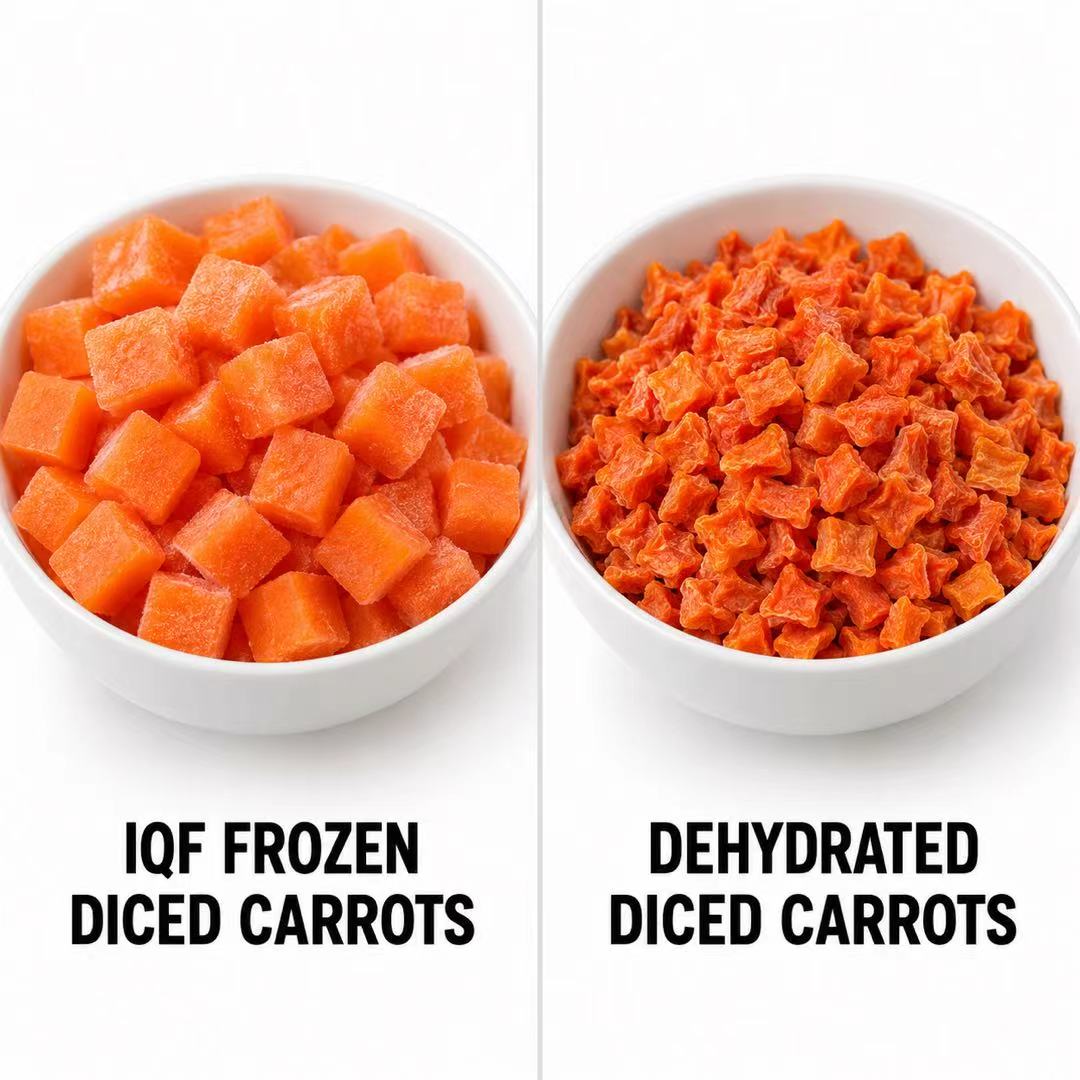
IQF frozen diced carrots compared with dehydrated diced carrots: moisture, storage and shipping weight move the value calculation in different directions. Image: YOKID Foods.
The limits deserve equal space. Frozen product requires continuous electricity for storage and refrigerated transport, plus freezer maintenance and protection from thawing and refreezing. Dehydrated product carries higher processing cost and requires rehydration, which changes texture and adds handling time. Fresh product wins on texture and short local supply chains but loses on shelf life and spoilage risk. There is no universally superior format, only a format that matches storage, application and rotation.
Where the checklist applies
The same five terms are weighted differently depending on where the product ends up.
- Ready meals and prepared foods: cut definition and portioning consistency dominate, because piece size affects fill weight and cook behaviour.
- Soups, sauces and fillings: dispersion and texture matter more than piece integrity, so a chopped or cut format may outperform a leaf format.
- Foodservice, catering and institutional kitchens: cook-from-frozen behaviour and pack handling dominate, with cold-chain discipline in the kitchen as important as in the warehouse.
- Retail frozen packs and vegetable blends: appearance, colour consistency and pack integrity carry commercial weight, and blend components must be specified together rather than separately.
- Food manufacturing of fried rice, pasta, pizza toppings, hot pot and stir-fry bases: a combination of format tolerance, glazing control and remaining shelf life at delivery.
YOKID lists food factories, restaurants, catering companies, institutional kitchens, supermarkets and household consumption among the settings its frozen vegetables are supplied into, alongside importers, distributors and wholesalers. For a buyer, that breadth is useful context but not a qualification: the same supplier can hold different documentation packages for different products and destinations.
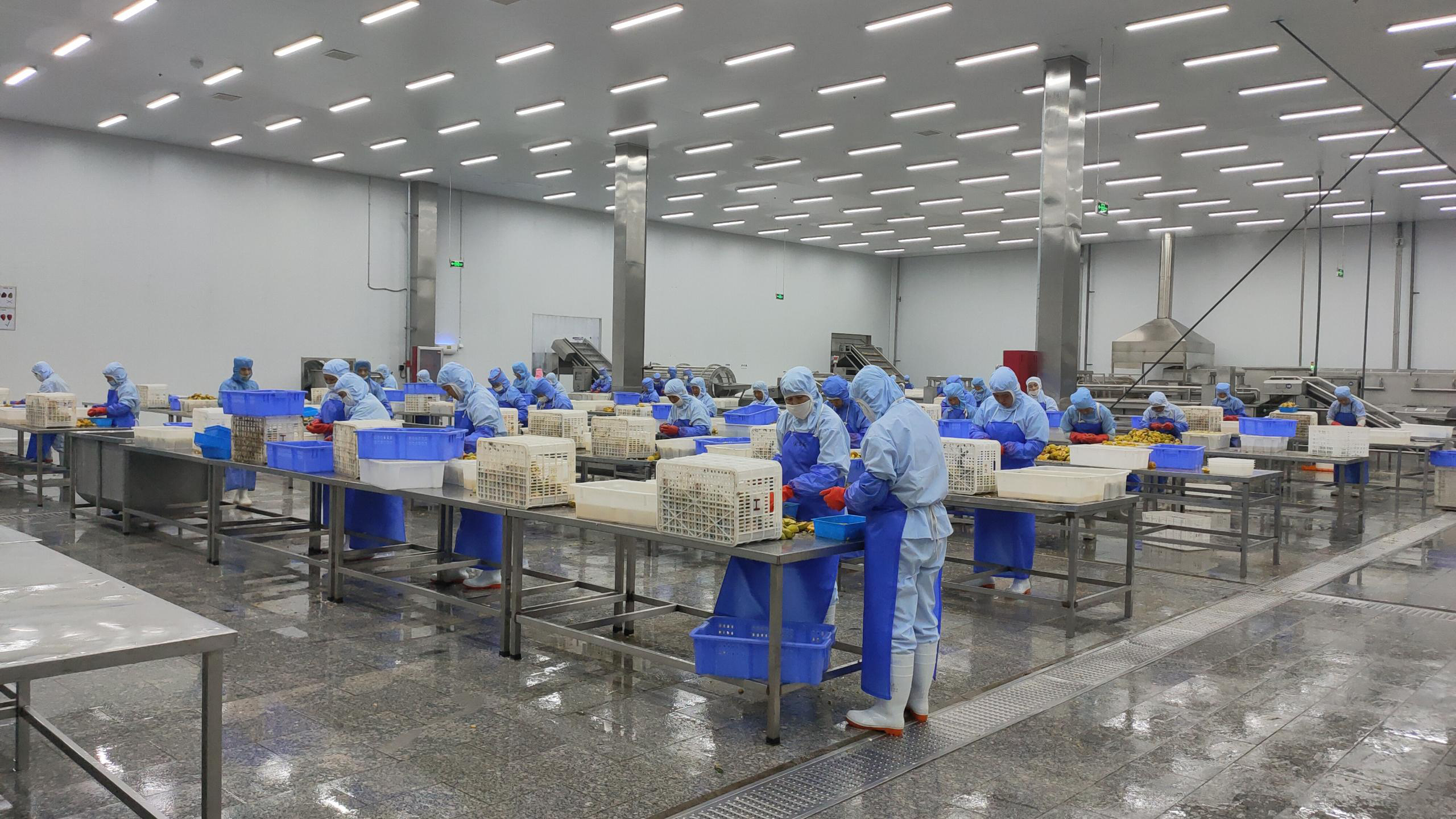
Manual selection of raw fruit and vegetables: the raw-material stage is where residue control and defect removal are decided. Image: YOKID Foods.
Applying the checklist to a supplier profile
YOKID Frozen Vegetables is the frozen vegetable range of Qingdao Yokid Foods Co., Ltd., a Chinese frozen food supplier established in 2009 and based in Qingdao, Shandong. The company operates a 30,000 m² facility with 135 employees, an annual output of 40,000 tons and a six-engineer R&D team, and supplies frozen vegetables, frozen fruit, frozen prepared foods and mushrooms, with 75% of output exported to Europe, East Asia, South East Asia, Australia and North America.
Against the five terms, the profile supports a specific reading. Product scope covers the vegetables discussed here, including onion, spinach, sweet corn, carrots and broccoli, within a wider frozen vegetable range. Cut size, blend and packaging can be customized, with MOQ generally 500 kg to 3 tons depending on product and packaging. Documentation is described as product- and market-dependent, with certificates and test reports released accordingly. The company's published profile also lists BRC, HACCP, ISO 22000, KOSHER and HALAL certification, which is the appropriate point at which to request the certificate set that applies to your product and destination rather than treating the list as a universal claim.
The limits deserve the same clarity as the capabilities. These are first-party statements from a supplier profile, not an independent audit result. Numeric cut-size tolerances, format-specific MOQ and per-market certificate validity are not published in the source material, so a decision-stage buyer must request them per SKU. A qualification checklist that stops at the supplier's own summary has not been completed.
Market context worth checking before signing
Three signals frame the decision environment. The IQF segment held 55.43% of the frozen vegetables market in 2024, so buyers are largely comparing like with like on process and should concentrate differentiation on documentation and cold-chain execution. China's frozen vegetable exports reached approximately USD 1.55 billion in 2024, a 7% year-on-year increase, indicating a deep and competitive export base. Mordor Intelligence expects the global frozen vegetables market to reach USD 21.51 billion in 2026.
The third figure deserves a caution that fits this article's theme. Published commercial estimates for the same market diverge materially, and their methodologies and product scopes are not always verifiable. Treating any single number as consensus is a qualification error of the same kind as accepting a food-grade phrase without documents. Use market sizing for direction, and use batch-level evidence for decisions.
What changes next
Two shifts are already visible in how buyers write IQF specifications. First, shelf-life language is moving from a headline maximum to a negotiated remaining life at delivery, which turns a marketing number into a logistics commitment. Second, scope review is becoming routine: a specification written for direct consumption and catering is not automatically the right document for an industrial ingredient, and buyers increasingly ask which scope a certificate was issued against.
A third shift is likely as cold-chain costs stay visible on energy bills. The operating burden of continuous frozen storage is now part of the value comparison rather than an afterthought, which favours buyers who model total usable cost instead of quoted price. None of these changes alter the underlying products; they change what a buyer is expected to verify before signing.
Reference points used in this checklist
- Codex Standard for Quick Frozen Vegetables, CXS 320-2015: product definition, quick-freezing process and the −18°C or colder cold-chain condition, subject to permitted tolerances.
- GSO CODEX STAN 320:2021: regional scope limited to direct consumption and catering, excluding product indicated for further processing or industrial purposes.
- HS 0710: customs classification for vegetables, uncooked or cooked by steaming or boiling in water, frozen.
- Mordor Intelligence, 2024–2026 market figures for frozen vegetables and IQF segment share.
- China Customs: China frozen vegetable export value for 2024.
FAQ
What does food grade mean on an IQF frozen vegetable specification?
It indicates that the product and its packaging are intended for food use and are handled under food-safety controls. It is a suitability statement rather than a certificate, and it does not by itself name a standard or a market. Buyers should attach the approved product specification, a food-contact packaging declaration and batch-linked test reports, and confirm which documents are released per product and destination market.
Why does the cold-storage clause say −18°C or below instead of a narrow range?
Because the requirement is a condition held across the chain rather than a single reading. Codex Standard CXS 320-2015 describes quick-frozen vegetables as maintained at −18°C or colder at all points in the cold chain, subject to permitted temperature tolerances. Verification therefore covers production freezing, cold storage, loading, transit and receiving, not only the storage line in the specification.
Can a 24-month shelf life be treated as a guaranteed minimum?
No. The supplied documentation presents 18 to 24 months at −18°C or below as the typical expectation, with 24 months at the outer edge. The claim assumes continuous frozen storage; storage above −18°C, repeated thawing and refreezing, damaged packaging and long storage all shorten usable life. Buyers normally convert it into a production date, a batch code and an agreed remaining shelf life at delivery.
How should cut size and packaging customization be written into an order?
As a format definition locked to an approved sample, plus pack format, net weight, labelling responsibility and MOQ per format. IQF frozen fruits and vegetables can be customized in cut size, blend and packaging according to buyer requirements, and minimum order quantity is generally 500 kg to 3 tons, negotiable by product and packaging. Because customization moves MOQ, pack choice is a commercial decision as well as a specification one.
Is frozen always better value than fresh or dehydrated?
No. IQF frozen suits ready meals, catering and food manufacturing through consistent specifications, long shelf life and reduced preparation, and frozen broccoli can show a lower total usable cost than fresh even at a higher price per kilogram, because 1 kg of usable fresh broccoli requires about 1.23 kg of untrimmed input. Dehydrated product cuts shipping weight substantially but needs rehydration, and fresh product wins on texture where supply chains are short. The right choice follows storage, application and rotation.
What should be checked at goods receipt?
Packaging condition, labels, product temperature and carton integrity, followed by immediate transfer to storage at −18°C or below, sealed cartons kept off the floor and away from walls, and FEFO rotation. Clumping, excess frost, softness, discoloration or odour indicate temperature fluctuation or handling problems: isolate the cartons, review transport and cold-room records, restore storage below −18°C, do not refreeze thawed product, and send batch data and photographs to the supplier.
Reference note: the YOKID 2025 English product brochure, covering product range and specification scope, is available for download at the YOKID product brochure (PDF). Certificate and test-report coverage is confirmed per product and destination market.
Have Questions or Need More Details?
Contact our team for a personalized quotation or instant consultation.
Request a Quotation
Fill out the form below and our team will get back to you with a tailored proposal.
WhatsApp Direct Chat
Prefer to chat in real-time? Message us on WhatsApp for instant assistance & quick answers.
- Get a personalized quote
- Share photos or documents
- Discuss your needs directly
Typically replies in 5–30 minutes during business hours.