
IQF Frozen Vegetable Supplier Evidence: 2-Year Cases in New Zealand, Singapore and Chile
A bulk IQF frozen vegetable supplier is usually evaluated on three documents: a specification sheet, a certificate list and a quotation. None of them show whether the supplier actually delivered 40 metric tons of a 6 mm dice to a food factory for two consecutive years. Delivery records do, and that is why documented case evidence carries more weight at the evaluation stage than catalogue claims.
Five such records exist across New Zealand, Singapore, Chile, Indonesia and Uruguay, each running for two years. They cover onion, carrot, sweet corn, mixed vegetables, broccoli, spinach and red pepper, at volumes between 17.38 and 45 metric tons, with declared cut sizes of 6 mm and 10 mm where the buyer's process required one. Read together, they describe how tailored cut sizes, large-volume delivery, cold-chain control and repeat supply are tested in practice rather than in a brochure.
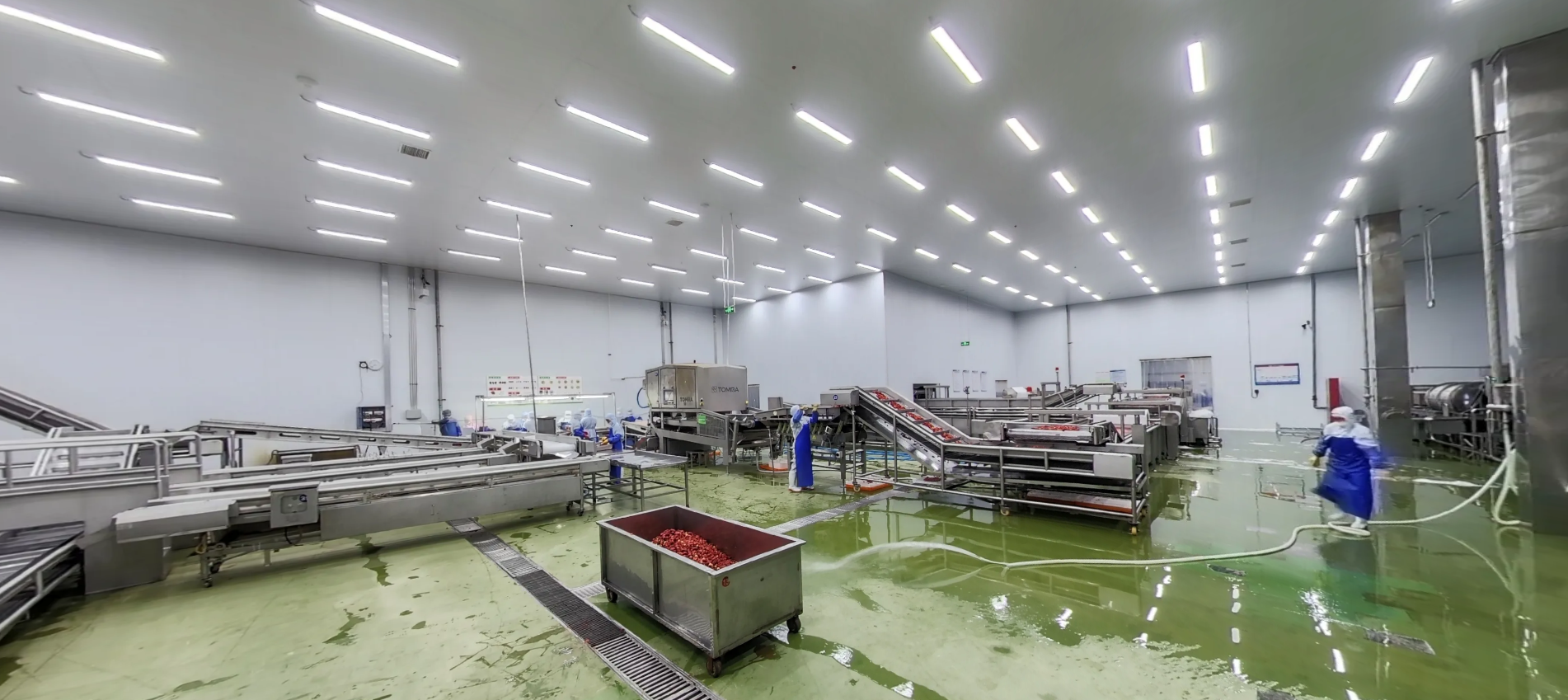
Qingdao Yokid Foods Co., Ltd. is a Chinese frozen food manufacturer established in 2009, based in Qingdao, Shandong, and trading under the brand YOKID Frozen Vegetables. The company operates a 30,000 m² facility with 135 employees, an annual output of 40,000 tons and a stated export ratio of 75%, supplying frozen vegetables, frozen fruit, frozen prepared foods and mushrooms to customers in Europe, East Asia, South East Asia, Australia and North America. Its buyers are importers, distributors, wholesalers, food processors and foodservice businesses.
Why delivery records matter more than specification sheets
The evaluation-stage question is rarely "what can you make?" It is closer to "what have you already delivered, to whom, at what tolerance, and did they come back?" A specification sheet answers the first question for every supplier in the market, which is exactly why it discriminates so little.
Three failure modes dominate bulk IQF sourcing: a cut size that does not match the buyer's filling or topping line, a volume commitment that cannot be repeated after the first container, and a cold chain that holds at the port but not in the buyer's store. Each of these is visible in a two-year record and invisible in a product catalogue. That is the practical value of the case set below: it converts capability claims into dated, quantified supply relationships in five different regulatory and culinary environments.
The case record in one table
| Market | Product and cut | Volume | Duration | Buyer type |
|---|---|---|---|---|
| New Zealand | IQF frozen onion pieces, 6 mm | 40 metric tons | 2 years | Food processing plants and catering delivery companies |
| Singapore | IQF carrot cubes, 10 mm | 45 tons | 2 years | Local food importers and a central factory for pre-prepared dishes |
| Chile | IQF sweet corn and mixed vegetables | 23 MT | 2 years | Food import distributor and pre-packaged food processing factory |
| Indonesia | IQF frozen broccoli florets | 17.38 tons | 2 years | Food import traders and pre-packaged / fast food processing plants |
| Uruguay | IQF spinach dices and red pepper dices | 20.58 MT | 2 years | Food import distributors and pre-packaged food processing factories |
The table is deliberately narrow. It does not claim market share, price advantage or universal suitability. It records what was shipped, in what form, for how long, and to what kind of buyer, which is the level of evidence a procurement team can actually challenge and verify.
New Zealand: 40 metric tons of 6 mm onion pieces
The New Zealand case is the clearest example of cut size functioning as a production parameter rather than a marketing detail. Food processing plants and catering delivery companies there used IQF onion pieces as a raw ingredient for soups, sauces, ready meals, stir-fries, pizza toppings and catering food. The specification was a 6 mm standard piece size, and that size was chosen because it matched how the customer's own lines and recipes behave.
Two years of supply followed. The stated result is that the specification matched local processing requirements, the product proved practical and adaptable in use, and customer recognition of that fit increased willingness to repurchase. For a buyer reading this, the transferable point is not the volume. It is that a millimetre-level dice specification can be held consistently across a long supply relationship, which is the same capability a buyer needs when their own product depends on onion piece size staying visually and texturally uniform after cooking.
Singapore: 45 tons of 10 mm carrot cubes
The Singapore record is the largest single volume in the set. A local food importer and a central factory for pre-prepared dishes took 45 tons of IQF carrot cubes at a 10 mm size over two years, for use as raw ingredients in ready meals, catering and food manufacturing.
Two requirements were tested simultaneously. The first was dimensional: the cubes had to be cut evenly enough to meet the appearance expectations of the customer's finished dishes, because a diced carrot that reads unevenly on a packed meal tray is a visible defect regardless of how it tastes. The second was continuity: stable supply of 45 tons allowed the customer to keep pre-prepared dish and catering lines running without reformulating, and adequate supply supported the customer's sales expansion in Singapore's local catering and ready-made food markets. Volume and dimensional consistency are usually discussed separately in supplier evaluation; here they were the same order.
Chile: 23 MT of sweet corn and mixed vegetables
The Chile case tests a different variable: product combination. A local food import distributor and pre-packaged food processing factory took 23 MT of IQF sweet corn and mixed vegetables over two years, used as raw ingredients for ready meal production and food manufacturing, including pre-prepared dishes, frozen meal packages, salads and stews supplied to food factories and catering channels.
Stable quality that met the customer's factory standards was the stated outcome, and the corn-plus-mixed-vegetable combination matched consumption patterns in the Chilean pre-prepared and frozen meal segment. Commercially, the case is described as a breakthrough on the west coast of South America that diversified the supplier's single-market risk and built experience with South American frozen vegetable customers. For an evaluating buyer, a mixed-product order is a harder test than a single SKU: it requires two product lines to be scheduled, frozen, packed and shipped together without one of them becoming the constraint.
Two further records: Indonesia and Uruguay
Indonesia: 17.38 tons of IQF broccoli florets
Indonesian local food import traders and pre-packaged and fast food processing plants took 17.38 tons of IQF frozen broccoli florets over a two-year relationship, for lunch boxes, frozen meal sets and fast food side dishes supplied into factory and chain restaurant channels. Delivery was completed on time and the stable supply of broccoli raw material supported the customer's pre-prepared and fast food production lines. The customer reported that the fulfilled order verified supply stability, enhanced confidence in the supplier and helped stabilise finished-product supply to local chain restaurants. Product quality was described as stable and suited to fast food and boxed meal processing, and aligned with local dining habits.
Uruguay: 20.58 MT of spinach and red pepper dices
The Uruguay record covers 20.58 MT of IQF spinach dices and IQF red pepper dices supplied over two years to local food import distributors and pre-packaged food processing factories in South America, used as raw ingredients for spring roll filling and food manufacturing. Two things were being controlled at once: the dice size of the ingredients, so the filling behaved correctly during processing, and raw material quality. The case is also the clearest multi-category proof in the set, because the product range was extended from onion pieces into spinach and red pepper, which verified the feasibility of exporting multiple frozen vegetable categories to Uruguay and laid the groundwork for later mixed vegetable and filling product reorders.
What sits behind the cases: inspection, cold chain and capacity
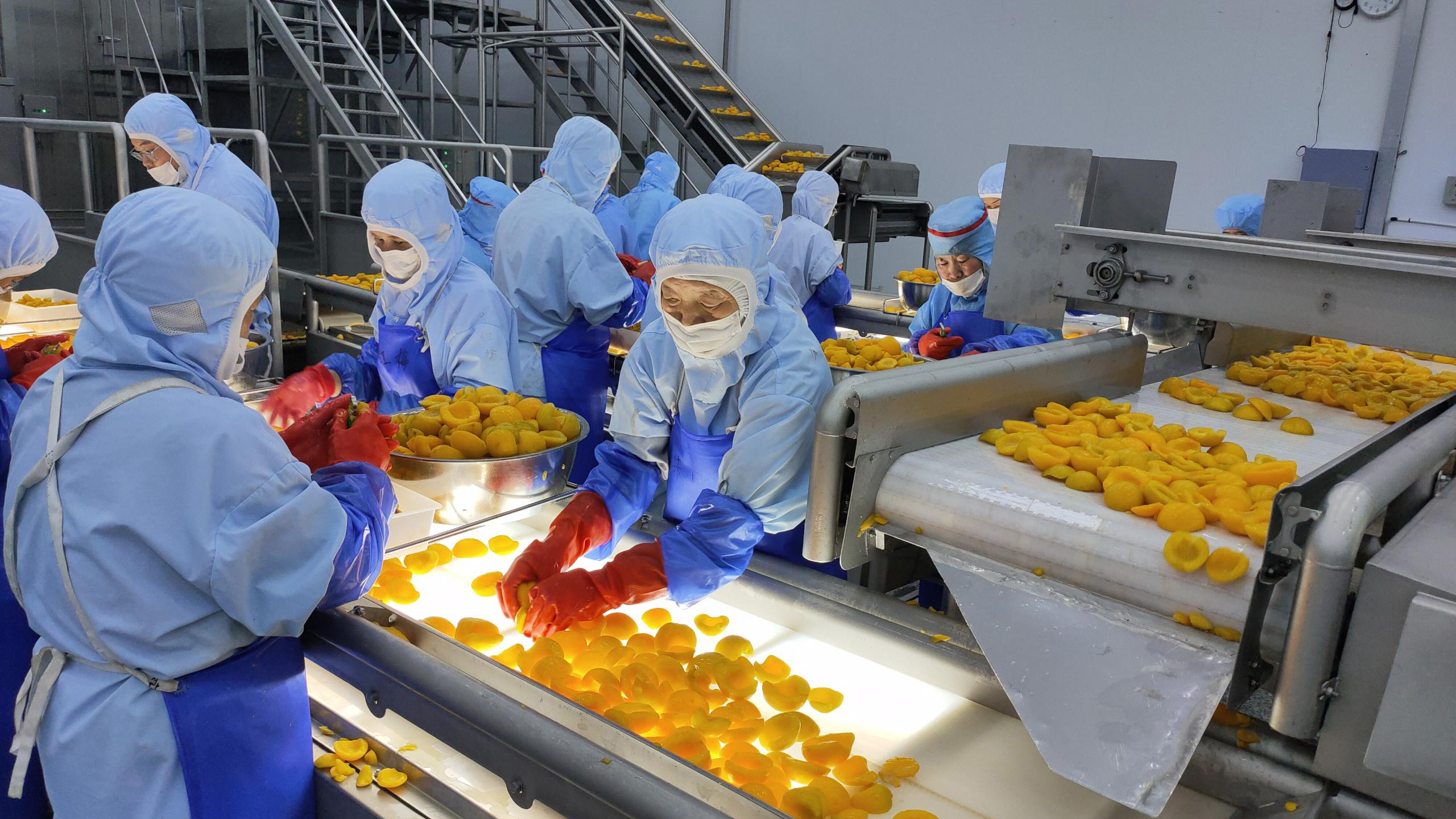
Case outcomes do not explain themselves. Three operational layers make a two-year record possible, and buyers evaluating a bulk IQF supplier should look for all three.
Batch-level inspection
The manufacturer conducts 100% batch inspection covering raw material checks, process control, visual and size inspection, temperature monitoring, metal or X-ray detection, finished product sampling and laboratory testing. Size inspection is the layer that connects most directly to the New Zealand and Singapore specifications: a 6 mm or 10 mm commitment is only meaningful if it is measured on the line and not only written on the specification sheet.
Cold-chain discipline
Codex Alimentarius Standard CXS 320-2015 for quick frozen vegetables describes products maintained at -18°C or colder at all points in the cold chain, subject to permitted temperature tolerances. That is the reference condition the two-year relationships depend on: IQF freezing keeps pieces individually loose, and continuous frozen storage preserves texture, colour and portioning behaviour. Repeated thawing would undo both, which is why temperature monitoring sits inside the batch inspection routine rather than outside it.
Third-party testing and documentation
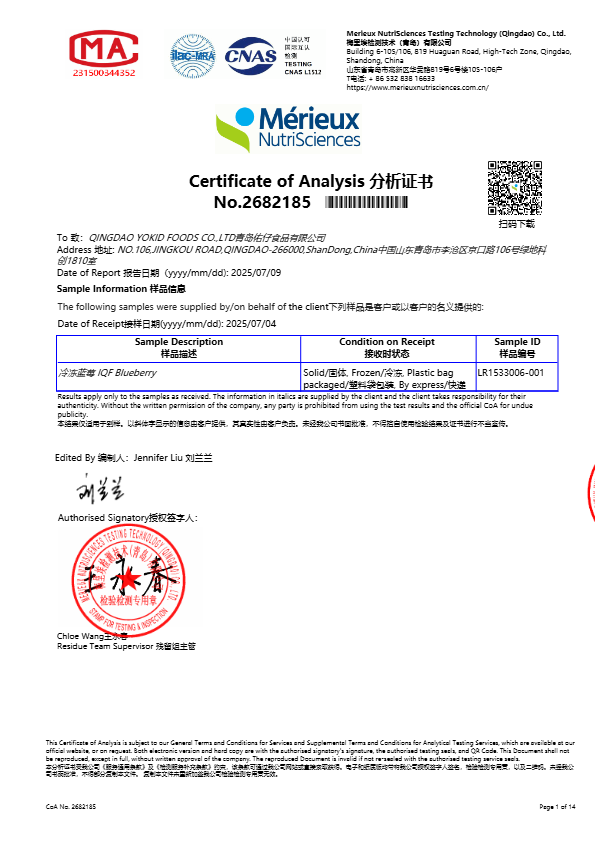
Laboratory verification is documented outside the production floor. One example in the supplier's quality file is a Mérieux NutriSciences Certificate of Analysis, No. 2682185, issued on 9 July 2025 by Mérieux NutriSciences Testing Technology (Qingdao) Co., Ltd. and applying the EN 15662:2018 pesticide-residue method; the specific sample in that report is a frozen IQF blueberry batch, and it is referenced here as documentation of the testing route rather than as a vegetable specification. Supporting services around shipments include online support, remote assistance, order tracking, export documentation support, product traceability, quality complaint handling and after-sales resolution according to the sales agreement.
Volume, lead time and customization
Capacity is the constraint that most often breaks a repeat-supply promise. Stated monthly capacity is 3,500 metric tons, with a lead time of 10 to 15 days after order confirmation. Minimum order quantity is negotiable, generally 2 to 3 metric tons per item for mixed 20ft or 40ft containers, with trial or small pack orders of 500 kg to 1 metric ton potentially accepted. Customization covers logo, packaging, graphic treatment, vegetable varieties, cuts, sizes, blends and pack weights, under OEM, ODM, private label and customized processing arrangements.
Where these specifications are actually used
The five cases map onto distinct downstream uses, and the mapping is the most practical part of the evidence for a buyer comparing their own process against someone else's.
- Soups, sauces and ready meals: the New Zealand 6 mm onion and the Chile corn and mixed vegetable combination both sit in this category, where piece size and thaw behaviour affect texture after cooking.
- Pizza toppings and stir-fries: onion pieces at a defined millimetre size, where visual uniformity on the finished product is part of the specification.
- Pre-prepared dishes and packed meal trays: the Singapore 10 mm carrot cubes, where evenness is judged on the tray, and the Indonesian broccoli florets, where florets go into lunch boxes and frozen meal sets.
- Frozen meal packages, salads and stews: the Chile corn and mixed vegetable combination, supplied to food factories and catering channels.
- Fillings: the Uruguay spinach and red pepper dices, where dice size determines how the filling holds together during processing.
- Fast food and chain restaurant supply: the Indonesian broccoli case, where raw material stability translates directly into finished-product availability at outlet level.
Market context: why supplier evidence is being examined more closely
Two verified data points frame the evaluation. Mordor Intelligence estimates the global frozen vegetables market at USD 21.51 billion in 2026, and reports that the individual quick freezing (IQF) segment held a 55.43% share in 2024. China Customs statistics cited in the same period put China's frozen vegetable exports at approximately USD 1.55 billion in 2024, a 7% year-on-year increase.
Read together, those figures describe a market where IQF is the dominant technique and where Chinese export volume is expanding. Neither tells a buyer which supplier will still be shipping the same cut size in year two. That gap is precisely where case documentation becomes decisive, and it is also where market data needs handling with care.
Regulatory scope adds a second layer of context. GSO CODEX STAN 320:2021, the Gulf adoption of the Codex quick-frozen vegetable standard, applies to products offered for direct consumption including catering, and explicitly does not apply to product indicated as intended for further processing or other industrial purposes. A specification written for retail or catering therefore is not automatically the correct reference for an industrial further-processing line, and buyers in different channels need to confirm which framework their supplier is working to.
IQF versus conventional supply models, and where the limits sit
| Model | Strength | Boundary to plan for |
|---|---|---|
| IQF frozen | Pieces stay loose and portionable; consistent size; suited to ready meals, catering and food processing | Occupies more cold-store volume per ton than block-frozen product, and requires an unbroken chain at -18°C or colder |
| Block frozen (BQF) | Dense packing, efficient for bulk industrial further processing where the block is cut or milled downstream | Less suited to line-side portioning where individual pieces are needed straight from the carton |
| Fresh | Texture and presentation for premium retail and immediate use | Short shelf life, seasonal availability and higher spoilage risk; not a substitute for a frozen ingredient programme |
The limits of the case evidence itself deserve the same candour as the limits of the technique. Five relationships in five markets do not represent every destination, and the documented order sizes of 17.38 to 45 metric tons are container-scale evidence rather than proof of multi-thousand-ton annual contracts. Two-year records show that repeat supply happened; they do not show that it will happen for every specification.
Custom cut sizes carry their own boundary. A 6 mm or 10 mm commitment only holds if the buyer's requirement is written down and their own line is calibrated to accept it, because a millimetre tolerance that is acceptable in a soup may be unacceptable on a pizza topping. Cold-chain performance is similarly conditional: IQF condition is preserved only while storage stays at -18°C or colder, and interrupted cold chain shows up as clumping, frost, softening or discolouration rather than as a supplier defect that can be proven after the fact. Buyers who treat the case record as a starting checklist, rather than as a guarantee, get more from it.
Future outlook
Two directions are reasonable to expect. The first is specification tightening: as IQF becomes the default technique rather than a premium choice, differentiation shifts from freezing method to cut consistency, blend accuracy and documentation depth, and buyers are likely to ask for size-inspection records rather than product photographs. The second is documentation-led qualification: laboratory reports, cold-chain logs and traceable batch records are becoming part of the commercial conversation rather than a post-contract formality, which favours suppliers whose quality system already produces them.
For suppliers, the implication is that repeat-supply evidence compounds. Each two-year relationship becomes a reference that answers the next buyer's hardest question before it is asked. For buyers, the implication is simpler: ask for the case record first, then the specification sheet, because the specification will look identical from every supplier in the market.
FAQ
What cut sizes can be specified for bulk IQF frozen vegetables?
Cut sizes are customized by variety, cut and size. Documented specifications include 6 mm IQF frozen onion pieces for the New Zealand market and 10 mm IQF carrot cubes for Singapore, alongside diced spinach and red pepper for a Uruguay filling application. Blends and pack weights are also customizable, so a buyer can define cut, blend and pack weight as one specification rather than three separate requests.
What order volumes and lead times are realistic for a bulk IQF supplier?
Documented order sizes range from 17.38 metric tons of IQF broccoli florets to 45 tons of 10 mm carrot cubes, with onion at 40 metric tons, spinach and red pepper at 20.58 MT and corn plus mixed vegetables at 23 MT. The stated monthly capacity is 3,500 metric tons and the lead time is 10 to 15 days after order confirmation. Minimum order quantity is negotiable, generally 2 to 3 metric tons per item for mixed 20ft or 40ft containers, with trial orders of 500 kg to 1 metric ton potentially accepted.
What evidence shows repeat supply rather than a single shipment?
Each of the five records — New Zealand, Singapore, Chile, Indonesia and Uruguay — is described as a two-year supply relationship rather than an isolated order. The Indonesia case states that the 17.38-ton order was fulfilled on time and that stable broccoli supply supported the customer's pre-prepared and fast food production lines, while the Uruguay case states that the range was extended from onion pieces into spinach and red pepper and that this laid the foundation for later mixed vegetable and filling product reorders.
How is quality and cold-chain performance verified in practice?
Verification runs at three levels. In-house, 100% batch inspection covers raw material checks, process control, visual and size inspection, temperature monitoring, metal or X-ray detection, finished product sampling and laboratory testing. Technically, Codex Standard CXS 320-2015 describes quick frozen vegetables maintained at -18°C or colder at all points in the cold chain, subject to permitted temperature tolerances. Externally, third-party laboratory documentation is used, such as a Mérieux NutriSciences Certificate of Analysis (No. 2682185, issued 9 July 2025) applying the EN 15662:2018 pesticide-residue method.
Which product categories are covered by the documented cases?
The five records cover IQF frozen onion pieces, IQF carrot cubes, IQF sweet corn, mixed vegetables, IQF broccoli florets, IQF spinach dices and IQF red pepper dices. The wider product range also includes frozen cauliflower, green beans, green peas, edamame, asparagus, okra, sweet potato, pumpkin, garlic, ginger, leek and vegetable ingredients, alongside frozen fruit, frozen prepared foods and mushrooms.
What are the limitations of this case evidence?
Three limitations are worth stating plainly. The documented volumes of 17.38 to 45 metric tons are container-scale rather than multi-thousand-ton annual contracts, so they demonstrate repeatability at that scale and not beyond it. Five markets do not represent every destination or regulatory regime, and scope rules differ — GSO CODEX STAN 320:2021, for example, covers direct consumption and catering but excludes product indicated for further processing or industrial purposes. Finally, IQF condition depends on the buyer's own storage holding at -18°C or colder; case records describe what left the supplier, not what happens in a warehouse after arrival.
A downloadable company brochure covering the full product range and specifications is available here: YOKID Frozen Vegetables company brochure (PDF).
Have Questions or Need More Details?
Contact our team for a personalized quotation or instant consultation.
Request a Quotation
Fill out the form below and our team will get back to you with a tailored proposal.
WhatsApp Direct Chat
Prefer to chat in real-time? Message us on WhatsApp for instant assistance & quick answers.
- Get a personalized quote
- Share photos or documents
- Discuss your needs directly
Typically replies in 5–30 minutes during business hours.