
IQF Frozen Vegetables: Size, Grade and Cold-Chain Rules
Frozen vegetables are traded as a category but purchased as a specification. Two shipments can be described identically as IQF frozen vegetables and still differ in cut size, grade, packaging, test documentation and the temperature history behind them. For buyers in the research and evaluation stages, the practical question is therefore not which frozen vegetables exist, but which parameters can be verified before a container is booked.
Qingdao Yokid Foods Co., Ltd. (YOKID) is a Chinese frozen food supplier established in 2009 in Qingdao, Shandong, producing IQF frozen vegetables, frozen fruit, frozen prepared foods and mushrooms. Its published company profile describes a 30,000 m² facility, 135 employees, an annual output of 40,000 tons, a 75% export ratio and customers in Europe, East Asia, South East Asia, Australia and North America. Those figures describe scale and orientation. They do not, on their own, tell a buyer whether a particular SKU will run cleanly on a particular line. That gap between category language and measurable specification is what this reference addresses.
Why the Category Name Is Not a Purchasing Specification
A purchase order that states only frozen vegetables leaves the supplier to decide what the buyer receives. The supplier may select a different floret size, a different dice dimension, a different leaf-to-stem ratio, a different packaging format, or a different set of supporting documents, and still deliver something correctly described by the category name. The result is a shipment that passes a name check and fails a production check.
The size of the category makes this problem more common, not less. Mordor Intelligence estimates the global frozen vegetables market at USD 21.51 billion in 2026, and reports that the individual quick freezing segment held a 55.43% share in 2024. China Customs data cited in a 2025 export guide put China's frozen vegetable exports at approximately USD 1.55 billion in 2024, a 7% year-on-year increase. A market of that scale supports many suppliers offering overlapping product names. Specification discipline is what separates them at the point of use.
For a food manufacturer, the cost of an ambiguous specification appears later: uneven cooking in a ready meal, visible size variation in a retail pack, inconsistent fill weights, extra labour at the sorting table, or a documentation gap discovered during an import review. All of these are cheaper to resolve in the specification than in the container.
The Parameters That Actually Constrain an IQF Order
Six parameters do most of the work in defining an IQF frozen vegetable order. They are not marketing attributes; each one changes how the product behaves in storage, in processing or at customs.
| Parameter | Verified statement used in YOKID product documentation | Why it constrains the order |
|---|---|---|
| Freezing method | IQF (individual quick freezing) | Determines whether pieces are free-flowing and portionable, or fused into a block |
| Grade | Food Grade | Sets a baseline claim; it does not by itself establish destination-market compliance |
| Storage temperature | −18°C or below | Defines the cold-chain condition under which the stated shelf life is valid |
| Shelf life | 24 months | Conditional on continuous storage at the stated temperature |
| Colour | Natural yellow or natural green, depending on the product | Used as a visual acceptance criterion at goods-in inspection |
| Cut size | Stated in millimetres or centimetres by product form | Drives yield, appearance, cooking behaviour and portion control |
| Packaging | Customizable | Determines handling, portion size, private-label requirements and carton logistics |
Cut size deserves particular attention because it is the parameter most often treated as exact when it is in fact nominal. A 10 × 10 mm diced carrot is a product specification, not a machining tolerance. Natural raw material variation, cutting equipment and blanching behaviour all leave room for piece-to-piece differences. Buyers who need a narrow visual band should state the acceptance range and the inspection method, not only the nominal figure.

Product-Level Specification Reference
YOKID's published product data sets out the forms and dimensions available across its IQF vegetable range. The table below summarises the documented options for the five products for which full specifications are available.
| Product | Documented forms and sizes | Shared conditions |
|---|---|---|
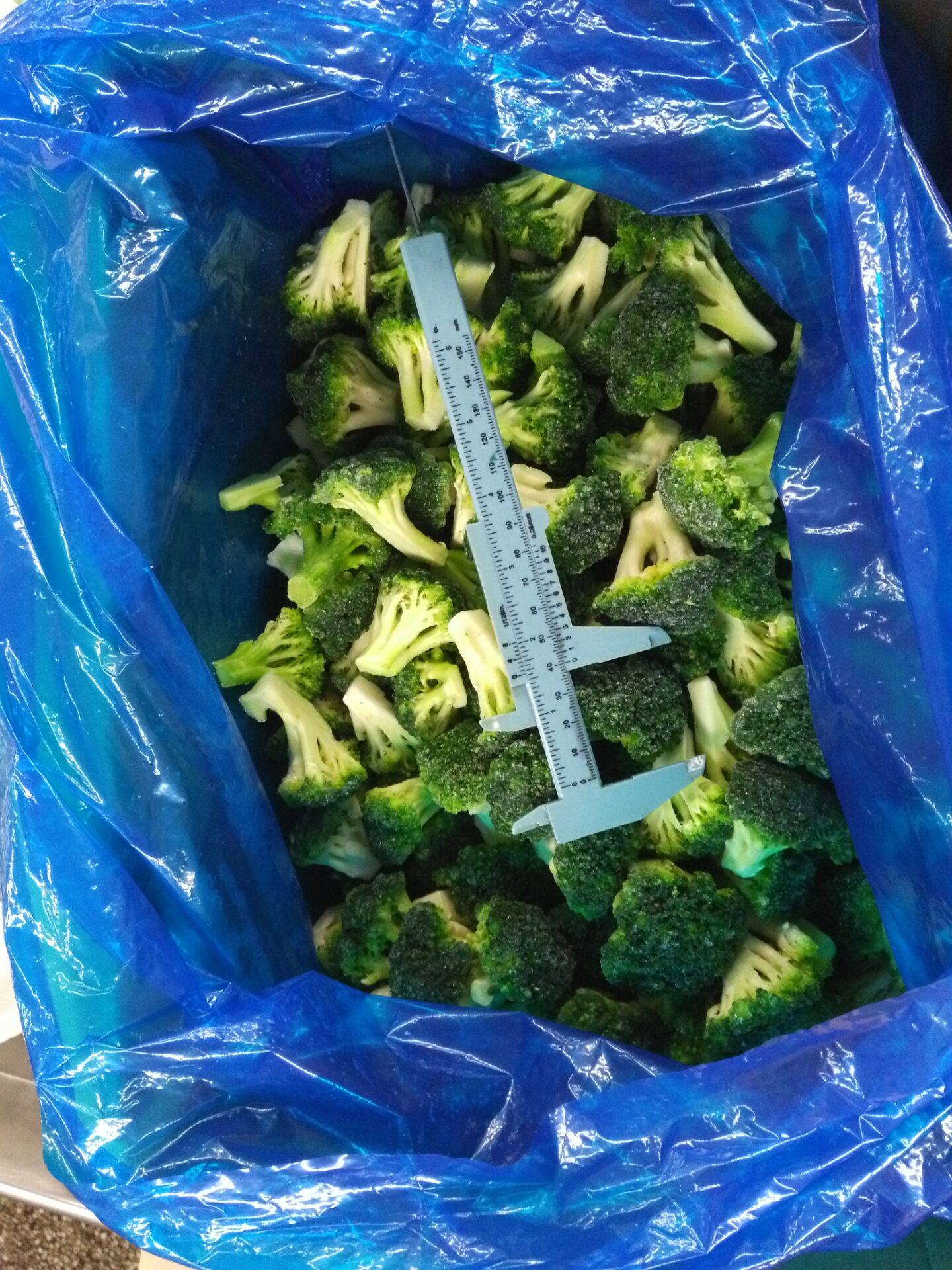
| IQF Frozen Broccoli (Florets) | Florets in 20–40 mm, 30–50 mm and 40–60 mm | IQF; Food Grade; −18°C or below; 24 months; packaging customizable |
| IQF Frozen Carrots | Diced 5 × 5, 6 × 6, 8 × 8, 10 × 10 and 12 × 12 mm; sliced straight, crinkle or flower cut at 3, 4 or 5 mm thickness; sticks 3 × 3 × 40 mm and 5 × 5 × 50 mm; chunks 15 × 15 and 20 × 20 mm; whole 20–45 mm diameter; flower cut 30–35 mm, with 25 mm and 40 mm on request; shredded customizable | IQF; −18°C or below; 24 months; packaging customizable |
| IQF Frozen Sweet Corn | Whole cob, cut cob and kernels | IQF; Food Grade; natural yellow; −18°C or below; 24 months; packaging customizable |
| IQF Frozen Spinach | Chopped 5 × 5, 10 × 10 and 15 × 15 mm; cut 2–3, 3–5 and 5–7 cm; whole leaf with root removed; portion balls 15–25 g, 20–30 g and 25–35 g; blocks 500 g or 1 kg; standard leaf-to-stem ratio 70:30, customizable | IQF or BQF depending on form; Food Grade; natural green; −18°C or below; 24 months; packaging customizable |
| IQF Frozen Onion | Diced 5 × 5, 6 × 6, 8 × 8 and 10 × 10 mm; chunks 20 × 20 mm; strips 4–6, 6–8 or 8–10 mm wide with natural length 3–7 cm; sliced 4–6, 5–7 or 8–10 mm thick; rings 6–10 mm thick with customizable diameter; minced below 3 mm; whole peeled 5–9 cm diameter | IQF; Food Grade; −18°C or below; 24 months; packaging customizable |
The value of this level of detail becomes clear when it is matched to a production line. A Singapore customer producing pre-prepared dishes and boxed meals specified IQF 10 mm carrot cubes and took 45 tons over a two-year relationship; the uniform cube supported both the appearance of the finished dish and the portioning logic of the line. A New Zealand customer processing soups, sauces, ready meals and catering food specified 6 mm onion pieces and took 40 metric tons over a comparable period, because the dimension matched its existing preparation flow. In both cases the specification, not the category, determined fitness for use.
Other applications pull the specification in a different direction. A Uruguayan customer producing spring roll fillings required diced spinach and diced red pepper at a size suited to filling machinery, and took 20.58 metric tons. An Indonesian customer producing lunch boxes, frozen meal sets and fast-food side dishes took 17.38 tons of IQF broccoli florets. The same product family served three different specifications because three different processes were being fed.
Certification and Test Reports: Read the Scope Before the Logo
Certification is where evaluation-stage buyers most often over-read a document. A certificate is evidence about a defined product, a defined sample, a defined method and often a defined market. It is not a general statement that every SKU from a supplier is compliant everywhere.
YOKID's published company profile lists BRC, HACCP, ISO 22000, KOSHER and HALAL certification. Separately, the available documentation includes a Certificate of Analysis issued by Mérieux NutriSciences Testing Technology (Qingdao) Co., Ltd., report number 2682185, dated 9 July 2025, applying standard EN 15662:2018 and identified as applying to the EU market. The sample described in that report is frozen IQF blueberry, sample ID LR1533006-001, received in solid/frozen condition.
That level of specificity is normal and should be read as such. A residue test report on a blueberry sample demonstrates that a testing pathway exists, that an accredited laboratory was used, and that a method was applied. It does not certify a broccoli floret, an onion dice or a spinach block, and it does not replace destination-specific requirements.
This is also where the honest limit of supplier documentation sits. The verified data set used for this reference did not establish country-specific microbiological limits, pesticide residue limits, labelling rules, allergen declarations or conformity marking requirements for each destination. Those remain the buyer's responsibility to confirm with the importing authority or a qualified regulatory adviser, product by product and market by market.
What IQF Does to a Vegetable, and What It Cannot Do
IQF means Individual Quick Freezing. Each prepared piece is frozen separately and rapidly instead of being frozen together into a single block. Rapid heat removal produces smaller ice crystals than slow freezing, which reduces damage to plant cells, and the pieces remain loose and free-flowing for storage, portioning and processing.
The Codex Standard for Quick Frozen Vegetables (CXS 320-2015) describes quick-frozen vegetables as products prepared from substantially sound fresh or frozen vegetables at appropriate maturity and subjected to a quick-freezing process, maintained at −18°C or colder at all points in the cold chain, subject to permitted temperature tolerances. Two implications follow for buyers.
First, the standard couples the freezing step with the storage condition. IQF is not a one-time event at the factory; it is a process whose benefit is preserved only while the cold chain holds. A 24-month shelf life stated on a specification is valid under storage at −18°C or below, not as an unconditional property of the product.
Second, IQF is not a sterilisation step. Low temperature slows microbial growth and chemical change but does not eliminate microorganisms. Safety depends on raw material control, blanching and hygiene during processing, packaging integrity and continuous frozen storage. Buyers who treat IQF as a safety guarantee rather than a quality-preservation method are misreading the technology.
Repeated thawing and refreezing is the most common way the benefit is lost. Freezer burn, excess frost, clumping, softening, colour change and excessive drip loss after thawing all point to temperature fluctuation, damaged packaging, overlong storage or handling faults rather than to a fault in the freezing method itself. Once a product has thawed, refreezing does not restore its original condition.
Where IQF Frozen Vegetables Fit in Production
IQF vegetables are used as ingredients rather than as a single finished product. Documented applications include ready meals, soups, sauces, salads, pizza, pasta, fillings, fried rice, hot pot, stir fries, side dishes, vegetable blends and processed food products. The operational advantage in each case is the same: pieces can be taken from the freezer in the required quantity without thawing an entire block, and they can be cooked directly from frozen or partially thawed according to the recipe.
The working conditions are equally consistent. Frozen storage and transport at −18°C or below, a continuous cold chain, hygienic handling, temperature monitoring and protection from repeated thawing and refreezing are required. Typical matched equipment includes washing, sorting and grading, cutting, blanching, IQF freezing, weighing and packaging, metal detection or X-ray inspection, cold storage and refrigerated vehicles. Buyers evaluating a supplier are effectively evaluating how well that chain of equipment and records is controlled.
YOKID describes its quality control as 100% batch inspection covering raw material checks, process control, visual and size inspection, temperature monitoring, metal or X-ray detection, finished product sampling and laboratory testing. The company also describes OEM, ODM, private-label and customized processing, including customized vegetable varieties, cuts, sizes, blends and pack weights, with a stated monthly capacity of 3,500 metric tons. For a buyer, these are capability statements to be tested against a specification and a sample, not conclusions to be accepted in advance.
Market Signals Buyers Should Read Carefully
Two signals are usable and one needs a warning.
The usable signals are scale and process mix. The global frozen vegetables market is estimated at USD 21.51 billion in 2026 by Mordor Intelligence, and IQF held a 55.43% share of that market in 2024 according to the same source. China's frozen vegetable exports reached approximately USD 1.55 billion in 2024, up 7% year on year, according to China Customs data cited in a 2025 export guide. Together these indicate a large, export-oriented category in which IQF is the dominant processing route rather than a niche option. When IQF is the default, supplier differentiation shifts away from the freezing method itself and toward specification control, documentation and cold-chain discipline.
The warning concerns market-size figures generally. Published commercial estimates for the global frozen vegetables market differ materially depending on product scope and methodology, and they should not be averaged or presented as a consensus number. A buyer building a business case should use a single sourced estimate, state its scope, and treat it as directional rather than as a verified industry total.
IQF Versus Block Frozen and Fresh: Where IQF Is Not the Answer
IQF is the most common format for frozen vegetables, but it is not universally the right one. The comparison below sets out where each format fits and where IQF carries a real cost.
| Dimension | IQF | Block frozen (BQF) | Fresh |
|---|---|---|---|
| Piece behaviour | Free-flowing, portionable straight from the carton | Fused block; requires full or partial thawing or mechanical breakdown | Loose, but perishable within days |
| Fit with further processing | Suited to portioned recipes, blends and line feeding | Suited to bulk comminution, pulping and large-scale industrial processing | Suited to immediate preparation and premium presentation |
| Storage | −18°C or below, with volume taken up by individual pieces | −18°C or below, denser packing | Controlled chilled storage, short window |
| Documented shelf life in YOKID specifications | 24 months | 24 months for block spinach forms | Not applicable |
| Main constraint | Higher energy and cold-chain demand; free-flow benefit is wasted where the product will be crushed anyway | Thawing and breakdown add a process step and handling risk | Short shelf life, seasonal availability and higher spoilage risk |
The limitation is worth stating plainly. Where a factory will comminute, pulverise or bulk-cook the vegetable, the free-flow property of IQF delivers little operational value, and a block format can be the more practical choice. YOKID's own spinach range reflects this: alongside chopped, cut and whole-leaf IQF forms, it offers spinach blocks at 500 g or 1 kg, described as a cost-effective solution for large-scale industrial processing. A buyer who defaults to IQF for every application is paying for a handling advantage the process will not use.
A second limit is physical. IQF pieces occupy more volume per tonne than a dense block, so cold-store utilisation and freight configuration differ between the two formats. Neither format removes the need for destination compliance review, and neither compensates for a broken cold chain.
A Procurement Sequence for IQF Frozen Vegetables
The following sequence converts the parameters above into an evaluation order. It is intentionally front-loaded, because most costly errors are specification errors rather than price errors.
- Define the product form first. Floret, dice, slice, strip, ring, mince, whole, kernel, cut cob or block. Form determines everything downstream.
- State the dimension as a range with an inspection method. A nominal figure such as 10 × 10 mm should be accompanied by the acceptance range and the point at which it is checked.
- Confirm grade, colour and defect expectations. Food Grade and natural colour are baseline statements; visual acceptance criteria belong in the specification.
- Fix the storage and shelf-life conditions. −18°C or below and 24 months are the documented conditions; the buyer should confirm they can be held end to end.
- Specify packaging and any private-label requirements. Packaging is customizable, which means it must be defined rather than assumed.
- Request documents against product, method and market. Test reports, certificates and batch records should each be traceable on those three fields.
- Agree commercial terms and lead time. Stated terms are a minimum order quantity generally of 2 to 3 metric tons per item for mixed 20 ft or 40 ft containers, with trial or small pack orders of 500 kg to 1 metric ton potentially accepted, and a lead time of 10–15 days after order confirmation.
- Plan receiving inspection. Check packaging, product temperature and condition at arrival, and record the result before the pallets enter the cold store.
Price is deliberately last in this sequence, because price is a consequence of the earlier decisions. The cost drivers in IQF vegetables are raw material season and grade, cut yield (small dices and elaborate cuts reduce usable output), sorting labour, packaging format, testing and certification scope, order size, and the cold-chain distance to destination. A quotation that is lower than another usually differs on one of these variables. Comparing quotations without aligning the specification compares two different products.
What Changes Next
Three developments are likely to shape evaluation over the next buying cycles. The first is documentation depth: as import reviews become more granular, the supplier who can produce batch-level records, test reports matched to product and market, and traceable temperature logs will be easier to qualify than one who can only produce a certificate image. The second is scope awareness: regional adoptions such as GSO CODEX STAN 320:2021 apply to quick-frozen vegetables offered for direct consumption including catering, and explicitly exclude products indicated as intended for further processing or industrial use, which means intended use must be declared correctly at the specification stage. The third is format rationalisation: buyers are increasingly separating direct-use SKUs, where IQF free-flow matters, from industrial SKUs, where a block format may serve better.
None of these trends requires a new technology. They require better specification writing, which remains the cheapest quality intervention available to a frozen vegetable buyer.
Company information: www.yokid-china.com. A downloadable English-language company brochure is available here.
FAQ
IQF stands for Individual Quick Freezing. Each prepared vegetable piece is frozen separately and rapidly rather than being frozen together into one solid block. Rapid heat removal forms smaller ice crystals than slow freezing, which reduces damage to plant cells, and the pieces remain loose and free-flowing for storage, portioning and processing. IQF describes a process, not a grade or a safety status; the frozen product still requires storage at −18°C or below throughout the cold chain.
Documented options include broccoli florets at 20–40 mm, 30–50 mm and 40–60 mm; carrot dice at 5 × 5, 6 × 6, 8 × 8, 10 × 10 and 12 × 12 mm, with sliced, stick, chunk, whole, shredded and flower-cut forms also available; chopped spinach at 5 × 5, 10 × 10 and 15 × 15 mm, cut spinach at 2–3, 3–5 and 5–7 cm, and spinach balls at 15–25 g, 20–30 g and 25–35 g; and onion dice at 5 × 5 to 10 × 10 mm, with chunks, strips, slices, rings, minced and whole peeled forms. These dimensions are nominal ranges rather than precision tolerances, so the acceptance range and inspection method should be agreed in the specification.
YOKID product specifications state storage at −18°C or below and a shelf life of 24 months. The shelf life is conditional: it applies while the product is held continuously at the stated temperature. Codex Standard CXS 320-2015 likewise describes quick-frozen vegetables as maintained at −18°C or colder at all points in the cold chain, subject to permitted temperature tolerances. Interrupted storage shortens effective shelf life regardless of the printed date.
YOKID's published company profile lists BRC, HACCP, ISO 22000, KOSHER and HALAL certification. The available test documentation includes a Certificate of Analysis issued by Mérieux NutriSciences Testing Technology (Qingdao) Co., Ltd., report number 2682185, dated 9 July 2025, applying standard EN 15662:2018 and identified as applying to the EU market, for a frozen IQF blueberry sample with sample ID LR1533006-001. That report is evidence about a specific sample, product and method. It does not certify other products, and destination-specific microbiological, pesticide, labelling and conformity requirements still have to be confirmed for each market.
No. IQF keeps pieces separate and portionable, which suits direct cooking, blends and line feeding. Where a factory will comminute, pulverise or bulk-cook the vegetable, that free-flow advantage is largely unused, and a block format can be more practical. YOKID's spinach range includes blocks at 500 g or 1 kg alongside chopped, cut and whole-leaf IQF forms, described as a cost-effective solution for large-scale industrial processing. Format should be selected from the process requirement, not from a default preference.
YOKID's stated terms are a minimum order quantity generally of 2 to 3 metric tons per item for mixed 20 ft or 40 ft containers, with trial or small pack orders of 500 kg to 1 metric ton potentially accepted. The stated lead time is 10–15 days after confirmation of order, with a stated monthly capacity of 3,500 metric tons. These figures are commercial statements that should be confirmed against the specific product, cut size and packaging at the quotation stage.
Clumping, excess frost, softening, discolouration, damaged packaging or unusual odour usually indicate temperature fluctuation, package leakage, thawing, overlong storage or handling faults rather than a defect in the freezing method. The practical response is to isolate the affected cartons, check packaging and production details, measure core and storage temperatures, review transport and cold-room records, and restore storage to below −18°C. Thawed goods should not be refrozen; photographs and batch data should be submitted to the supplier for assessment.
Have Questions or Need More Details?
Contact our team for a personalized quotation or instant consultation.
Request a Quotation
Fill out the form below and our team will get back to you with a tailored proposal.
WhatsApp Direct Chat
Prefer to chat in real-time? Message us on WhatsApp for instant assistance & quick answers.
- Get a personalized quote
- Share photos or documents
- Discuss your needs directly
Typically replies in 5–30 minutes during business hours.