
IRLAB Limited: Custom FPV Camera Solutions for Extreme Tactical Missions
Custom FPV Cameras Engineered for the World's Toughest Operational Environments
When a first-person-view (FPV) drone must operate under total darkness, heavy vibration, extreme cold, or thick smoke, off-the-shelf consumer cameras fall short. Mission-critical users—from defence contractors to industrial survey operators—require cameras that are not only reliable under such conditions but also configurable to their exact interface, latency, and payload constraints. IRLAB Limited, a Shenzhen-based manufacturer with over three decades of camera engineering heritage, addresses this gap by offering bespoke FPV camera solutions that combine deep customizability with certified quality across global markets.
[IMAGE: Cover | Industry scene]
The Market Need: Extreme-Condition FPV with Fast Customization
The tactical drone sector, in particular, demands cameras that can function from -38°C to 60°C while enduring high vibration, electromagnetic interference (EMI), dense fog, and torrential rain. According to IRLAB's technical documentation, its cameras are designed specifically for these extreme environments, supporting roles such as covert night reconnaissance, no-IR tactical manoeuvres, terminal visual guidance, high-speed penetration, and precision strike support. Beyond the military, similar requirements exist in firefighting, search and rescue, and border security. The common challenge is that mainstream camera suppliers rarely offer the combination of extreme-environment robustness, ultra-low latency (under 50ms), and rapid OEM/ODM customization that project-based buyers need.
IRLAB's Approach: In-House Engineering Meets Flexible OEM/ODM
IRLAB Limited is an FPV camera manufacturer that integrates software, hardware, mechanical structure, video image tuning, and quality control entirely in-house. With over 100 employees including 10+ engineers and a 3,000m² facility, the company has been developing cameras since 1992 (founded in Taiwan, established in Shenzhen in 2003). Its annual output exceeds 6 million units, with 70% exported to Europe, the USA, Japan, Korea, and Taiwan.
[IMAGE: Diagram | Process/Architecture]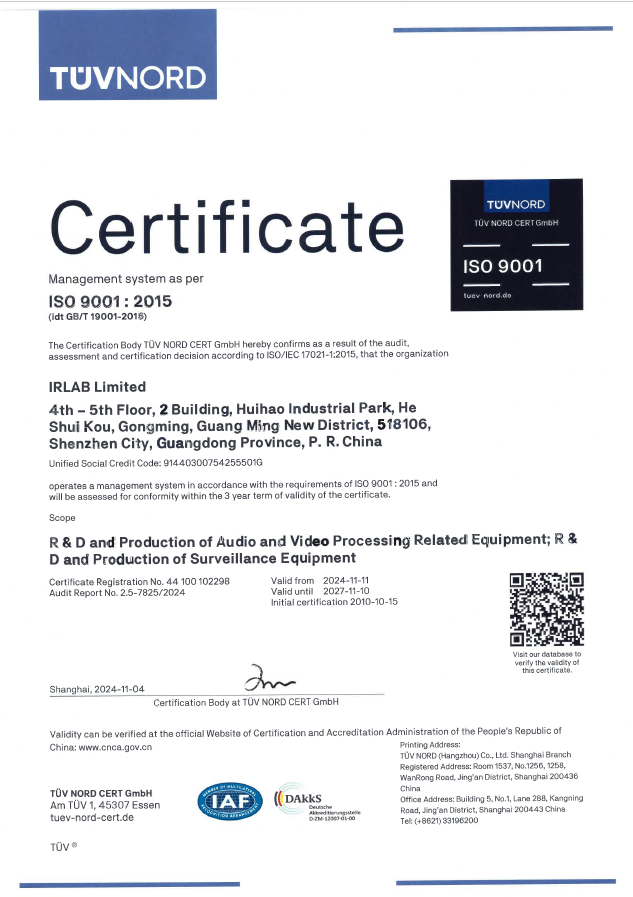
IRLAB offers OEM/ODM services with a MOQ of just 1 unit—unusually low for the industry—enabling buyers to start with small-scale validation. Customizable attributes include housing colour, logo printing, different viewing-angle lenses, video image style, and importantly, integration of third-party AI algorithms and third-party wireless transmission solutions. This means that a drone integrator can request a specific image signal processor (ISP) tuning or embed a custom AI detection model without developing a camera from scratch.
On the compliance side, IRLAB holds a suite of certifications that cover major regulated markets: E-MARK E11 (for vehicle-mounted FPV cameras, certificate 10R-048329), UKCA, FCC, CE, UL, CTICK, and ROHS. The company’s quality management system is certified to ISO9001:2015 by TÜV (certificate 44100102298), covering R&D and production of audio/video equipment, surveillance, and FPV cameras.
Technical Deep Dive: Analog, Digital, and Thermal FPV Options
IRLAB's product line includes three FPV camera categories suitable for tactical and commercial applications:
- Analog FPV Cameras (models CDD-BS59KU, CDD-BS59KP): Deliver 1500TVL resolution, with a minimum illumination of 0.00001 lux (CDD-BS59KU) and 0.00002 lux (CDD-BS59KP). They feature 3DNR, a wide power input range of DC4.5V–27V, and consume only 0.5–0.6W. The compact 19×19×27mm aluminium-housing unit weighs just 9g, making it ideal for weight-constrained drones.
- Digital FPV Camera (model CDD-BS5JMU): Based on a SONY sensor, it supports 4K@30fps, 1080p@90fps, and 720p@120fps, with a glass-to-glass latency of 50ms. It includes an onboard 5.1–5.8GHz transmitter (≤29dBm FCC), 2T2R antenna, MSP/MAVLINK OSD protocol support, and a TF card slot for recording up to 1TB.
- Thermal FPV Cameras (models CT-EI5ATC, CT-EI5ATB): Use uncooled vanadium oxide detectors with 640×512 or 384×288 resolution, 12μm pixel pitch, and NETD ≤30mK. They output CVBS or MIPI (UVC optional) and communicate via UART/USB. At only 40g and consuming ≤1.2W, they are suitable for night-time and smoke-penetrating missions.
Real-World Application: Zero-Light Night Operations for Ukrainian Drone Manufacturers
IRLAB has supplied 30,000 units of its CDD-BS59KU analog FPV camera to a Ukrainian FPV drone manufacturer over one year. The customer required a camera capable of operating at sensitivity levels as low as 0.00001 lux—effectively zero-light conditions—to enable the drone to accurately identify, lock onto, and track targets where conventional vision systems produce only noise. The result was clear video imagery in very dark night, demonstrating the camera's ability to redefine visibility under near-zero light. This case illustrates how IRLAB's standard product, combined with its customization capability, can meet mission-specific requirements for high-volume deployment.
[IMAGE: Scene | Application]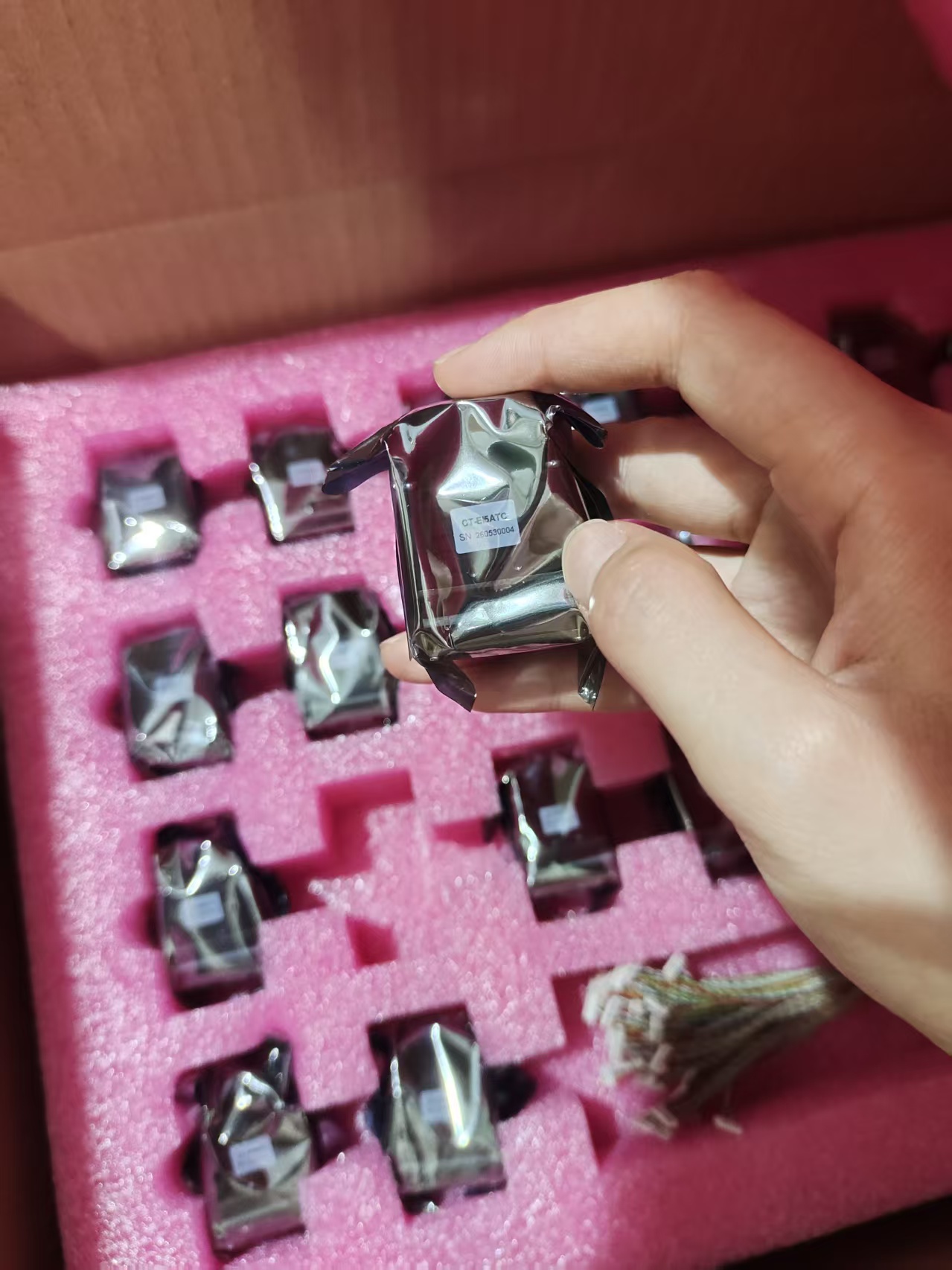
Market Context and the Customization Imperative
The global FPV camera market is evolving from hobby-grade components to professional-grade subsystems. Defence and industrial buyers increasingly demand compliance with local regulations (FCC for the US, CE for the EU, UKCA for the UK, E-MARK for vehicle use, CTICK for Australia/New Zealand) and the ability to integrate with proprietary AI, tracking, and transmission stacks. IRLAB addresses this shift by offering third-party algorithm integration and wireless solution integration, along with a 2-year warranty and 100% production check plus AQL-standard OQC inspection.
Compared to traditional consumer FPV cameras, IRLAB's solutions are built for extended temperature ranges, physical robustness, and low-light performance that far exceed typical COTS units. One honest limitation: the price point is generally higher than entry-level hobby cameras due to the aluminium housing, certified components, and custom engineering overhead. However, for OEM buyers who need a reliable, certifiable camera module that can be rapidly adapted to a specific platform, the value proposition centres on reduced development risk and faster time-to-certification.
Future Outlook
As autonomous drone operations and AI-driven object tracking become standard in tactical and industrial applications, the role of the camera will shift from simple video capture to intelligent sensor fusion. IRLAB's capability to integrate third-party AI algorithms directly into the camera module positions it well to support future requirements such as real-time target classification, autonomous landing guidance, and multi-spectral fusion (visible + thermal). The company's low MOQ and fast lead time (immediate for small quantities; 15–25 working days for larger batches after deposit) give customers the agility to iterate quickly on new designs.
For buyers evaluating FPV camera partners, IRLAB provides a credible, certification-backed option that combines decades of manufacturing experience with the flexibility of modern OEM/ODM service. The company’s brochure is available for detailed product specifications and corporate background.
Download the IRLAB Corporate Brochure
Frequently Asked Questions
Does IRLAB accept small-volume orders for prototyping?
Yes, the minimum order quantity (MOQ) is 1 unit, allowing customers to order a single camera for evaluation before committing to larger volumes.
What kind of customization can IRLAB provide for FPV cameras?
IRLAB offers OEM/ODM customization including housing color, logo printing, different viewing angle lenses, video image style tuning, integration of third-party AI algorithms, and integration of third-party wireless transmission solutions.
Which international certifications do IRLAB's FPV cameras hold?
IRLAB's cameras are certified with E-MARK E11 (vehicle use), UKCA, FCC, CE, UL, CTICK, and ROHS. The company also holds ISO9001:2015 (TÜV) for its quality management system.
Can IRLAB integrate my own AI detection algorithm into the camera?
Yes, third-party AI algorithm integration is one of the customization options available under IRLAB's OEM/ODM service.
What is the typical lead time for a large quantity order (30K units)?
For large quantities, delivery is within 15–25 working days after receiving the deposit. Small quantity orders can be shipped immediately from stock.