
ISO 15848-1 Certification Scope: Floating, Trunnion, PC and Wafer Ball Valves
Fugitive emission performance has become a routine line item in ball valve procurement. For buyers evaluating high-quality ball valve supply, the practical question is no longer whether a supplier holds an ISO 15848-1 certificate, but what that certificate actually covers — which sizes, which stem dimensions, which pressure ratings, which valve types and which markets. Zhejiang Dico Valve Co., Ltd, a ball valve manufacturer founded in 2015 and located in Wenzhou, Zhejiang Province, holds an ISO 15848-1 Qualification Certificate (No. 337275) issued by TUV. This article reads that certificate as a scope document and maps its coverage onto four ball valve types: floating, trunnion-mounted, PC and wafer.
Why the Certificate Title Matters Less Than Its Scope
In chemical, petrochemical, refining, pharmaceutical and hydrogen-related service, valve leakage is judged on two different things: leakage that passes through the seat when the valve is closed, and leakage that escapes to the atmosphere through stem seals and body joints. Seat tightness is normally addressed by product standards and pressure testing. Atmospheric leakage, usually described as fugitive emissions, is addressed separately — and that is where ISO 15848-1 enters the conversation.
The consequence for procurement is subtle but important. Since fugitive emission qualification is a type-testing exercise, a certificate is always written against a defined envelope: a valve size, a stem dimension, a pressure rating, a temperature range and a tested design. Two suppliers can both state “ISO 15848-1 certified” while covering completely different product ranges. When that happens, the certificate text, not the certificate title, decides whether the valve a buyer actually orders is inside the qualified envelope.
This is why qualification documents are increasingly read the way material certificates are read: as data that must be matched against the purchase specification, line by line.
What the ISO 15848-1 Certificate Records
The certificate held by Zhejiang Dico Valve Co., Ltd is a product qualification certificate issued by TUV. Its recorded parameters are as follows.
| Certificate field | Recorded content |
|---|---|
| Certificate | ISO 15848-1 Qualification Certificate |
| Certificate number | 337275 |
| Issuing authority | TUV |
| Standard | ISO 15848-1:2015+Amd.1:2017 |
| Qualified scope | 2" 2000PSI Ball Valve, stem size Φ7–28 mm, pressure rating PN138 and lower |
| Applicable markets | EU, NA, South Africa, South America |
| Issue date | 2026-04-16 |
| Expiry date | 2099-04-16 |
| Linked product families | Floating Ball Valve (Q41F), Trunnion-Mounted ball valve (Q47F), PC Ball valve (Q11F), wafer ball valve (Q71F) |
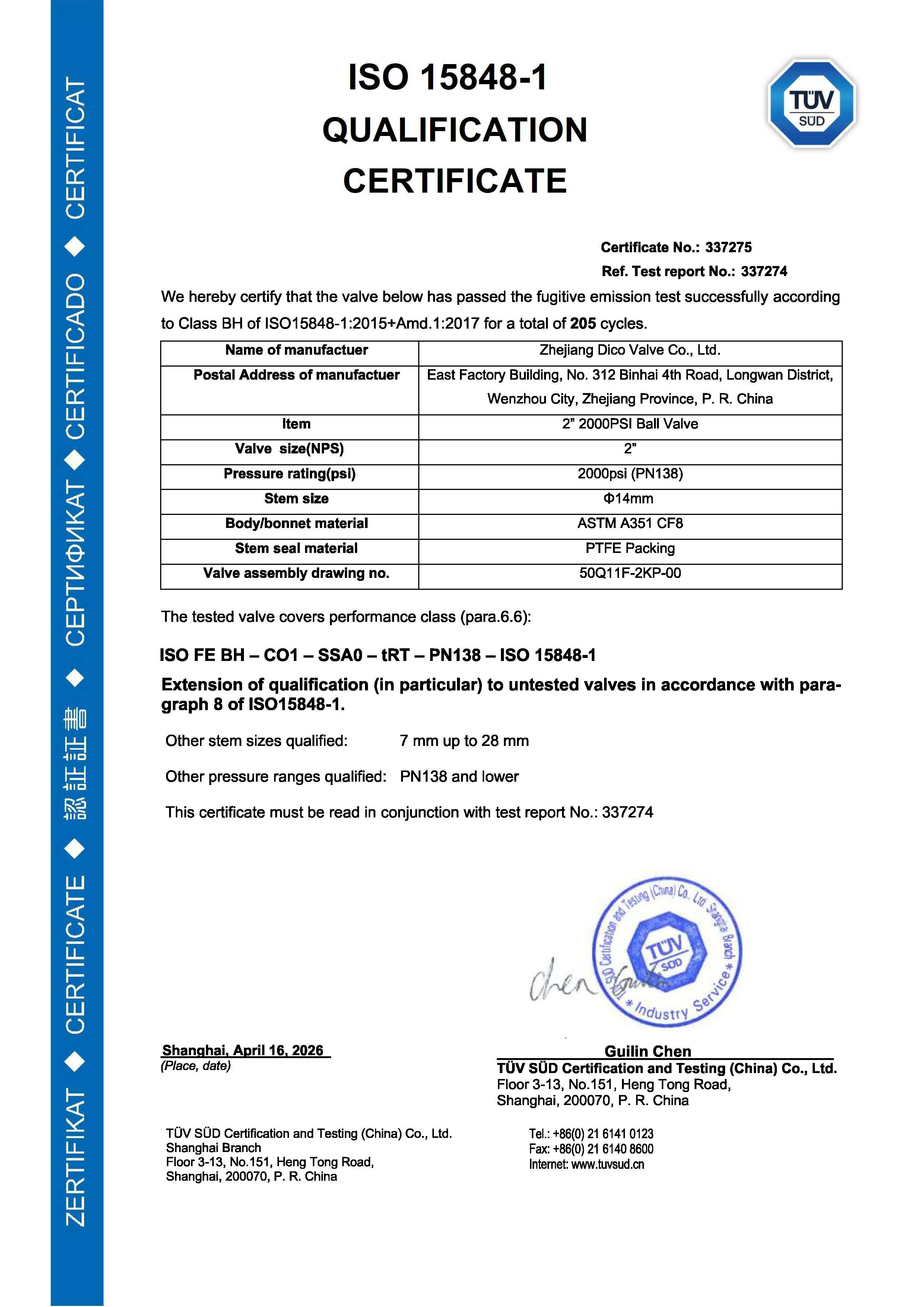
The ISO 15848-1 Qualification Certificate No. 337275 issued by TUV. The scope line — 2" 2000PSI Ball Valve, stem size Φ7–28 mm, pressure rating PN138 and lower — is the field buyers should match against their own specification.
Two features of this record deserve attention. First, the scope is expressed in three dimensions at once: nominal size, stem diameter and pressure rating. A valve can satisfy the size condition and still sit outside the qualified envelope if its stem dimension or pressure class falls beyond the stated limits. Second, the applicability list names four product families rather than a single model, which means the certificate is intended to function as a family-level qualification for those designs within the stated envelope.
Coverage Across Four Ball Valve Types
Dico Valve manufactures high-end ball valves and supplies complete fluid control solutions. The four families named in the certificate differ in body architecture, connection style and pressure capability, so their relationship to the certified envelope is not identical.
| Valve type | Model | Connection | Pressure range | Temperature range |
|---|---|---|---|---|
| Floating Ball Valve | Q41F | Flange | 1.0–10.0 MPa | −29°C to 425°C |
| Trunnion-Mounted ball valve | Q47F | Flange | 1.0–10.0 MPa | −29°C to 425°C |
| PC Ball valve | Q11F | Thread, weld, Tri-Clamp, tube, press-fit | 1.0–13.0 MPa | −196°C to 425°C |
| Wafer ball valve | Q71F | Wafer | 1.0–4.0 MPa | −29°C to 425°C |
Across these families the sealing menu is shared: seat and seal materials may be PTFE, PPL, PI, PEEK or Stellite, and the ball may be hollow or solid. Body materials span carbon steel, SS304, SS316, dual phase steel, titanium and alloy steel, depending on the model. The Q41F floating ball valve and the Q47F trunnion-mounted ball valve are both classified as metal-seated or soft-seated designs depending on configuration; the Q41F additionally carries an ISO 5211 mounting pad, an anti-static structure and three-layer stem sealing.
Floating and trunnion-mounted: the pressure-rated core
The floating and trunnion-mounted flange valves are the designs most often specified where isolation duty and actuation are combined. Both are rated 1.0–10.0 MPa over −29°C to 425°C and use the same sealing material options, which places a large part of their range inside a 2000 PSI / PN138-class envelope. Trunnion-mounted construction is normally selected when torque and bore size increase, because the ball is supported rather than seated against the upstream seat under differential pressure.
PC ball valve: the widest pressure and temperature span
The Q11F PC ball valve has the broadest operating envelope of the four families: 1.0–13.0 MPa and −196°C to 425°C, with threaded, welded, Tri-Clamp, tube and press-fit connections. It is also the family that covers compact and multi-port configurations, including sanitary, mini, 3-way, 4-way, ISO 5211, floating and 3PC Tri-Clamp variants. Because the certified scope references stem sizes of Φ7–28 mm, matching a specific PC valve configuration against that stem range is the decisive check.
Wafer ball valve: short face-to-face, lower pressure class
The Q71F wafer ball valve is rated 1.0–4.0 MPa over −29°C to 425°C and is manufactured in carbon steel, SS304 or SS316. It is classified under the floating and ISO 5211 categories and is designed for the petroleum industry among others. Its lower pressure range sits comfortably inside the certified pressure limit, which makes the size and stem conditions the main screening criteria for this family.
Technical Reading: Why Sealing Architecture Defines the Envelope
A fugitive emission qualification is fundamentally a statement about sealing behaviour at the stem and body joints under thermal cycling and mechanical cycling. Three design choices in this product range interact with that behaviour.
- Stem sealing. The Q41F floating ball valve uses three-layer stem sealing, a configuration intended to create multiple barriers along the stem path rather than a single packing element.
- Seat material. Soft seats based on PTFE, PPL, PI or PEEK support tight shut-off in clean media and moderate temperatures, while Stellite hard facing is used where abrasive or high-temperature service would degrade a polymer seat. Seal choice therefore influences both emission behaviour and service life.
- Ball support. Floating and trunnion-mounted architectures distribute seating force differently, which changes actuation torque and seat loading as pressure rises.
Because these variables change with size and pressure class, a qualification certificate is written against an envelope rather than against a catalogue. Qualification testing also differs from routine production testing: it validates a design under the standard's procedure, while production quality control validates individual units. Dico Valve's production control includes 100% testing in the first round followed by a second round of random checks, which is the layer that supports consistency across delivered batches.
How Buyers Verify Certificate Scope
Scope verification can be reduced to a short sequence that works for any supplier, not only for this one.
- Confirm the certificate number and issuing authority. For this certificate: No. 337275, issued by TUV.
- Confirm the standard revision. Here it is ISO 15848-1:2015+Amd.1:2017; an older revision is not equivalent to the current one.
- Read the scope sentence in full. Size (2" 2000PSI ball valve), stem size (Φ7–28 mm) and pressure rating (PN138 and lower) must all be satisfied by the ordered configuration.
- Match the product family. Check that the model you are buying — floating Q41F, trunnion-mounted Q47F, PC Q11F or wafer Q71F — appears within the certificate's applicability list.
- Check the market statement. This certificate applies to the EU, NA, South Africa and South America markets, which aligns with the company's export activity. The company reports an export ratio of 40% and lists the EU, South Africa and North America among its main markets.
- Check validity dates. Issued 2026-04-16, valid to 2099-04-16; confirm the copy you receive is current.
- Cross-check neighbouring certificates. Fugitive emission qualification does not replace fire-safe testing, functional safety assessment or European conformity documentation; each is a separate document with its own scope.
Application and Use Cases
The four certified families are specified across petroleum, petrochemical, pharmaceutical, water treatment, liquid cooling, metallurgy, chemical, semiconductor, hydrogen energy and HVAC applications. Those industries share one requirement: airborne leakage from packing and joints must be controlled, not only through-seat leakage.
A documented case illustrates how these valves behave in continuous service. An ironmaking and metallurgical plant in China installed 1000 units of the floating ball valve (product 8332, model Q41F) on boiler water piping with pneumatic automatic control. The project has run for one year with stable operation. The relevant procurement lesson is not the unit count but the combination: actuated operation, continuous thermal load and a metallurgical environment, where a documented sealing architecture supports predictable maintenance planning.
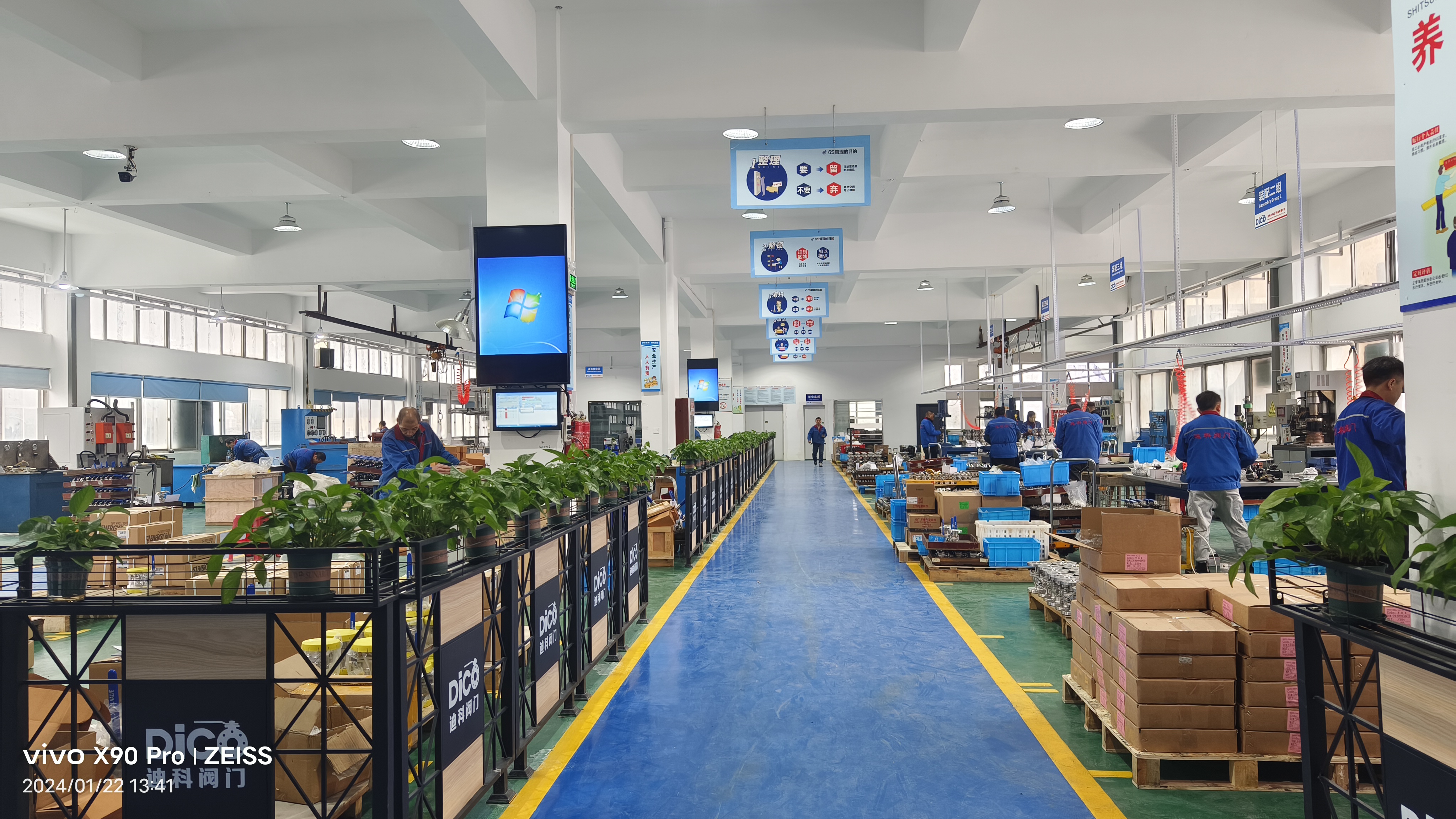
Assembly operations for ball valve families covered by the qualification record. Production control combines 100% first-round testing with a second round of random checks.
Market Trend: Certification Data Is Becoming Procurement Data
Several shifts are visible in how industrial buyers handle valve qualification documents.
First, emission-related expectations continue to tighten in the EU and North America, and certification statements are increasingly converted into specification clauses during tendering rather than reviewed after award. Second, newer application areas — hydrogen energy, semiconductor manufacturing and data-centre liquid cooling — bring their own sealing sensitivities, and buyers in these segments tend to ask for evidence of sealing architecture rather than a general quality claim. Third, procurement teams are moving toward document verification: certificate number, standard revision, scope line and validity dates are now commonly checked against the purchase order.
Manufacturing-side data supports this trend. Dico Valve operates a digital workshop with 6-S standardized management, 48 CNC machines and a digital production management system, together with a one-item-one-code system and 98% warehouse data accuracy across 2000 m² of warehouse space. Traceability of this kind matters because a scope-based qualification is only useful if the delivered valve can be traced back to the qualified design.
Certified Versus Conventional Specification: A Fair Comparison
Buyers frequently compare a fugitive-emission-qualified design against a conventionally specified ball valve that relies on seat leakage testing and a supplier declaration. The two approaches are not equivalent, and the difference runs in both directions.
| Dimension | Conventional specification | ISO 15848-1 qualified design |
|---|---|---|
| Emission evidence | Relies on supplier declaration and routine pressure testing | Third-party qualification certificate with a defined scope |
| Verification effort | Low, but relies on trust | Higher: scope, size, stem and pressure must be matched |
| Coverage | Applies broadly, but without documented emission performance | Applies only inside the qualified envelope |
| Suitable for | Non-critical utility lines, cost-driven projects | Regulated, toxic, flammable or high-purity service |
That distinction is not a weakness of the certification system; it is how type qualification works. The practical benefit is that a buyer can define, in advance, exactly which lines require a qualified valve and which do not, instead of applying a single blanket requirement across a plant.
Future Outlook
Qualification documents are likely to become more granular rather than less. As emission expectations spread from refining and chemicals into hydrogen, semiconductor and liquid-cooling infrastructure, buyers will increasingly expect certificates to state size, stem dimension, pressure class and temperature range explicitly, and will compare those fields against line data during procurement.
For manufacturers, the corresponding requirement is traceability: a qualified design is only valuable if delivered units can be linked back to it through production and warehouse records. For buyers, the practical takeaway is simple: read the scope line first, then decide whether the valve on the purchase order sits inside it.
FAQ
What does ISO 15848-1 actually cover?
ISO 15848-1 is the industrial valve standard that specifies test and qualification procedures for fugitive emissions — leakage escaping to atmosphere through stem seals and body joints, as distinct from leakage through the closed seat. A qualification certificate issued under this standard documents that a tested valve design met the standard's procedure within a stated envelope. It is a design-level qualification, not a record of individual unit inspection.
What does the Dico Valve ISO 15848-1 certificate cover?
Certificate No. 337275, issued by TUV, references standard ISO 15848-1:2015+Amd.1:2017. Its qualified scope reads: 2" 2000PSI Ball Valve, stem size Φ7–28 mm, pressure rating PN138 and lower. The certificate applies to the EU, NA, South Africa and South America markets, was issued on 2026-04-16 and is valid to 2099-04-16.
Which ball valve types are listed under the certificate?
Four product families are associated with the certificate: the Floating Ball Valve (Q41F, flange connection, 1.0–10.0 MPa, −29°C to 425°C), the Trunnion-Mounted ball valve (Q47F, flange connection, 1.0–10.0 MPa, −29°C to 425°C), the PC Ball valve (Q11F, thread, weld, Tri-Clamp, tube or press-fit connection, 1.0–13.0 MPa, −196°C to 425°C) and the wafer ball valve (Q71F, wafer connection, 1.0–4.0 MPa, −29°C to 425°C). Individual configurations within these families must still satisfy the size, stem and pressure conditions of the scope.
Which markets does the certificate apply to?
The certificate states applicability for the EU, NA, South Africa and South America markets. Separately, the manufacturer reports an export ratio of 40% and lists the EU, South Africa and North America among its main markets.
How can a buyer verify the certificate scope before ordering?
Check five fields against the purchase specification: the certificate number (337275) and issuing authority (TUV); the standard revision (ISO 15848-1:2015+Amd.1:2017); the scope sentence, which requires a 2" 2000PSI ball valve, a stem of Φ7–28 mm and a pressure rating of PN138 or lower; the product family list, which must include the model being ordered; and the validity dates, 2026-04-16 to 2099-04-16.
How long is the certificate valid?
The certificate was issued on 2026-04-16 and its stated expiry date is 2099-04-16.
Does ISO 15848-1 certification replace API 607 or functional safety certification?
No. They address different risks and are issued separately. Fire-safe performance is documented by the API STD 607 Fire-safe Test Certificate No. 285697 issued by TÜV SÜD Industrie Service GmbH, covering ball valves 2" and below as well as 2-1/2", 3" and 4" sizes in Class 150 and Class 300 austenitic material, valid to 2027-03-23. Functional safety is documented by Functional Safety Certificate No. 6L241216.ZDVWQ00 issued by ECM under IEC 61508:2010 Parts 1-7, covering industrial valves DN≤400 mm and PN≤13.0 MPa with SIL3 capability, valid to 2029-12-15. European market access is documented by PED CE Verification Certificate No. 6L241216.XSVWQ18 issued by ECM under EN 12266:2012 and PED Directive 2014/68/EU, also covering DN≤400 mm and PN≤13.0 MPa, valid to 2029-12-15.
What should a buyer do if the required valve falls outside the certified scope?
If the valve size, stem dimension or pressure rating exceeds the scope — for example a larger-bore trunnion-mounted valve or a class above PN138 — the existing certificate does not cover that configuration. In that situation the standard procurement route is to request the supplier's qualification position for that specific design, and to confirm in writing which document, if any, applies before the order is placed.
Zhejiang Dico Valve Co., Ltd was founded in 2015 and is located in the Longwan District of Wenzhou, Zhejiang Province. It operates a 12,000 m² facility with 80 employees, a 7-engineer R&D team, a monthly production capacity of 10,000 units and lead times of 7–45 days. System certifications include ISO 9001:2015, ISO 14001:2015 and ISO 45001:2018, alongside product certifications ISO 15848-1, API STD 607, PED CE and functional safety documentation.
A downloadable company and product overview, including the certification set described above, is available here: Dico Valve company and product introduction (PDF).