
ISO 9001:2015 in Commodity Mould Manufacturing: What Buyers Should Trust
ISO 9001:2015 in Commodity Mould Manufacturing: What Buyers Should Trust
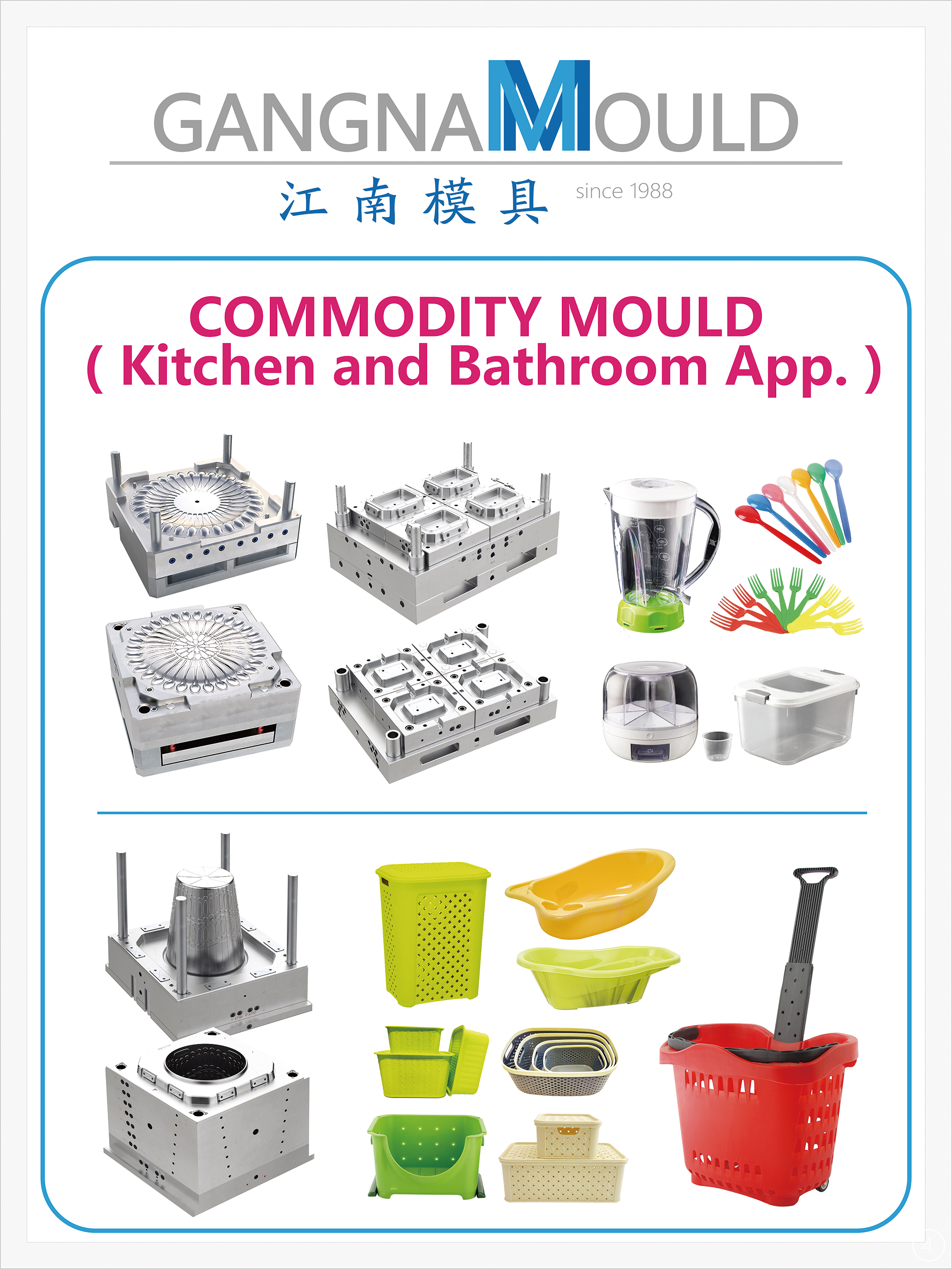
Commodity mould categories such as kitchen and bathroom accessory tooling are engineered and inspected under a documented quality management system.
ISO 9001:2015 certification in commodity mould manufacturing tells a buyer how a supplier controls its processes. It does not certify the dimensional tolerance, cycle time or surface finish of any individual mould. That distinction matters because commodity moulds — the tooling that produces chairs, tables, stools, sofas, storage cabinets, baskets, trays, boxes, crates, buckets, basins, garden planters, pallets and thin-wall containers — are purchased once and then run for years, often through millions of cycles. By the time the consequences appear in production, every decision that produced them has already been locked in.
GANGNAM MOULD CO., LTD (Zhejiang Huangyan Jiangnan Mould Factory) is a plastic mould manufacturer established in 1988 and based in Huangyan District, Taizhou, Zhejiang, China. The company operates a 3,000 m² facility with approximately 40 employees and produces more than 800 sets of moulds per year. Its commodity mould product line is certified to the ISO 9001:2015 quality management system, and that accredited system is a practical reference point for a question most mould buyers eventually ask: what does a certified QMS actually allow me to trust?
Why a Management System, Rather Than a Sample, Defines Trust
ISO 9001:2015 is an international standard for quality management systems. Certification means an accredited certification body has audited how an organisation plans, controls, monitors and improves its processes. In mould manufacturing, that translates into controlled intake of customer requirements, controlled design and manufacturing steps, defined inspection points, and records that can be reviewed after the work is complete.
The scope of a certificate matters as much as the certificate itself. The commodity mould product (product code 5670) produced by Gangnam Mould is certified under the ISO 9001:2015 quality management system standard. Certification number 18118Q10459R3S was issued by Beijing Xingguo Inspection and Certification Co., Ltd.; the scope covers the manufacture and design of plastic parts moulds; the certification was issued on 2024-06-14 and expires on 2027-06-15; and it applies to the global market.
Read precisely, that statement means the design and manufacturing organisation behind the mould has been audited against a recognised standard. It does not mean that a specific tool will hold a specific dimension, achieve a specific cycle time, or behave identically to another tool built from the same drawing. Those outcomes depend on the specification agreed between buyer and supplier, on the tool design itself, and on the measurement evidence produced at trial.
The Problem: Commodity Moulds Are Bought on Limited Evidence
Most mould buyers never see the tool being built. Assessment happens in a narrow window — a quotation, a drawing review, a sample, perhaps a factory visit — and then production starts. Moulds are durable capital goods, so a deviation discovered at month six costs far more to correct than the same deviation caught at trial molding, when the mould is still on the bench.
The category also resists generalisation. A chair mould, a storage box mould and a thin-wall injection mould carry very different cooling, gating and warpage risk profiles. A supplier that performs well on a large household item is not automatically suitable for a thin-wall container, where wall uniformity and cycle time dominate the economics. Without documented processes, that performance often depends on individual toolmakers rather than on an institution, which makes it harder to reproduce across repeat orders, additional cavities or a second tool.
The opportunity for buyers lies in evidence. A functioning quality management system generates the records that turn an assessment from an opinion into a review: measurement data, inspection records, trial results and a traceable sequence of process steps. That is the practical value of certification in this category — not the logo on a page, but the trail behind it.
How a Certified Commodity Mould System Is Structured
Gangnam Mould works as an OEM, ODM and customisation partner. The customisable variables stated for its commodity moulds include cavity count and size, surface texture and polish, gating and cooling system design, inserts and multi-component integration, and material and heat-treatment requests. Monthly capacity is around 80 sets of moulds, and the minimum order quantity is one unit. Lead time depends on mould complexity: the company outlines a sequence of requirement, design, manufacturing, trial and inspection, and delivery with training, and indicates an order-specific timeline in the region of 30 to 45 days that is confirmed per order.
Quality control is where the certified system becomes visible to a buyer. The stated methods are non-destructive testing (NDT), coordinate measuring machine (CMM) measurement, and full-size trial testing supported by inspection reports. After-sales activity covers mould delivery, installation and operation training, plus detailed inspection reports during trial, with the specific after-sales terms agreed contractually.
That combination — documented design inputs, NDT and CMM verification, a full-size trial with reports, and a defined handover — is what a buyer is actually selecting when they choose a certified supplier. The certificate is evidence that these steps are governed by a system rather than improvised project by project.
Technical Explanation: From Drawing Intake to Trial Molding
The practical difference between a controlled and an uncontrolled mould project appears in the sequence. A certified workflow treats each stage as an input to the next, so a change in the drawing propagates through design, machining, assembly and inspection in a documented way. The table below maps the stages a commodity mould passes through against the controls behind them and the evidence a buyer can reasonably expect to see.
| Stage | What the controlled process covers | Evidence a buyer can expect |
|---|---|---|
| Requirement intake | Moulds are manufactured end-to-end from samples or drawings through to trial molding and delivery; customer requirements are confirmed during requirement communication | Confirmed requirement record; agreed drawing and specification, including the tolerance framework |
| Design and development | Cavity count and size, uniform cooling system layout, optimised gating and venting, surface treatment, inserts and multi-component integration, material and heat-treatment requests | Tool design documentation; defined acceptance criteria for the trial |
| Manufacturing | Machining on digital controlled milling equipment, three-dimensional coordinated mapping inspection, mould assembly | Process records maintained inside the certified system |
| Trial and inspection | Non-destructive testing, CMM measurement, full-size trial testing | Inspection reports, including detailed reports issued during trial |
| Delivery and handover | Mould delivery, installation and operation training; after-sales terms agreed contractually | Delivery documentation, training records and contractually agreed service terms |
Two aspects of this flow deserve attention from a procurement perspective. First, intake is the stage at which a supplier's system either captures the buyer's real requirement or compresses it. Because moulds are produced from samples or drawings all the way through to trial molding, an incomplete requirement at intake becomes an expensive change later. Second, inspection is not a single event. Full-size trial testing on the actual mould, supported by CMM measurement and NDT where required, is the stage that converts design intent into verified output.
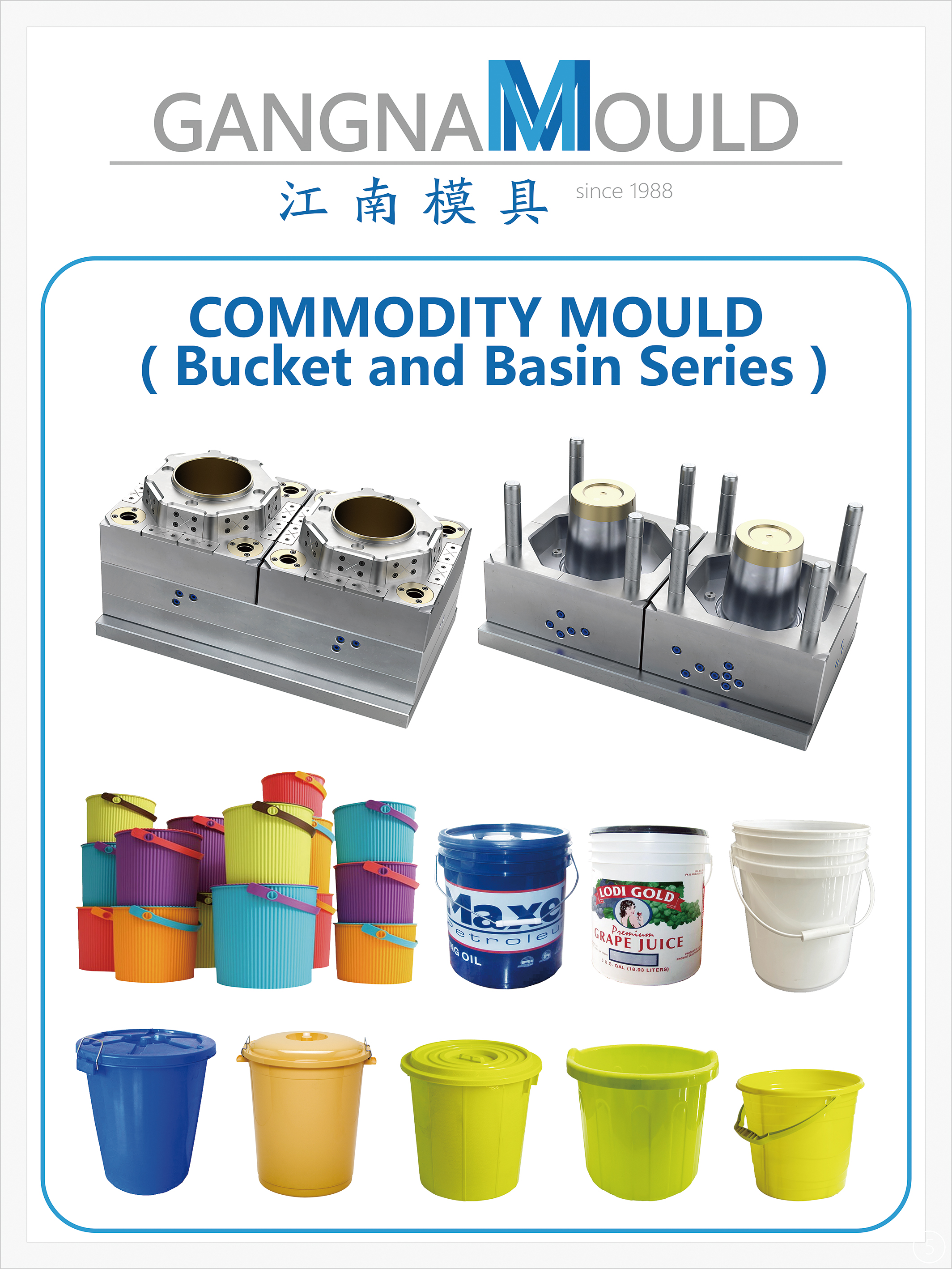
Bucket and basin series moulds: high-volume categories where cooling uniformity and batch consistency determine production economics.
The tooling base supporting this flow includes more than 20 sets of digital controlled milling machines, a three-dimensional coordinated mapping inspector and a mould assembly group, with a stated output of over 800 sets of moulds per year. For a buyer, the relevant point is not the equipment list itself but its relationship to the inspection stage: dimensional verification is only meaningful when the manufacturing process is stable enough for a measurement to represent a repeatable result rather than a one-off adjustment.
Where Precision Comes From — and What a Certificate Cannot Fix
Precision in commodity moulds is designed in, not inspected in. The stated design priorities for these moulds are a uniform cooling system to shorten cooling time, optimised gating and venting to reduce warpage, surface treatment control, and tolerance control for batch consistency. Each of those is a process decision made before the first trial shot, and each governs whether part one and part one hundred thousand come out the same.
This is also where buyers most often misread a specification. Mould quotations sometimes carry a tight dimensional figure — a tolerance expressed in hundredths of a millimetre, for instance. Such a figure is only meaningful when it is tied to a specific drawing, a specific polymer and a specific measurement method. ISO 20457:2018, the primary international standard for manufacturing tolerances and acceptance conditions of plastic molded parts, exists precisely because moulded plastic does not behave like machined metal: shrinkage, warpage and gate location all move the final dimension. A quality management certificate does not fix that number. What it does is make the supplier's route to that number reviewable, through CMM measurement and full-size trial inspection reports.
For moulds intended for PP and engineering-grade plastics, including recycled polymers, the practical advice is straightforward: agree the tolerance standard and the acceptance conditions at the RFQ stage, reference them on the drawing, and require the trial inspection report to demonstrate them. Certification supports that conversation; it does not replace it.
Applications and Use Cases
Commodity moulds serve packaging and retail, daily necessities, logistics and warehousing, home appliance manufacturing, and industrial component production. They run on mass injection and blow molding lines where durability, short cycle times and dimensional stability determine the economics of the whole production cell. A mould that runs reliably is a production asset; one that needs frequent adjustment is a recurring cost.
The category range is broad: chair moulds, table moulds, stool moulds, sofa moulds, storage cabinet and storage box moulds, basket, tray and box moulds, turnover box and crate moulds, kitchen utensil moulds, bathroom accessory moulds, basin moulds, bucket moulds, trash bin moulds, garden planter moulds, pallet moulds, home appliance moulds and thin-wall injection moulds. Mould material is quality mould steel, and the processed plastics include PP, engineering-grade plastics and recycled polymers. Cavity count, surface treatment, inserts and multi-component design can all be customised, with the specific technical parameters confirmed during requirement communication.
A long-running example is instructive. Over a ten-year period, Gangnam Mould has supplied custom moulds to customers in Bangladesh, Algeria, India, Iraq, Italy, Jordan, Nigeria and Turkey — a delivered quantity of 800 units — for applications including injection pallets, circulation crates, daily plastic containers and home appliance housings. The stated design intent for these tools is reliability across millions of operational cycles, which is the outcome the certification framework is meant to protect. The company reports an export ratio of about 70% and lists the Middle East, Africa, Central Asia, South America, Mexico, Italy and India among its export markets.
Market Trend Analysis: Why Compliance Evidence Is Moving Up the Checklist
Mould sourcing has been growing and dispersing at the same time, and both movements push process evidence higher up the buyer's checklist. Reported industry research placed the global plastic mould market at approximately USD 29.5 billion in 2021, with a projection of USD 36.78 billion by the end of 2025. China's exports of plastic and rubber moulds reached USD 5.35 billion in 2023, compared with USD 2.97 billion in 2017 — a substantial increase in the volume of tooling crossing borders in a six-year period.
Downstream demand points the same way. The global plastic furniture market, which includes chairs, tables and storage items, was valued at USD 48.7 billion in 2023, with the residential segment holding a 53.1% revenue share. The global thin-wall mould market was valued at USD 41.6 billion in 2024, driven by injection molding's ability to produce complex, lightweight designs at minimal cycle times. Published estimates in this space should be read with care, however: figures for the plastic furniture market vary widely depending on whether raw materials for furniture or finished plastic furniture are counted, with one source placing the same category at USD 15.05 billion. Buyers should treat such totals as directional rather than precise.
Geography reinforces the pattern. Huangyan District in Taizhou, China — where Gangnam Mould is located — is officially recognised as the "Capital of Molds," with 614 large-scale industrial enterprises specialising in mould and plastic production. Dense clusters of this kind shorten tooling lead times and improve material access, but they also make supplier differentiation harder from the outside. When many suppliers can quote a similar price and lead time, documented process control becomes one of the few verifiable differentiators available to a buyer who cannot inspect every workshop in person.
Comparison with Traditional Solutions — and the Limits of Certification
Certified and uncertified mould suppliers are not simply good and bad versions of the same thing. They trade different strengths, and the right choice depends on order profile, volume, and how much process risk the buyer is prepared to carry.
| Consideration | Small uncertified tooling shop | ISO 9001:2015 certified mould manufacturer |
|---|---|---|
| Process documentation | Often informal; knowledge frequently held by individual toolmakers | Documented procedures operating under an audited management system |
| Dimensional verification | Typically final-part measurement, sometimes without a formal report | CMM measurement, NDT and full-size trial testing with inspection reports |
| Repeat orders and extra cavities | Consistency depends on the same staff being available | Design and manufacturing steps repeatable by procedure |
| Auditability | Limited; assessment relies on references and site visits | Auditable through certificate scope, validity dates and inspection records |
| Speed and direct contact | Often faster on small, simple tools with direct access to the toolmaker | Structured intake and approval steps can add administrative time |
| Cost profile | Lower overhead on simple, low-volume tools | Documentation and inspection effort is built into the price |
| Typical fit | Non-critical parts, prototypes, simple low-tolerance items | Volume production, multi-category programmes, tools expected to run for years |
Certification is not a substitute for project-level diligence, and buyers should be clear about its boundaries:
- It certifies a system, not a product. ISO 9001:2015 contains no numeric tolerance value. For commodity moulds, dimensional acceptance depends on the drawing and on the tolerance framework the buyer agrees, which is the role of ISO 20457:2018.
- It is audited periodically, not continuously. A certificate issued on 2024-06-14 and valid to 2027-06-15 confirms conformity at audit points within that cycle; it does not describe the status of a specific project in progress.
- It does not promise capacity or lead time. A certified supplier may still be fully booked. The stated capacity here is around 80 sets per month, with an indicative 30 to 45 day lead time confirmed per order, so capacity must be checked against the actual schedule.
- Documentation has a cost, proportionally higher on small orders. The minimum order quantity is one unit, but the administrative load of a controlled process does not scale down with the tool, which matters when comparing quotations at the low end.
- Scope wording is decisive. The certification held here covers the manufacture and design of plastic parts moulds. Activities outside that scope are not automatically covered, and buyers evaluating additional services should ask which scope they fall under.
None of this reduces the value of certification. It means the certificate should be treated as a qualification filter and a documentation guarantee, while mould-specific performance claims are verified the way they always have been: on the drawing, at trial, and in the inspection report.
Future Outlook
Three trends appear likely to shape how compliance evidence is used in commodity mould procurement. The first is the standardisation of tolerance conversations: referencing ISO 20457:2018 at the RFQ stage converts a vague claim about precision into a testable specification, and buyers who adopt that habit early gain leverage with suppliers who have not. The second is the normalisation of inspection data as a deliverable. CMM measurement and full-size trial testing are already stated quality control methods for these moulds, and buyers increasingly treat the accompanying inspection reports as part of the product rather than as an optional extra.
The third is certificate lifecycle management. Certification now carries explicit issue and expiry dates — 2024-06-14 to 2027-06-15 in this case — and renewal cycles create natural review points for supplier qualification. Buyers who build certificate validity checks and audit-currency questions into annual supplier reviews will surface problems earlier than those who treat certification as a one-time onboarding step.
For the categories covered here, from chair and table moulds through bucket, basin and thin-wall injection moulds, the direction is consistent: the physical tool remains the deliverable, but the evidence around it increasingly determines who reaches the shortlist.
Frequently Asked Questions
What does ISO 9001:2015 certification cover for a commodity mould supplier?
ISO 9001:2015 is a quality management system standard, so certification covers how a supplier's processes are planned, controlled and recorded rather than a specific product characteristic. In the case of Gangnam Mould, the commodity mould product (product code 5670) is certified under the ISO 9001:2015 quality management system standard, with certification number 18118Q10459R3S issued by Beijing Xingguo Inspection and Certification Co., Ltd. The scope covers the manufacture and design of plastic parts moulds, and the certification applies to the global market.
Does ISO 9001:2015 certification guarantee that a mould will hold a specified dimensional tolerance?
No. The standard certifies process control and does not contain a tolerance value. Dimensional acceptance for commodity moulds depends on the drawing, the polymer being processed and the acceptance conditions agreed between buyer and supplier, with ISO 20457:2018 as the primary international standard for manufacturing tolerances and acceptance conditions of plastic molded parts. Documented design priorities such as uniform cooling, optimised gating and venting, and tolerance control for batch consistency support repeatability, and the corresponding evidence is produced through CMM measurement and full-size trial testing rather than through the certificate itself.
How do ISO 9001:2015 and ISO 20457:2018 differ in practice?
They operate at different levels. ISO 9001:2015 addresses the supplier's management system — how requirements are captured, how design and manufacturing are controlled, and how conformity is verified. ISO 20457:2018 addresses the product — manufacturing tolerances and acceptance conditions for plastic molded parts. A buyer sourcing commodity moulds typically needs both: a supplier whose processes are governed, and a specification that states which tolerances apply to the parts the tool will produce.
How can a buyer verify a mould supplier's ISO 9001:2015 certificate?
Verification rests on four items that appear on the certificate itself: the certification number, the issuing body, the scope statement and the validity dates. The certification covering this commodity mould carries number 18118Q10459R3S, was issued by Beijing Xingguo Inspection and Certification Co., Ltd., covers the manufacture and design of plastic parts moulds, and runs from 2024-06-14 to 2027-06-15. Buyers should confirm that the scope wording matches the activity being purchased and check that the certificate has not expired.
What inspection evidence should accompany a commodity mould trial?
The stated quality control methods for these moulds are non-destructive testing, CMM measurement and full-size trial testing, supported by inspection reports. Detailed inspection reports are provided during the trial phase, and delivery includes installation and operation training. Buyers should treat the trial inspection report as the point at which design claims become measurable, and confirm in advance which measurements the report will contain, since specific technical parameters are agreed during requirement communication.
Does certification replace sample approval for a new commodity mould?
No. A certified quality management system governs how the trial is conducted and recorded; it does not replace the trial itself. Mould manufacturing runs from samples or drawings through to trial molding and delivery, and the full-size trial test is where conformity to the agreed specification is demonstrated for that particular tool. Buyers commonly approve a sample or first-off part against the drawing before releasing the mould for volume production, and management system certification does not remove that step.
Is ISO 9001:2015 certification relevant for a single-mould order?
The standard applies to processes rather than to order volume, and the minimum order quantity for these commodity moulds is one unit, so a single tool is produced under the same certified system as a larger batch. The practical consideration is proportional rather than categorical: documentation and inspection effort spread over one mould represents a larger share of project cost than the same effort spread over many, which is worth accounting for when comparing quotations from certified and uncertified suppliers.
Reference: Gangnam Mould company brochure (PDF).