
ISO 9001 Is Not Enough: Qualifying a Data Center Transformer Supplier
ISO 9001 Is Not Enough: Qualifying a Data Center Transformer Supplier
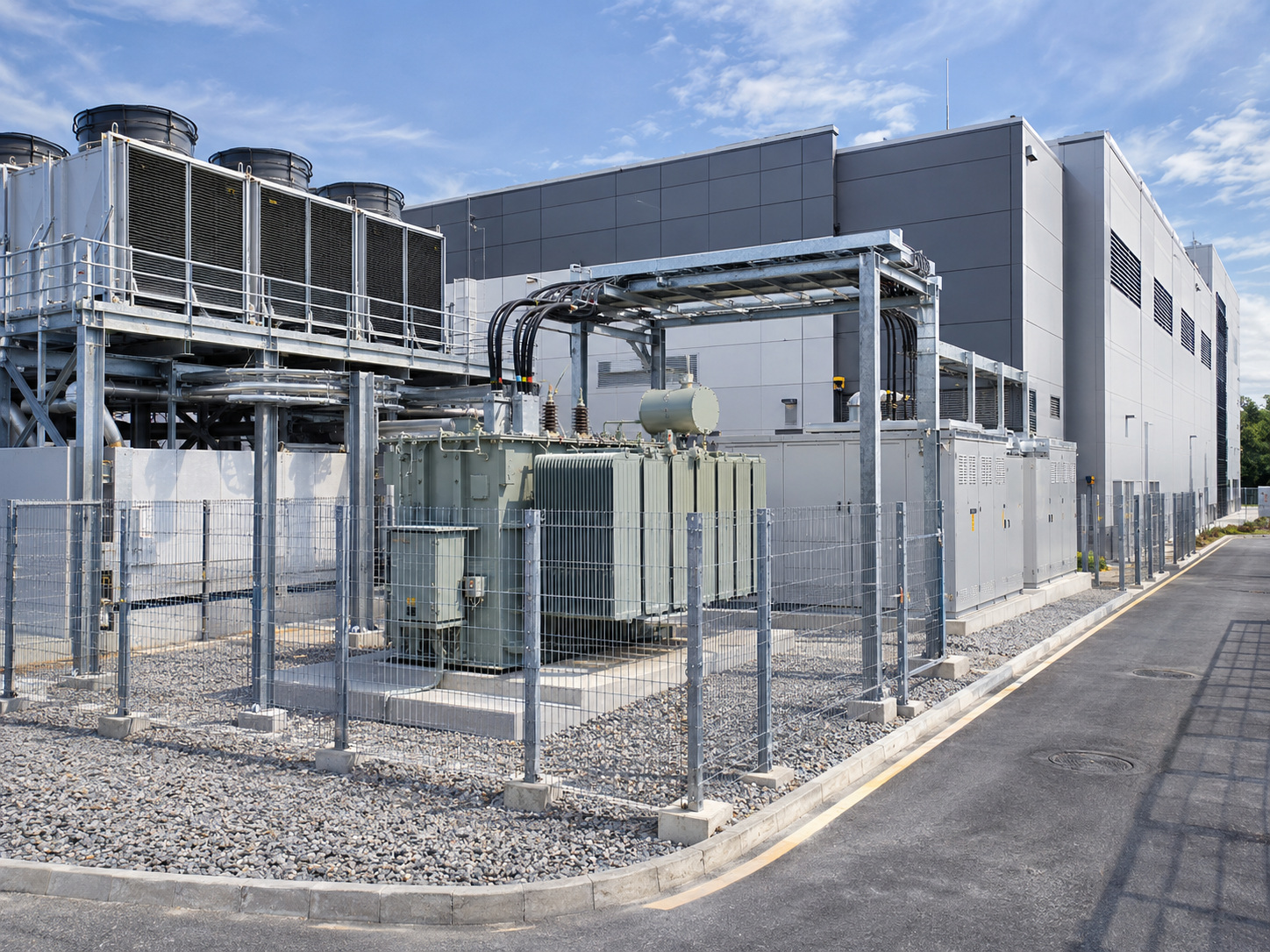
An ISO 9001 certificate tells a data center buyer that a supplier runs a controlled quality management system. It does not tell the buyer that the offered transformer has been type-tested in the configuration being purchased, that its harmonic and thermal duty has been assessed for continuous IT load, or that the factory acceptance test will measure what the project actually needs. Qualifying a data center transformer supplier therefore means moving from system-level certification to product-level evidence.
The Gap Between a Management Certificate and a Product Claim
ISO 9001 is a quality management system standard. Certification confirms that an organisation has implemented documented processes for design control, purchasing, production, inspection, control of nonconforming output and corrective action, within the scope stated on the certificate. The audit happens at system level, against process requirements.
What it does not do is certify a transformer. It does not establish that a particular model conforms to IEC 60076 or GB/T 1094, that a type test exists for the exact rating and cooling arrangement on the inquiry, that declared losses have been verified on a representative unit, or that the design has been evaluated for the harmonic currents a modern data hall produces. Those are product-level claims, and they need product-level evidence.
For many procurement categories this distinction is manageable. For data center transformers it is central, because the equipment sits between a medium-voltage supply and loads that cannot tolerate avoidable interruption: UPS input systems, cooling plant, switchgear and the IT load behind them. A purchasing team that stops at the certificate has qualified a management system, not an asset.
Where ISO 9001 Stops
The practical way to use the certificate is as a threshold. It answers questions about how the supplier controls drawings and revisions, how incoming components are checked, how test records are retained and how corrective actions are closed. Those controls matter on a customised unit, where a drawing revision can change an impedance value or a terminal arrangement.
It does not answer the questions that decide an award:
- Has the offered dry-type or liquid-immersed design been type-tested to the standard named in the specification?
- Does that type test cover the rating, voltage ratio, cooling class and winding arrangement being purchased?
- What evidence supports the declared no-load loss, load loss, impedance and temperature rise?
- Is the unit approved or listed for the destination market, and under which scheme?
- What exactly will the factory acceptance test measure, and who may witness it?
Each is a separate evidence item with its own scope. Each can be verified independently of ISO 9001, and each should be written into the inquiry rather than assumed from a supplier profile.
First Check: Does the Type Test Match the Product?
A type test report is not a general licence to supply. It is evidence about an identified design. The report normally states the model, rated capacity, voltage ratio, frequency, vector group, cooling method, winding arrangement and the standard applied. Change the cooling class or the winding construction materially, and the report may no longer describe what is on the purchase order.
The certification documentation published by Milestone Electrical — Milestone (Xiong'an) Electrical Technology Co., Ltd., a transformer engineering and manufacturing company based in Xiong'an New Area, Hebei, China — illustrates both the strength and the boundary of this kind of evidence. The file includes:
- Type test report AK1500514-2025 from the Shandong Institute for Product Quality Inspection, issued 9 September 2025, covering an S13-M-2000/10-NX3 oil-immersed transformer (2000 kVA, 10/0.4 kV, Dyn11, ONAN) against GB/T 1094.1, 1094.2, 1094.3, 1094.5 and 1094.10, GB/T 6451-2015 and JB/T 501-2021.
- Type test 20M1198-S from the China National Center for Quality Supervision and Test of Electrical Apparatus Products, covering an SSZ13-240000/220 power transformer (240 MVA, 220 kV) against the GB/T 1094 series and IEC 60076-1, -2, -3, -5 and -10.
- ASTA type test certificate ASTA-TYPE-0005379 from Intertek, issued 11 April 2026, covering an SFZ-66000/132 three-phase oil transformer (66/52.8 MVA, ONAF/ONAN, 132±8×1.25%/33/11 kV) against IEC 60076-1, -2, -3, -5 and -10.
- KEMA inspection report 3043-16, issued 3 June 2026, covering an OSFPSZ-200000/230 three-phase auto-transformer (200 MVA, 230/121/10.5 kV) against IEC 60076-1, -2, -3 and -10.
- CE certificate 3N261027.METCQ45 from ECM, valid from 27 October 2026 to 26 October 2031, covering oil-immersed transformer models S9, S11, S13, S20, S22, SF11 and SFS11 under the EN 60076 series and related standards.
The pattern is informative. The third-party evidence is concentrated on oil-immersed power and distribution transformers, from 2 MVA to 240 MVA, which is consistent with the utility and industrial projects those tests support. It also means a buyer specifying an indoor cast-resin dry-type unit for a data hall should not assume that the file automatically covers that product. The question to ask is precise: which document covers the exact model, rating and cooling arrangement being purchased, and if none exists, what type-test programme will be run, to which standard, and who will witness it?
This is not a criticism of one supplier. It is the normal structure of transformer certification. Type tests are expensive and design-specific, so manufacturers test representative designs and extend evidence across design families. The buyer's task is to confirm that the extension is technically defensible for the unit on the order, and to record that conclusion before award.
Second Check: Data Center Duty Is a Separate Constraint Set
A transformer that passes routine tests at rated sinusoidal load has not automatically been qualified for a data center. Four duty conditions deserve their own evidence.
Harmonic loading
UPS systems, rectifiers, variable-frequency cooling drives and switched-mode IT power supplies draw non-sinusoidal current. Harmonic currents raise winding and stray losses and can lift hot-spot temperatures beyond what a sinusoidal rating implies. IEEE C57.110 is the reference practice for establishing transformer capability when supplying non-sinusoidal load current, and naming it in the specification gives every bidder the same evaluation framework, even where the project applies another standard. If the design calls for a K-rated unit, the K-factor should be stated on the nameplate and supported by design evidence for the actual harmonic spectrum, not only by a catalogue label.
Thermal performance at continuous load
Data centers tend to run near design load for long periods. Declared temperature rise, cooling class and the difference between AN and AF ratings matter more than a short-term overload figure. A dual AN/AF rating is valid only while the fans and their control supply are available, so the load that can be carried after a cooling failure should be agreed in writing.
Sound level
Indoor electrical rooms place transformers close to occupied space. Low-noise design is a measurable selection criterion, not a preference, and it should be specified in decibels at a stated distance and operating condition so that quotations can be compared.
Enclosure, environment and fire
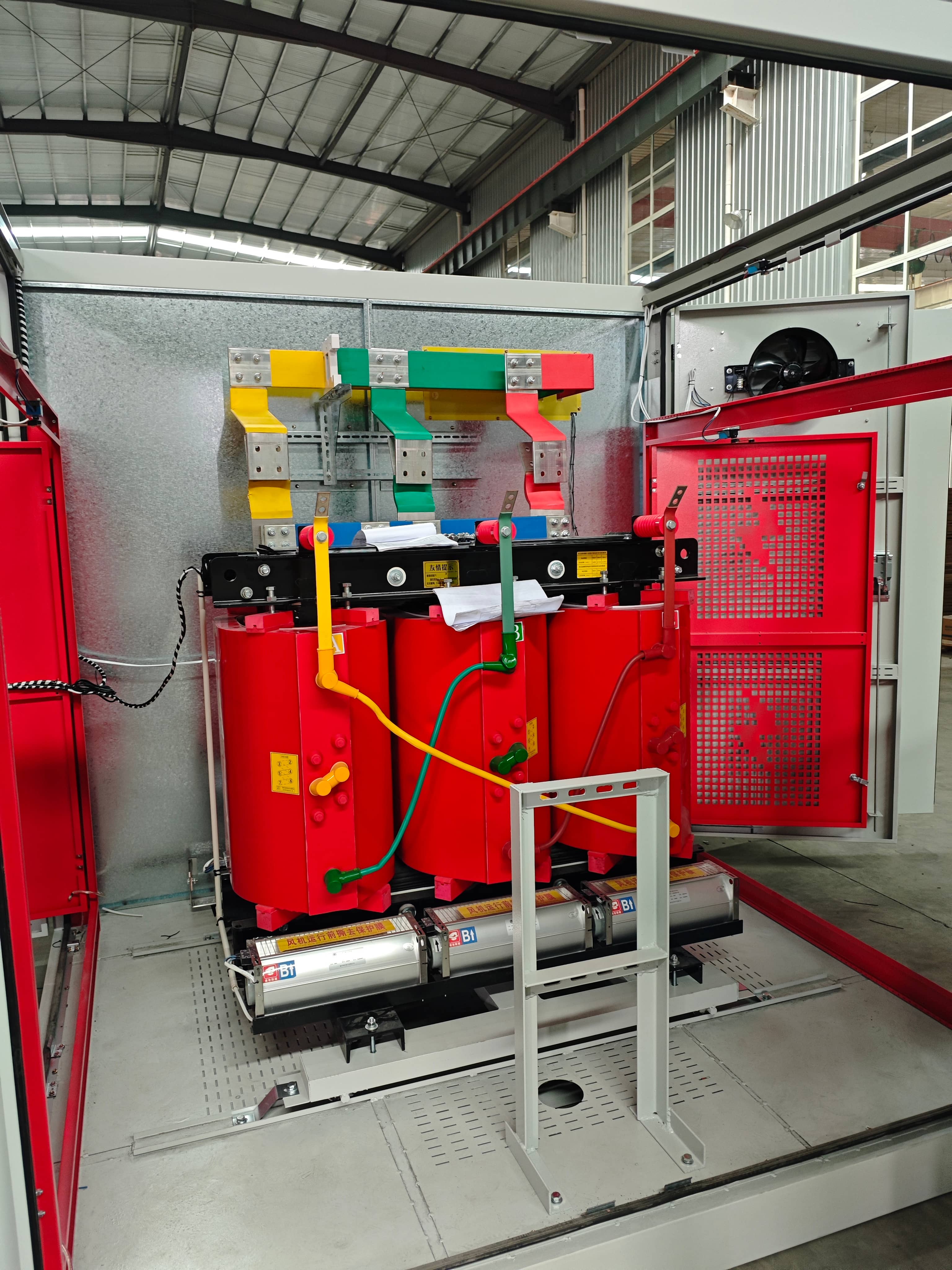
IP20 and IP23 are both common for indoor dry-type units, but they describe different protection against falling water and foreign objects. For outdoor or containerised installations, higher ratings such as IP54 may be specified, and the enclosure then becomes part of the thermal design rather than a cosmetic choice. High-altitude sites and high ambient temperatures change the required creepage and cooling margin; Milestone's dry-type transformer data lists altitude conditions of 1,000 m to 4,000 m, which makes the site condition a selection input rather than a footnote. Cast-resin construction removes insulating oil from the electrical room and changes fire-protection and containment requirements compared with a liquid-filled unit, but it does not remove the need to confirm the installation against local fire and building codes.
Milestone's data center application material describes transformer selection as considering harmonic distortion, load characteristics, temperature rise, losses, ventilation and operating continuity, alongside the oil-free characteristics of cast-resin construction for indoor rooms. Those are selection considerations; the project specification still has to set the limits and define the evidence that demonstrates them.
Third Check: The Factory Acceptance Test
FAT is the last point at which a buyer can see evidence before the unit ships, so it should be defined in the contract rather than left to a standard report template. For a typical distribution or dry-type data center transformer, routine testing before shipment covers winding resistance, voltage ratio, impedance, no-load loss, load loss and dielectric withstand, in line with IEC 60076 requirements and the approved technical specification.
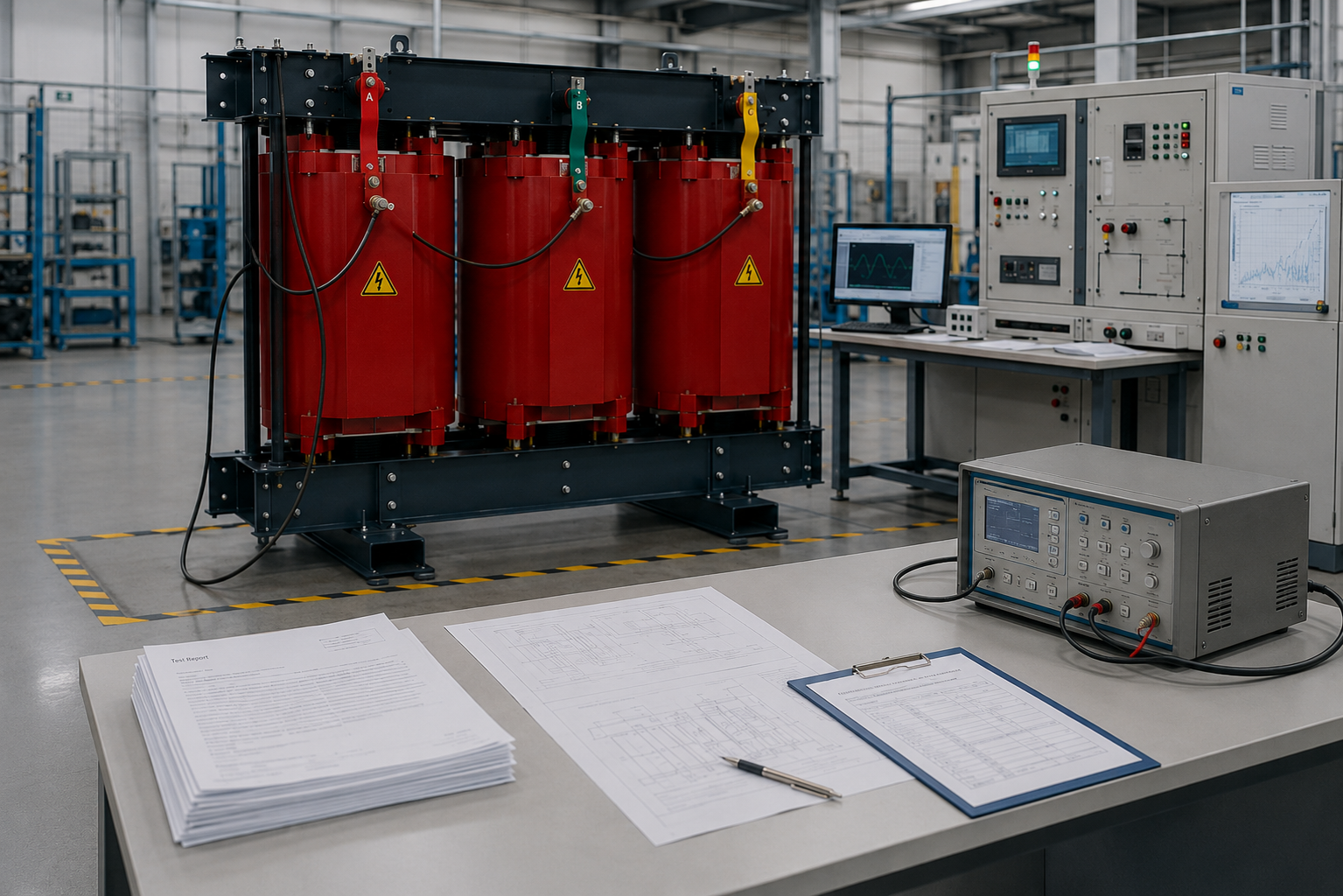
Milestone states that every transformer undergoes routine testing before shipment, and that witnessed factory acceptance testing, type tests and special tests can be arranged to meet project-specific requirements, including third-party inspection. That describes an available scope, not an automatic entitlement on every order; the contract should say which tests are witnessed, at which hold points, and what happens if a result falls outside tolerance.
The review that matters is not whether a report says "pass". It is whether the report belongs to the unit purchased, whether the test scope matches the contract, whether measured values sit inside the guaranteed tolerances, and whether any corrected or missing result is documented. A report with a mismatched serial number, an incomplete test list or an unexplained correction is a qualification finding, not a formality.
Fourth Check: Factory and Engineering Evidence
System certification and product testing sit on top of manufacturing capability. Useful factory evidence includes production equipment relevant to the construction being bought, test facilities matched to the voltage class, and engineering processes that catch specification conflicts before they reach the shop floor.
Milestone operates a 38,000 m² production base with 270 employees, an annual output of 25,000 units and a 30-person engineering team, and exports about 85% of output to markets including South America, the Middle East and Southeast Asia. Its dry-type production includes vacuum resin casting equipment for cast-resin windings, coil winding and core assembly stations, and a test area used for routine electrical tests and factory acceptance testing. The published dry-type range extends to 35 kV, with voltage ratio, cooling, enclosure protection and winding material configured to project requirements. For buyers requiring private-label or custom-ratio supply, the company publishes an OEM/ODM service with a 30–50 day lead time and a one-unit minimum order.
On the engineering side, the company describes technical specification review of RFQs, data sheets, single-line diagrams and tender documents, including clause-by-clause compliance checks, identification of missing data and preparation of deviation lists before quotation. For a data center project, that is where the harmonic spectrum, redundancy architecture, interface details and site conditions should be resolved. A supplier that quotes without asking about load characteristics or installation environment has provided a price, not a qualification.
Project experience is supporting evidence rather than proof of capability. Milestone's data center references include a 10-unit dry-type installation supplied to a project in Ecuador, where the oil-free design avoided transformer-oil handling inside the electrical room and the design review addressed ventilation, heat dissipation, noise, load profile and maintenance access. That is useful context for a buyer assessing fit; it does not replace the type-test and FAT evidence for the specific units on a new order.
A Practical Qualification Matrix
The matrix below separates what each evidence type establishes from what it cannot establish. It is intended to be attached to the inquiry so that every bidder answers the same questions.
| Evidence item | What it establishes | What it does not establish | What to request |
|---|---|---|---|
| ISO 9001 certificate | Documented quality management processes within the certified scope | Performance of a specific model, or conformity to a product standard | Certificate with scope and validity dates, plus the latest audit summary |
| Type test report | Tested performance of an identified design to a named standard | Coverage of a different rating, cooling class, winding or voltage class | Report matching the offered model, rating and standard |
| Market certification (CE, UL, CSA) | Conformity or listing for a defined model scope and market | Product performance, or coverage of models outside the listed scope | Certificate with model list, standards and validity dates |
| FAT report | Measured results for the unit being shipped | Design suitability for harmonic or continuous duty | Unit-specific report with test scope, tolerances and witness record |
| Factory and process evidence | Manufacturing and test capability for the construction offered | Product performance without test evidence | Equipment list, test facility description, project references |
| Application engineering record | Ability to translate duty into a specification | That the resulting design meets that duty | Specification review record and documented harmonic and thermal assessment |
Where Qualification Reviews Go Wrong
Three errors recur. The first is treating a certificate wall as product evidence; the certificates may be genuine and still not cover the offered unit. The second is accepting a type test for a similar model without confirming which parameters changed. The third is comparing quotations prepared on different technical bases, where a lower price can reflect a smaller scope — different impedance, cooling class, test list or documentation package — rather than a better offer.
A fourth error is less obvious: assuming redundancy solves the qualification problem. Tier III or Tier IV redundancy describes an architecture, not a transformer rating. Two transformers do not by themselves create N+1 capability; the remaining unit must be able to carry the specified critical load after one unit is out of service, and the upstream supply, transfer arrangement and protection coordination all form part of that assessment.
A fifth is accepting a market certificate beyond its stated scope. Milestone's ECM certificate, for example, lists specific oil-immersed models. A buyer specifying a cast-resin dry-type unit should confirm whether that product family appears on the certificate, and if not, what conformity route applies in the destination market.
What Buyers Should Expect Next
As data hall designs place more nonlinear load behind the same transformer, and as redundancy requirements become more explicit in specifications, the qualification packet — type tests, harmonic assessment, thermal evidence, FAT scope and documented limits — will carry more weight than the certificate summary. That is a reasonable planning assumption rather than a forecast about any particular market. The practical response is to write the evidence requirements into the specification before quotation, so that all suppliers answer the same questions and the comparison stays technical as well as commercial.
Milestone's own documentation follows that structure: ISO 9001-based quality procedures and 100% routine testing as the baseline, with type tests, special tests and witnessed factory acceptance testing arranged according to project requirements. Buyers should confirm the specific scope that applies to their order rather than inferring it from the file as a whole.
FAQ
What does an ISO 9001 certificate actually verify for a transformer supplier?
It verifies that the supplier operates a quality management system covering the processes and scope named on the certificate, such as design control, purchasing, production, inspection and corrective action. It does not verify the performance of a specific transformer model, the existence of a type test for the offered configuration, or conformity to a product standard such as IEC 60076.
Which standards should a data center transformer comply with?
The applicable standard depends on the market and the project specification. IEC 60076 is widely used for power and distribution transformers, GB/T 1094 is used in China, and UL or CSA requirements often apply in North America. Harmonic capability is commonly assessed using IEEE C57.110. The specification should name the standard, the required tests and the acceptance criteria, because a certificate to one standard does not establish conformity to another.
How can a buyer confirm that a type test report covers the offered transformer?
Compare the report with the offer line by line: model designation, rated capacity, voltage ratio, frequency, vector group, cooling method, winding arrangement and the standard applied. Confirm the issue date, the issuing laboratory and the tested configuration. If any parameter differs materially from the offered unit, ask the supplier to explain the design family relationship or to propose a type-test programme for the actual configuration.
What should be reviewed in a data center transformer FAT report?
Check that the report identifies the correct unit and serial number, that the contracted test scope is complete, and that measured values fall within the guaranteed tolerances. Typical routine tests include winding resistance, voltage ratio, impedance, no-load and load losses, and dielectric withstand. Confirm instrument calibration records, any witness signatures, and the disposition of corrections or nonconformities before shipment release.
How should harmonic loads be handled in transformer selection?
The harmonic spectrum produced by UPS systems, rectifiers and variable-frequency drives should be estimated and provided to the supplier, who can then assess additional losses, hot-spot temperature and any derating. Where a K-rated unit is specified, the K-factor should be stated on the nameplate and supported by design evidence for that spectrum. Selecting a standard transformer on sinusoidal rating alone leaves the harmonic duty unverified.
Does a CE certificate cover dry-type data center transformers?
Only if the models and standards listed on the certificate include them. Milestone's ECM certificate 3N261027.METCQ45, for example, lists oil-immersed transformer models S9, S11, S13, S20, S22, SF11 and SFS11. A buyer specifying a cast-resin dry-type unit should confirm the certificate scope explicitly rather than assuming that a company-level CE document covers every product line.
Project teams preparing a data center transformer inquiry can review the published product range and technical parameters in the Milestone Transformer Catalogue before finalising the specification.
Its website is www.milestonelectric.com
Have Questions or Need More Details?
Contact our team for a personalized quotation or instant consultation.
Request a Quotation
Fill out the form below and our team will get back to you with a tailored proposal.
WhatsApp Direct Chat
Prefer to chat in real-time? Message us on WhatsApp for instant assistance & quick answers.
- Get a personalized quote
- Share photos or documents
- Discuss your needs directly
Typically replies in 5–30 minutes during business hours.