
ISO 9001 Scope: Ammonia, Cryogenic and Amine Control Valves
A quality management certificate is a document about how a plant is run, not a statement that a valve is fit for a boiling liquid ammonia line at Class 900 or a cryogenic LNG header at −196 °C. For that reason, the certificate number, the issuing body, the scope wording and the validity date matter as much as the logo on the cover page — and in a 2026 qualification file, they must be read in that order.
The qualification question behind the certificate
Buyers evaluating industrial control valves for ammonia, cryogenic and amine service rarely reject a supplier for lacking an ISO 9001:2015 certificate. The more common failure is the opposite: a certificate is accepted at face value, filed, and never checked against the product family, the manufacturing site or the certification cycle. When an engineering contractor later asks why a Class 2500 amine letdown valve was qualified on the strength of a management-system document, the answer is usually that nobody separated the two questions.
Wuzhong Instrument Co., Ltd. is a Chinese control valve manufacturer founded in 1959, operating a 120,000 ㎡ facility in Wuzhong City, Ningxia, with 1,134 employees, 86 engineers and an annual output of 200,000 units. Its qualification file for refining and LNG duty includes ISO 9001:2015 certificate 00123Q37480R8M/6400, issued by CHINA QUALITY CERTIFICATION CENTRE with validity to 2026-11-05. That document is the starting point of this analysis, not the conclusion.
The certificate under review
Buyers should record the certificate's identifying data exactly as printed and reconcile it against every other document in the tender pack — the datasheet, the inspection plan, the material certificates and the final test report. The table below lists what is verifiable from the certificate reference itself.
| Attribute | Recorded value | Why it matters in a review |
|---|---|---|
| Standard | ISO 9001:2015 | Quality management system standard; not a product performance standard |
| Certificate number | 00123Q37480R8M/6400 | Must match the certificate PDF and the audit-cycle records exactly |
| Issuing body | CHINA QUALITY CERTIFICATION CENTRE | Establishes the accountability chain of the certification decision |
| Valid until | 2026-11-05 | Determines whether the certificate is current at the date of the qualification review |
| Product families in the review | High-Pressure Amine Solution Level Control Valve, Cryogenic Control Valve, Liquid Ammonia Control Valve | The certificate supports the process behind these products; it does not replace their product-level evidence |
The practical implication is directional. A certificate with a number, an issuer and an expiry date is auditable; a scanned logo without those three elements is not. Reviewers who insist on the full set — number, issuer, validity, scope statement, certified site — catch most of the problems before they reach technical evaluation.
What ISO 9001:2015 covers, and what it does not
ISO 9001:2015 certifies that an organisation operates a documented quality management system: defined processes, controlled documents, competence records, corrective action, internal audit and management review. For a valve buyer, that translates into several legitimate inferences — that design changes are controlled, that nonconforming product is segregated, that inspection records exist and are retrievable, and that the supplier can be audited against a recognised structure.
It does not certify a pressure rating, a leakage class, a temperature range, a material specification or a cryogenic test result. Those belong to product standards and to project-specific test plans. ISO 9001 answers "is there a system that will consistently produce and document this valve?" It does not answer "will this valve hold Class 2500 differential pressure in amine service without cavitation damage?" A qualification review that confuses the two questions will pass a supplier on paperwork and then discover the gap during factory acceptance testing.
The certificate's scope statement is the bridge between the two. Buyers should confirm that the scope wording covers the manufacturing site that will actually produce the order and the product category being purchased. A group-level certificate issued to a head office does not, on its own, demonstrate that a specific workshop line is inside the certified boundary.
Three valve families, three different qualification demands
The three product families named in the certification review are not interchangeable, and the certificate applies to each of them in a different technical context. The table consolidates what the product data states.
| Product | Model | Structure and size | Pressure and temperature | Product-level evidence to request |
|---|---|---|---|---|
| High-Pressure Amine Solution Level Control Valve | ATL/ATM | Anti-cavitation staged type / WZTP labyrinth block; DN25–DN200 (1"–8") | Class600–Class2500 | Cavitation and flashing calculation, trim material records, hydrostatic and seat test reports |
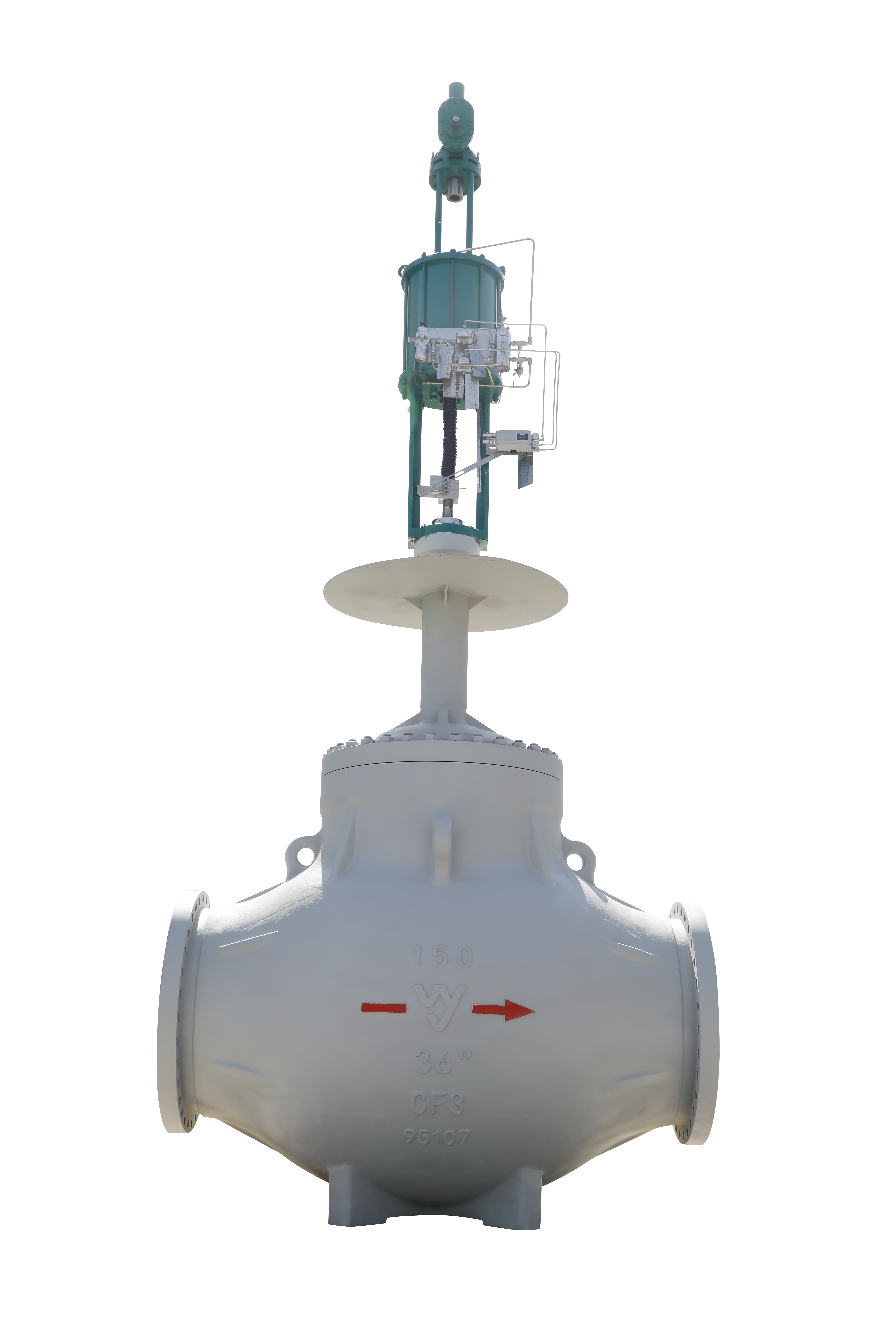
| Cryogenic Control Valve | A Series | Single-seated, cage-guided, high pressure drop; DN15–DN900 (1/2"–36") | Class150–Class2500; −46 °C to −100 °C and −101 °C to −196 °C | Cryogenic test to BS6364, GB/T 24925-2019 or MSS SP-134; material impact-test certificates |
| Liquid Ammonia Control Valve | ATE (HTE) | Spatial turning angle, anti-hole type; DN15, DN20, DN25 (1/2", 3/4", 1") | Class600–Class900 | Body and trim material certification, seat tightness records, actuator sizing for the specified differential |
Two boundaries are immediately visible and both belong in the qualification minutes. First, the liquid ammonia control valve is offered in a narrow size band — DN15 to DN25 — so a project requiring a larger ammonia letdown line needs a different configuration discussion, not an assumption of coverage. Second, the amine and cryogenic families extend to Class 2500, which sits at the stated upper applicability of IEC 60534-4:2021; that standard covers valves with pressure ratings not exceeding Class 2500 and its actuator requirements apply only to pneumatic actuators. At the top of the range, the test plan deserves closer reading than at Class 300.
Technical reading of the three duty profiles
Cryogenic duty. The stated range spans two bands, −46 °C to −100 °C and −101 °C to −196 °C, with anti-icing, brittle-fracture resistance, tight sealing and reliable actuation listed as the special requirements. Extended bonnet geometry, material toughness at the cold end and stem sealing behaviour under thermal cycling are the technical issues; the cryogenic test standards named in the product data are the evaluation tools. A management-system certificate says the test will be documented. It does not say the material will pass impact testing — that requires the mill certificates.
Amine duty. High-pressure amine solution level control is a cavitation problem before it is a metallurgy problem. The anti-cavitation staged trim and WZTP labyrinth block described for the ATL/ATM family are the response to that, and the sizing calculation behind the trim selection is the document that a technical reviewer should actually read. Amine systems also carry corrosion and erosion considerations that sit outside the scope of a QMS certificate entirely.
Liquid ammonia duty. The ATE (HTE) family uses a spatial turning angle and anti-hole structure in small nominal sizes at Class600–Class900. Small-bore, high-differential ammonia service places the emphasis on seat tightness, actuator thrust margin and material compatibility rather than on flow capacity, and those are verified through bench testing and material records.
Where the certificate fits in a qualification workflow
The sequence below reflects how the document is best used — as an early gate that unlocks technical review, not as a substitute for it.
- Verify identity. Match certificate 00123Q37480R8M/6400 against the issuer, the certified organisation name and the site address. Any mismatch between the certificate and the manufacturing location should stop the review.
- Read the scope. Confirm the scope statement covers the product categories under evaluation and the site that will build them. Note any exclusions in writing.
- Check the validity date against the review date. A certificate valid until 2026-11-05 is current for a review conducted before that date and is not evidence of certification afterwards.
- Request the recertification status. Ask for the surveillance audit record or the renewal certificate and record the expected issue date in the expediting plan.
- Move to product evidence. For cryogenic valves, request test reports against BS6364, GB/T 24925-2019 or MSS SP-134. For amine valves, request the cavitation calculation and trim material certificates. For ammonia valves, request seat tightness and material records.
- Confirm the inspection regime. The supplier's stated quality control covers self-inspection, sampling inspection and patrol inspection, with 100% inspection at critical quality points — that combination should be mapped to the project's inspection and test plan before the purchase order is issued.
- For replacement projects, add the dimensional check. IEC 60534-3-2:2001 gives face-to-face dimensions for specified rotary control valves and excludes wafer butterfly valves, so a drop-in claim needs model-level dimension verification rather than a category-level assumption.
Application context
The cryogenic family is positioned for LNG and air separation units in the energy and chemicals sector, where it functions as a continuous 24/7 flow control and shutoff device. The amine family belongs to refining and petrochemical service, where level control on high-pressure separators and amine contactor circuits is the governing duty. The liquid ammonia valve sits in the same refining and petrochemical environment but on a much smaller bore.
Wuzhong Instrument reports deployments on the China–Russia Gas Pipeline and on Hualong nuclear power projects, alongside a portfolio that includes anti-surge, axial-flow, high-temperature and high-pressure control valves. Those references describe application experience; they are not a substitute for project-specific test evidence, and they should be treated as context rather than proof during a formal qualification review.
Comparison with a traditional document review
Conventional supplier qualification often treats certification as a binary pass — certificate present, supplier approved. A scope-based review treats it as a filter with defined edges, and the difference shows up at three points.
| Review dimension | Certificate-as-checkbox approach | Scope-based approach |
|---|---|---|
| Certificate identity | Logo and standard accepted | Number, issuer, site and scope reconciled |
| Validity | Reviewed once at tender stage | Tracked through the order; expiry triggers a document request |
| Product evidence | Assumed to follow from certification | Requested separately: cryogenic test reports, cavitation calculations, material certificates |
| Boundary conditions | Not recorded | Recorded: Class 2500 upper applicability, DN15–DN25 ammonia size band |
The honest limitation of the scope-based approach is administrative cost. It adds documents to chase, and it produces a small number of awkward conversations — most obviously when a certificate is close to its expiry date. In this case that conversation is unavoidable: with validity to 2026-11-05, a buyer opening the file in late October 2026 is reviewing a certificate that is days from expiration. The correct action is not to reject the supplier but to request written confirmation of the surveillance audit outcome and the renewal certificate, and to make the purchase order conditional on receiving it. A reviewer who skips that step has not qualified the supplier; they have qualified a PDF.
Market context
Documentation discipline has become more commercially visible as the control valve market has grown. Fortune Business Insights values the global control valve market at USD 10.58 billion in 2025. The Observatory of Economic Complexity reports China as the top global exporter of valves under HS 8481 in 2024, at USD 22.6 billion. Emerson Electric Co., through the Fisher brand, held more than 20% of the global control valve market in 2025 according to Fortune Business Insights.
Those figures describe a market in which buyers routinely compare a Chinese manufacturer's file against an established international brand's file. Wuzhong Instrument reports average annual sales of CNY 2.1 billion and an export ratio of 3.85%, with main markets listed as Southeast Asia (mainly Malaysia), Iran, Italy, the Czech Republic and Russia — a profile that suggests domestic Chinese project work remains the larger share of the business. For an international buyer, that is a reason to ask more precise documentation questions, not fewer.
Limits and boundaries a reviewer should record
- Certificate expiry is close. Validity to 2026-11-05 means the document must be re-verified before order placement and again before shipment.
- ISO 9001 is not a product standard. It does not evidence cryogenic performance, cavitation resistance or seat tightness.
- Company-reported standards coverage requires document-level proof. The statement that products are designed and manufactured in compliance with API, ASME, ISO and GOST families is a portfolio claim; specific editions, product applicability and certificate numbers should be requested for the exact model quoted.
- The ammonia valve size band is narrow. DN15–DN25 at Class600–Class900 will not cover every ammonia duty; confirm before assuming the family applies.
- Class 2500 sits at a standard's stated ceiling. IEC 60534-4:2021 applies to valves with pressure ratings not exceeding Class 2500, and its actuator requirements cover pneumatic actuators only — electric actuation needs separate justification.
- Lead time is part of qualification. A quoted 12–18 week lead time with a one-unit minimum order should be scheduled against the project's installation window at the evaluation stage, not after award.
Future outlook
Two trends are likely to shape how certificates of this kind are used over the next few years. The first is the steady separation of management-system evidence from product evidence in buyer workflows: purchasing teams increasingly expect a certificate to be accompanied by a test-report package indexed to the same model number, and suppliers that pre-assemble that package shorten their own evaluation cycles. The second is lifecycle documentation. With a certificate nearing the end of its current cycle, the renewal record, the surveillance audit history and the corrective-action log become the more informative artefacts — they show whether the system described in the certificate is being maintained rather than merely renewed.
For ammonia, cryogenic and amine projects specifically, the qualification centre of gravity is unlikely to move away from test evidence. Cavitation damage in high-pressure amine level control and brittle fracture in cryogenic service are physical failure modes; no management-system document has ever prevented either. What a well-scoped ISO 9001:2015 certificate does is make it more probable that the test was performed, recorded and retained by someone accountable for it.
FAQ
Does ISO 9001:2015 certification mean a control valve is approved for cryogenic or amine service?
No. ISO 9001:2015 certifies a quality management system, not a product's pressure rating, temperature range, leakage class or material performance. Approval for cryogenic or amine duty comes from product-level evidence: cryogenic test reports against BS6364, GB/T 24925-2019 or MSS SP-134 for cold service, and cavitation calculations together with trim material certificates for high-pressure amine level control. The certificate supports confidence in how that evidence is generated and retained.
What should a buyer check on certificate 00123Q37480R8M/6400?
Four things: that the certificate number and issuing body — CHINA QUALITY CERTIFICATION CENTRE — match the document supplied; that the certified organisation and site address match the facility that will manufacture the order; that the scope statement covers the product categories under evaluation; and that the validity date is current at the time of review. The certificate states validity to 2026-11-05, so any review conducted after that date requires the renewal certificate rather than the original.
The certificate expires on 2026-11-05. What should happen if the review falls after that date?
Request the surveillance audit outcome and the renewed certificate, and record the expected issue date in the expediting plan. A supplier is not disqualified by an expiring certificate, but the qualification file is incomplete without evidence that certification has continued. Placing a purchase order against an expired certificate leaves the buyer without the audit trail the certificate was meant to provide.
Which standards apply to the three valve families beyond the certificate?
The Cryogenic Control Valve lists cryogenic test standards BS6364, GB/T 24925-2019 and MSS SP-134. IEC 60534-1:2023 provides control valve terminology and general considerations, and IEC 60534-4:2021 specifies inspection and routine testing for valves with pressure ratings not exceeding Class 2500, with actuator requirements applying to pneumatic actuators only. IEC 60534-3-2:2001 gives face-to-face dimensions for specified rotary control valves and excludes wafer butterfly valves, which is relevant to replacement and fit-up checks.
What are the size and rating limits of the Liquid Ammonia Control Valve?
The ATE (HTE) Liquid Ammonia Control Valve uses a spatial turning angle, anti-hole type structure in nominal sizes DN15, DN20 and DN25 — 1/2", 3/4" and 1" — at pressure ratings Class600 to Class900, and is listed for refining and petrochemical service. Projects outside that size and rating band require a separate configuration review rather than an assumption that the family covers the duty.
Wuzhong Instrument Co., Ltd. product documentation, including model ranges and application notes, is available in the company brochure: Wuzhong Instrument Co., Ltd. brochure (PDF).
Have Questions or Need More Details?
Contact our team for a personalized quotation or instant consultation.
Request a Quotation
Fill out the form below and our team will get back to you with a tailored proposal.
WhatsApp Direct Chat
Prefer to chat in real-time? Message us on WhatsApp for instant assistance & quick answers.
- Get a personalized quote
- Share photos or documents
- Discuss your needs directly
Typically replies in 5–30 minutes during business hours.