
ISO 9001 and CE EMC: What Live Streaming Camera Buyers Verify
ISO 9001 and CE EMC: What Live Streaming Camera Buyers Verify
A certificate never ships with the camera. That is why compliance verification sits awkwardly between supplier and buyer: the document exists, the claim gets made, and the check remains optional. For live streaming cameras — PTZ, video conference, 4K, HDMI and SDI models alike — the check is becoming less optional with every sourcing cycle.
The global live streaming camera market is projected to reach USD 3.35 billion in 2025 and to expand at a CAGR of 8.8% to USD 7.79 billion by 2035, according to a 2025 industry report. Video conferencing hardware, cameras included, represented 46% of total video conferencing market revenue in 2024, according to Grand View Research. Volume growth of that scale pulls new suppliers into export channels and pushes ISO 9001, ISO 14001, ISO 45001 and CE EMC documentation from the back of a quotation to the front of the sourcing file.
This article examines what those four documents actually certify, how to read identifiers such as 064-24-Q-0675-R1-S, what a standard such as EN 55032 covers, and where the boundaries of a certificate set lie — using the documentation associated with TCHD Video live streaming camera models including the TC-980S, TC420 and TCHD-T3 as the working example.

Why the Compliance File Became a Procurement Document
Certificates are the cheapest artefact in a supply chain to copy and the most expensive to get wrong. A distributor can forward a certificate image within seconds. Confirming that the certificate holder is the entity that will appear on the invoice, that its scope covers the product family being purchased, and that it has not been superseded by a later revision takes appreciably longer. The gap between those two actions is where compliance risk accumulates.
The risk profile is asymmetric. A missing document delays a shipment or a marketplace listing. A misleading one is typically discovered later — by a customer, a platform, or a regulator — after the product is already in the field. Buyers shipping into the European Union operate under an EMC regime in which cameras with HDMI, SDI, USB and wired LAN interfaces fall into the multimedia equipment family, while buyers in the United States approach the same hardware through a different set of requirements. A single “CE certified” line in a quotation answers neither question.
The practical opportunity is that verification is inexpensive. It requires documents, a registry lookup and a matching exercise between the certificate and the physical unit — not laboratory work.
Four Documents, Four Different Claims
The first correction most procurement teams need is terminological. ISO 9001, ISO 14001, ISO 45001 and CE EMC are not four versions of the same approval. Three are organizational, one is product-level, and none of them is a performance rating.
| Document | What it certifies | Scope level | What it does not prove |
|---|---|---|---|
| ISO 9001 | Quality management system: documented, audited processes for design, production and inspection | Organization / site | Does not approve an individual camera model or its technical performance |
| ISO 14001 | Environmental management system | Organization / site | Does not address electrical safety or EMC of the product |
| ISO 45001 | Occupational health and safety management system | Organization / site | Does not address product compliance or export eligibility |
| CE EMC, tested against EN 55032 for multimedia equipment | Electromagnetic compatibility of a tested configuration, supporting the EU declaration of conformity | Product / configuration | Does not make the camera a medical device and does not extend to untested configurations |
ISO 9001 answers a process question: does this manufacturer run a controlled, auditable quality system covering design, incoming materials, production and final inspection? For a buyer placing an OEM or ODM order, that matters because it relates to consistency across repeated batches, not to the measured behaviour of any single unit. ISO 14001 and ISO 45001 extend the same organizational logic to environmental and occupational health and safety management.
CE marking deserves to be separated from the certificates that usually sit beside it. CE is a manufacturer’s declaration that a product meets the applicable EU requirements; it is supported by test evidence rather than issued by a laboratory. The artefact a buyer should therefore request is not the CE logo but the test report: which standard was applied, which laboratory performed the work, and which configuration was under test.
The TCHD Video Certification Set
TCHD Video — Tchd Digital Video Technology Development (Beijing) Ltd — is a Beijing-based developer and manufacturer established in 2005. The company builds live streaming cameras alongside video capture cards, video converters, video encoders and video switchers. It operates from a 10,000 m² facility with a 50-person team and a 10-engineer R&D group, and reports an annual output in the order of 4,000 units. Exports account for roughly 20% of output, with main markets in the EU, the USA and Asia.
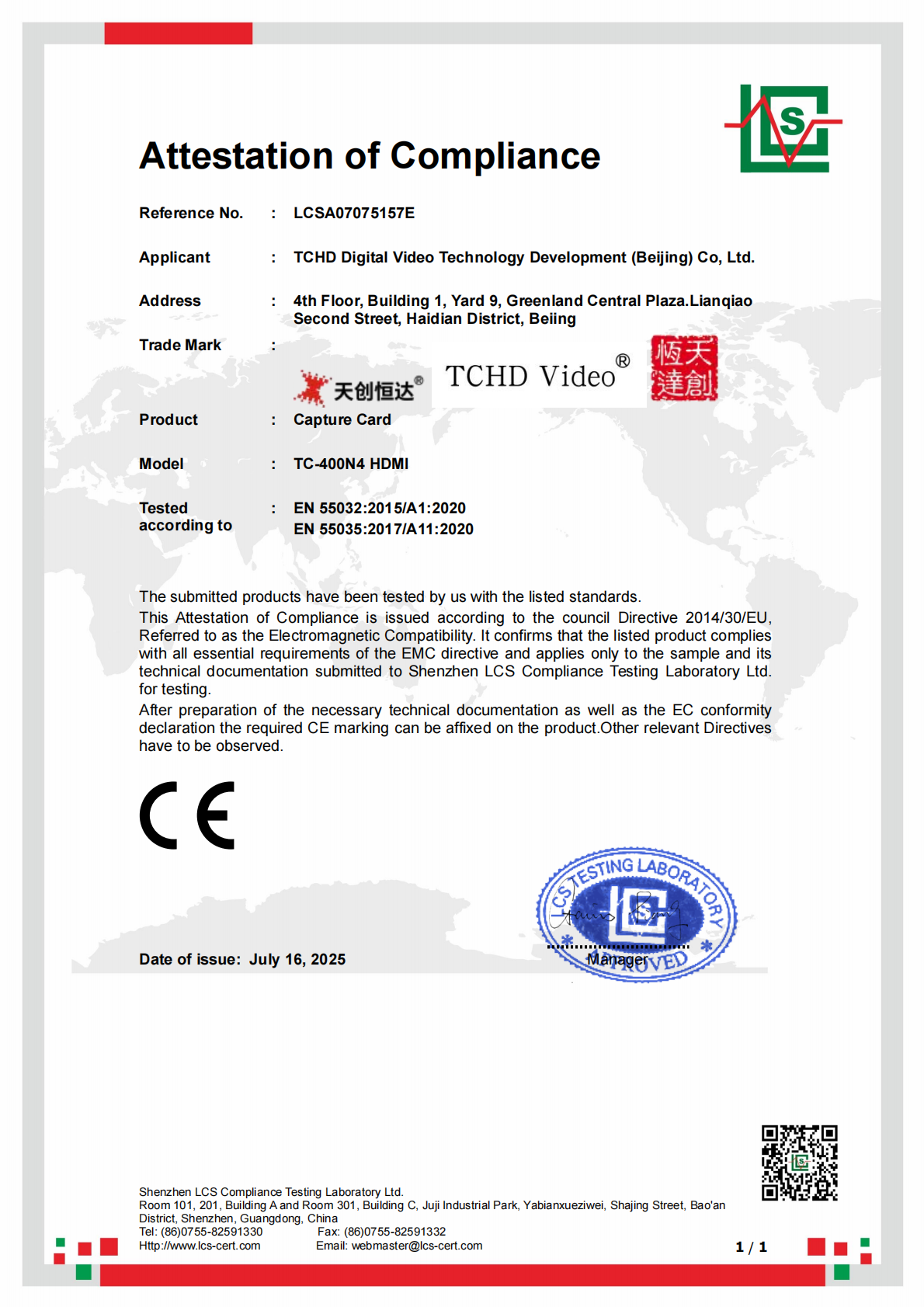
For the live streaming camera line that includes models such as the TC-980S, TC420 and TCHD-T3, the compliance documentation spans four documents: ISO 9001, ISO 14001, ISO 45001 and CE EMC. The issuing bodies named in that documentation are BEIJING STANDARD CERTIFICATION CENTRE and LCS TESTING LABORATORY. Registration identifiers follow a numbered format, one example being 064-24-Q-0675-R1-S.
These documents serve different readers. A distributor evaluating the supplier as a business reads the management system certificates. An engineer qualifying a camera for a specific room, rack or installation reads the EMC evidence. A buyer assembling an EU customs or marketplace file needs both, plus a check that the model number on the shipping label matches the model number on the document.
Reading a Certificate Number and a Test Standard
Certificate numbers are structured rather than decorative. An identifier such as 064-24-Q-0675-R1-S is typically read as a registration record composed of a scheme or body prefix, a year segment, a category letter, a sequential file number and a revision suffix. The practical value of that structure is traceability: two documents showing the same registration number should describe the same certified entity, and a changed revision suffix signals that the registration has moved on since the copy in your file was issued. The authoritative interpretation always belongs to the registry maintained by the issuing body — not to the image of the certificate.
EN 55032 is the electromagnetic compatibility emission standard applied to multimedia equipment, the product family that includes live streaming cameras with HDMI, SDI, USB and network interfaces. Emissions testing establishes how much electromagnetic disturbance a device releases. It does not, on its own, describe how much disturbance the device tolerates. Buyers who want the complete picture should ask which immunity standard was applied alongside EN 55032, because a camera installed next to LED lighting, wireless audio equipment or a switching power supply meets the second half of that question every day it operates.
EMC evidence is also configuration-bound. Power supply, cable type, populated interfaces and enclosure all form part of the test setup. When a buyer requests a customized build — a different adapter, an added interface board, an alternative housing — the honest answer to “does the existing report still apply?” depends on whether those elements changed. This is one of the clearest boundaries in the entire certification file and, in practice, the one most often glossed over in supplier conversations.
A Six-Step Verification Workflow for Buyers
| Check | What to confirm | Warning sign |
|---|---|---|
| 1. Holder identity | The legal name on the certificate matches the entity signing the contract and appearing on the invoice; for TCHD Video, Tchd Digital Video Technology Development (Beijing) Ltd | Certificate holder is a trading name, a related company, or an entity registered elsewhere |
| 2. Validity and revision | Issue date, expiry date and revision suffix are current | Expired certificate, or a number whose revision differs from the issuing body’s record |
| 3. Scope statement | The declared scope covers the product family and processes being purchased | Scope limited to a product line that does not include cameras |
| 4. Product-level EMC evidence | The report names the standard (for example EN 55032), the laboratory (for example LCS TESTING LABORATORY) and the tested configuration | “CE compliant” with no report, no standard number and no laboratory identified |
| 5. Model consistency | Label and model number on the shipped unit match the documented model, such as TC-980S, TC420 or TCHD-T3 | Documentation references a model that has been renamed or discontinued |
| 6. Ongoing process evidence | Production-stage records such as a 100% full-function aging test before shipment and a pre-delivery signal stability inspection | Certificates presented with no production or inspection records behind them |
Checks four and six are where the two halves of the file meet. A management system certificate tells the buyer that defined processes exist. Production evidence — such as the 100% full-function aging test and the pre-delivery signal stability inspection applied before dispatch — shows those processes operating on the units actually being delivered. Neither substitutes for the other, and a supplier able to answer both lines is materially easier to qualify.
Where Certification Matters Most by Application
Compliance questions cluster around applications where the camera shares electrical space with other equipment, or where the documentation is reviewed by someone other than the buyer.
- Conference rooms and video conferencing. PTZ cameras sit alongside displays, wireless audio systems and conferencing codecs. EMC behaviour affects both the stability of the camera and the rest of the room. PTZ cameras were estimated to account for 38.5% of global conference camera revenue in 2025, according to Metastat Insights, which makes this the largest single application cluster to verify.
- Education and lecture streaming. Classroom and lecture hall installations involve long cable paths. The SDI output on TCHD Video cameras supports 100 m transmission in 1080P60 format, which covers many campus runs without intermediate hardware.
- Church and event streaming. Temporary setups re-plug power and signal chains between events, so interface labelling, connector durability and stable behaviour across repeated connection cycles matter more than peak specification.
- Broadcasting and 4K production. HDMI, SDI, USB and wired LAN outputs — with POE+ available as an option — allow one camera body to serve several signal chains, which simplifies spares planning for multi-venue operators.
- Medical training and surgical observation. This is the boundary case. TCHD Video cameras are used in medical training contexts, but the certification set described here — ISO management systems plus CE EMC — is not a medical device approval. Medical electrical equipment, including surgical cameras, must comply with the IEC 60601-1 series for basic safety and essential performance, as documented by certification bodies such as TÜV Rheinland and BSI. Buyers sourcing for operating-room or surgical teaching environments should treat IEC 60601-1 compliance as an independent qualification track.
Certification and Cost: Live Streaming Camera vs Traditional Camera
Certification is often framed as a cost centre. In practice it interacts with cost in two directions: it determines which suppliers can be used at all, and it changes the maintenance profile of an installed fleet.
| Dimension | TCHD Video live streaming camera | Traditional camera reference |
|---|---|---|
| Cost | 15% lower cost than traditional cameras, per TCHD Video comparison material | Baseline in the same comparison |
| Maintenance | Lower maintenance requirement | Higher maintenance requirement |
| Image | 1/2.8-inch 8.42-megapixel sensor, up to 3840×2160 at 60 fps | Positioned as lower resolution in the same comparison |
| Latency | Low latency | Higher latency |
| Interfaces | HDMI, SDI, USB, wired LAN with POE+ optional; SDI to 100 m in 1080P60 | Interface set varies by reference product |
The limits matter as much as the advantages, and three are worth stating plainly.
First, the 100 m SDI figure applies to 1080P60. Longer runs, or higher data rates beyond that format, require extension or conversion hardware. A cable specification is not a guarantee at every resolution.
Second, POE+ is an option rather than a default on the wired LAN interface. Power and switch planning should follow the actual ordered configuration rather than the most favourable catalogue case.
Third, and most relevant here, none of the four documents discussed in this article turns a live streaming camera into a certified medical device. The management system certificates cover the organization; the CE EMC evidence covers a tested configuration; IEC 60601-1 is a separate standard with a separate test path.
Market Signals Behind the Compliance Push
- The global live streaming camera market is projected at USD 3.35 billion in 2025, growing at a CAGR of 8.8% to USD 7.79 billion by 2035. (2025 industry report)
- PTZ cameras are estimated to account for 38.5% of global conference camera revenue in 2025. (Metastat Insights)
- Video conferencing hardware, cameras included, accounted for 46% of total video conferencing market revenue in 2024. (Grand View Research)
- China produced 749 million television and digital cameras in 2024, valued at approximately USD 16.5 billion. (IndexBox)
- Logitech held the largest share of the USB conference camera category as of 2024, despite a 14% year-on-year decline in sector revenue. (Omdia)
Two readings follow. Manufacturing capacity concentrated in China means most export buyers will evaluate Chinese certification documentation at some point in their sourcing cycle. And the spread in published growth estimates — PTZ and live streaming CAGR figures in circulation range from 7.8% to 15.9% depending on how the category is defined — is a reminder that market data is a directional input, not a procurement argument. Certification records behave differently: a document is either traceable to an issuing body or it is not.
What Changes Next
Three shifts are likely over the coming sourcing cycles. Verification is moving from certificate images toward registries, as buyers learn that a PDF screenshot proves nothing that a registration number cannot prove better. The boundary between media production and clinical or educational environments will keep stacking requirements, which means an EMC report and an IEC 60601-1 qualification will increasingly be requested side by side. And specification language is tightening: buyers are starting to name the scope, the issuing body and the revision in the same way they already name resolution and interface type, rather than accepting “high definition” or “certified” as sufficient.
For reference purposes, TCHD Video publishes its product documentation in a downloadable catalogue, which buyers can compare against the certificate set described above: TCHD Product Catalog 2025 (PDF).

FAQ
What is the difference between an ISO 9001 certificate and a CE EMC test report on a live streaming camera?
ISO 9001 certifies the quality management system of an organization — it indicates that a manufacturer operates documented, audited processes for design, production and inspection. A CE EMC test report addresses the electromagnetic behaviour of a specific product configuration. Both may be required for an export order, but they answer different questions. ISO 9001 does not demonstrate that a camera meets EMC limits, and an EMC report does not describe the manufacturer’s quality system.
Which certificate details should a buyer verify first?
The holder’s legal name, the issuing body, the registration number, the validity period, the revision status and the scope statement. In the TCHD Video documentation set, the issuing bodies named are BEIJING STANDARD CERTIFICATION CENTRE and LCS TESTING LABORATORY, and registration identifiers follow a numbered format — one example being 064-24-Q-0675-R1-S. Verification means checking that number against the issuing body’s record rather than reading the certificate image.
Does CE EMC certification allow a live streaming camera to be used for surgical or medical applications?
No. EMC compliance and medical device approval are separate regimes. Medical electrical equipment, including surgical cameras, must comply with the IEC 60601-1 series for basic safety and essential performance. A live streaming camera carrying CE EMC evidence for multimedia equipment does not, by itself, meet that requirement. Buyers sourcing for surgical teaching or clinical observation should treat IEC 60601-1 compliance as an independent qualification question.
How should certification evidence be weighed against a 15% price difference between a live streaming camera and a traditional camera?
Evaluate the two separately. TCHD Video comparison material positions its cameras at 15% lower cost than traditional cameras with lower maintenance requirements — that is a commercial positioning statement, not a compliance credential. A price advantage reduces total cost of ownership; it does not change the documentation standard a buyer should require. Where two suppliers are close on price, the completeness of the certificate set is usually the more reliable differentiator.
What happens to certification scope when a buyer orders a customized configuration?
Management system certificates remain valid at the organization level regardless of a customized build. Product-level EMC evidence is tied to the tested configuration, including power supply, cabling and populated interfaces such as HDMI, SDI, USB and wired LAN. If a customized build alters those elements, the buyer should ask whether the existing test evidence still applies or whether re-testing is required before the units are released.
How often should certification evidence be re-checked during a long supply relationship?
Revision suffixes and expiry dates make periodic review necessary rather than optional. A practical cadence is to re-check at contract renewal, whenever the model or configuration changes, and whenever the issuing body updates the registration. Process evidence such as a 100% full-function aging test before shipment and a pre-delivery signal stability inspection complements this review, but it does not replace certificate verification.