
ISO 9001 and ECM: What Diamond Sanding Belt Paperwork Proves
ISO 9001 and ECM: What Diamond Sanding Belt Paperwork Proves
A diamond sanding belt file that arrives with a certificate logo on its cover usually contains three different kinds of document, and each one answers a different question. A quality management system certificate — ISO 9001 is the one buyers ask for most often — describes how an organisation controls its processes. A product conformity certificate describes one product family, against one standard, for one market, for a stated period. A batch record describes what was actually measured on the goods in the box. When a buyer lets any one of these stand in for the other two, the file looks complete while the commercial risk stays exactly where it was.
Zhengzhou Ruite Diamond Belts Co., Ltd. is a workable case for reading such a file line by line. The company reports that it was established in 2003, operates a 500 m² facility with 45 employees and five engineers, produces about 100,000 units a year and exports roughly 70% of its output to the EU and the USA. Its qualification record also includes an ECM certificate, No. 0P210906.ZRDQ038, issued for a product that is not a belt. That single detail is the most instructive thing in the pack, because it demonstrates why the scope line, rather than the logo, is what a procurement team should read first.
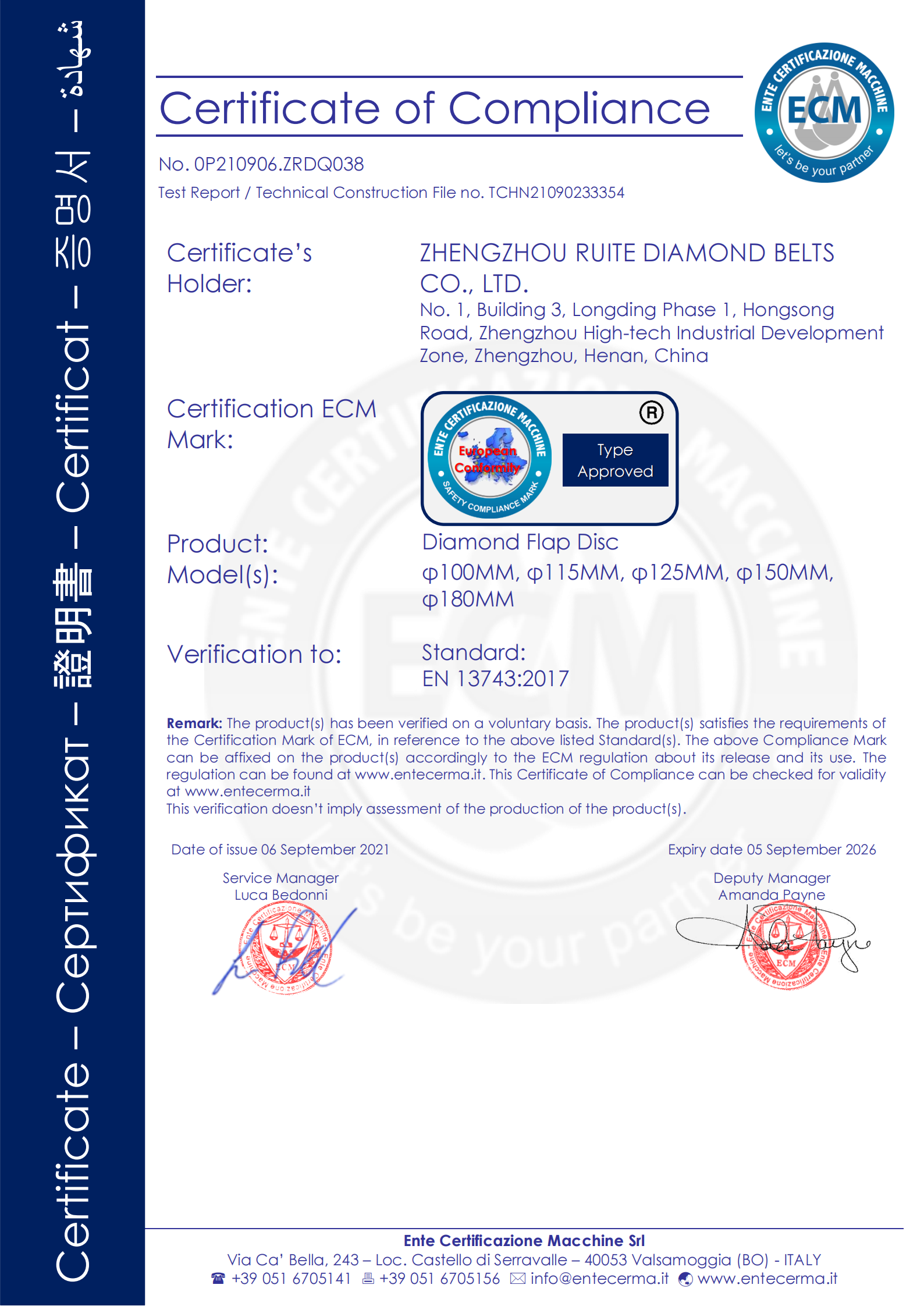
A certificate of conformity is a scoped document: it names a product, a standard, a market and a validity period. The scope line decides which products it speaks for.
Three documents, three questions, one file
The first step in reading a qualification pack is to assign every document to the question it can actually answer, and to note what remains unanswered afterwards. Most disputes over supplier compliance come from a document being credited with more reach than its scope allows, not from a document being missing.
| Document type | Question it answers | What it does not establish | What to request alongside |
|---|---|---|---|
| Quality management system certificate (for example ISO 9001) | Whether the organisation runs a documented, audited quality management system, within a defined scope and validity window | That a specified belt meets a technical specification, or that a particular batch was inspected | The certificate with its scope statement, plus the batch inspection record the system is supposed to generate |
| Product conformity certificate (ECM, EN 13743:2017) | That the named product, in the named configuration, was assessed against the named standard for the named market | That other products from the same factory — including the belt range — are covered | The scope line, the current validity status, and any renewal or re-issued document |
| Process and batch evidence (100% testing, pre-shipment procedures, sample validation, specification sign-off) | What was checked on your order, against which criteria, and with what result | Independent data on removal rate, surface finish or belt life under your operating conditions | Test parameters, acceptance criteria, the signatory, and the record that travels with the shipment |
The three rows are different kinds of claim. Only the third is specific to the goods on your pallet. The first two are statements about an organisation and about a product family, and both remain true whether or not your order was produced well.
What an ISO 9001 certificate does and does not certify
ISO 9001 is a management system standard. Certification is issued to an organisation — normally for a defined scope covering specific sites and activities — by a certification body, after an audit of documented processes, and it carries a validity period. What the certificate attests is that the organisation maintains a documented system for consistent output, monitoring, corrective action and improvement. What it does not do is certify a belt's dimensions, joint strength, grit distribution, backing or finished edge.
For a buyer, that distinction has a practical consequence. A 100% inspection claim is a process claim, and a certified system is what turns it from a sentence in a brochure into a documented expectation that should leave a record behind. The certificate does not prove that your batch was tested. It establishes that the process which generates the test record is defined, auditable and subject to internal review. The artifact you actually want is the record.
Four fields to read before accepting a system certificate
- Issuing body and certificate number. These allow the document to be checked at source rather than accepted as an image.
- Standard and version. A certificate written against an older edition tells you the audit reference point, not necessarily the current one.
- Validity window. Issue and expiry dates determine whether you are citing a live document or a historical one.
- Scope statement. Which legal entity, which manufacturing site, which product categories. A certificate covering one site or one product group does not automatically extend to another.
The ECM certificate: read the scope line before the logo
The ECM document in this supplier's record is specific. It carries certificate number No. 0P210906.ZRDQ038, is issued by ECM Certification Machine Srl, cites standard EN 13743:2017 and is recorded as valid for the EU market. Its scope is the Diamond Flap disc, product code 5282, in diameters of φ100 mm, φ115 mm, φ125 mm, φ150 mm and φ180 mm. The record shows an issue date of 6 September 2021 and an expiry date of 5 September 2026.
That is a strong document for the flap disc range. It is not a document about diamond sanding belts, and the mismatch is visible in the way the two products are specified. A flap disc is described by diameter; a belt is described by width from 5 mm to 350 mm, length from 150 mm to 5000 mm and grit from 40# to 5000#, in diamond or CBN, with further variables such as resin bond or electroplated construction and dry or wet use. A scope written in disc diameters does not describe a belt, and no amount of cross-referencing turns it into one.
The buying consequence is direct. If the ECM number is quoted in a belt purchase order, an EU tender response or a customs file, the buyer is citing a document whose scope line does not name the product being bought. The correct question is therefore not whether the supplier is certified, but whether this product, in this configuration, falls inside the scope of a certificate that is current.
Why the standard number alone is not enough
EN 13743:2017 is the standard named on this certificate, and that reference should match whatever your own market-access route requires. Standards are also market-specific, which is why a single EU document cannot be presented as global compliance. In North America, the safety reference recorded in the verified data behind this article is ANSI B7.7-2003, Safety Requirements for Abrading Materials with Coated Abrasive Systems. Two markets, two document regimes — and in both cases the scope line, not the standard number by itself, tells you which products are addressed.
Dates, renewal and the difference between held and current
A certificate is a lease, not a deed. The record for No. 0P210906.ZRDQ038 shows an issue date of 6 September 2021 and an expiry date of 5 September 2026, so any buyer relying on it should confirm the current status of the document before it is quoted in a shipment or a tender, and should ask for the renewal or re-issued certificate if the validity period has moved on. Timing matters here: a compliance problem discovered at the port costs far more than the same question asked at the quotation stage.
Two further checks are worth building into the file. First, renewal is a new assessment, so a renewed certificate should be read again rather than assumed to carry the identical scope. Second, the pack should show version control: a superseded document sitting unmarked beside its replacement is a documentation risk in its own right, because the wrong one eventually gets forwarded.
What 100% testing actually claims
In this supplier's capability record, quality control is stated as 100% testing, alongside OEM production, customisation of packing and logo, a monthly capacity of 1,000 units, a lead time of 30–45 days and a minimum order quantity of 50 units. The distinction that matters commercially is between coverage and performance. A 100% testing statement is a coverage claim: it says every unit passed through an inspection step. It does not, by itself, say what the step measured, against what tolerance, with what instrument, or what happens to a unit that fails.
A belt inspection step becomes assessable only when it names the characteristics. Dimension and circumference, joint integrity, coating uniformity across the working face, backing condition and edge finish are all checkable items; each one needs a criterion before a pass or fail means anything. This is where the application record earns its place in the file: the same record notes that precise control of speed, pressure and time is required to reach consistent results and service life, which means a test protocol is only meaningful when it reflects the intended operating mode — handheld power tool use with intermittent operation, or a stationary belt grinding machine running continuously.
The acceptance route: three gates before shipment
Acceptance in this supplier's model runs through pre-shipment test procedures, customer confirmation of technical specifications and sample validation. Read as a sequence rather than a list, these are three gates, and each one should produce a document.
- Sample validation. A physical trial on your material and your machine, judged against characteristics you named in advance — fit, joint behaviour, edge condition, finish at the target grit. Record the operating parameters used, because a sample approved at one pressure and speed is not automatically approved at another. Note that a 30–45 day lead time means a failed first sample costs a full production cycle, which is the commercial reason sample validation belongs before the order, not after it.
- Specification confirmation. Written sign-off on width, length, grit, bond type, dry or wet use, and any packing or logo customisation. This is the step that converts an enquiry into a specification. Without it, the specification is whatever was shipped last time.
- Pre-shipment test. The batch check before dispatch. The buyer should know which characteristics are covered, whether coverage is full or sampled, who signs the result, and which document travels with the consignment. A test that produces no record is indistinguishable from no test at all once the goods are in transit.
After-sales terms as qualification evidence
The after-sales terms recorded for this supplier are a 12-month shelf life quality warranty, free technical consultation and replacement for defective batches. These are three different commitments and each needs a trigger definition before it can be relied on in a purchase decision.
For the shelf life warranty, confirm when the 12 months start — production date or delivery date — and what storage conditions preserve the claim, since coated abrasive products are sensitive to humidity and the warranty clock is only meaningful alongside a storage specification. For replacement of defective batches, confirm what counts as a defective batch, who determines it, what evidence is required (retained samples, photographs, test data) and whether the remedy is replacement or credit. For free technical consultation, the useful question is what it covers: bond and grit selection, machine parameter advice, or troubleshooting on an existing process.
It is worth being precise about what the relationship record does and does not show. The supplier's case material documents an OEM relationship in ceramic grinding with an Italian customer, running for eight years across 20,000 units and recorded as stable quality with no customer complaints. That case is tied to the Diamond Flap disc, product 5282 — the same product the ECM certificate covers. It is credible evidence of relationship continuity for the product it names; it is not a belt performance claim, and reading it as one would repeat exactly the scope error this article is about.
Matching the belt range to the application before acceptance
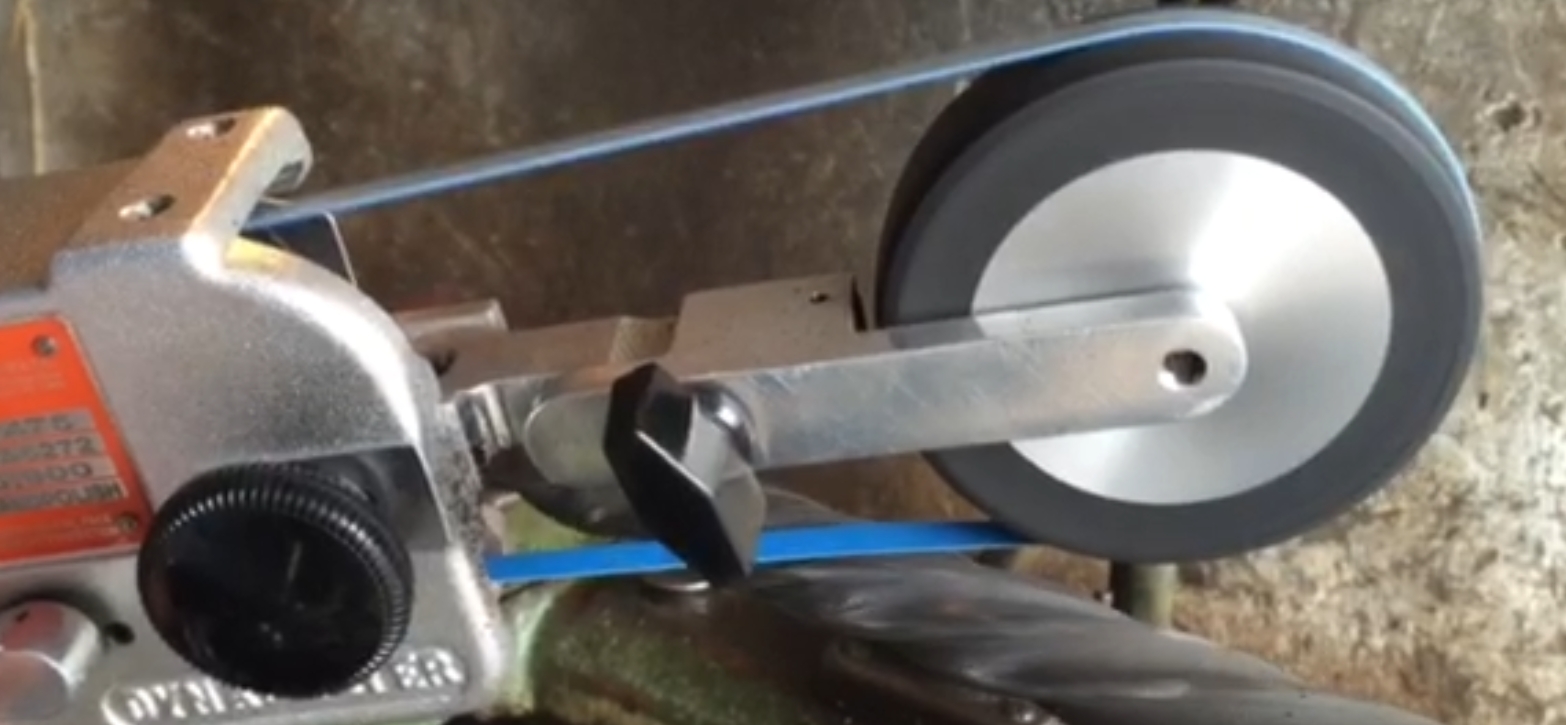
Application fit is decided before the document conversation: material, grit range, bond type and operating mode define what acceptance has to test.
The belt range itself is specified for grinding and polishing hard brittle materials, including glass, stone, ceramics, monocrystalline and polycrystalline silicon, synthetic materials and cemented carbide, with named industry use in glass, stone, thermal spray coating, wind power, porcelain, aeronautics and astronautics, and carbide tool sharpening. The recorded applications cover deburring carbide parts, polishing composite materials, grinding ceramic tiles, polishing glass edges, sharpening carbide tools and grinding high-temperature alloys, with customisation available to customer requirements.
The application record also fixes the operating envelope: dry and wet abrasive grinding, high friction, normal ambient temperature, with matched equipment including glass process systems and sanders. Those conditions are what a specification should be written against, and they are the reason the certificate conversation comes second. Scope questions are meaningless until the buyer knows which product and configuration is being purchased; conversely, a perfectly scoped certificate for the wrong bond type and grit range solves nothing.
A document checklist for the belt file
- System certificate with scope statement, number, issuing body and validity dates — confirm which site and product categories are covered.
- Product conformity certificate, if one exists for the belt range, with its scope line read word by word rather than assumed.
- Written confirmation of the belt specification: width, length, grit, bond type, dry or wet use, packing and logo requirements.
- Sample validation record including the operating parameters used during the trial.
- Pre-shipment test procedure naming the characteristics checked and the acceptance criteria.
- Named signatory for the pre-shipment result, and the document that accompanies the shipment.
- Definition of a defective batch and the evidence required to support a claim.
- Shelf life start date and the storage conditions the warranty assumes.
- Statement of what the free technical consultation covers.
- Version status of every certificate in the pack, so superseded documents are marked as such.
What a well-read file looks like
A qualification pack is not stronger because it is thicker. It is stronger when each document is attached to the claim it can support: the system certificate to process control, the product certificate to the product family it names, the batch record to the goods being shipped, and the after-sales terms to the remedy available if something goes wrong. In this file, the belt question is answered by testing and specification evidence, while the ECM certificate answers a question about the Diamond Flap disc.
That reading method does not change as documentation requirements grow; it simply gets applied more often. Buyers who adopt it early stop treating certification logos as a proxy for product conformance, and start asking suppliers for the two things that actually settle a purchase decision — a scope line that names the product, and a test record that names the batch. Zhengzhou Ruite Diamond Belts Co., Ltd. publishes its product range and company details at www.ruitechn.com, and a consolidated specification reference is available in the company catalogue: download the catalogue (PDF).
Frequently asked questions
Does an ISO 9001 certificate cover a specific diamond sanding belt?
No. ISO 9001 is a management system standard, and certification is issued to an organisation's processes within a defined scope and validity period. It does not certify a belt's dimensions, joint, coating or finish. Those characteristics need product-level evidence: a specification confirmed in writing, a validated sample and a batch test record.
Does ECM certificate No. 0P210906.ZRDQ038 apply to diamond sanding belts?
Not as recorded. The scope names the Diamond Flap disc, product 5282, in diameters from φ100 mm to φ180 mm, against EN 13743:2017 for the EU market, with an issue date of 6 September 2021 and an expiry date of 5 September 2026. Belts are specified by width, length and grit rather than disc diameter, so the belt range requires its own scope and its own evidence, and the current status of the certificate should be confirmed before it is cited.
What does 100% testing mean on a diamond belt order?
It means full inspection coverage rather than sampling: every unit passes an inspection step. The claim becomes usable in a purchasing decision only when the file also names the characteristics inspected, the acceptance criteria, the instrument or method used, the signatory, and the disposition of nonconforming units.
What should be agreed before a pre-shipment test?
The specification first — width, length, grit, bond type, dry or wet use, packing and logo requirements — followed by the characteristics to be measured, the acceptance criteria, whether coverage is full or sampled, and the document that travels with the shipment. Sample validation on the buyer's own material and machine should precede it, particularly where the lead time of 30–45 days makes a second production cycle expensive.
What does the 12-month shelf life warranty cover?
It sets a twelve-month storage-life expectation and sits alongside free technical consultation and replacement for defective batches as part of the after-sales terms. Before relying on it, confirm whether the period starts at production or at delivery, which storage conditions preserve the claim, how a defective batch is defined, and what evidence a claim requires.
Have Questions or Need More Details?
Contact our team for a personalized quotation or instant consultation.
Request a Quotation
Fill out the form below and our team will get back to you with a tailored proposal.
WhatsApp Direct Chat
Prefer to chat in real-time? Message us on WhatsApp for instant assistance & quick answers.
- Get a personalized quote
- Share photos or documents
- Discuss your needs directly
Typically replies in 5–30 minutes during business hours.