
ISO Certificates as Procurement Evidence in Stone Coated Metal Roofing
A management-system certificate is not a product certificate. Understanding that distinction is what turns three ISO numbers from a logo block into a compliance framework that stone coated metal roofing buyers can actually verify.
Roofing specifications usually travel faster than the paperwork behind them. A buyer in a coastal, high-wind market is often asked to approve a stone coated metal roofing profile on the strength of a brochure, a wind-uplift figure and a scanned certificate, sometimes before anyone has confirmed what that certificate covers, who issued it, and whether the number printed on it can be traced to a live record.
For a buyer who has already selected stone coated metal roofing and is moving into the decision and execution stage, the question is no longer whether the category works. It is whether one supplier's file can survive an internal audit, a project consultant's review, or a compliance check six months after the purchase order is signed.
Three Standards, Three Different Questions
ISO 9001:2015 addresses quality management: whether a manufacturer can consistently meet customer and applicable requirements and improve its processes over time. ISO 14001:2015 addresses environmental management: how environmental obligations, emissions, waste and resource use are controlled. ISO 45001:2018 addresses occupational health and safety: how workplace hazards are identified, controlled and reviewed.
In a roofing supplier file, these three certificates answer three separate buyer questions. First, can this factory produce the same tile, to the same coating specification, on the fifth container as on the first? Second, can it respond to the environmental questionnaires that importers, project owners and public-sector buyers increasingly attach to tenders? Third, can it keep its workforce and its production lines running without safety-driven stoppages or labour-practice disputes?
None of the three certifies a product. A tile's wind-uplift resistance, salt-spray endurance or colour retention is established by product testing and, in many markets, by a project-level approval route. The distinction matters because the most common screening error is treating a certificate number as a performance guarantee. It is not. It is evidence that a system exists which is capable of producing and retaining the performance records a buyer will later need.
The Sango Cailin Certificate Set
Sango Cailin (Tianjin) Building Tech. Co., Ltd. is a stone coated metal roofing manufacturer based in Tianjin, China, producing stone coated metal roofing alongside asphalt shingles, BIPV solar tiles, rain gutter systems and butyl tape. The company describes itself as a factory rather than a trading company, reporting multiple production bases in China, seven facilities in total, a 15,000 m² footprint, fewer than 100 employees, annual output of 6,000,000 units, a 10-engineer R&D team, and exports representing roughly 25% of output, with main markets in the USA, Canada and Southeast Asia.
The three management-system certificates are held under the following numbers and were issued by Beijing World Standards for Certification.
| Standard | What the system governs | Certificate number | Practical use in a buyer's file |
|---|---|---|---|
| ISO 9001:2015, quality management | Process control, incoming material, nonconforming output, corrective action | 03824Q14379R2S | Links batch records, inspection reports and installation documentation to a documented quality system |
| ISO 14001:2015, environmental management | Environmental obligations, emissions, chemical and waste handling | 03824E14377R2S | Supports responses to importer and project-owner environmental questionnaires |
| ISO 45001:2018, occupational health and safety | Hazard identification, training, incident management | 03824S14378R1S | Supports supplier social-compliance checks and factory-audit preparation |
The value of those numbers is procedural rather than decorative. Each certificate carries a scope statement, a standard version, an issue date and an expiry date. That allows a buyer to put three specific questions to the issuing body: is the certificate currently valid, does the scope name the manufacturing site in question, and which revision of the standard does it cover. A supplier that cannot answer those three questions with one document is not yet audit-ready, regardless of how many standard marks appear on its brochure.
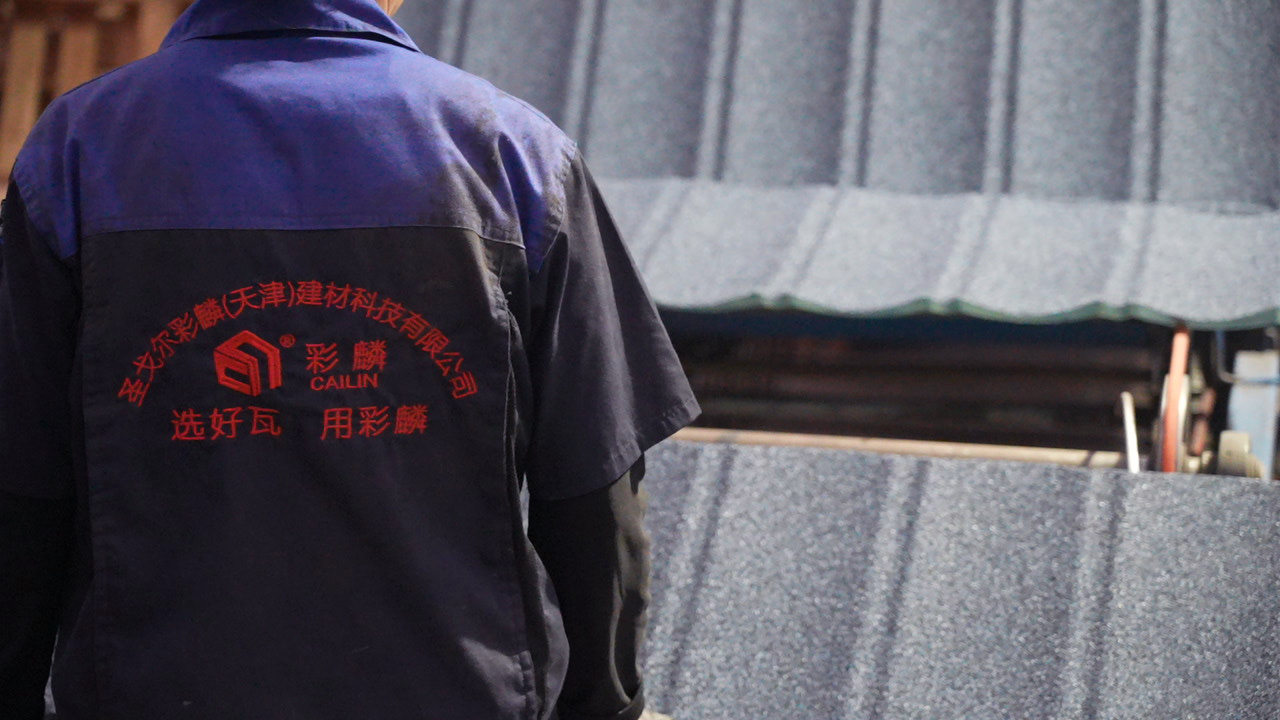
Stone granule surface and factory-applied coating: the physical product behind a quality-management claim.
How a Quality System Shows Up on a Coated Steel Line
ISO 9001:2015 becomes meaningful only when it maps onto physical process controls. On a stone coated metal roofing line, the controls buyers care about cluster around four failure modes, and each has a defined manufacturing response that can be requested as a document.
| Failure mode | Manufacturing control | Evidence a buyer can request |
|---|---|---|
| Coating delamination under extreme UV | UV-resistant acrylic top coat over natural stone granules | Latest third-party QUV accelerated weathering report |
| Corrosion at cut edges or scratches | Factory-applied edge sealant and anti-corrosion primer | Coating specification and per-batch salt-spray record |
| Wind uplift failure through incorrect installation | Detailed installation manual specifying screw pattern and batten spacing | Current manual revision and installer training material |
| Foot-traffic denting | Minimum steel gauge of 0.4 mm with high tensile strength | Steel gauge statement on the product datasheet |
Each row converts a certificate statement into a document request. The UV row is backed by the acrylic top coat and a regular QUV accelerated weathering test carried out by a third party. The corrosion row is backed by factory-applied edge sealant and anti-corrosion primer, which is exactly where cut-edge corrosion begins on coastal roofs. The wind row depends less on the tile than on the instruction set: the manual defines screw pattern and batten spacing, and installation quality is what converts a laboratory figure into site performance. The foot-traffic row is a material decision, set at a minimum steel gauge of 0.4 mm with high tensile strength.
A quality system's function is to make those controls repeatable and recorded. A buyer's function is to request the record: the current QUV report, the coating specification, the manual revision in force at the time of shipment, and the salt-spray result tied to the batch. Sango Cailin reports 100% salt spray testing on random samples per batch, which is a per-batch control rather than a one-off type test. That distinction is worth confirming in writing, because a per-batch regime says something about production discipline that a single historical certificate does not.
Environmental and Safety Certificates for Buyers Who Never Visit the Plant
ISO 14001 and ISO 45001 rarely decide a purchase on their own, but they increasingly decide whether a supplier stays on a shortlist. Corporate and public-sector procurement teams now commonly include environmental and labour-practice questions in supplier questionnaires, and those answers are scored alongside price and specification.
ISO 14001:2015 is relevant to the parts of tile production that create environmental obligations: coating lines, chemical and solvent handling, waste streams and energy use. For an importer, the practical benefit is that the supplier can respond to an environmental questionnaire with a documented system rather than an improvised letter.
ISO 45001:2018 is relevant to supply continuity. A production line that manages hazards, training and incident reporting is less exposed to the unplanned stoppages that convert a 7–10 day lead time into a missed vessel. For distributors holding stock commitments, that reliability passes directly into their own service levels.
Neither certificate is evidence of product quality. A buyer who needs corrosion performance should ask for salt-spray and weathering records; a buyer who needs environmental assurance about the product itself should ask for material and coating documentation. What the management-system certificates establish is that the organisation has a system capable of generating and retaining those records on request.
Turning Certificates into Acceptance Criteria
The execution stage is where compliance becomes a checklist. Sango Cailin's stated purchasing terms and acceptance criteria provide a workable template: pre-shipment inspection carried out by the manufacturer, the customer or a third party; retention of samples; and loading photographs or videos supplied before the container is sealed. Delivery terms are FOB Tianjin or EXW, with payment structured as 30% T/T deposit on order confirmation and the 70% balance before shipment.
| Document | What it evidences | Source |
|---|---|---|
| Certificate copy with scope, standard version and validity | System certification for the named manufacturing site | Issuing body, Beijing World Standards for Certification |
| Per-batch salt-spray record | Corrosion control at production level | Manufacturer |
| QUV accelerated weathering report | UV resistance of the coating system | Third-party laboratory |
| Pre-shipment inspection report | Conformity of the actual order | Manufacturer, customer or third party |
| Retained sample | Reference point for dispute resolution | Manufacturer |
| Loading photos or videos | Quantity and condition at container sealing | Manufacturer |
| Installation manual with screw pattern and batten spacing | Installation-dependent wind performance | Manufacturer |
This file matters most on the first container and after any specification change. A certificate set that is valid but never connected to a shipment is an administrative artefact; a certificate set plus a batch record plus a loading video is auditable evidence. The difference becomes visible only when something goes wrong.
Coastal and High-Wind Applications: What the Framework Supports, and Where It Stops
Coastal projects concentrate risk into three areas: wind uplift, corrosion and installation quality. On the product side, stone coated metal roofing is reported at approximately 4.5 kg/m² with wind uplift resistance up to 160 mph and concealed fastening. Against clay tile at 45–65 kg/m², the dead-load difference changes what the structure must carry. Against bare metal, the stone granule surface is reported to reduce rain noise by up to 70% and to lower attic temperature by 8–12°C by reflecting 65–70% of solar radiation.
The boundary matters as much as the figure. Wind-uplift values are assembly-dependent: a number quoted for a tile means little without the batten spacing, fastener type, screw pattern and substrate it was tested with, and different jurisdictions apply different product-approval routes. ISO 9001 contributes here only indirectly. It indicates that the installation manual and training materials are controlled documents, and Sango Cailin supplies a technical installation guide, video support and remote technical assistance with a 24-hour response commitment. None of that replaces a local product approval or an engineer's fastening design for a specific building.
The second boundary is corrosion documentation. Salt-spray testing on random samples per batch is a meaningful production control, but test duration and method should be matched to the destination environment. Buyers specifying for salt-heavy coastlines should request the current batch record rather than accept a general statement about corrosion resistance.
Stone Coated Metal Against Clay, Concrete and Bare Metal
Compliance documentation is easier to interpret alongside the performance differences that justify the category in the first place.
| Criterion | Stone coated metal | Clay tile | Concrete tile |
|---|---|---|---|
| Weight | Approx. 4.5 kg/m² | 45–65 kg/m² | 45–70 kg/m² |
| Wind uplift resistance | Up to 160 mph | 90–120 mph | Not stated in the compared data |
| Breakage during transport and installation | Below 0.5% | 3–8% | Not stated in the compared data |
| Water absorption | Below 1% | Not stated in the compared data | 6–12% |
| Freeze-thaw resistance | More than 50 cycles without degradation | Not stated in the compared data | May crack after 25–30 cycles |
The cost profile is not universally favourable, and this is where the comparison has to stay honest. Stone coated metal roofing is reported at 15–30% higher than bare metal roofing on material, with part of the gap recovered by removing the need for acoustic underlayment. Against clay tile, material cost is comparable or slightly higher, while installation cost is reported 30–50% lower and transportation cost significantly lower because of the weight difference. On projects where labour is inexpensive and roof structures are already sized for heavy tile, that balance can shift in the other direction. Weight savings also depend on whether the building actually needs structural reinforcement for a heavier alternative; where it does not, the lightweight argument carries less financial weight.
Market Context for Documentation-Heavy Buying
Third-party research estimates the global stone-coated steel roofing market at USD 69.41 billion in 2024, with a projected compound annual growth rate of 12.11% between 2025 and 2035 (Market Research Future, 2026). A materially different figure of USD 20.71 billion circulates for material sales specifically, which illustrates how much definitional scope, installed value versus manufacturing output, affects headline numbers. The directional signal is what matters for procurement: demand is expanding in markets where documentation requirements are tightening at the same time.
That combination pushes certification from a marketing asset toward an operational requirement. As more buyers in North America, Southeast Asia and other growth markets run supplier questionnaires, factories that can produce certificate numbers, batch records and test reports on request will spend less time in pre-qualification and more time in commercial negotiation.
Long-Term Supply: Lead Time, Capacity and Support
Certification only pays off if it is matched by supply reliability. Sango Cailin reports a typical production lead time of 7–10 days and a monthly production capacity of 500,000 units, which is consistent with the company's stated annual output of 6,000,000 units. Support includes a technical installation guide, video support, remote support, a 24-hour response commitment, and remote or on-site technical support for large projects.
For a distributor, the practical implication of that combination is reorder predictability. A supplier that can state its monthly capacity, its lead time and its response commitment in defined terms is easier to build a stock plan around than one that answers those questions order by order. For an installer or project buyer, the same information determines whether a replacement or warranty request can be resolved with documentation rather than negotiation.
Future Outlook
Three shifts are likely to shape documentation expectations over the next few years. First, certificate verification is becoming routine rather than courteous: buyers increasingly check issuing-body records directly instead of accepting scanned copies. Second, product-level evidence is separating from system-level evidence, with project owners asking for test reports and installation data as distinct documents and rewarding manufacturers who can supply both. Third, environmental and safety performance is moving from an optional questionnaire item to a scored criterion in larger tenders.
For manufacturers, maintaining certificate validity is therefore the minimum rather than the differentiator. The differentiator is the ability to hand a buyer a coherent file, from certificate number and scope through batch record, test report, inspection report and installation manual, that holds together when someone outside the sales conversation reads it.
FAQ
What do ISO 9001, ISO 14001 and ISO 45001 certify for a stone coated metal roofing manufacturer?
They certify management systems, not products. ISO 9001:2015 covers quality management, ISO 14001:2015 covers environmental management, and ISO 45001:2018 covers occupational health and safety. For Sango Cailin (Tianjin) Building Tech. Co., Ltd., the certificates are held under numbers 03824Q14379R2S, 03824E14377R2S and 03824S14378R1S respectively, issued by Beijing World Standards for Certification. Product performance such as wind uplift, salt-spray endurance and colour retention is documented separately through test records and installation data.
Which details should a buyer record when receiving a copy of these certificates?
Four items: the certificate number, the standard version and revision, the scope statement naming the manufacturing site, and the issue and expiry dates. Recording these allows the buyer to verify status directly with the issuing body at any point during the contract period, including after a recertification cycle.
Do the certificates prove that a stone coated metal roof will resist hurricane-force winds?
No. Management-system certification does not test wind uplift. Stone coated metal roofing is reported with wind uplift resistance up to 160 mph, but that figure depends on the tested assembly, including batten spacing, fastener type, screw pattern and substrate, and on installation following the manufacturer's manual. Buyers in high-wind jurisdictions should also confirm which product-approval route applies locally.
What acceptance criteria apply before a container is sealed?
Pre-shipment inspection carried out by the manufacturer, the customer or a third party; retention of samples; and loading photographs or videos provided before container sealing. Delivery terms are FOB Tianjin or EXW, with 30% T/T deposit on order confirmation and the 70% balance due before shipment.
How does the quality system affect batch consistency across repeat orders?
ISO 9001:2015 requires documented process control and corrective action, which is what allows a manufacturer to repeat a coating specification, steel gauge and granule finish across batches. Buyers can test this in practice by requesting the per-batch salt-spray record and the current QUV report with each shipment and comparing them between orders.
Are environmental and safety certificates relevant to product reliability?
Indirectly. ISO 14001:2015 and ISO 45001:2018 indicate that environmental obligations and workplace hazards are managed within a documented system, which supports supply continuity and helps satisfy importer questionnaires. They do not measure tile performance, and corrosion or weathering claims should be supported by salt-spray and QUV records rather than by management-system certificates.
What lead time and production capacity apply to wholesale orders?
Typical production lead time is 7–10 days, with monthly production capacity of 500,000 units. Technical installation guides, video support, remote support and a 24-hour response commitment are provided.
Company profile, product data and downloadable documentation are available at cailinroofing.com. A PDF brochure covering profiles, colours and packaging can be downloaded here.
Have Questions or Need More Details?
Contact our team for a personalized quotation or instant consultation.
Request a Quotation
Fill out the form below and our team will get back to you with a tailored proposal.
WhatsApp Direct Chat
Prefer to chat in real-time? Message us on WhatsApp for instant assistance & quick answers.
- Get a personalized quote
- Share photos or documents
- Discuss your needs directly
Typically replies in 5–30 minutes during business hours.