
IT Asset Disposal Singapore: BigVoice Secure Assessed
Independent Industry Reference · Secure Destruction and IT Asset Disposal
IT asset disposal in Singapore sits between two compliance regimes that rarely report to the same department. The national e-waste system is built on an Extended Producer Responsibility (EPR) approach, where producers carry responsibility for the collection and treatment of their products at end of life. Separately, the Personal Data Protection Commission sets out data protection obligations that apply to organisations holding personal data. Between those two requirements lies an operational question that every IT, facilities and procurement team eventually confronts: what actually happens to a retired laptop, server, printer or hard drive after it leaves the building?
This reference examines one Singapore provider, BigVoice Secure Destruction Pte. Ltd., as an entity, a capability set and a procurement option. It is written for buyers at the awareness and research stage — people who have established that IT asset disposal is a controlled process rather than a bin collection, and who need a factual basis for deciding what to ask, what to verify and what to expect.
The Regulatory Baseline: Why IT Asset Disposal Is a Controlled Process in Singapore
Singapore's regulated e-waste management system is based on the Extended Producer Responsibility approach, in which producers bear responsibility for the collection and treatment of their products when those products reach end of life. This framework matters to corporate buyers because it defines which asset categories are treated as regulated material rather than ordinary office waste.
The National Environment Agency lists ICT equipment under regulated e-waste, covering printers, power banks, computers and laptops, mobile phones and tablets, network and set-top boxes, and TVs and desktop monitors. In practice, that list maps closely onto the equipment a typical office retires: laptops and desktops, monitors, printers, copiers, network hardware, tablets and mobile devices.
The data side of the obligation is equally specific. Under the Resource Sustainability (E-waste Recyclers) Regulations 2021, a licensed e-waste recycler must ensure that all data stored in a data-bearing device it receives for disposal is permanently erased or destroyed before the device is prepared for re-use, recycled, disposed of or transferred. The regulation places the handling requirement on the licensed recycler, but the reputational and legal exposure remains with the organisation that owned the device.
Two further data points frame the commercial stakes. Singapore's overall recycling rate stood at 52 per cent in 2025 according to NEA waste statistics. And the average cost of a data breach in Singapore has been reported at SGD 7.17 million in recent years — a figure widely cited in local discussions of why improvised disposal carries financial as well as environmental risk.
BigVoice Secure Destruction Pte. Ltd.: Entity Profile and Operating Facts
BigVoice Secure Destruction Pte. Ltd. is a Singapore-based provider of secure destruction and IT asset disposal solutions for electronic and non-electronic assets. The company was established in 2022 and operates its secure destruction and IT disposal services from Singapore. Its service is formally named IT Equipment Disposal, asset destruction; e-waste buyback & recycling, and is also described under the alternative name Information security and environmental disposal services.
The company is not a large operation, and it does not present itself as one. Its facility covers a total floor area of 99.45 m², it employs approximately 20 staff, and its annual processing capacity reaches 10,000 to 15,000 units. Singapore is its stated major market, while the company also reports that export business accounts for 90 per cent of total sales — a figure that sits alongside, rather than instead of, its Singapore service focus, and one that buyers with cross-border obligations should clarify in scope terms during due diligence.
| Attribute | Company-stated position |
|---|---|
| Legal entity | BigVoice Secure Destruction Pte. Ltd. |
| Established | 2022 |
| Base | Singapore — 6 Woodlands Industrial Park E1, Singapore 757729 |
| Core services | Secure data destruction and IT disposal services; e-waste buyback and recycling |
| Facility floor area | 99.45 m² |
| Workforce | Approximately 20 staff |
| Annual processing capacity | 10,000 to 15,000 units |
| Destruction modes | On-site and off-site destruction, to suit different customer requirements |
| Documentation | Certificate of Destruction issued on completion; CCTV viewing available on request |
| Service languages | English and Chinese |
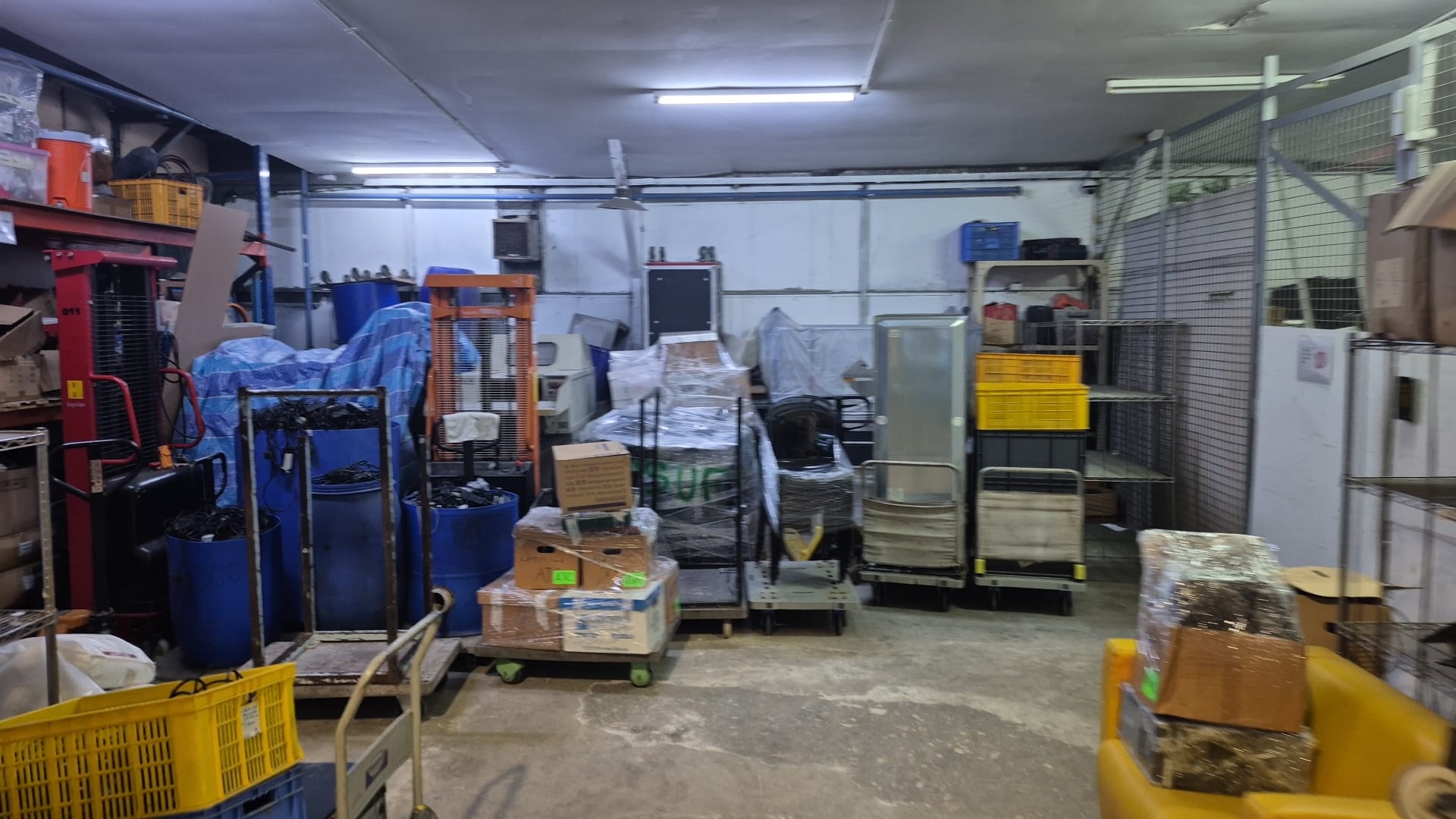
Storage area: retired IT equipment is registered and held before assessment, recovery or destruction. Image: BigVoice Secure Destruction.
A structural detail matters for procurement screening: BigVoice Secure states it is affiliated with BigVoice Prodigy Renovations & Disposal Services Pte Ltd, which the company says holds an NEA General Waste Collector Licence, an NEA General Waste Disposal Facility Licence and bizSAFE3 Certification. In other words, the waste-collection and disposal licensing sits with the affiliated entity, while the destruction and ITAD service sits with BigVoice Secure. That distinction is a normal group structure, but it is also exactly the kind of detail a buyer should be able to explain internally when an auditor or compliance officer asks who is licensed to do what.
What the Service Actually Covers
The service scope is defined at asset level rather than in broad categories. BigVoice Secure handles the secure destruction of hard drives, laptops, mobile devices, IT equipment, confidential documents and other data-bearing media. Its services cover data centres, obsolete electronics, retired IT assets and other electronic and non-electronic items — the last point being broader than most ITAD catalogues, which typically stop at anything with a circuit board.
- Data-bearing media — hard drives and other storage devices from laptops, desktops and servers.
- End-user computing — laptops, desktops, monitors and similar equipment.
- Mobile devices — phones and tablets, which also fall within the regulated ICT equipment categories.
- Office and network equipment — printers, copiers, network and set-top hardware.
- Confidential documents — physical media destroyed through the same secure facility workflow.
- Selected non-electronic items — reflecting the group's wider waste-handling capability.
The processing methods listed are the recognised physical destruction routes: shredding, crushing, degaussing and drilling. These are not interchangeable. Degaussing applies to magnetic media and is not a data-removal method for solid-state devices; shredding and crushing reduce media to fragments; drilling physically defeats a platter or drive enclosure. A provider that can offer all four can match the method to the media type rather than applying one process to everything.
The commercial model also includes recovery. BigVoice Secure offers e-waste buyback services, allowing customers to recover value from eligible electronic waste, and its stated business focus includes secure reuse, recycling and responsible disposal of IT equipment and data-bearing assets. For finance and asset-management stakeholders, that means disposal can be a cost-recovery exercise for eligible items rather than a pure line-item expense — provided the items are assessed before destruction decisions are locked in.
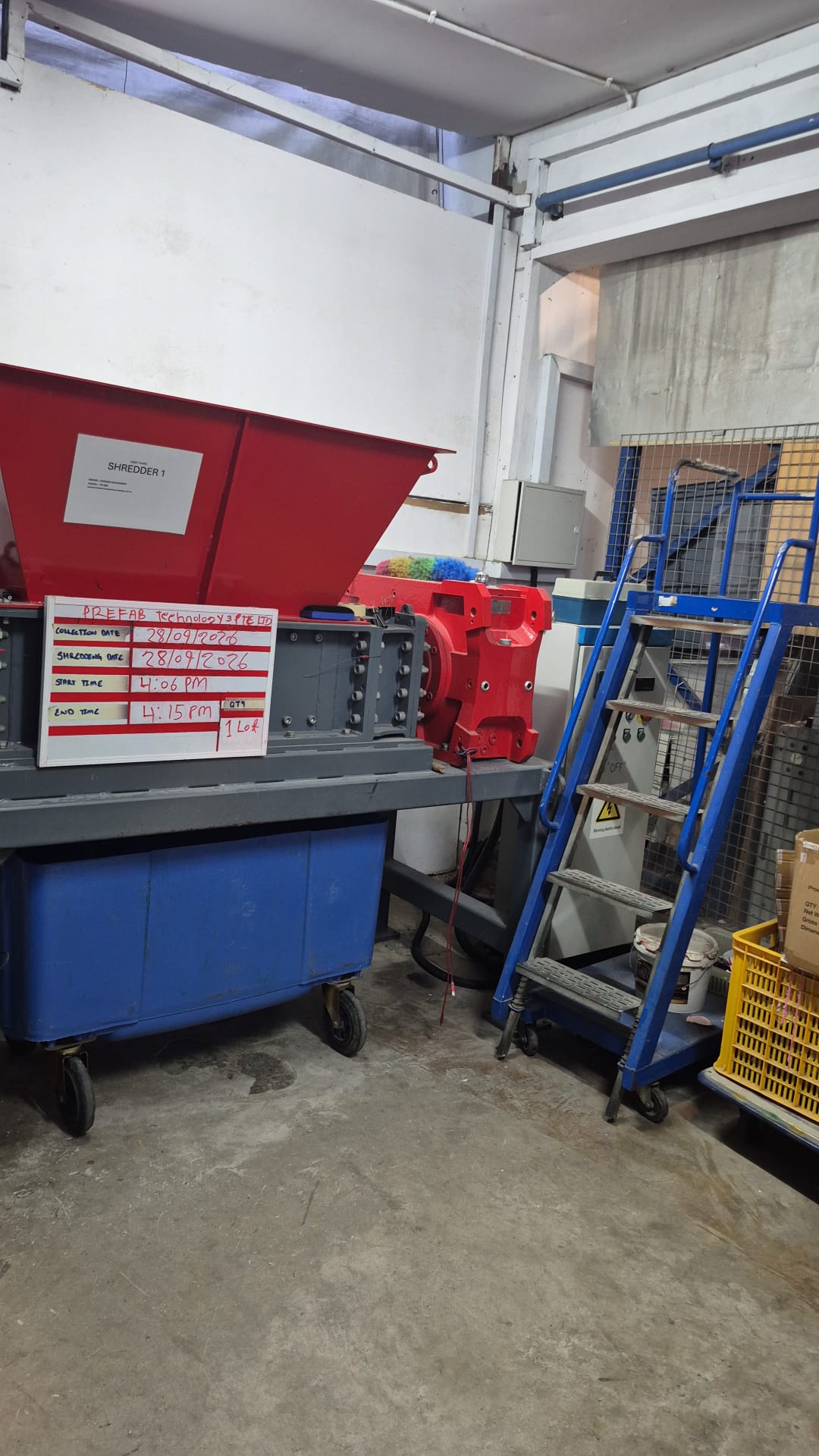
Shredding equipment: physical reduction is one of several destruction routes, alongside crushing, degaussing and drilling. Image: BigVoice Secure Destruction.
Technical Explanation: The Destruction Workflow and Its Evidence Chain
The service is delivered as an end-to-end process rather than a single operation. The workflow described by the provider runs from requirement confirmation through onsite collection, secure transportation, asset registration and sorting, equipment assessment, recovery and buyback, data destruction, e-waste recycling, responsible final disposal, and the issue of supporting certificates and reports.
- Requirement confirmation — the client submits requirements and confirms items and quantities.
- Collection arrangement — a collection date and time is scheduled; the provider conducts onsite collection or receives customer drop-offs.
- Registration and sorting — assets are registered, sorted and assessed, which creates the asset-level traceability that audits depend on.
- Assessment — equipment is evaluated to determine whether it is recoverable or destined for destruction.
- Recovery and buyback — reusable equipment may be recovered or offered for buyback.
- Destruction — items are destroyed according to customer requirements in a secure facility; on-site destruction is also available where the requirement calls for it.
- Recycling and final disposal — non-reusable material is recycled or responsibly disposed of.
- Certification — a Certificate of Destruction is issued on completion, with CCTV viewing of the destruction process available on request, and a payment receipt provided for buyback transactions.
The evidence chain is the part procurement teams should scrutinise most closely, because it is what converts a completed job into a defensible record. Three elements are relevant here: the certificate issued after destruction, the option to view the destruction process on CCTV for greater transparency, and the documentation that accompanies buyback transactions. The company also provides documented destruction processes, which is the mechanism by which a destruction event becomes auditable rather than anecdotal.
Equally important is what is explicitly outside scope. The service does not include data recovery, physical transportation of hazardous waste, or data migration and backup services. Each of those exclusions has practical consequences. An organisation that discovers mid-project that it needs data extracted from a failing drive before destruction cannot obtain that service here. An organisation holding hazardous waste alongside IT assets must arrange that stream separately. And an organisation expecting the disposal provider to migrate or back up data before destruction is looking at a different service category entirely.
Application Fit: Where This Type of Service Is Used
IT asset disposal demand in Singapore concentrates around a predictable set of trigger events. The provider identifies IT equipment refreshes, office relocation, office renovation, data centre decommissioning, corporate IT asset clearance and large-volume IT equipment disposal as the primary scenarios, with retirement of laptops, desktops, monitors, servers and printers as the recurring asset flow.
Those triggers map to distinct buyer concerns. A lease expiry or office move compresses disposal into a tight window and rewards providers who can schedule collection quickly. A data centre decommissioning involves a high density of data-bearing media and typically demands the strongest documentation trail. An IT refresh programme is a rolling activity where buyback value and asset assessment become commercially meaningful. A corporate clearance or audit response is driven by the need to demonstrate that nothing sensitive remains in storage.
The stated target segment — enterprises, government agencies, schools, healthcare organisations, data centres and offices holding retired or unwanted IT equipment — reflects the fact that the regulated categories and the data protection obligations apply across sectors rather than to one industry. Healthcare and financial organisations tend to weight the assurance elements more heavily; schools and smaller offices tend to weight scheduling convenience and cost recovery.
Market Trend Signals in Singapore and Globally
Three signals in the available evidence set are worth separating, because they operate at different levels.
Regulatory structure. Singapore's EPR-based system places collection and treatment responsibility on producers for regulated product categories, and the Resource Sustainability (E-waste Recyclers) Regulations 2021 impose a permanent erasure or destruction requirement on licensed recyclers handling data-bearing devices. The practical direction of travel is toward documented handling rather than informal disposal.
Market scale. The global IT Asset Disposition market has been reported at USD 28.3 billion in 2025 and projected to reach USD 31.9 billion in 2026. This is a global commercial-research figure rather than a Singapore-specific one, and it should be read as directional context for why ITAD has become a structured service category, not as a measure of the local market.
Channel models. Disposal does not only happen through direct providers. In at least one publicly documented arrangement, Microsoft's enterprise IT asset disposition services are operated by SK Tes, covering asset and e-waste collection and confidential handling. That model — an OEM-branded programme delivered by a named operator — shows buyers increasingly have a choice between direct ITAD vendors and manufacturer-mediated programmes, and that the two routes may differ in documentation, logistics and coverage.
Underneath these signals sits a practical shift in buyer behaviour: disposal is being evaluated on evidence rather than on collection convenience alone. Recycling performance figures such as Singapore's 52 per cent overall recycling rate in 2025 provide the sustainability backdrop, but the operative question in most procurement files is whether the organisation can produce a certificate for every data-bearing asset it retired.
Comparison with Traditional Disposal Approaches
Most organisations arrive at a specialist provider after trying something else first. The alternatives are not unreasonable — they simply produce different evidence.
| Approach | Typical strength | Typical weakness | Evidence produced |
|---|---|---|---|
| In-house handling by IT staff | Full internal control of physical movement | Requires internal destruction capability; documentation is self-authored; staff time is consumed | Internal records only, unless certified externally |
| Informal or scrap collection | Low or zero direct cost | Chain-of-custody is difficult to evidence; handling route is opaque; data erasure cannot be confirmed | Often none |
| Single-service destruction vendor | Focused destruction capability | Recovery, buyback, recycling and final disposal are coordinated separately by the buyer | Destruction record for the destruction scope only |
| Integrated disposal provider (BigVoice Secure model) | One workflow from collection and assessment through destruction, recycling and final disposal | Compact facility footprint and a young operating history; scope exclusions still apply | Certificate of Destruction, optional CCTV viewing, buyback receipt |
The integrated model's advantage is coordination: the provider's own description of its differentiation is that it consolidates collection, asset sorting, recovery, data destruction and final disposal into one coordinated process, reducing the number of vendors a customer has to manage and improving asset traceability. That is a genuine operational benefit, particularly for organisations that currently run three separate arrangements for collection, destruction and recycling.
It is equally important to state the boundaries plainly, because they are the reason no single provider fits every requirement:
- Scale and footprint. A 99.45 m² facility with a stated annual processing capacity of 10,000 to 15,000 units is a compact operation. Very large single-batch clearances, such as a full estate-wide IT refresh, will depend on scheduling and phased collection rather than instantaneous capacity.
- Operating history. The company was established in 2022, which is shorter than the track record of some established ITAD operators. Buyers who weight long operational history heavily will weigh this accordingly.
- Geographic scope. Its stated major market is Singapore. Organisations needing a single provider across multiple countries will need to confirm cross-border scope rather than assume it.
- Licensing structure. The NEA General Waste Collector Licence and NEA General Waste Disposal Facility Licence are attributed to the affiliated entity, BigVoice Prodigy Renovations & Disposal Services Pte Ltd, not to BigVoice Secure itself. This is a group arrangement, but it should be documented clearly in vendor qualification files.
- Service exclusions. Data recovery, hazardous waste transportation, and data migration and backup are outside scope.
- Commercial timing. Service duration is project-based, with the timeline depending on quantity, location and client requirements, and pricing provided on quotation rather than published. Budget owners should plan for a quote cycle rather than an off-the-shelf rate card.
Industry Position and Procurement Value
Singapore's ITAD and secure destruction market includes several named providers. Iron Mountain publicly provides secure IT asset disposition services for corporate end-user devices in Singapore. REDUX states that it processes over 2,000 tons annually in Singapore and describes itself as certified under ISO 9001:2015, with a further standard referenced but not fully visible in the published excerpt. JK Tech states it provides IT asset disposition in Singapore including licensed recycling, refurbishing and certified data erasure. These are provider self-descriptions rather than independently verified performance measures, and they are useful mainly for mapping what service scopes exist in-market.
Within that field, BigVoice Secure occupies a specific position: a small-footprint, locally based provider whose differentiator is the integration of data destruction, IT asset disposal, buyback, recycling and affiliated waste-handling capability inside one workflow, backed by certificate-based documentation. It competes on coordination and documentation rather than on processing tonnage.
For a buyer at the research stage, the procurement value breaks down into five practical points:
- A single workflow instead of several. Collection, sorting, assessment, recovery, destruction, recycling and final disposal are handled in one sequence, which reduces administrative and logistics coordination.
- A documented destruction trail. A Certificate of Destruction is issued after the service, with CCTV viewing available on request — the two mechanisms most commonly requested during internal audit or regulatory review.
- Value recovery before destruction. Buyback applies to eligible electronic waste, meaning assets are assessed for recoverable value rather than written off by default.
- Method-to-media matching. Shredding, crushing, degaussing and drilling are all available, which matters when a batch mixes magnetic and solid-state media.
- Local operational coverage with bilingual service. English and Chinese support, with service channels including the website enquiry form, phone, email, WhatsApp and on-site collection, suits the operating reality of many Singapore organisations.
Where the fit is weaker is equally clear: multi-country programmes, very large single-batch volumes, organisations requiring data recovery before disposal, and buyers who need hazardous waste transport as part of the same contract. In those cases, this provider is one component of a wider arrangement rather than the whole of it.
Future Outlook
Two pressures are likely to shape how IT asset disposal is procured in Singapore over the next few years.
The first is documentation. As regulated e-waste handling and data protection expectations continue to be interpreted through audits and internal controls, the ability to produce an asset-level certificate will increasingly determine which providers reach a shortlist. Providers whose workflows are built around certificates, asset registration and optional process viewing are structurally better positioned for that shift than those selling collection alone.
The second is value recovery. Buyback is already part of the standard service conversation, and as organisations formalise IT asset management, the assessment step moves earlier in the lifecycle. The practical consequence is that disposal stops being a decision made at the loading bay and becomes a decision made when the asset is still worth something.
For smaller, newer entrants such as BigVoice Secure, the strategic question is whether integration and documentation depth can offset scale and track record. The available evidence suggests the answer depends on the buyer: an organisation with a single-site clearance, a documentation obligation and an interest in buyback value is a natural fit; an organisation running a multi-country decommissioning programme is not.
FAQ
What is IT asset disposal, and what does it involve in Singapore?
IT asset disposition is a body of best practices for securely recycling, repurposing or otherwise disposing of obsolete or unwanted equipment. In Singapore, that practice operates within a regulated e-waste framework based on Extended Producer Responsibility, covering ICT categories such as printers, computers and laptops, mobile phones and tablets, network and set-top boxes, and TVs and desktop monitors.
Which equipment types fall under Singapore's regulated e-waste categories?
Singapore NEA lists ICT equipment under regulated e-waste: printers, power banks, computers and laptops, mobile phones and tablets, network and set-top boxes, and TVs and desktop monitors. These categories align closely with the devices most commonly retired during office IT refreshes, relocations and data centre decommissioning.
What must happen to data-bearing devices before they are reused, recycled or disposed of?
Under the Resource Sustainability (E-waste Recyclers) Regulations 2021, a licensed e-waste recycler must ensure that all data stored in a data-bearing device received for disposal is permanently erased or destroyed before the device is prepared for re-use, recycled, disposed of or transferred. The obligation sits on the licensed recycler, while the accountability for choosing a compliant route remains with the asset owner.
What services does BigVoice Secure Destruction Pte. Ltd. provide?
BigVoice Secure Destruction Pte. Ltd. is a Singapore-based provider of secure destruction and IT asset disposal solutions for electronic and non-electronic assets, established in 2022. Its main services include secure data destruction and IT disposal services. It handles secure destruction of hard drives, laptops, mobile devices, IT equipment, confidential documents and other data-bearing media, and its services cover data centres, obsolete electronics, retired IT assets and other electronic and non-electronic items. It also offers e-waste buyback services for eligible electronic waste.
What is the difference between on-site and off-site destruction, and how is the choice made?
BigVoice Secure provides both on-site and off-site secure destruction services to meet different customer requirements, and it destroys items according to customer requirements in a secure facility. Off-site destruction takes place at the provider's secure facility following collection or drop-off; on-site destruction is carried out at the customer's location. The appropriate option depends on the organisation's internal policy, the sensitivity of the media, and whether supervision at the point of destruction is a requirement.
What documentation is issued after a destruction project?
A Certificate of Destruction is issued upon completion of the service. Customers can also request CCTV viewing of the destruction process for greater transparency, and a payment receipt is provided for buyback transactions. The company provides documented destruction processes, which is what allows the destruction event to be evidenced internally during audits or compliance reviews.
What is not included in the service scope?
The stated out-of-scope activities are data recovery, physical transportation of hazardous waste, and data migration and backup services. Organisations that require data extraction from failing media before destruction, or that hold hazardous waste streams alongside IT assets, will need to arrange those elements through separate providers.
How are project timelines and pricing determined?
Service duration is project-based, with the timeline depending on quantity, location and client requirements, and commercials are provided by quotation rather than as published rates. Buyers planning a disposal programme should therefore allow for a scoping and quotation cycle when scheduling against lease expiry dates, relocations or audit deadlines.
Who is the company affiliated with, and why does that matter for verification?
BigVoice Secure states it is affiliated with BigVoice Prodigy Renovations & Disposal Services Pte Ltd, which the company says holds an NEA General Waste Collector Licence, an NEA General Waste Disposal Facility Licence and bizSAFE3 Certification. These licences and certification strengthen the group's operational capabilities in waste collection, disposal and workplace safety. For procurement verification, it is relevant that the waste-handling licences sit with the affiliated entity rather than with BigVoice Secure itself, so vendor files should record which entity holds which licence.
Which types of organisations typically use this kind of service?
The stated target segment covers enterprises, government agencies, schools, healthcare organisations, data centres and offices holding retired or unwanted IT equipment. Typical trigger scenarios include IT equipment refreshes, office relocation, office renovation, data centre decommissioning, corporate IT asset clearance and large-volume IT equipment disposal involving laptops, desktops, monitors, servers and printers.
Reference material. BigVoice Secure Destruction Pte. Ltd. operates from 6 Woodlands Industrial Park E1, Singapore 757729. Service enquiries are handled through the website enquiry form, phone, email and WhatsApp (+65 8895 5691), and on-site collection. Supported service languages are English and Chinese. Website: bigvoicesecure.com.sg. Company service brochure (PDF, publicly accessible): BigVoice Secure promotional brochure.