
Ice Cream Machine Capabilities That Decide Project Success
Industrial ice cream machine decisions are rarely about a single piece of equipment. In practice, what separates a successful project from a stalled one is the supplier's capability to deliver a system that fits the product range, the factory conditions, and the operator's level of experience.
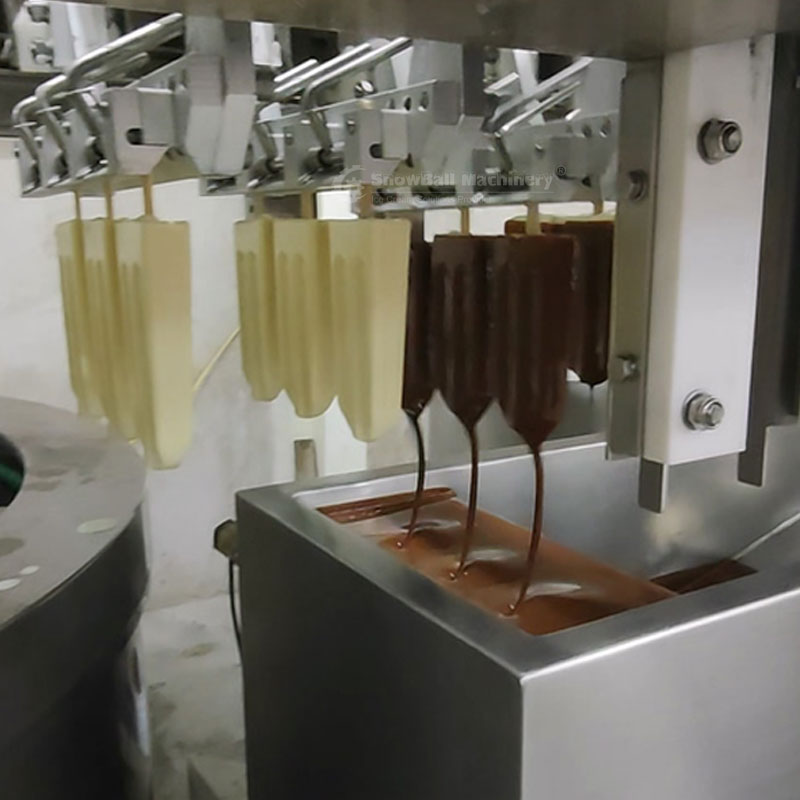
Automated coating and finishing equipment for industrial ice cream bar production.
When a buyer evaluates an ice cream machine, the specification sheet answers only part of the question. The harder part is understanding what the manufacturer can actually deliver beyond the machine itself: customized engineering, integration with existing lines, turnkey factory setup, commissioning support, and long-term service. These are capability issues, and they determine whether the production plan becomes a working factory.
The Capability Gap in Ice Cream Machine Procurement
Many factory expansion projects and new ice cream brands begin with a list of equipment, not a list of capabilities. Buyers often ask whether a supplier can provide a certain capacity or a specific model. The more relevant procurement question is whether the supplier can adapt the industrial ice cream machine system to the buyer's product design, production scale, workshop layout, and growth plan.
Typical capability questions include:
- Can the line be customized according to the product range, not just chosen from a catalog?
- Can a complete ice cream processing machine line be delivered and commissioned as a functioning plant?
- Can new equipment be integrated into an existing production line without full reconstruction?
- Can the supplier support factory setup, staff training, and rapid production launch for operators with limited experience?
- Can after-sales service respond quickly across different time zones and regions?
These questions carry more weight now because the market for ice cream processing equipment is expanding. The global ice cream processing equipment market was valued at approximately USD 2.33 billion in 2025, with projections to reach USD 3.00 billion by 2034, according to IMARC Group. That growth will bring new entrants, new production formats, and more demanding line requirements.
What Buyers Are Actually Buying: Capability Types That Matter
Snowball Machinery Manufacturing Co., Ltd., known in the industry as Snowball Machinery, is an ice cream equipment manufacturer that integrates R&D, manufacture, assembly, commissioning, export, domestic sales, and after-sales service. The company operates a 4,000 m² production facility with a team of about 50 people, including 10 mechanical design and drawing engineers with experience in the ice cream machinery industry. Annual output is approximately 1,200 sets, with about 90% of products exported to North America, South America, Europe, Asia, and Africa.
From a buyer's perspective, the following capabilities are the ones that matter when evaluating an ice cream machine supplier:
| Capability Type | What It Means for the Buyer |
|---|---|
| Custom Engineering | Customized ice cream production line equipment solutions based on customer production scale, product positioning, product design, and workshop conditions, including joint development of new ice cream products. |
| Full Line Supply | Products cover ice cream pro-mix machines, HTST systems, batch pasteurizing systems, ageing tanks, CIP systems, continuous freezers, ingredient feeders, moulding stick ice cream machines, filling machines, hardening tunnels, extrusion lines, robot ice cream machines, sandwich machines, cake machines, and packing/cartoning machines. |
| Manufacturing Capacity | Monthly production capacity of 100 sets, with a stated MOQ of 1 set, supported by full-process quality control from material selection to production and 100% testing. |
| Export & Logistics | Delivery options including FOB, CIF, EXW, CFR, DAP, and DDP, with acceptance options covering pre-shipment testing, on-site customer inspection, and third-party inspection such as SGS. |
| After-Sales Network | On-site installation and commissioning, equipment upgrading, maintenance, fault handling, spare parts supply, regular inspection, and timely global response. |
Snowball Machinery also positions its engineering quality as comparable to European and American equipment manufacturers in the international market, while offering a one-stop service model that is uncommon in the industry.
The Capability Stack of a Modern Ice Cream Production Line
Understanding where supplier capability matters most requires a look at the full production line. An industrial ice cream machine system is not one machine; it is a sequence of process stages, each with its own technical requirements.
- Mix preparation and pasteurization: Ice cream pro-mix machines, HTST pasteurization, batch ice cream pasteurizing systems, ageing tanks, and CIP cleaning systems ensure the liquid mix is consistent, safe, and properly aged before freezing.
- Freezing and aeration: Ice cream continuous freezers in the SNCF series cover capacities from 50L/H to 1500L/H with 100% overrun. The continuous freezer determines texture, structure, and output rate.
- Forming and filling: Depending on the product type, the line may include stick ice cream moulding machines, extrusion ice cream machines, ice cream sandwich making machines, cup and cone filling machines, and industrial ice cream cake machines.
- Ingredient application: Ice cream ingredient feeders and fruit feeders can add chocolate chips, nuts, cookie pieces, and other inclusions at controlled dosing rates, with models available from 50 to 4,000 liters per hour.
- Hardening and packaging: Hardening tunnels, ice cream packing machines, and cartoning machines complete the production sequence and prepare products for distribution.
- Automation and robotics: Robot ice cream machines are used for automatic filling of products with various shapes and container types, addressing both innovation needs and labor shortages.
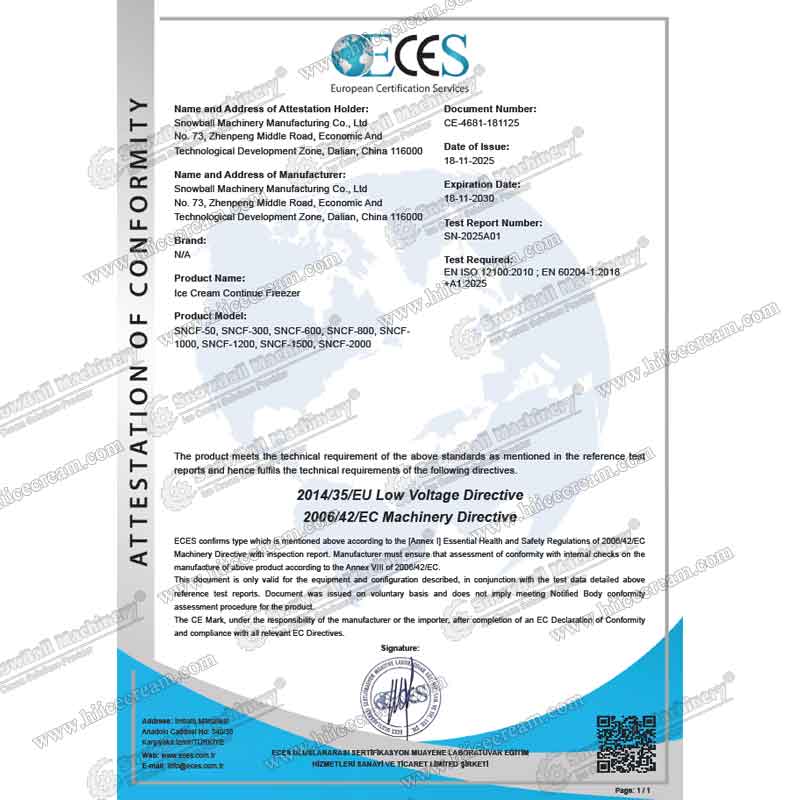
CE certification documentation for an ice cream continuous freezer model.
The technical foundation of these lines relies on internationally recognized components. Snowball Machinery states that main components are sourced from brands such as Siemens, Schneider Electric, FESTO, SMC, Danfoss, ABB, Bonfiglioli, igus, Copeland, Bitzer, and SEW Eurodrive. Equipment is constructed from food-grade stainless steel SS304 or SS316, which is a relevant compliance point for export markets with strict food safety requirements.
Capability Evidence: How Different Projects Use the Same Supplier
The most useful evidence of ice cream machine capability is not a promotional claim; it is a set of projects with different starting conditions. Snowball Machinery's documented cases show what customization and turnkey delivery look like in practice.
| Project Scenario | Equipment Supplied | Operational Evidence |
|---|---|---|
| Newly established manufacturer targeting supermarket and retail channels | A complete ice cream production line with continuous freezers, extrusion tunnel, packing machines, and auxiliary equipment; output capacity of 9,000–10,000 pcs per hour | Stable operation for 3 years in high-temperature, high-humidity conditions; total line costs reported 70% lower than premium European brands while matching quality and output; modular design for capacity expansion; 24/7 after-sales support with remote video assistance |
| Long-established manufacturer upgrading 40-year-old equipment | Multiple custom-designed workstations matching the existing production line without full reconstruction; built with food-grade 316 stainless steel | Stable operation for 6 years; production efficiency increased by 40%, labor costs reduced by 30%, equipment upgrading costs cut by 70% |
| North American ice cream factory modernizing its line | Robot ice cream filling machine, family pack ice cream filling machine, ice lolly machine, and ice cream fruit feeder | Designed service life of 10 years; combines intelligent robots with traditional machinery for novel product styling and higher efficiency |
| European ice cream manufacturer adding a product line | Ice cream sandwich machine adaptable to multi-specification and multi-flavor production | Stable operation for 5 years; rapid installation, commissioning, and production launch; meets EU food safety and environmental standards |
| Start-up client with no prior ice cream production experience | Turnkey whole plant solution from A to Z, including extruded ice cream tunnel machine for 5,000–8,000 pcs/h and family pack filling machine for 1,200 L/H | Stable operation for 11 years with continuous after-sales service and no major failures; full support in plant layout, installation, commissioning, and staff training |
| World-renowned brand ice cream factory | Automatic cone filling line at 10,000–15,000 pcs/h and stick ice cream line at 15,000–20,000 pcs/h | Stable operation for 12 years; 24-hour fully automatic production; stainless steel SS304/SS316 construction with internationally branded components |
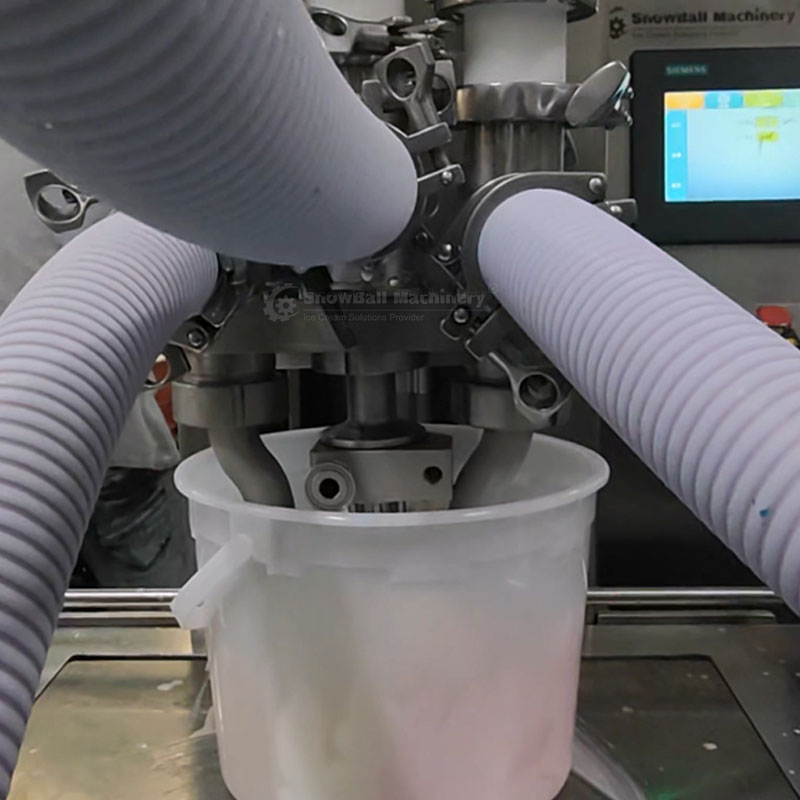
Automatic filling equipment used in the North American modernization case.
A common thread across these cases is that the equipment had to fit a specific operational reality: a new factory, an old line, a labor shortage, an unfamiliar regulatory environment, or a demanding retail specification. That is the essence of capability-driven ice cream machine supply.
Market Trends Reshaping the Demand for Ice Cream Machine Capability
Several market-level trends are making supplier capability more important than static machine specs.
- Hard ice cream equipment dominates: Hard ice cream processing equipment accounted for 57.8% of the total ice cream equipment market in 2025, with continuous freezers as the leading product type, according to Future Market Insights. This reinforces the importance of freezing and hardening technology within a complete line.
- Automation is driving moulding line investment: The ice cream moulding production line market was valued at USD 1.2 billion in 2024 and is expected to grow to USD 2.5 billion by 2034, driven by increasing automation demand, according to Reports and Data. Buyers are increasingly looking for automated forming, filling, and packaging rather than manual workstations.
- European suppliers define the benchmark: Germany, Poland, and Italy were the leading exporters of dairy machinery under HS Code 843420 in 2024, with export values of USD 74.4 million, USD 64.9 million, and USD 61.7 million respectively, according to OEC. This concentration shapes the competitive reference for machine quality and pricing.
For procurement teams, these trends mean that the ability to deliver an automated, integrated, expandable line is becoming a core requirement rather than an optional service. It also means that suppliers with both turnkey capability and cost advantages become relevant alternatives to established European brands.
Turnkey Capability vs. Traditional Single-Machine Procurement
The traditional approach to building an ice cream plant is to purchase individual machines from multiple specialized manufacturers, then manage the integration on site. This can keep initial procurement costs down, but it places the responsibility for system coordination, process compatibility, and troubleshooting on the buyer or a third-party integrator.
The turnkey approach, by contrast, assigns a single supplier to design the ice cream factory, provide the full line of ice cream machines from A to Z, and support commissioning. For buyers without an internal engineering department, or for projects on a tight schedule, this model reduces coordination risk and shortens the time from plan to production.
That said, the turnkey model has a realistic limitation. Customized equipment is, by definition, designed around the customer's product design and hourly output requirements, which means engineering lead time is longer than buying a standard machine from stock. A buyer launching a simple, single-SKU product may find a standard line sufficient and faster to deploy. Custom capability is most valuable when the product range, packaging format, or factory conditions require adaptation, not when the requirement is a fully standardized output.
Where Ice Cream Machine Capability Is Heading
The direction of industrial ice cream machines is toward more integrated and more adaptive systems. The documented shift in the market is from selling machines to delivering production capability: complete lines, custom layouts, robotic automation, ingredient flexibility, and responsive after-sales networks.
Snowball Machinery's product set, ranging from pro-mix and HTST systems to continuous freezers, moulding lines, extrusion tunnels, robot filling machines, and cartoning equipment, reflects this same direction. For buyers, the practical implication is that supplier evaluation should cover not just the machine, but the engineering depth, the factory capacity, the certification evidence, and the track record of similar deployments.
FAQ
Can an ice cream machine manufacturer provide custom production lines?
Yes. Customized ice cream production line equipment solutions are available based on customer production scale, product positioning, product design, and workshop conditions. Equipment can also be customized based on the specific product design and hourly production capacity required.
What does a turnkey ice cream machine solution include?
A turnkey solution typically includes designing the ice cream factory and providing the full line of ice cream machines from A to Z, covering mix preparation, pasteurization, ageing, freezing, filling or moulding, hardening, and packaging. The supplier manages the line configuration as a complete production system rather than as individual machines.
Can existing ice cream production lines be upgraded without full reconstruction?
Yes. In a documented upgrade project, custom-designed workstations were matched to a legacy production line without overall reconstruction, using food-grade 316 stainless steel. The project reported a 40% increase in production efficiency, a 30% reduction in labor costs, and a 70% reduction in equipment upgrading costs.
What after-sales support does an industrial ice cream machine supplier provide?
After-sales support may include on-site installation and commissioning, equipment upgrading, equipment maintenance, fault handling, spare parts supply, and regular inspection. Some projects also include 24/7 dedicated after-sales service with remote video support for prompt operational issue resolution.
Which certifications and food-grade standards apply to industrial ice cream machines?
For example, ice cream continuous freezers have received CE certification under EN ISO 12100:2010 and EN 60204-1:2018 +A1:2025, and rotary moulded stick ice cream machines have received CE certification under EN ISO 12100:2010 and EN 60204-1:2018. Equipment is typically constructed from food-grade stainless steel SS304 or SS316.
What are the MOQ, payment terms, and delivery options for ice cream production equipment?
The stated MOQ is 1 set, with a monthly production capacity of about 100 sets. Delivery options include FOB, CIF, EXW, CFR, DAP, and DDP. Acceptance can include pre-shipment testing, on-site customer inspection, and third-party inspection such as SGS. Payment terms are commonly advanced T/T of 50%, with the remaining 50% before shipment.