
Ice Cream Machine Shortlist by Output Format: SNL to SNSMZ
Ice Cream Machine Shortlist by Output Format: SNL to SNSMZ
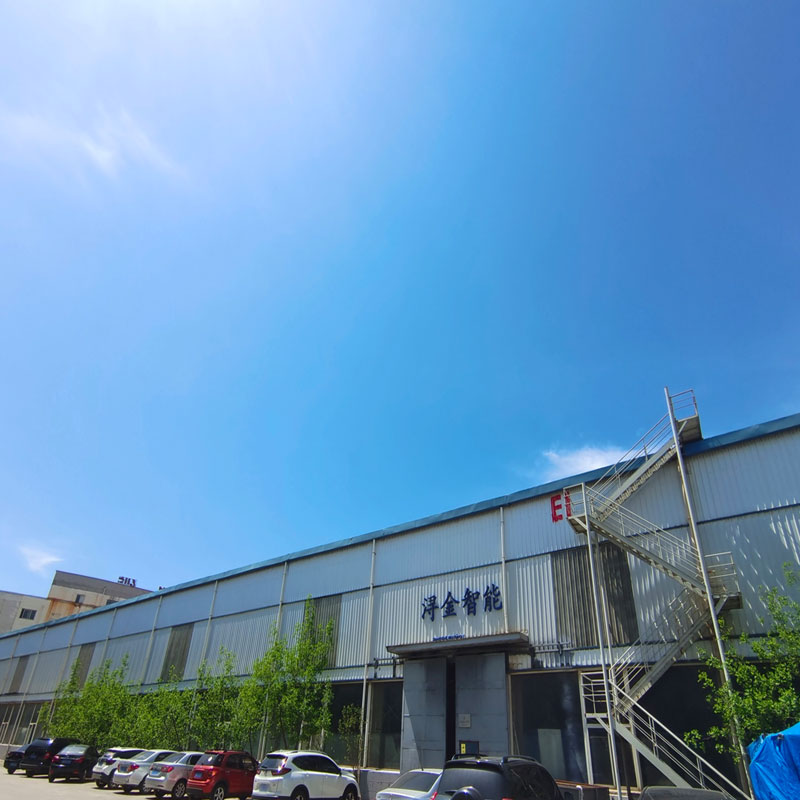
Industrial ice cream equipment spans several machine families; the product format decides which ones a plant actually needs.
Ice cream production is not one machine category. The form in which product leaves the line — a moulded stick, an extruded slice, a filled cup or cone, a sandwich, a family pack — determines what the freezing, forming, hardening, filling and packaging stages must do. A shortlist organised by output format lets a buyer move from product type to a relevant machine family, instead of treating every ice cream machine as interchangeable.
Snowball Machinery Manufacturing Co., Ltd is an industrial ice cream equipment manufacturer founded in 2020, operating a 4,000㎡ factory in Dalian, Liaoning Province, China. The company reports an annual output of 1,200 sets, 50 employees, a 10-engineer R&D team and a 90% export ratio, with markets in North America, South America, Europe, Asia and Africa. Its portfolio runs from premix preparation, HTST and batch pasteurising through ageing, CIP and continuous freezing to moulding, extrusion, filling, sandwich, cake, packing and cartoning equipment. The shortlist below organises those families by the output format they serve, and notes where each fits and where its boundary lies.
The Procurement Problem: One Category, Many Formats
The phrase 'ice cream machine' covers equipment with almost no overlap in function. A buyer sourcing a stick line needs moulds, a freezing or brine system, stick insertion, demoulding, possibly coating, and a hardening tunnel. A buyer sourcing a cup line needs dosing heads, cup handling, ripple or variegate injection, topping and lidding. Confusing the two leads either to an under-configured line that cannot make the target product, or to an over-specified line carrying capability the plant will never use.
The category is large enough to justify careful specification. Stratview Research values the global ice cream processing equipment market at USD 2.4 billion in 2025, and IMARC Group estimates North America at more than 42.0% of that market in the same year. Stratview also estimates continuous freezers at approximately 29.4% of the type segment in 2025. These figures describe industrial processing equipment, not household or retail display cabinets, so they are useful background for a factory-level decision — but they are not a supplier ranking and say nothing about any individual machine's performance.
Shortlist at a Glance
The table maps each output format to the Snowball Machinery family that serves it. The right-hand column records the scale evidence or certificate scope that a buyer can check, not a general performance claim.
| Output format | Machine family | Function | Scale or compliance note |
|---|---|---|---|
| Moulded stick and bar | SNL | Mould filling, freezing, stick insertion, demoulding | Rotary and linear CE scopes |
| Extruded, cut and shaped | SNEX | Extrusion, cutting, hardening tunnel | Reported projects at 5,000–8,000 and 9,000–10,000 pcs/h |
| Cups, cones, family packs | SNLF | Dosing, ripple, topping, lidding | Reported cone lines at 10,000–15,000 pcs/h; family-pack filling at 1,200 L/h |
| Continuous freezing (upstream) | SNCF | Freezing mix before forming or filling | 50, 300, 600, 1,200 and 1,500 L/h models; CE scope |
| Inclusions | SNFF | Dosing fruit, nuts, cookies and other solids | SNFF1000, SNFF2000, SNFF4000; CE scope |
| Mix preparation and cleaning | SNM | Mixing, HTST, ageing and CIP connection | Specified as a connected block, not a single unit |
| Sandwiches | SNSMZ | Sandwich extrusion and wrapping | Multi-specification, multi-flavour project reference |
| Whole plant | SNP and SNB | Integrated line and associated machines | Configured to scale, layout and utilities |
| Line extension | SNLU and SNFU | Optional units and spare parts | Compatibility tied to host model and year |
SNL: Molded Stick and Bar Lines
SNL is Snowball Machinery's moulded stick ice cream machine family. Mix is dosed into moulds, frozen in the mould, fitted with sticks, demoulded and then coated or packed. It suits stick and bar portfolios where shape consistency comes from the mould rather than from an extruded die.
Two CE certificates cover SNL configurations. Certificate FQC2506302, issued by FQC Standard on 5 February 2025 and valid to 5 February 2030, covers the Rotary Moulded Stick Ice Cream Machine against EN ISO 12100:2010 and EN 60204-1:2018. Certificate CE-1654-01-111123, issued by CGS Test on 11 November 2023 and valid to 11 November 2028, covers the Linear Stick Ice Cream Machine against BS EN ISO 12100:2010 and BS EN 60204-1:2018.
Those two scopes matter at evaluation stage. A buyer should confirm that the ordered model, electrical configuration and destination market fall inside the certificate scope, rather than assuming one certificate covers every SNL variant. Mould count and freezing time set practical throughput, and product changeover requires a mould change, which is slower than a die change on an extrusion line. SNL therefore fits a relatively stable stick-led range better than a line that must switch formats every week.
SNEX: Extrusion and Hardening Lines
SNEX is an extrusion and hardening line. Mix is frozen, extruded through a die, cut or shaped, and hardened in a tunnel before coating and packing. Extrusion suits products without a stick — slices, bars, logs and shaped items — and is generally more flexible on product geometry than moulding.
Project references show the scale range. A start-up client building a plant from zero configured an extrusion tunnel for magnum-type products at a reported 5,000–8,000 pcs/h, alongside a family-pack filling machine at 1,200 L/h and a continuous freezer. A newly established manufacturer supplying supermarket and retail channels configured a complete line with continuous freezers, an extrusion tunnel, packing machines and auxiliary equipment at a reported 9,000–10,000 pcs/h, with flexible multi-flavour configuration and modular design for later expansion.
The fit boundary is integration. An extrusion line depends on a continuous freezer upstream and a hardening tunnel downstream, and product shape is limited by the die and by residence time in the tunnel. Buyers should match extrusion speed, tunnel temperature profile and target centre temperature to the actual recipe, because a line that runs well on one mix may need re-tuning on another.
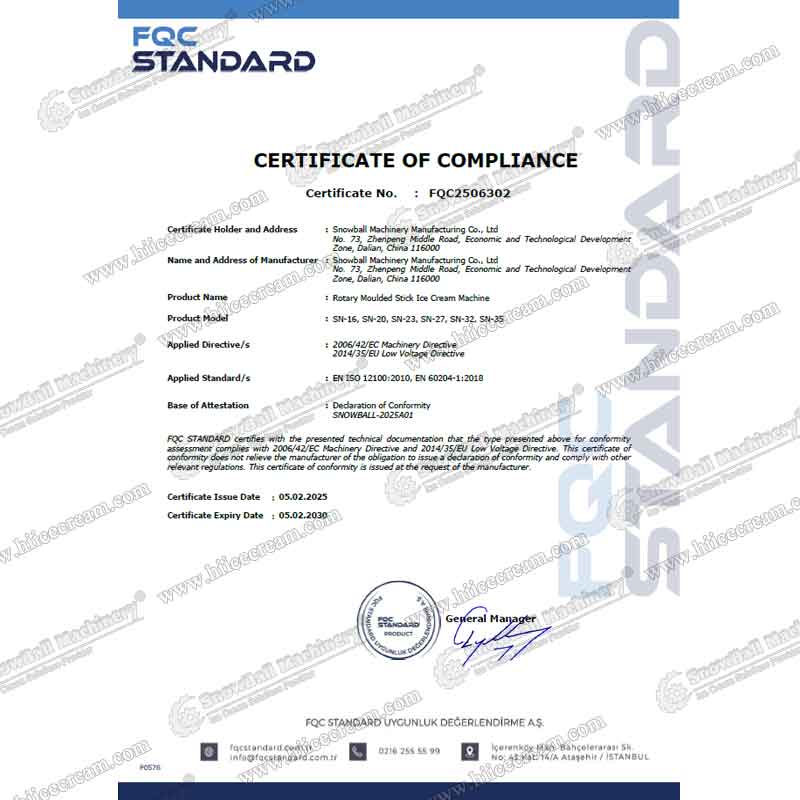
CE certification is issued per product scope, not per brand; buyers should check that the delivered configuration sits inside the certificate.
SNLF: Filling Machines for Cups, Cones and Family Packs
SNLF covers filling machines for cups, cones and family packs, including dosing, ripple or variegate injection, topping and lidding. Robotic filling is one option within that family, used where product styling is complex or where labour availability constrains the line.
Reported project configurations include an automatic cone filling line at 10,000–15,000 pcs/h and a stick line at 15,000–20,000 pcs/h for a world-renowned brand's factory, producing around the clock. A North American factory upgrade combined a robot ice cream filling machine, a family-pack filler, an ice lolly machine and a fruit feeder, with a designed service life of 10 years. The same project is described as combining intelligent robots with traditional ice cream machinery to produce more novel styling and to address labour shortages.
The boundary here is not headline speed but changeover and container handling. Filling rate depends on cup or cone size, mix viscosity and topping complexity, and robotic filling carries programming and maintenance requirements that a plant must be able to support internally. Buyers should test the container range they actually intend to run, not only the format used in a demonstration.
SNCF: Continuous Freezers Across 50–1500 L/h
SNCF is the continuous freezer family, offered in 50 L, 300 L, 600 L, 1,200 L and 1,500 L models — a stated processing range of 50–1500 L/h. The freezer is the shared upstream core of extrusion, filling and moulding lines: it sets mix freezing, overrun and available throughput. With continuous freezers estimated at roughly 29.4% of the ice cream processing equipment type segment in 2025, the category's position as the line's hub is consistent with that share.
Certificate CE-4681-181125, issued by European Certification Services on 18 November 2025 and valid to 18 November 2030, covers the Ice Cream Continue Freezer against EN ISO 12100:2010 and EN 60204-1:2018 +A1:2025.
The 50 L/h end suits small-batch or trial production; the 1,500 L/h end addresses mid-to-high volume plants. The useful selection rule is to size the freezer to downstream filling or extrusion speed and to required daily output across the product mix, not to the largest number on the datasheet. An oversized freezer adds buffer but not line throughput, while an undersized one becomes the permanent bottleneck.
SNFF: Ingredient Feeders
SNFF is the ingredient feeder family — SNFF1000, SNFF2000 and SNFF4000 — used to dose solid inclusions such as chocolate chips, nuts, cookies and fruit pieces into the mix stream before filling or extrusion. Certificate CE-1724-01-121223, issued by CGS Test on 12 December 2023 and valid to 12 December 2028, covers the Ingredient Feeder against BS EN ISO 12100:2010 and BS EN 60204-1:2018.
A North American upgrade project used a fruit feeder alongside robotic filling to add chocolate chips, granules, nuts, cookies, large fruit pieces and similar inclusions. The boundary is matching feeder design to inclusion size and dosage: large pieces and high inclusion rates can require different screw and dosing arrangements, and the downstream filler must handle the resulting texture without bridging or damage.
SNM: Mixing, HTST and CIP
SNM is the mixing and premix machine family. Snowball Machinery lists it alongside premix machines, HTST systems, batch pasteurising systems, ageing tanks and CIP systems, which means mix preparation and cleaning can be specified as one connected block rather than as separate purchases.
CIP is the part that most affects day-to-day flexibility. Cleaning between flavours and batches determines how quickly a plant can switch production, and its effectiveness depends on circuit design, spray coverage, cleaning steps and validation. Buyers should ask for the CIP coverage scope — which tanks, lines and filling heads are included — and the cleaning procedure, rather than assume a fixed changeover time.
The boundary is that CIP works as a system. Buying a mixer without planning the cleaning circuit for pipes, tanks and downstream fillers leaves manual stripping as the fallback after commissioning, which is exactly the cost the CIP specification was meant to remove.
SNSMZ: Sandwich Ice Cream Machines
SNSMZ is the sandwich ice cream machine, combining extruded ice cream with biscuits or wafers and wrapping the finished sandwich. It fits a sandwich-led range where several specifications and flavours run on one line.
A European ice cream manufacturer operating across Italy, Germany, Poland, the UK, Spain and Portugal installed an SNSMZ sandwich line for multi-specification, multi-flavour production; the equipment has operated stably for five years, uses food-grade 304 stainless steel, and was specified to meet EU food safety and environmental standards with an energy-saving design that reduces operating costs.
Sandwich throughput is set by the slowest element in the chain — extrusion, cutting, biscuit feed or wrapping — not by the extruder alone. Thickness and width changes require tooling adjustment, so a buyer should confirm the specification range and the changeover procedure before committing to a single format.
SNP and SNB: Turnkey Lines and Associated Machines
SNP is the turnkey ice cream production line and SNB covers associated machines. These are the options for a plant built from zero, or for a line being replaced as a whole, spanning mix preparation, freezing, forming, filling, hardening and packing.
In one reported project, a newly established manufacturer supplying domestic and international supermarket and retail channels configured a complete line with continuous freezers, an extrusion tunnel, packing machines and auxiliary equipment at 9,000–10,000 pcs/h, with multi-flavour flexibility. The project summary states that total line cost was 70% lower than premium European brands while matching their quality and output performance, and that modular design allows later capacity expansion. A separate start-up project began with no ice cream manufacturing experience and used a turnkey plant covering layout planning, installation, commissioning and staff technical training.
Turnkey pricing and lead time depend on workshop conditions, utilities, product mix and automation level, so the brief matters more than the brochure. Buyers should supply a floor plan, power, steam and refrigeration capacities, the target SKU list and the intended expansion path before asking for a line configuration.
SNLU and SNFU: Optional Units and Spare Parts
SNLU covers stick ice cream machine optional units and spare parts, and SNFU is a further optional-unit and spare-part family. For a plant already running an SNL line, these units extend the product range — additional coating, topping or handling steps — while spare parts support maintenance of wear items.
Compatibility is the practical constraint. Optional units are tied to the host model and year, so the sensible time to specify them is with the main machine, when interfaces and the upgrade path can be confirmed. Buying them later is possible but depends on whether the host was built to accept them, and the exact configuration should be confirmed with the supplier rather than inferred from the model name.
Technical Notes: Freezing, Hardening and Cleaning
Three process constraints sit behind every format. Freezing determines overrun and draw temperature, and therefore texture. Hardening determines how quickly the product reaches a temperature at which it can be packed and stored without deformation. Cleaning determines how fast the line can switch between products. A moulded stick line is dominated by mould freezing and demoulding; an extrusion line by die behaviour and tunnel residence time; a filling line by dosing accuracy and container handling.
These constraints explain why the same SNCF freezer can appear in different shortlists. A 600 L/h freezer feeding a filling line and a 600 L/h freezer feeding an extrusion line are the same model but different system components, with different downstream requirements. Buyers comparing quotations should therefore compare complete configurations — freezer, former or filler, tunnel, CIP and packaging — rather than individual machine prices.
How the Shortlist Maps to Production Scenarios
New plant from zero. SNP plus SNCF, an extrusion or filling line and packing equipment is the usual shape. The reported 9,000–10,000 pcs/h project and the 5,000–8,000 pcs/h start-up project both followed this pattern, with layout planning, installation, commissioning and training included in the scope.
Existing brand upgrade. A long-established manufacturer upgraded equipment that had been in service for 40 years by adding workstations matched to the existing line rather than rebuilding it. The project reports a 40% increase in production efficiency, a 30% reduction in labour costs and a 70% cut in equipment upgrading costs, using food-grade 316 stainless steel to meet North American compliance requirements, with six years of stable operation.
Format specialisation. A European manufacturer added SNSMZ sandwich capacity for multi-specification output, and the line has run stably for five years. A North American plant added robotic filling for complex styling and to address labour availability, using a robot filler, family-pack filler, ice lolly machine and fruit feeder.
Difficult climate and support. A project in high-temperature, high-humidity conditions has operated stably for three years, supported by 24/7 after-sales service with remote video support for operational issues.
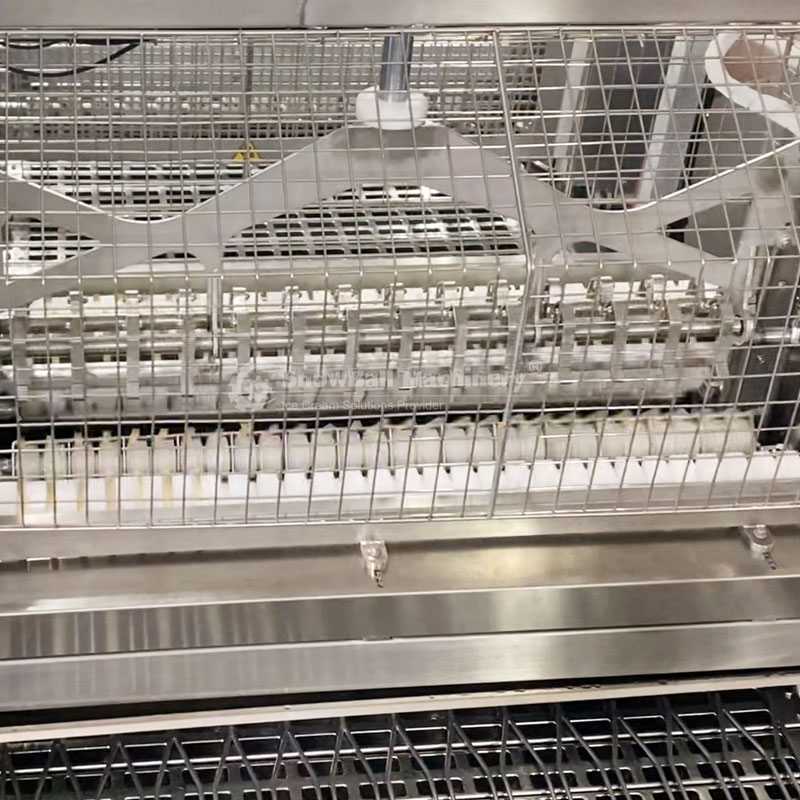
Upgrade projects often add workstations to an existing line rather than replacing the whole plant.
What the Market Data Does and Does Not Say
Stratview Research values the global ice cream processing equipment market at USD 2.4 billion in 2025, and IMARC Group estimates North America at more than 42.0% of that market in the same year. Both are commercial research estimates covering industrial processing equipment, not consumer or retail display cabinets. They are useful for judging category scale and regional weight; they are not a ranking of suppliers and say nothing about any single machine's performance.
ISO 22043:2020 sets classification, requirements and test conditions for ice-cream freezers, including dimensional requirements for transparent lids. It is a reference point for freezer classification, but it does not replace line-level acceptance testing agreed between buyer and supplier. Buyers should write the test conditions and acceptance method into the technical agreement rather than cite a standard number alone.
Format-Led Selection Versus Machine-First Buying
Machine-first buying starts with an 'ice cream machine' enquiry, collects quotations for individual units and then tries to connect them. The risk is interface mismatch: a freezer sized for one filler, a hardening tunnel that cannot keep pace with the extruder, or a certificate scope that does not cover the delivered configuration. Format-led selection starts from the product, narrows to the machine family, and then checks capacity, compliance and references against that family.
The boundary is product uncertainty. If the SKU range is not yet settled, the better sequence is product design and a small trial batch before locking the main machine, because a line built around a format the market rejects is expensive to repurpose.
Outlook for Buyers
Three structural signals are visible in the available data: continuous freezers remain the line's hub at roughly 29.4% of the type segment, North America remains the largest regional market at more than 42.0%, and project references show demand for flexible filling and robotic options where labour is constrained. These are observations about market structure and completed projects, not forecasts of growth.
The practical implication is to specify expansion interfaces at the outset. A line configured with modular sections and documented utilities can add capacity or a new format later; a line built to a single fixed format usually cannot. Buyers evaluating Snowball Machinery should also clarify one point during due diligence: the company profile cites more than 30 years of experience in the ice cream machinery industry, while the registered company dates from 2020, so the experience claim should be read as team and industry background and confirmed against the specific project team proposed.
FAQ
What is the difference between SNL molded stick lines and SNEX extrusion lines?
SNL forms product in moulds and is built around stick and bar formats; SNEX extrudes mix through a die and hardens it in a tunnel, which suits cut, layered and shaped products without a stick. The choice follows the target product portfolio rather than a general preference for one technology.
How should a buyer choose among the SNCF 50, 300, 600, 1200 and 1500 L/h models?
Start from required daily output, product mix and peak demand, then match freezer capacity to downstream filling or extrusion speed. A freezer above downstream capacity adds buffer but not throughput; one below it becomes the bottleneck.
What role do SNLU and SNFU optional units play?
They extend an existing line with additional units and supply spare parts for maintenance. Compatibility depends on the host model and year, so they are best specified together with the main machine rather than added afterwards.
Does CIP in the SNM mixer reduce changeover time?
CIP supports cleaning between batches and flavours, and its effect on changeover depends on circuit design, cleaning steps and validation. Buyers should ask for the CIP coverage scope and procedure instead of assuming a fixed changeover time.
What information is needed to specify a turnkey SNP line?
At minimum: target SKUs and formats, required output, workshop layout and utilities, automation level, destination-market compliance requirements and the intended expansion path. Snowball Machinery's customization starts from production scale, product positioning, product design and workshop conditions.
Working With Snowball Machinery
Snowball Machinery describes itself as an integrated ice cream equipment manufacturer covering R&D, manufacturing, assembly, commissioning, export and after-sales service. The stated one-stop service spans premix, HTST, batch pasteurising, ageing, CIP, continuous freezing, ingredient feeding, moulding, filling, hardening, extrusion, robotic filling, sandwich, cake, packing and cartoning. Minimum order quantity is one set, reported monthly capacity is 100 sets, lead time depends on the specific equipment plan, and quality control includes full-process control and 100% testing. After-sales support covers on-site installation and commissioning, equipment upgrading, maintenance, fault handling, spare parts supply, regular inspection and global response.
For evaluation enquiries, the company can be reached at ice@hiicecream.com or ice@snowballmachinery.com. The company website is icecreammachinemanufacturer.com, and the product brochure is available for download below.
Download the Snowball Machinery ice cream equipment brochure (PDF)
Have Questions or Need More Details?
Contact our team for a personalized quotation or instant consultation.
Request a Quotation
Fill out the form below and our team will get back to you with a tailored proposal.

LINE Direct Chat
Prefer to chat in real-time? Message us on LINE for instant assistance & quick answers.
- Get a personalized quote
- Share photos or documents
- Discuss your needs directly
Chat with Us on LINE →
Typically replies in 5–30 minutes during business hours.