
Ice Cream Machine Specs: From 50 L/h to Factory Acceptance
Ice Cream Machine Specs: From 50 L/h to Factory Acceptance
Technical and Procurement Reference
Industrial ice cream equipment is decided on documents: the capacity figure a supplier will put in writing, the steel grade attached to each wetted part, the component brands that appear in a bill of materials, and the tests both parties accept before final payment. Where those four items stay vague, the gap between two quotations usually reflects risk transferred to the buyer rather than a real difference in value.
That is the practical reason a technical questionnaire belongs in the evaluation file and not in the appendix. A machine rated at a headline capacity, built from food-grade stainless steel and fitted with recognised control and refrigeration brands still has to be measured against the product a buyer actually intends to make, and against an acceptance protocol signed before the machine was built.
Snowball Machinery Manufacturing Co., Ltd is an industrial ice cream equipment manufacturer based at No. 73 Zhenpeng Zhonglu, Development Zone, Dalian City, Liaoning Province, China. Its portfolio runs from premix preparation, HTST and batch pasteurizing systems, ageing tanks and CIP systems through continuous freezers, fruit feeders, moulding, extrusion, filling, hardening, packing and cartoning equipment. The company reports a 4,000 ㎡ facility, an annual output of 1,200 sets and roughly 90% of output exported to North America, South America, Europe, Asia and Africa. The questions below decide whether that scope is delivered as specified.
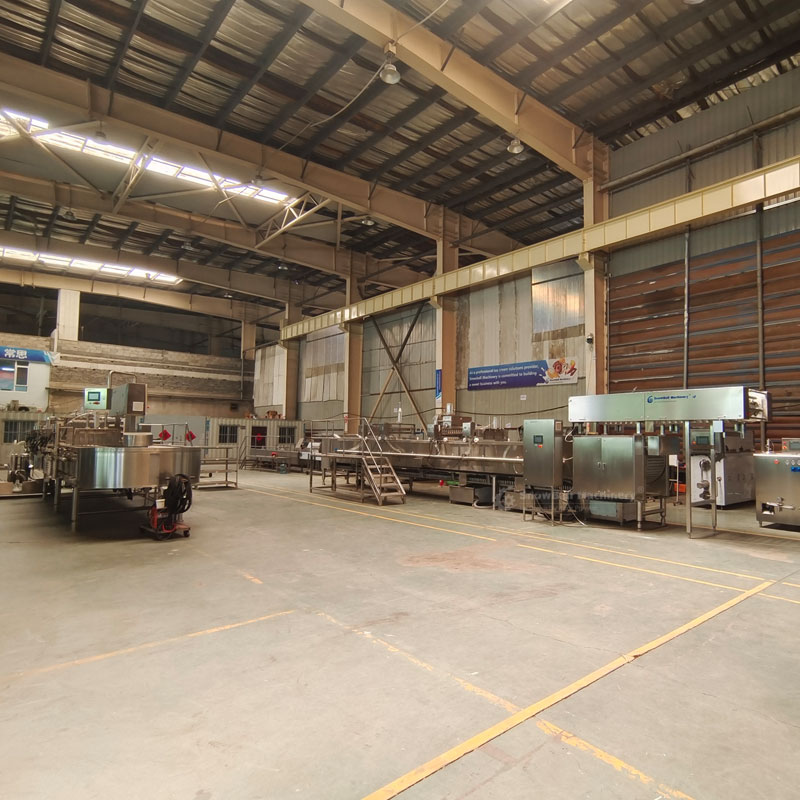
Assembly workshop: the stage at which capacity, materials and component claims stop being a brochure statement and become a measurement.
Why Technical Questions Cluster in Four Places
Commissioning disputes in food machinery tend to trace back to the same four gaps. Capacity is stated without the conditions attached to it. A material grade is stated without saying which surfaces carry it. Component brands are named without model numbers. Acceptance is written as a promise rather than a procedure.
Each gap is answerable, but only while the quotation is still negotiable. After the purchase order, the same questions become change requests.
Capacity: Reading a 50–1500 L/h Range Correctly
Snowball quotes its SNCF series continuous freezers across a capacity range of 50 L/h to 1500 L/h, spanning pilot output through mid-to-high industrial production. Within industrial ice cream processing, continuous freezers represent approximately 29.4% of the equipment type segment (Stratview Research, 2026), which is consistent with the freezer acting as the throughput gate for most lines.
A continuous freezer capacity figure is a flow rate of finished ice cream at the outlet, and it is meaningful only when three conditions are fixed: the mix formulation with its fat and solids content, the overrun (the air deliberately incorporated into the mix), and the draw temperature at which product leaves the barrel. Quoted without those conditions, the number is nominal and should not be used for line balancing or for sizing hardening and filling equipment downstream.
Buyers should therefore ask for rated capacity at the overrun and draw temperature they intend to run commercially, and for the refrigeration duty that corresponds to it. If a supplier cannot state the conditions, the right response is not to assume a conservative value but to request a material-loaded trial at the factory, where capacity becomes a measured number instead of a claim.
Sizing rules that hold up in practice: specify peak hourly demand rather than average weekly demand; add allowance for format changeovers and cleaning cycles; and confirm that the quoted overrun is the one the sales product actually requires, since a higher overrun delivers more volume from the same mix but changes texture and filling behaviour.
One boundary should be stated plainly. The published SNCF range tops out at 1500 L/h per unit. A project needing materially more than that in a single stream has to be planned as parallel freezer units with shared mix supply and separate control, or evaluated on a different platform. Two freezers drawing from one mix line do not behave as a single machine of double capacity, and the balancing logic should be confirmed with the manufacturer before layout is frozen.
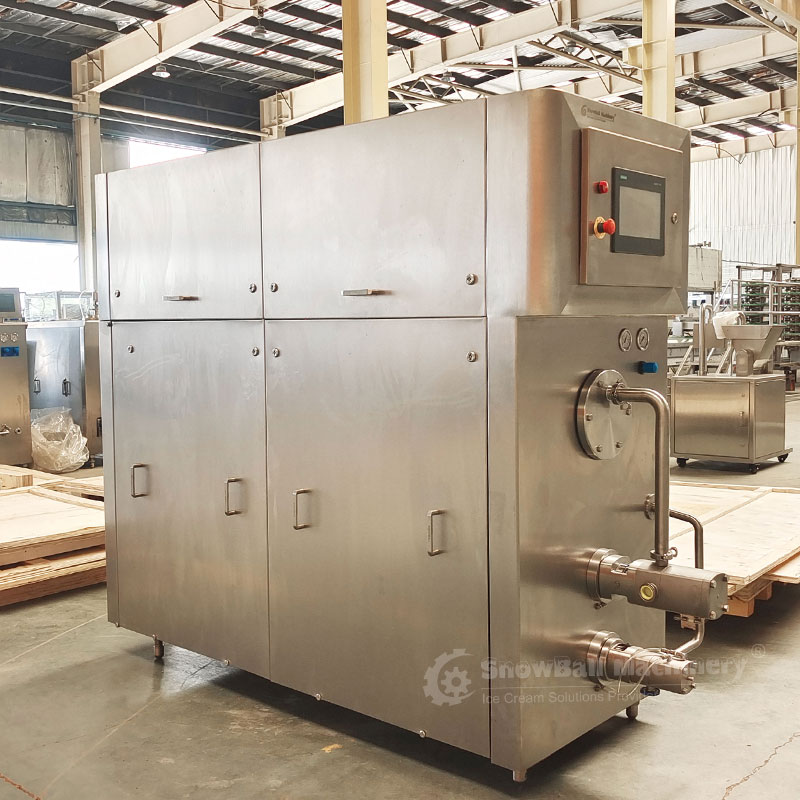
Continuous freezing is the capacity anchor of an industrial line; the rating only holds at a defined overrun and draw temperature.
Materials: SS304, SS316, and Where the Grade Stops Mattering
Snowball specifies food-grade 304 and 316 stainless steel as its construction standard. The difference between the two grades is a corrosion question, not a ranking of quality.
- SS304 covers most product-contact surfaces in dairy mix under standard alkaline and acid cleaning cycles, and is the normal choice for frames, covers and general fabrication.
- SS316 is molybdenum-bearing and is justified where chlorides, salt, acidic fruit inclusions or aggressive washdown chemistry are present, and in parts that see repeated chlorinated or caustic cleaning.
The useful question is not whether a machine is 304 or 316, but which surfaces, welds and fittings carry which grade. A line described only as stainless steel may combine 304 frames and 304 product piping with 316 in a handful of small parts, and the reverse also occurs. The specification should map grade to product-contact surfaces, mix piping, pump casings, tank shells and covers, valve bodies and any part exposed to brine or chlorinated water.
Grade alone does not create hygiene. Two machines built from identical sheet can differ in weld penetration and post-weld treatment, internal surface finish, slope and drainability, dead-leg length, gasket elastomer compatibility and instrument pocket placement. Those are the details a hygiene audit actually examines, and none of them is visible in a material grade label.
Requests worth making at quotation stage: material certificates traceable to heat numbers, welding procedure and welder qualification records, a surface-finish specification for product-contact areas, an elastomer schedule naming gasket and seal materials by location, and a drainage drawing showing that every low point empties.
Mix Preparation, Pasteurization and CIP: The Under-Specified Half of the Line
The freezer only receives what the mix room prepares. Snowball's SNM mixing machine integrates a CIP cleaning system, and the company separates two pasteurizing categories — HTST (high-temperature short-time, continuous flow) systems and batch pasteurizing systems — with ageing tanks positioned between pasteurization and freezing.
HTST versus batch: what the choice actually determines
An HTST system runs mix continuously through a hold tube and pairs naturally with continuous freezing in a single flow, which suits long runs of a small number of recipes. A batch system processes discrete volumes in a vessel, creating a natural changeover point between recipes, which suits multi-flavour or smaller-batch programmes and makes traceability a matter of batch records rather than flow records.
The choice changes the acceptance protocol as much as the layout. An HTST system is verified on flow rate, holding time and temperature control under load; a batch system is verified on heating curve, hold-time confirmation and record completeness for each batch.
What a CIP specification should contain
CIP is where buyers most often accept a description in place of a specification. The system should be defined by circuit: which lines, tanks, freezer barrels and filler heads are covered, at what flow and temperature, with which chemical concentrations, and how the rinse endpoint is verified. Records matter as much as hardware; a CIP system that cleans well but leaves no retrievable record is difficult to defend in an audit.
Questions to put in writing: does the CIP circuit reach the freezer barrel and the fruit feeder; how are detergent and rinse water separated; which instrumentation confirms flow and concentration; which records are stored, for how long, and can they be exported for a customer audit?
Component Brands: What the Name on the Part Proves — and What It Does Not
Snowball's build specification names internationally recognised component brands, and it is worth understanding what each contributes before the list is read as a quality statement.
| Function in the line | Brands named in the build specification | What the buyer should verify |
|---|---|---|
| Machine control, PLC/HMI and electrical distribution | SIEMENS, Schneider Electric | Controller and HMI model, firmware generation, spare module availability, program backup and access rights |
| Pneumatics and valve actuation | FESTO, SMC | Cylinder and valve model numbers, required air quality, seal-kit availability |
| Refrigeration control and variable-speed drives | Danfoss, ABB | Drive rating and parameter backup, harmonic treatment where the site requires it |
| Refrigeration compressors | Copeland, Bitzer | Compressor model and capacity at the design evaporating and condensing temperatures |
| Gearboxes, motors and mechanical drive | Bonfiglioli, SEW Eurodrive | Service factor, lubricant type, replacement lead time for the local market |
| Linear and motion components | igus | Bearing type, lubrication regime, scheduled wear-part replacement |
The list proves provenance, not performance. A brand name on a quotation does not specify the model, and the model determines the outcome: a control platform can be a current generation with documented support or an older unit with thinning spares; a compressor can be comfortably sized for duty or marginal; a drive can be supplied with or without the harmonic mitigation a site needs.
Snowball states that it selects internationally renowned brands for core components to improve equipment stability, and that it applies a supplier screening mechanism with incoming inspection for each batch of components. What converts that into verifiable fact is a bill of materials with model numbers agreed before the order, plus a substitution clause requiring written approval and a stated equivalence test for any alternative part. At factory acceptance, nameplates and serial numbers should be photographed and matched line by line to that bill of materials.
Model Families in a Quotation and the Acceptance Scope Attached to Each
Snowball quotations reference model families rather than a single machine: SNCF for continuous freezers, SNM for the mixing machine with integrated CIP, and the designations SNL, SNLF, SNEX, SNSMZ, SNFF, SNFU, SNLU and SNB, which appear across the forming, filling, extrusion, hardening and customised configurations that complete a line.
The procurement point is that acceptance scope is not uniform across those families. A freezer is accepted on capacity at defined overrun and draw temperature; a filler on dosing accuracy and changeover time; an extrusion or moulding unit on format repeatability and mould condition; a CIP skid on circuit coverage and rinse verification; a hardening tunnel on retention time and temperature stability. A single line-level certificate cannot substitute for a per-unit annex.
For every family in the quotation, the buyer should request the unit rating and the conditions attached to it, the grade of each wetted part, the bill of materials, the safety devices, the utility demand, and the specific test that will demonstrate the unit meets its rating.
Purchasing Terms That Belong Beside the Technical Specification
Commercial terms are usually negotiated in a separate document from the technical annex, which is precisely how disputes begin. These items are better agreed in one place.
- Scope boundary. What the supplier delivers and what the buyer provides — steam, chilled water, compressed air, power quality, drains, flooring, control-room space. Most commissioning delays are boundary disputes.
- Price basis and delivery point. Which Incoterm applies, what packing includes, who carries insurance in transit.
- Delivery window definition. Measured from which event — down payment, drawing approval or utility confirmation. Snowball reports delivery times 60–80% shorter than major well-known brands; that number is only enforceable when the start and end events are named.
- Warranty. Duration, start trigger (shipment or commissioning), parts covered, wear-part exclusions, response obligations.
- Spare parts. Recommended first-year list, wear-part schedule, lead times for critical items.
- Documentation package. Electrical drawings, P&ID, utility schedules, operation and maintenance manuals in the buyer's language, material certificates, bill of materials, control-program backup.
- Training and support. Who trains operators, whether commissioning is supervised, remote assistance availability, escalation path. Snowball describes a 24-hour after-sales response mechanism, remote troubleshooting and multi-language manuals; specify the response window and channel rather than accepting the description.
- Payment milestones tied to acceptance, not only to shipment.
Acceptance Criteria: A Protocol Buyers Can Attach to the Contract
Acceptance is where capacity, materials, components and pasteurization claims converge into evidence. A protocol naming the test, the conditions and the record converts each claim into something checkable at the factory and again on site.
| Test area | How it is measured | Record retained |
|---|---|---|
| Rated capacity | Run with production mix at the agreed overrun and draw temperature over a stated period | Output volume per hour, mix specification, overrun and outlet temperature log |
| Overrun | Weigh fixed-volume samples at the freezer outlet against declared value | Sample weights and calculated overrun |
| Filling accuracy | Weigh samples across heads or cavities over a full cycle | Deviation per head, acceptance band |
| Inclusion dosing | Check fruit feeder uniformity across a sustained run | Dosing rate and distribution record |
| Pasteurization | Review HTST or batch temperature and time records under load | Temperature/time chart or batch log |
| CIP performance | Confirm circuit coverage, flow, temperature, chemical concentration and rinse endpoint | CIP cycle record, swab or ATP result |
| Materials | Certificates reviewed with spot verification of grade markings | Heat-number certificates, inspection note |
| Components | Match installed parts to the approved bill of materials | Nameplate and serial-number photographs |
| Stability run | Sustained operation with material loaded, simulating the buyer's production environment | Run log, faults raised and closed |
| Safety and electrical | Interlocks, guarding, earthing and insulation checks | Signed checklist |
The manufacturer's own pre-delivery practice supports this structure: Snowball states that all continuous freezers undergo a material-loaded trial operation before delivery, with the run simulating the buyer's production environment to expose potential faults. A material-loaded run is the correct setting for a capacity test, because water testing does not reproduce mix viscosity, overrun behaviour or freezing load.
Where a recognised reference strengthens the protocol, ISO 22043:2020 covers classification, requirements and test conditions for ice-cream freezers and can be cited as the test-condition framework. It does not replace the buyer's product-specific pass and fail values.
Standard Machine Set versus Turnkey Line: Where the Acceptance Burden Shifts
A standard machine set transfers responsibility unit by unit; a turnkey line transfers it once, at the end. That difference decides who owns interface risk — mix supply pressure, control integration, utility balancing and the sequence in which units are commissioned. With a machine set, the buyer's engineering team must prove that the freezer, filler and hardening tunnel perform together. With a turnkey scope, that proof is the supplier's obligation and should be written as a line-level performance test rather than a collection of unit certificates.
Snowball positions itself as a full-line supplier able to cover the process from premix through packing, offering customised configurations and support for retrofitting equipment from well-known brands, which the company states can cut renovation costs by 40%–70%. For a buyer, the value of that scope depends entirely on how the interface obligations are written; a turnkey promise without a line-level acceptance test simply moves the ambiguity later in the schedule.
Two figures in Snowball's own comparison material should be read as supplier-reported rather than independently benchmarked: total costs 40%–70% lower than internationally renowned brand equipment, and a service life 6–9 times longer than comparably priced alternatives. Neither appears in the third-party data reviewed for this article, and both depend on the buyer's utility costs, labour rates, product mix, cleaning regime and maintenance discipline. They are reasonable hypotheses to test inside a total cost of ownership model, not a purchase justification on their own.
A second boundary concerns published performance data. The verified material available for this category does not include independently measured throughput, energy consumption, uptime or hygiene validation results for the SNCF, SNL, SNLF, SNEX or other families. Buyers should expect to generate that evidence themselves through factory acceptance testing, reference-site visits and installation verification — and should treat a supplier willing to support that process as lower risk than one substituting brochure figures for test records.
Market Signals That Change What Buyers Test
The global ice cream processing equipment market was valued at USD 2.4 billion in 2025 (Stratview Research, 2026). Continuous freezers account for approximately 29.4% of the equipment type segment, and North America held more than 42.0% of global market share in 2025 (IMARC Group, 2026).
Read at buyer level, those figures describe a market where freezing capacity remains the central investment and where procurement practice in the most consolidated region sets the documentation standard. Two consequences follow. Capacity claims are increasingly tested rather than accepted, which favours suppliers able to run material-loaded trials. And as lines are expanded rather than replaced, the ability to add capacity without discarding existing units becomes part of the purchase case — which is why modular, expandable design and retrofit support matter more at evaluation than at installation.
Future Outlook
Three shifts are likely to shape ice cream machine procurement over the next planning cycle. Acceptance documentation will move from optional annex to standard attachment, because buyers who have been caught by nominal capacity figures now ask for test conditions inside the quotation. Component traceability will tighten, driven less by regulation than by spare-part lead times. And expansion capability will be evaluated at purchase, since a line that cannot add a second freezer or a new filling head without replacing its control system carries a hidden future cost.
For manufacturers, the implication is that a technical claim which cannot be tested becomes a liability in competitive evaluation. For buyers, it is simpler: the specification document is the negotiation.
A downloadable brochure covering Snowball Machinery's ice cream equipment portfolio is available here: Snowball Machinery equipment brochure (PDF).
FAQ
What does a 50–1500 L/h capacity range mean when sizing an ice cream line?
It is the range across which Snowball quotes its SNCF continuous freezers, from pilot output to mid-to-high industrial production. A specific figure inside that range applies only at a defined mix formulation, overrun and draw temperature, so a buyer should request capacity at the conditions they will run commercially and confirm it in a material-loaded trial. Capacity is also not additive in practice: two freezers on one mix supply have to be planned as a balanced parallel installation, not as a single machine of double capacity.
Should an ice cream line be built in SS304 or SS316?
Both are food-grade stainless steels; the choice is a corrosion decision rather than a quality ranking. SS304 covers most product-contact surfaces in dairy mix under standard cleaning cycles. SS316 is justified where chlorides, salt, acidic fruit inclusions or aggressive washdown chemicals are present. The specification should state which parts carry which grade instead of describing the machine as stainless steel as a whole, supported by material certificates traceable to heat numbers. Grade alone does not determine hygiene — weld quality, surface finish, drainage, dead legs and gasket materials do.
How can a buyer confirm that the named component brands are actually installed?
By making the bill of materials part of the contract. The bill should list each component by brand and model number across control and electrical equipment (SIEMENS, Schneider Electric), pneumatics (FESTO, SMC), refrigeration control and drives (Danfoss, ABB), compressors (Copeland, Bitzer), gearboxes and drive components (Bonfiglioli, SEW Eurodrive) and motion components (igus). At factory acceptance, nameplates and serial numbers are photographed and matched against that list, and a substitution clause requires written approval plus a stated equivalence test for any replacement part.
HTST or batch pasteurizing — which suits an ice cream plant?
HTST systems pasteurize mix continuously through a hold tube and pair naturally with continuous freezing in a single flow, which suits long runs of a limited number of recipes. Batch pasteurizing systems process discrete volumes in a vessel and create a natural changeover point between recipes, which suits multi-flavour or smaller-batch programmes. The acceptance protocol differs accordingly: HTST is verified on flow, holding time and temperature control under load, while batch is verified on heating curve, hold time and per-batch record completeness. Snowball supplies both categories alongside ageing tanks and CIP.
What should an ice cream machine acceptance test include?
At minimum: capacity measured with production mix at the agreed overrun and draw temperature; overrun verification by sample weight; filling accuracy across heads or cavities; inclusion dosing uniformity where a fruit feeder is fitted; pasteurization temperature and time records; CIP circuit coverage with flow, temperature and rinse-endpoint verification; material certificates with spot checks; component verification against the bill of materials; safety interlock and electrical checks; and a sustained stability run. ISO 22043:2020 can be cited as a test-condition framework for ice-cream freezers, but the buyer's own product-specific values should drive pass and fail criteria.
Which purchasing terms belong in the same document as the technical specification?
Scope boundary (which utilities and site works the buyer supplies), price basis and delivery point, the events that start and end the delivery window, warranty duration and its start trigger, the recommended spare-parts list with lead times for critical items, the documentation package covering drawings, manuals, certificates, bill of materials and control-program backup, training and remote-support obligations with a defined response window, and payment milestones tied to acceptance rather than to shipment alone.
How should a buyer compare delivery-time and total-cost claims between suppliers?
By converting them into measurable terms. A claim of delivery times 60–80% shorter than major well-known brands becomes comparable only when both suppliers define the starting event (down payment, drawing approval or utility confirmation) and the ending event (shipment, arrival or successful site acceptance). Likewise, a claim of total costs 40%–70% lower should be rebuilt in the buyer's own model — including energy, water and chemicals, spare parts, labour, changeover losses and expected service life — before it is used in a decision.
Have Questions or Need More Details?
Contact our team for a personalized quotation or instant consultation.
Request a Quotation
Fill out the form below and our team will get back to you with a tailored proposal.

LINE Direct Chat
Prefer to chat in real-time? Message us on LINE for instant assistance & quick answers.
- Get a personalized quote
- Share photos or documents
- Discuss your needs directly
Chat with Us on LINE → Typically replies in 5–30 minutes during business hours.