
Impact Crusher in a Stone Crushing Production Line: Roles and Limits
A stone crushing production line turns quarried rock into graded aggregate and manufactured sand through a fixed sequence of duties: feeding, primary crushing, secondary crushing, screening and, where the product mix requires it, sand making and washing. The impact crusher most often occupies the secondary stage. It is not chosen because it can crush everything, but because it produces a particular result: a cubical particle shape from medium-hard, brittle rock, at a lower purchase cost than compressive-crushing alternatives. Knowing where that advantage ends is what separates a line that holds its specification from one whose wear-part bill grows faster than its output.
An impact crusher breaks rock by impact rather than by compression. The PF series impact crusher is classified as impact crushing equipment for stone crushing production lines, and model PF-1315 is identified within that series. The classification is worth reading literally: an impact crusher is a stage machine, not a standalone solution. Its performance is set by the feed the primary crusher delivers, the screen that closes the circuit behind it, and the abrasiveness of the deposit itself.
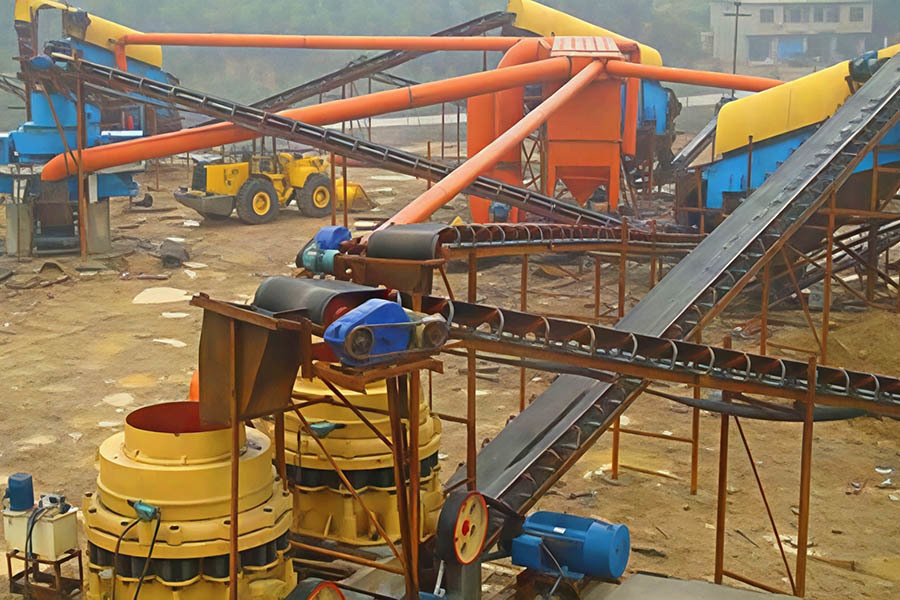
Aggregate production site: a secondary crushing stage only performs as well as the feed, screening circuit and material characteristics around it allow.
What an impact crusher does, mechanically
Material enters the rotor zone and is accelerated by high-speed blow bars, then thrown against impact plates. After rebound, particles collide repeatedly with the blow bars and plates until they are small enough to pass the gap between the impact plates and the rotor. Discharge size is therefore controlled mainly by adjusting that gap, a mechanical setting rather than a screen change or a closed-side-setting adjustment.
Two PF models are commonly specified in mid-size aggregate lines. Their published parameters frame the working range of the series:
| Parameter | PF-1214 | PF-1315 |
|---|---|---|
| Equipment type | Impact crusher, PF series | Impact crusher, PF series |
| Rotor | Φ1250 × 1400 mm | Φ1320 × 1500 mm |
| Maximum feed size | 400 mm | 500 mm |
| Capacity | 80–180 t/h | 100–250 t/h |
| Motor power | 132–160 kW | 160–200 kW |
| Housing and main wear part | Carbon steel housing, high-chromium alloy blow bar | Carbon steel housing, high-chromium alloy blow bar |
| Typical applications | Limestone quarry, construction waste recycling | Large aggregate plant, highway construction |
Two consequences follow directly from the mechanism. First, the reduction ratio is high for a secondary machine: commonly quoted at 10–20 for impact crushers, against roughly 20–40 for a single-stage hammer crusher. A well-matched primary stage can therefore feed a PF unit directly and still deliver a finished product after screening. Second, because the blow bars do the work, the abrasiveness of the feed, not its compressive strength alone, decides the wear bill.
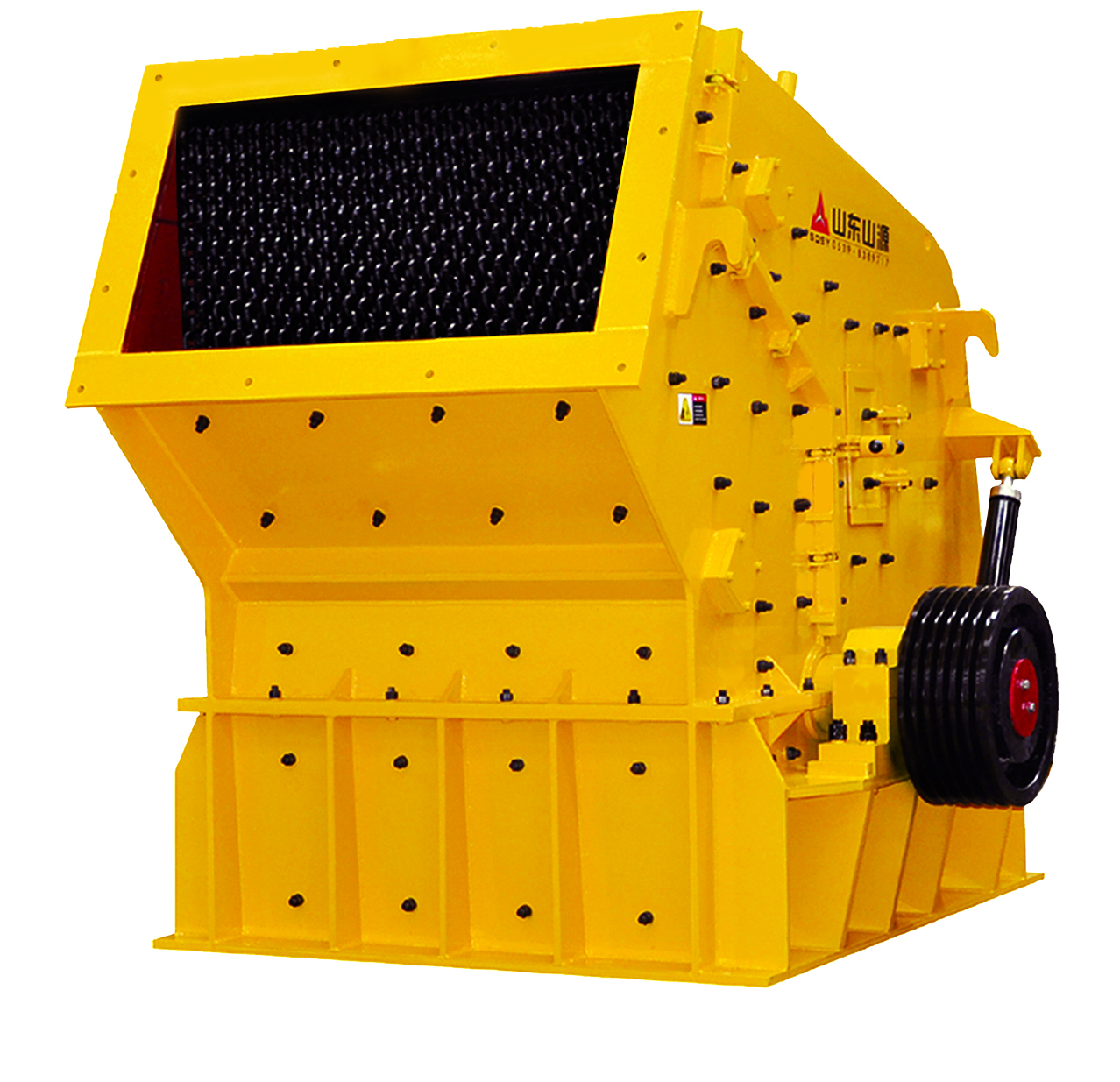
PF series impact crusher: rotor, blow bars and impact plates are the working elements of the secondary crushing stage.
Where the impact crusher sits in the line
A conventional fixed line runs in this order: vibrating feeder, primary jaw crusher, secondary impact crusher, circular vibrating screen, belt conveyors, and optionally a sand maker and sand washer. The feeder performs pre-screening as well as feeding, while the screen closes the circuit and returns oversize material to the impact crusher.
Capacity matching between those units matters more than any single machine nameplate, because a line runs at the speed of its weakest stage. Published technical guidance from Lianbang sets out four working rules:
- Feeder capacity = 1.1–1.2 × the rated capacity of the primary jaw crusher;
- Secondary crusher capacity = 1.0–1.1 × the actual output of the primary stage, not its rated output;
- Vibrating screen capacity = 1.2–1.3 × line capacity;
- Belt conveyor capacity = 1.2 × maximum instantaneous flow.
The distinction between rated and actual capacity is not pedantic. Rated figures are measured under ideal feed size, hardness and moisture conditions. In practice a line usually runs at 70–85% of rated capacity, and units are healthiest when they operate at 70–90% of rated load. Sizing a screen or conveyor on the nameplate number of the crusher ahead of it is one of the most common causes of material pile-up and rising recirculating load.
What a PF impact crusher is designed to process
Impact crushing performs best on medium-hard, brittle rock. Limestone is the classic case, typically described in the region of 80–150 MPa compressive strength: it cracks and breaks readily under impact, produces a cubical product with a low proportion of flaky particles, and generates comparatively few 0–5 mm fines. The PF-1214 is commonly applied to limestone quarries and construction waste recycling; the PF-1315, with its larger rotor and 500 mm maximum feed size, to larger aggregate plants and highway construction.
Construction and demolition waste is the second major application. The same impact mechanism tolerates mixed feed reasonably well, and mobile impact stations built on the PF-1214 host, such as the tyre-type YCG-I1214 rated at 100–180 t/h, are applied to limestone crushing and on-site construction waste processing.
The practical envelope published in Lianbang technical guidance is a feed compressive strength of up to about 350 MPa with moisture content not exceeding 8%. Those two conditions, hardness and moisture, define most of the selection problem.
Where an impact crusher stops being the right answer
The principal limitation of impact crushing is economic rather than mechanical. Blow bars are consumable, and consumption scales with abrasiveness. Published guidance puts blow bar life at roughly 3–6 months on limestone but only 1–2 months on granite. On hard, abrasive rock the same comparison is expressed as a cost of about RMB 2–5 per tonne for impact crushing against about RMB 0.5–1.5 per tonne for a cone crusher. Over a five-year window on hard rock, total cost of ownership for an impact crusher has been estimated at roughly 3–4 times its purchase price, against about 2–2.5 times for a cone crusher.
Other boundaries follow from the same logic:
- Hardness and silica content. Highly abrasive rock with high quartz content accelerates blow bar wear and is better handled by the laminated compression action of a cone crusher.
- Moisture. Feed moisture above roughly 8% risks build-up and blockage in the impact chamber. Hammer crushers are more sensitive still and are prone to clogging with wet, sticky material.
- Single-unit capacity. For capacities above roughly 300 t/h in one secondary unit, impact crushing is not the usual recommendation.
- Tramp metal. Feed carrying large quantities of metal impurities is problematic for an impact rotor.
- Buying on price alone. An impact crusher typically costs about 70–80% of an equivalent-capacity cone crusher at purchase. On hard rock, that saving is recovered as wear cost within the first years of operation.
Impact, hammer or cone: comparing the secondary-stage options
| Decision dimension | PF impact crusher | PC / PCX hammer crusher | PY / CS cone crusher |
|---|---|---|---|
| Crushing mechanism | Impact and rebound against plates | High-speed hammer impact | Laminated compression inside a crushing chamber |
| Best-fit feed | Medium-hard brittle rock, construction waste | Brittle, low-abrasion material such as limestone and coal gangue | Medium-hard and harder, abrasive rock |
| Particle shape | Cubical, low flaky content | More fines and over-crushing | Uniform but with more flaky particles; VSI shaping improves it |
| Reduction ratio | Approximately 10–20 | Up to roughly 20–40 in one stage | Moderate, normally achieved in stages |
| Main wear part | High-chromium alloy blow bar | High-manganese or composite hammer | High-manganese mantle and concave |
| Wear life reference | About 3–6 months on limestone; 1–2 months on granite | About 1–4 months depending on abrasiveness | About 3–6 months, longer on hard rock than impact blow bars |
| Moisture tolerance | Up to about 8% | Low: wet, sticky feed causes clogging | Not suited to soft or sticky material |
| Avoid when | Hard abrasive rock; single-unit capacity above about 300 t/h; metal in feed | High-silica limestone; wet feed; high-grade concrete aggregate as the only crusher | Feed above about 300 mm; sticky material; first-stage duty |
The decision rule that follows is straightforward. For hard rock such as granite and basalt, use a jaw crusher for primary crushing and a cone crusher for secondary and tertiary duty, adding a VSI machine if particle shape needs correction. For medium-soft limestone where shape matters, a jaw plus PF impact combination is usually the better economic fit. Where the priority is a high reduction ratio and lower investment, with tolerance for a flatter product, a PC or PCX hammer crusher is the alternative. For expressway and high-speed-rail aggregate, published guidance points to a cone plus VSI shaping combination, and the same principle applies to basalt and granite aggregate production lines.
Operation and maintenance: the checks that protect uptime
Most impact crusher failures are not sudden. They present first as vibration. Published troubleshooting guidance treats horizontal or vertical vibration above about 4 mm/s, loosening or breaking foundation bolts, rising bearing-housing temperature and a dull or metallic operating sound as one symptom cluster, with a defined order of checks:
- Reduce load or stop; inspect and re-torque foundation bolts and damping pads to standard values, typically 350–500 N·m.
- Open the top cover and inspect blow bars; replace in pairs when the weight difference within the same circle exceeds 50 g, marking installation positions.
- Check rotor bearing clearance and grease condition; replace bearings if required.
- Confirm the feed chute is centred and adjust guide plates so material is distributed evenly across the rotor width.
- Check motor-to-machine coupling alignment with a dial indicator: radial and axial deviation within 0.1 mm.
- Send the rotor for dynamic balancing after extended service if imbalance persists.
Preventive practice is equally specific. Install blow bars symmetrically by number and lock them after each replacement. Inspect foundation bolts and damping pads every 200 hours, and schedule rotor dynamic balance inspection every 2,000 hours. Keep the feed chute centred, use the specified grease, and escalate to the manufacturer when the rotor shows cracks, blow bar seats are damaged, vibration continues after a blow bar change, or bearing temperature exceeds 80 °C.
Mobile impact crushing stations: a configuration question, not a crusher question
Whether the secondary stage should be fixed or mobile is decided by the project, not by the machine. Published guidance frames it this way: mobile plants suit short-duration projects, commonly under two years, with frequent relocation, difficult road access, dispersed material sources or tight environmental approval conditions. Fixed lines suit long-life quarries operating beyond roughly three years, capacities above about 300 t/h, stable grid power and the lowest cost per tonne.
The trade-offs are structural. A mobile unit integrates crusher, feeder, screen and conveyors on a chassis, needs no concrete foundation and can be repositioned quickly, but single-unit capacity is generally lower than a fixed line and tyre, fuel and transport costs are additional operating items. Where a mobile unit is used to crush rock or reprocess construction materials, safety requirements and verification are addressed by ISO 21873-2:2019.
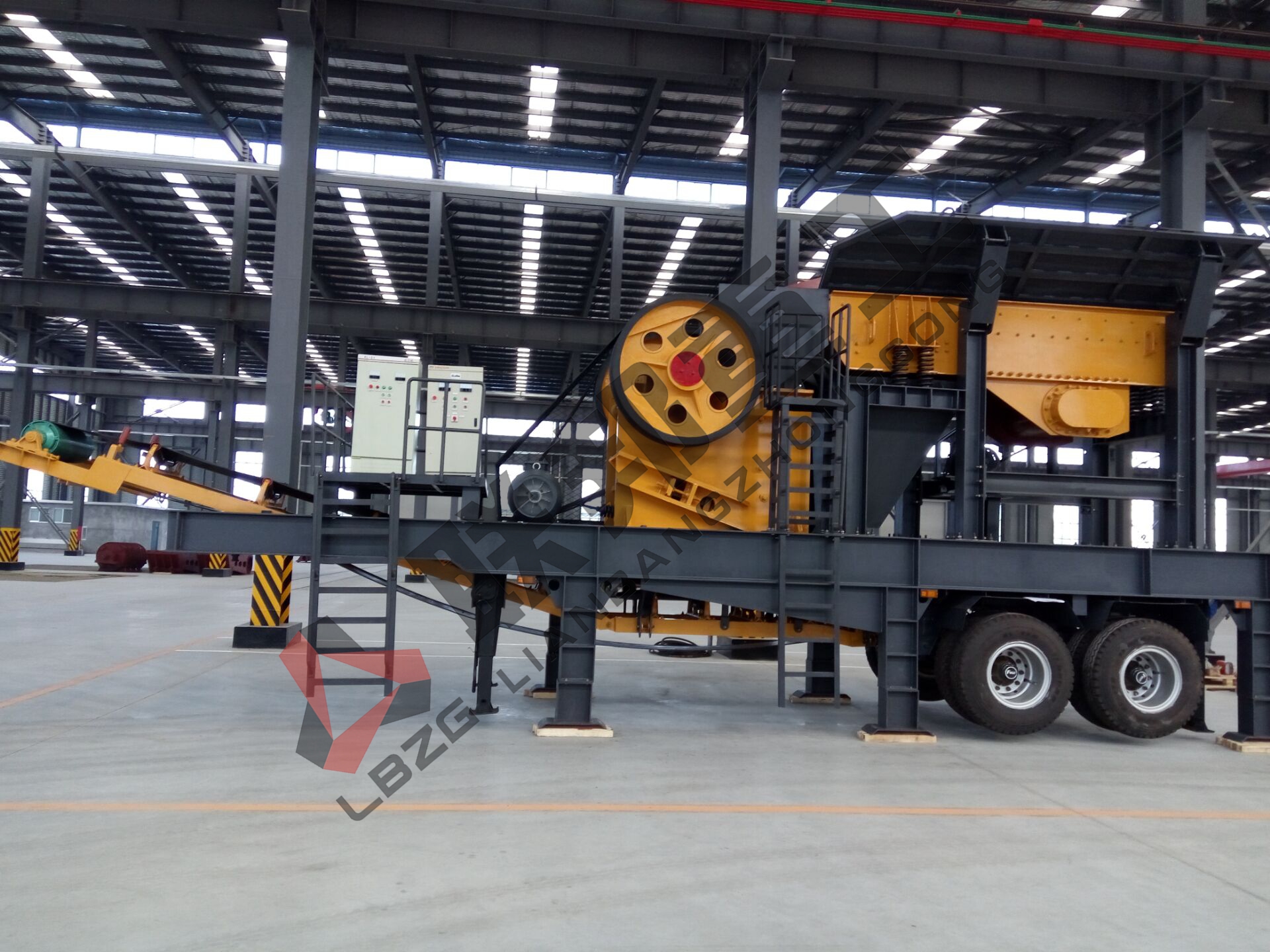
A trailer-mounted mobile crushing station: the alternative to a fixed secondary stage where the material source moves.
Lianbang supplies the YCG-I1214 tyre-type mobile impact crushing station, built on the PF-1214 host with a rated capacity of 100–180 t/h for limestone crushing and construction waste mobile processing. It is one configuration within a wider mobile range that also covers jaw, cone, sand-making and screening stations.
The market context behind the equipment choice
The category the impact crusher belongs to is large and internationally traded. Commercial research published by Market Research Future estimates the global stone crushing equipment market at USD 8.47 billion in 2024. Trade data tells a complementary story: the Observatory of Economic Complexity reports that China was the leading exporter of machines to crush or grind stone, ores and minerals (HS 847420) in 2024, with exports valued at USD 1.38 billion. On the demand side, the United States Geological Survey, cited in a Research Nester market report, records US crushed stone production of 1.5 billion tons in 2023 valued at more than USD 24 billion. That contrast is useful for buyers: equipment spend is a small fraction of the value of the material the equipment produces, so downtime and wear cost dominate the economics of a line far more than purchase price.
Product-level data shows how the stage hierarchy shapes the market. Polaris Market Research estimates that jaw crushers held a 35.2% share of the crusher market in 2025, reflecting their role as the primary crushing stage in most fixed lines. Impact crushers occupy the stage behind them, and their share of that secondary duty depends on deposit type and product specification rather than on category growth.
Two cautions apply to these figures. Published growth forecasts for the same category differ materially, with some estimates clustering around mid-single-digit annual growth and others approaching double digits; a large part of the difference comes from whether parts and service revenue is included in the base. And market-level numbers say nothing about whether an impact crusher suits a specific deposit. That question is answered by feed testing, wear-part economics and circuit design.
Regulation is also moving. Summaries of China revised mandatory energy efficiency standards indicate that standby power limits are being extended to industrial machinery from 2026, an indirect signal that energy consumption of crushing and screening equipment is becoming a purchasing criterion rather than a footnote.
Supplier-side context
The PF impact crusher range discussed here is manufactured by Shandong Lianbang Heavy Industry Co., Ltd., a crushing equipment manufacturer based in Linyi, Shandong Province, China, operating under the brand trademark Shanyuan LBZG. The company was registered in 2013, with technical origins traceable to Chengming Machinery, an affiliated enterprise established in 1996. It operates two production bases covering about 120,000 m² in total, including 40,000 m² of standard workshops and more than 150 sets of processing equipment, with roughly 110 on-the-job employees including over 40 R&D personnel and a registered capital of 50 million Yuan.
Its verification profile includes ISO 9001 quality management, ISO 14001 environmental management and OHSAS 18001 occupational health and safety system certification, together with CE export certification for foreign trade projects. The company states that it participates in revising national industry standards for crushers, and its published honours include National High-tech Enterprise (re-recognised in 2023), Shandong provincial Specialised, Refined, Differential and Innovative SME status, municipal-level engineering laboratory and enterprise technology centre status, and a provincial One Enterprise, One Technology R&D centre.
For buyers, the relevant point is not the list itself but what it enables: documented quality management, traceable wear-part sourcing for blow bars and liners, and a service footprint that matches the company export mix of roughly 30% of output, concentrated in the Middle East, Central Asia, Southeast Asia and infrastructure-focused African markets. Line configuration work for the impact crusher stage is normally driven by three inputs from the buyer, namely rock type and abrasiveness, maximum feed size, and target capacity in tonnes per hour.
Future outlook
Three shifts are likely to shape how impact crushers are specified in the next planning cycle. The first is material quality pressure: as high-grade aggregate specifications tighten for infrastructure and ready-mixed concrete, the value of cubical particle shape rises, which favours impact crushing in medium-hard rock and combination flows such as cone plus VSI in hard rock. The second is the growing share of manufactured sand and recycled construction waste in the feed mix, both of which place a premium on circuit flexibility rather than on a single crusher specification. The third is operating-cost transparency: buyers increasingly compare wear cost per tonne and total cost of ownership at tender stage rather than purchase price, which is exactly the comparison in which an impact crusher wins on limestone and loses on granite. None of these trends changes the underlying rule. The right secondary crusher is the one whose wear economics match the deposit it will spend the next decade processing.
Frequently asked questions
What is an impact crusher, and where does it sit in a stone crushing production line?
An impact crusher is a secondary or tertiary crusher that breaks rock by impact: high-speed blow bars accelerate material and throw it against impact plates, and repeated rebound collisions reduce it until particles pass the gap between the plates and the rotor. In a stone crushing production line it normally sits after the primary jaw crusher and before the vibrating screen, accepting prepared feed of up to 400 mm on a PF-1214 and up to 500 mm on a PF-1315, and producing a cubical product for the sizing screen. It is a stage machine rather than a complete production line.
Which materials suit a PF impact crusher, and when should a different secondary crusher be used instead?
Impact crushing suits medium-hard brittle rock such as limestone, and it is also applied to construction and demolition waste. Published Lianbang technical guidance places the practical envelope at a feed compressive strength of up to about 350 MPa with moisture not exceeding 8%. Hard, highly abrasive rock such as granite and basalt is better served by a cone crusher, whose laminated crushing action and high-manganese or high-chromium wear parts last longer under abrasion. Hammer crushers tolerate less moisture and less silica than impact crushers, and single-stage impact crushing above roughly 300 t/h, or feed containing large amounts of metal impurities, is generally not recommended.
What capacity and power do the PF-1214 and PF-1315 models deliver?
The PF-1214 is specified with a Φ1250 × 1400 mm rotor, a maximum feed size of 400 mm, a capacity range of 80–180 t/h and 132–160 kW drive power, and is typically applied to limestone quarries and construction waste recycling. The PF-1315 is specified with a Φ1320 × 1500 mm rotor, a maximum feed size of 500 mm, a capacity of 100–250 t/h and 160–200 kW, and is typically applied to larger aggregate plants and highway construction. Both use a carbon steel housing and high-chromium alloy blow bars as the main wear part. These are rated figures measured under ideal conditions; actual throughput is affected by material hardness, feed size, moisture and wear state, and in practice lines often run at 70–85% of rated capacity.
Why does an impact crusher start to vibrate and loosen its foundation bolts?
Strong vibration combined with loosening foundation bolts, rising bearing-housing temperature and a dull or metallic operating sound usually indicates rotor imbalance or uneven blow bar wear, with loose or aged foundation bolts and damping pads as contributing causes. Uneven or segregated feed and misalignment between motor and machine shaft can also be involved. First checks are to reduce or stop load, re-torque the foundation bolts to standard values of typically 350–500 N·m, inspect the blow bars and replace them in pairs when the weight difference within one circle exceeds 50 g, check rotor bearing clearance and grease, centre the feed chute, and verify coupling alignment to within 0.1 mm radial and axial deviation. Rotor dynamic balancing requires specialist equipment and is normally performed at the factory or by a qualified service provider.
When is a mobile impact crushing station a better choice than a fixed secondary crushing stage?
Mobile plants suit projects with a short duration, commonly under two years, frequent relocation, difficult road access, dispersed material sources or strict environmental approval conditions. Fixed lines generally win on long-life quarries operating beyond roughly three years, capacities above about 300 t/h, stable grid power and the lowest cost per tonne. As one example of the mobile option, the Lianbang YCG-I1214 tyre-type mobile impact crushing station is built on the PF-1214 host with a rated capacity of 100–180 t/h and is applied to limestone crushing and construction waste mobile processing. Single-unit capacity is generally lower than a fixed line, and tyre, fuel and transport costs are additional operating items. Safety requirements and verification for mobile crushers used on rock or construction materials are addressed by ISO 21873-2:2019.
Product and company brochure (PDF, publicly accessible): Shandong Lianbang Heavy Industry brochure.