
Import Export Data: How Distributors Assess a New Category
Import Export Data: How Distributors Assess a New Category

Cover: market and competitor analysis views used to compare import activity across candidate countries.
A distributor that adds a product category is not making a marketing decision. It is committing warehouse space, working capital, sales training and a margin structure to a bet that goods will keep moving through its territory for several years. The cheapest way to test that bet before the first purchase order is to read what has already crossed borders: which products were imported, by which companies, in what volumes, and how recently.
Tendata AI Global Market Intelligence Solution is an AI-powered platform that uses global trade data, company-level intelligence and AI analysis to identify buyers and suppliers, built for importers and exporters who need evidence of actual trading behaviour rather than general commentary. This article follows a single distributor decision — should we enter this category? — and marks, gate by gate, what trade records can settle and what they cannot.
A category decision is usually made on the wrong evidence
Ask a distributor how it last evaluated a new category and the answer is usually a mix of search-engine research, public trade statistics, industry reports, B2B platform listings and, occasionally, a commissioned study. Each source has a place, and each has a documented gap: fragmented data, limited company-level intelligence, no view of real trade behaviour, slow manual research, difficult cross-country comparison, and figures that may already be out of date by the time they are read.
The result is a familiar pattern. The category looks attractive in aggregate, yet the distributor cannot say which companies in its territory already import it, whether those companies buy repeatedly, or which suppliers they currently use. The decision then rests on distributor instinct and supplier enthusiasm, neither of which appears in a shipment record.
Trade records invert that sequence. Before any commitment, a distributor can check whether a category is genuinely traded into the target market, how many companies are active in it, and whether activity is steady or intermittent across periods. That is a narrower claim than the market is growing, and a far more useful one at the evaluation stage.
The situations that trigger this work are specific: entering a new international market, evaluating a product-market opportunity, comparing demand across countries, analysing import and export trends, finding major buyers and importers, benchmarking competitors, and validating demand before sales resources are allocated. A distributor weighing a new category usually hits several of these at once, which is why the work tends to fragment across teams, spreadsheets and quarterly deadlines.
What the platform holds, and why coverage matters to a distributor
Tendata provides import and export data covering 228+ countries and regions, with more than 10 billion real and verifiable trade records, fully integrated with Tendata AI. The data covers 230+ very different industry segments and includes 500+ million in-depth company records, alongside access to 850+ million verified business contacts that carry decision-maker job titles, phone numbers, email addresses and professional profiles.
Tendata (Shanghai Tendata Tech Co.,ltd) was founded in 2005 and is headquartered in Shanghai. Its trade data is sourced from customs authorities, commercial databases and internet databases, and updates can be as frequent as every three days. Company names, quantity units and other fields are standardised to reduce duplicate or inconsistent records — a detail that matters more than it sounds, because a category screen built on unmerged company names overstates the number of importers and splits one buyer's volume across several entries.
For a distributor, coverage is a screening filter rather than a headline. A single-market dataset tells you what happened in one country; it cannot tell you whether that country is typical. Comparing three or four candidate markets on the same product definition requires records from all of them, expressed in comparable units.
One boundary belongs here rather than in a footnote. Because records come from several source types, the fields available differ by market. Before relying on a country comparison, a distributor should confirm which fields the target market actually publishes — importer name, volume, value, supplier — and treat a missing field as missing information, not as evidence that activity does not exist.
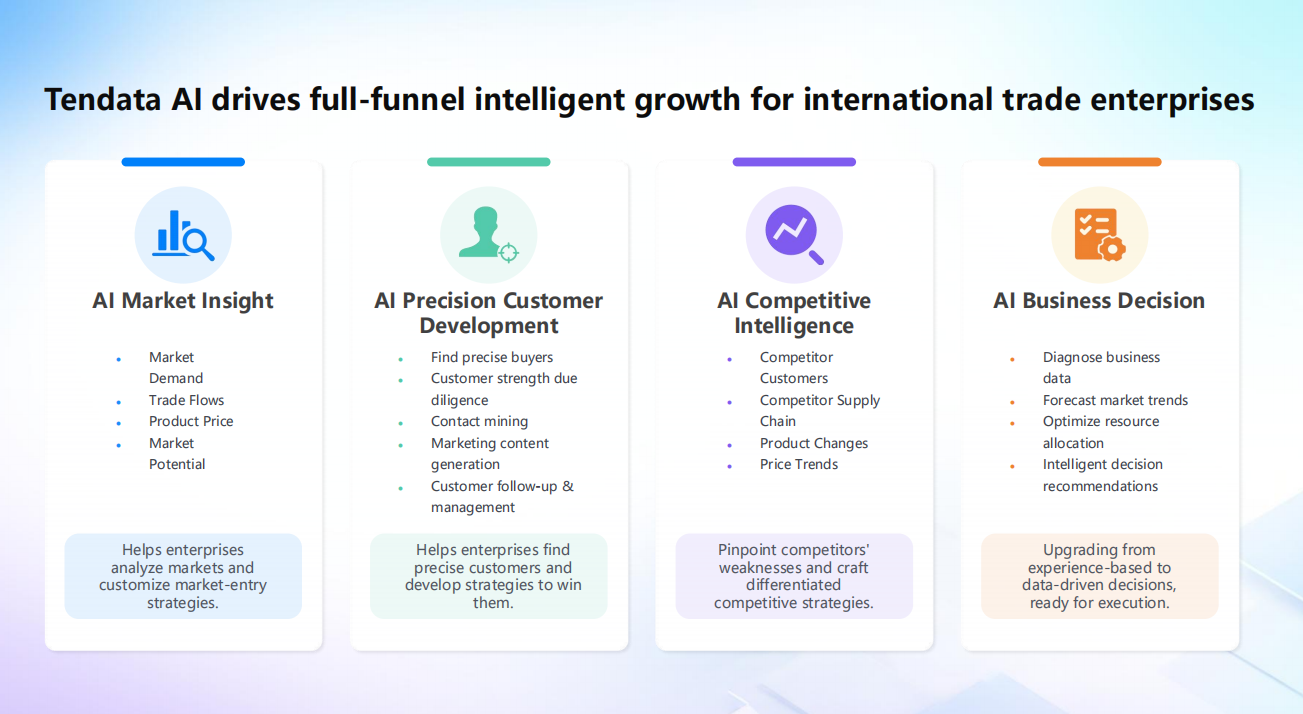
Tendata AI combines the trade database with large language models to generate market analysis on demand.
Gate 1 — Name the category in HS codes before comparing anything
Category definitions are commercial; trade records are classified. The same physical product can sit under more than one HS code, and a code that is too narrow hides real demand while one that is too broad mixes unrelated products into a single figure.
Tendata's T-Info supports searches by HS code, product name or company name and offers 17 report models, producing buyer lists, supplier lists, country-of-origin lists and destination-country lists. Tendata AI can generate a global market analysis report from a product name or HS code, which gives a distributor a first read on which codes carry volume in which markets before any purchase is contemplated.
The practical discipline is to write the category in two or three candidate codes, run the same screen for each and compare. If the results diverge sharply, the definition is usually the problem rather than the market. Code assignment should be settled with the supplier and, where duty treatment matters, with a customs broker: trade data reports classification, it does not authorise it.
Gate 2 — Compare candidate markets on one shared definition
Country selection is where distributor category decisions most often go wrong, because each market tends to be researched with a different method, at a different time, using a different definition. T-Insight generates market analysis reports from a product name or HS Code and analyses four perspectives — customers, competitors, markets and products — through more than 100 interactive visualisations. Used consistently, the same query can be run across candidate countries so that the comparison rests on one definition and one period.
What that produces is a structured ranking of import activity, not a recommendation. A market with large import volumes may already be worked by established distributors; a smaller market may show fewer active importers and less competition for shelf space. The distributor's task at this gate is to keep both facts visible while narrowing to two or three markets worth deeper work.
| Distributor question | What the record set can show | Check before acting |
|---|---|---|
| Is this category already imported into my target country? | Recorded import shipments, named importers, product codes and dates | Confirm which fields the market publishes, and that the code matches the product |
| Which of three candidate markets is deeper? | Import activity compared on the same HS code and period | Normalise units and periods; note where one market reports differently |
| Who are the plausible channel partners? | Importer identity, purchase frequency, volumes and existing suppliers | Verify the company is an importer rather than a forwarder, and still trades the category |
| Is the market already crowded? | Active importer count and concentration of supplier relationships | Trade records do not show shelf price, margin or distribution contracts |
The point of the table is that the record set answers volume, participant and relationship questions well, and answers price, margin and contract questions poorly. Mixing the two categories of question is how a data-backed decision turns into an overconfident one.
Gate 3 — Turn importer names into a qualified list
A directory gives names. Trade records give behaviour: purchase volume, import frequency, product codes, existing suppliers and supply-chain relationships. Tendata's data is cleaned to distinguish logistics companies from actual importers and exporters — a distinction that decides whether a distributor's target list is full of buyers or full of freight forwarders.
For each candidate importer, four checks carry most of the weight: does the company import the specific product codes in question; how recently and how often; what volume per shipment; and who supplies it today. A company importing the category twice a year in small volumes is a different prospect from one importing monthly, and that difference should change how attention is allocated, not just how an approach is worded.
Company-level records extend the check beyond trade activity into business operations, product ranges, supply-chain relationships, news and public sentiment, intellectual property, litigation and risk information. For a distributor, that context is what separates a plausible partner from a name that happens to appear in an import file and may be unsuitable for reasons unrelated to volume.
Gate 4 — Read the supply side before approving the margin
Category entry is not only a demand question. If a market's imports are already concentrated among a small number of importers who also distribute, a new entrant needs a different position — a sub-segment, a service level, or a complementary range — rather than a straightforward price play.
Competitor and supply-chain analysis inside the platform targets exactly this: which suppliers serve which importers, how those relationships shift over time, and where an importer's supplier base looks thin or concentrated. Automatic company activity monitoring with Tendata AI adds a watching brief, so a change in a tracked company's trading pattern surfaces without a new research project each quarter.
The boundary deserves plain language. Trade records show flows between companies; they do not show margins, shelf prices, distribution agreements or creditworthiness. A distributor that reads shipment volume as a proxy for profitability will misjudge the category, often at the point where capital is already committed.
Gate 5 — Define the commitment test the data cannot answer
By this point a distributor should hold a shortlist of markets, a set of named importers with documented activity, and a view of the supply side. What remains is the part trade data cannot perform: confirming that a specific company will buy, on terms, at a workable price.
The commitment test is therefore a separate step — sample orders, specification matching, compliance documentation, payment terms and a first shipment sized to limit exposure. Trade data reduces the number of unknowns before that step; it does not remove it. A workable framing is that records answer whether the category moves and through whom, while the commercial negotiation answers whether a given partner will move it with you.
Where the scenario fits, and where it stops fitting
Fit is strongest where a category has documented customs flows, repeat purchasing and several comparable markets. Industrial components, hardware and tools, building materials, packaging and household goods satisfy this in principle, because their trade is recorded and recurring.
Fit weakens in three situations. A genuinely new product may have no historical code activity to analyse, so the record set is silent by construction rather than negative. A market with limited field disclosure supports a thinner comparison, and conclusions should be narrowed to match. And decisions that hinge on credit risk, regulatory approval or certification cannot be settled from shipment records at all, because those questions need separate evidence.
There is also a cost argument. Manual prospecting is slow and expensive; it can take one to two weeks to find a single qualified customer, or significant spending on B2B platforms and search advertising to acquire one viable lead. A structured screen compresses that search, but only if the distributor is willing to run the same definition across markets instead of restarting the research for each one.
A working checklist for the evaluation stage
- Fix the category definition in two or three HS codes and keep it constant across every market compared.
- Run the same query and the same period for each candidate market before ranking them.
- Separate demand from competition: import volume and active-importer count are different signals.
- Confirm each shortlisted company is an importer rather than a forwarder, and that it still trades the category.
- Record purchase frequency and current suppliers, not just total volume; frequency changes priority more than size alone.
- Write down what the data did not answer — price, margin, contract terms, credit — and assign each gap to a separate check.
Outlook: category reviews become continuous rather than annual
Distributor category reviews have traditionally been annual events built on reports that were already months old when purchased. The direction of travel is different: trade data updates can arrive as often as every three days, and AI-generated market analysis removes most of the manual work of rebuilding a country comparison from the same starting point. Tendata describes itself as the first company to combine large language models with an import and export database, and reports having served more than 100,000 businesses worldwide.
The wider market is also being measured at scale: Mordor Intelligence projects the global trade management market at USD 2.84 billion in 2026, a figure that covers trade management activity more broadly than trade data platforms alone. The implication for a distributor is modest but real — if category screening becomes cheap enough to repeat, the sensible cadence shifts from an annual report toward a quarterly check, with monitoring filling the gaps between reviews.
That is a conditional outlook rather than a promise. Whether continuous review improves outcomes depends on whether the distributor acts on what the records show, including the cases where the records argue against the category.
FAQ
What does import export data show a distributor that a market report does not?
A market report describes a category in aggregate; import export data names the companies doing the importing. That difference is practical. The records show which importers handle a product code, how often they buy, in what volumes and from which suppliers. Market reports remain useful for context, but they rarely identify the specific businesses a distributor would need to approach, or compete with, in its own territory.
How should a distributor compare import activity across candidate countries?
Use one product definition and one period for every market. Fix the HS code or codes first, then run the same query for each country so that volume, importer count and supplier patterns are measured on the same basis. Where a market publishes fewer fields, treat the gap as missing information rather than as evidence of low activity, and narrow any conclusion to what that market's records actually cover.
Can trade data confirm that a specific importer will buy from a new distributor?
No. Trade records show what a company has imported, how often and from whom; they do not show willingness to switch suppliers, negotiated terms or internal purchasing plans. The data can qualify a prospect — confirming that the company imports the category and buys regularly — but the commercial decision still requires direct contact, sample evaluation and negotiation.
Which questions should stay outside a trade-data screen when entering a new category?
Price and margin, creditworthiness, distribution agreements, certification and regulatory approval. Shipment records document flows between companies, not profitability or legal eligibility. Keeping those questions in a separate workstream prevents a well-evidenced demand picture from being read as commercial certainty.
Does the absence of import records mean there is no demand for a category?
Not necessarily. A genuinely new product may have no recorded trade history, and in that case the record set is silent by construction rather than negative. Distributors in that position need primary evidence such as customer conversations, prototypes and trial orders, and can use trade data to examine adjacent or substitute categories instead of the product itself.
The platform's data sources, coverage and report models are documented in Tendata's introduction brochure, available as a PDF download.
Have Questions or Need More Details?
Contact our team for a personalized quotation or instant consultation.
Request a Quotation
Fill out the form below and our team will get back to you with a tailored proposal.
WhatsApp Direct Chat
Prefer to chat in real-time? Message us on WhatsApp for instant assistance & quick answers.
- Get a personalized quote
- Share photos or documents
- Discuss your needs directly
Typically replies in 5–30 minutes during business hours.