
Import Export Data for Compliance Qualification: Pre-Onboarding Checks
Import Export Data for Compliance Qualification: Pre-Onboarding Checks
Trade-record qualification is the practice of deciding whether to onboard an importer or exporter on the basis of observable shipment activity rather than directory listings or self-reported company profiles. The two evidence types answer different questions. Import export data can show that a named company repeatedly buys or ships a specific product on specific routes; it cannot show that the same company is licensed, solvent, certified, or compliant in its own jurisdiction. A defensible pre-onboarding file combines three layers — trade activity, company background, and verified contact — and records what each layer did and did not establish.
Why directory evidence breaks down at the onboarding gate
B2B directories and buyer lists are built for discovery. A company submits its product categories, target markets and claimed scale, and the platform republishes that information. This is efficient when the task is to build a long list of possible counterparties. It becomes fragile when the same record is used to approve a first order, a first payment or a first container, because the evidence is self-reported and usually undated.
The gap is rarely about honesty. A small exporter can describe itself accurately and still lack the shipment volume a buyer assumes. A trading intermediary can describe itself as a manufacturer because that is how its customers search. A genuinely active importer can sit behind a generic corporate name that appears in three different spellings across three databases. None of these situations is visible in a listing, and each of them changes what a compliance or procurement team should do next.
Trade activity leaves a trace outside the company's own marketing. Each consignment tends to generate a record containing a shipper, a consignee, a product description, an HS code, a date, a quantity or weight, and an origin and destination pair. Aggregated over months and quarters, those records describe behaviour rather than intention — which is exactly the type of evidence an onboarding decision needs.
What a trade record can and cannot establish
Shipment and bill of lading data are commercial evidence. They are strong where the question is about activity and weak where the question is about legal status. Most qualification failures come from confusing the two.
Four questions shipment records answer
- Does the entity actually trade this product? Product descriptions and HS codes reveal whether the counterparty moves goods in the category being purchased, rather than merely advertising it.
- At what scale and rhythm? Purchasing frequency and trade volume distinguish a one-off trial order from a recurring import programme. A single shipment is a data point; a repeating pattern across several quarters is a behaviour.
- Who else sits on the chain? Counterparties, routes and supply relationships show whether the company is embedded in a plausible network for the product, market and price band under discussion.
- Is the entity an operating trader or an intermediary? Separating logistics providers, forwarders and agents from actual importers and exporters changes how the record should be read. A forwarder appearing on hundreds of shipments is doing its job, not buying your product.
What the same records do not answer
Trade records do not confirm business registration, licence validity, beneficial ownership, product certification, solvency, or contractual reliability. A company with an impressive shipment history can still fail a sanctions or restricted-party screen; a company with modest volume can be entirely compliant. Treating a record set as a compliance certificate is the most common way this evidence is misused, and it is the reason qualification needs a second and third layer rather than a bigger version of the first.
A five-stage qualification workflow for pre-onboarding
The workflow below is designed to be completed before a purchase order or a sales contract, and to leave a written trace that a colleague can audit later. Each stage produces a decision, not just a document.
Stage 1 — Fix the entity identity first
Every later conclusion depends on attaching the records to the right legal or operating entity. Company names are transliterated, abbreviated, grouped or duplicated across markets, and a parent company's shipments are not automatically evidence about its local subsidiary. Practical checks include matching name variants, confirming the address and country combination, and testing whether two apparently different companies share the same operational footprint.
This is the stage where data hygiene carries commercial weight. Tendata standardizes company names, quantity units and other data fields to reduce duplicate or inconsistent records, which matters precisely because an unresolved name is not a weak signal — it is an unusable one. If two records cannot be confidently resolved to one entity, the qualification should pause rather than proceed on an assumption.
Stage 2 — Test trade activity against your own HS scope
A general claim that a supplier "exports to Europe" is not testable. A defined HS scope is. Before running the check, write down the product descriptions and HS codes that genuinely represent the goods in scope, then look for shipments that match them. Two questions follow: does the observed activity fall inside that scope, and is the pattern consistent with the volumes being discussed?
A counterparty that appears only under a neighbouring HS code may be a legitimate adjacent producer, or may be repositioning someone else's goods. That ambiguity is a reason to ask a specific question during contact — not a reason to disqualify automatically. The honest output of this stage is a description of the observed pattern with its period, route mix and volume range attached, so the conclusion stays bounded by what was actually reviewed.
Stage 3 — Research the company behind the shipments
Shipment counts say what moved; background research says whether the operator behind those shipments looks like a durable business. The relevant material typically includes business operations, product lines, supply-chain relationships, financial information where available, news and public sentiment, intellectual property, litigation and risk information, and trade-show participation. Cross-checking trade activity against that material answers a different question: is the observed flow consistent with a credible operating company, or does it look like a broker fronting someone else's volume?
This layer also gives the onboarding team its language. If the background material shows a product portfolio narrower than the one being offered, the follow-up question is specific and answerable.
Stage 4 — Verify the contact and the authority to transact
Many qualification files stop at a name, an email address and a job title. Contact data supports outreach, but onboarding needs authority. Decision-maker records — titles, phone numbers, email addresses and professional profiles — help identify the right person; they do not establish that the person can bind the company to a contract, approve payment terms, or sign for regulatory declarations. That confirmation belongs in the written commercial exchange, not in the data platform.
Stage 5 — Record the decision and set re-verification triggers
A qualification is a snapshot with an expiry date. The final stage converts the evidence into an approval with conditions: which entity was approved, on what observed activity, over which period, with which open questions, and under what circumstances the file must be reopened. Ownership changes, a sudden shift in HS code mix, a long gap in shipments after a consistent history, or a new route into a sanctioned or high-risk jurisdiction are all reasonable triggers. None of them is a conclusion on its own; each is a reason to look again.
Evidence map: what each layer contributes
The table below is the practical version of the three-layer argument. Its most important column is the third one, because it prevents an onboarding file from claiming more than its sources support.
| Evidence layer | Question it answers | What it cannot answer |
|---|---|---|
| Shipment and bill of lading activity | Does the company actually move this product, how often, and on which routes? | Whether goods meet specification, or whether the contract will be honoured |
| HS code and product-description pattern | Is the declared scope consistent with the goods being purchased? | Whether classification is correct in the counterparty's own jurisdiction |
| Company background research | Is the operator consistent with the trade activity observed? | Legal registration status, beneficial ownership, solvency |
| Decision-maker contact data | Who is the commercial counterpart, and how are they reached? | Whether that person is authorised to sign or to approve terms |
| Internal decision record | Why the entity was approved, on what evidence, and when it is reviewed | Future changes in ownership, direction or trade behaviour |
How Tendata supports trade-record qualification
Shanghai Tendata Tech Co.,ltd is a Shanghai-based trade intelligence provider founded in 2005. Its platform combines import export data, company records, contact data and AI-assisted analysis, and the company states that it has served more than 100,000 businesses worldwide across manufacturing, importing and exporting, cross-border e-commerce, logistics, finance and the public sector.
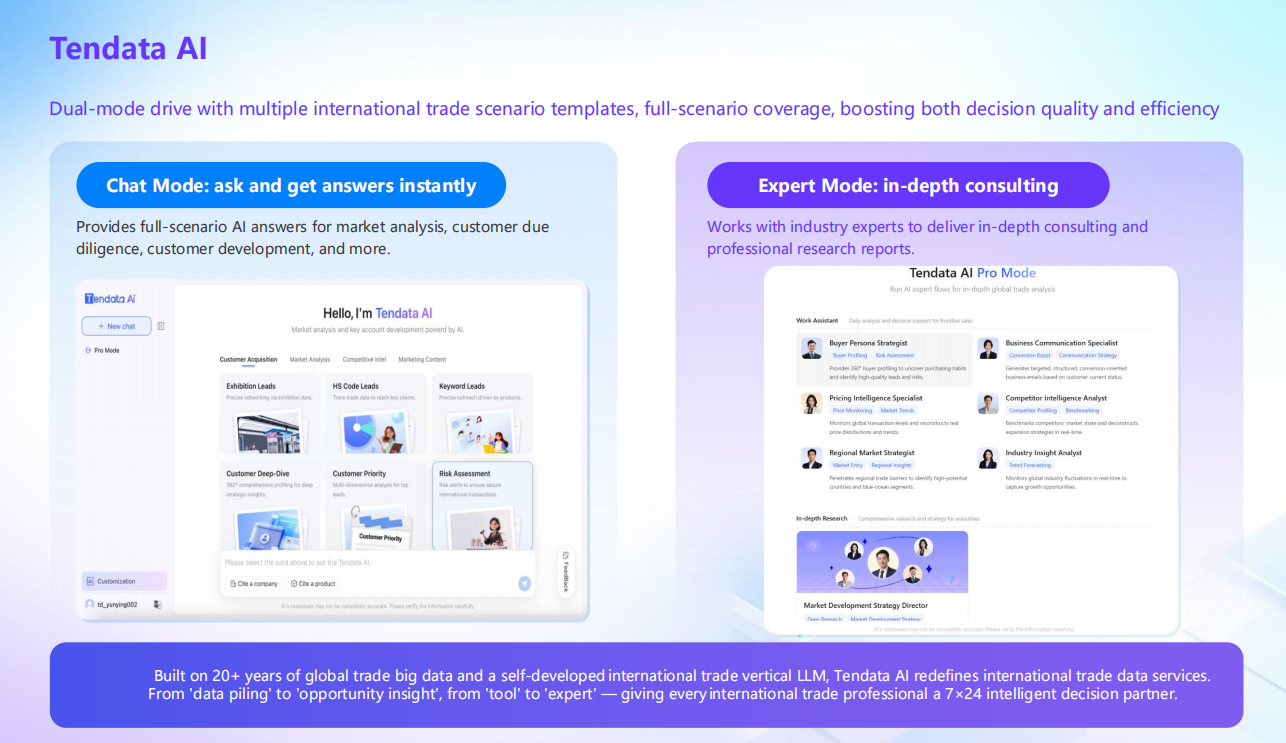
Four facts define what the platform can contribute to a pre-onboarding file. First, coverage: Tendata provides global trade data covering over 10 billion records from more than 228 countries and regions, with bill of lading data and shipment records accessible through the platform. Second, breadth: the database includes more than 500 million import and export companies and more than 850 million business contacts, including decision-maker job titles, phone numbers, email addresses and professional profiles. Third, module structure: the platform separates Buyer & Supplier Qualification, Company Background Research and Global Trade Records Analysis, which maps onto stages two, three and four of the workflow above rather than forcing one undifferentiated search. Fourth, traceability of inputs: Tendata states that its trade data is sourced from customs authorities, commercial databases and internet databases, that updates can be as frequent as every three days, and that company names and quantity units are standardized to reduce duplicate or inconsistent records.
The data layer goes deeper than shipment counts. Records for a target company can include purchased products, HS codes, purchasing frequency and trade volumes, and company-level material covers operations, supply-chain relationships, intellectual property, litigation and risk information, and trade shows. Tendata lists the separation of logistics companies from actual importers and exporters among its data-processing capabilities — a detail that matters directly to stage two, where a forwarder's footprint can otherwise be mistaken for buyer behaviour.
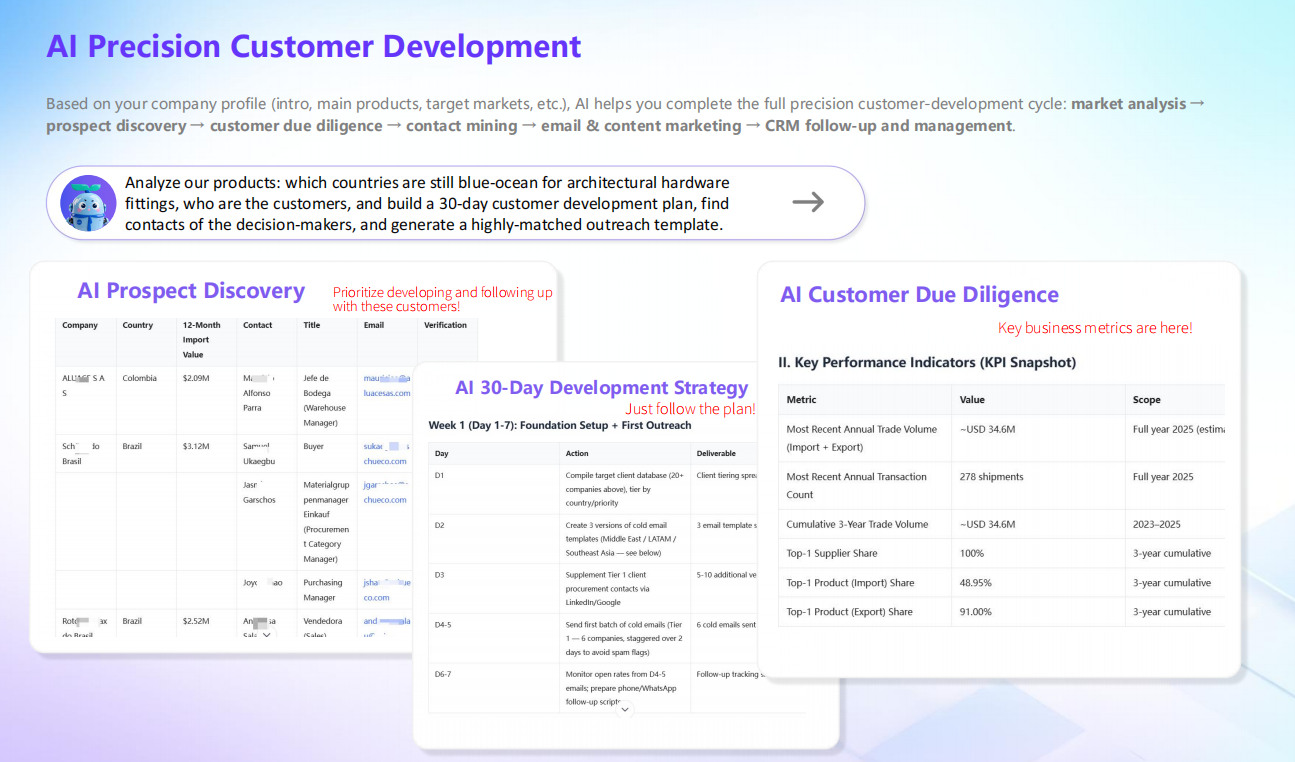
On speed, Tendata AI is built so that a user can enter a prompt in natural language and complete an initial customer due diligence pass in as little as one minute, drawing on the same trade and company records rather than on general internet content alone. For a qualification workflow, the realistic reading of that capability is triage: it compresses the first pass over a long list of candidate entities, so that analyst time is spent on the cases that survive. It does not remove the need for the judgement described in stages three to five.
Where the workflow applies
The same five stages serve several recurring situations, with different emphasis.
- First-time overseas buyer approval. The emphasis is on whether the buyer genuinely imports the product and at what rhythm, because payment terms and production capacity are usually the live commercial risk.
- Adding a second source. The emphasis shifts to whether the alternative supplier's export record is consistent with the capacity being promised, and whether its existing buyer base suggests it is already under load.
- Trade-show follow-up. Contact lists collected at an exhibition are unqualified by definition. Running the trade-record check before the follow-up email separates companies with real purchasing activity from badge scans.
- Annual re-qualification. Existing counterparties are the least examined and most assumed. A scheduled review against current trade activity catches direction changes that no initial approval anticipated.
Trade-record qualification versus traditional onboarding checks
Traditional onboarding relies on documents supplied by the counterparty — business licence, certificates, bank references, sample orders — plus, in mature programmes, a registry search and a sanctions screen. Those checks answer legal and financial questions that trade records cannot, and nothing here suggests replacing them.
The difference is timing and direction. Document-based checks mostly verify what the counterparty chooses to present, and they arrive after contact. Trade-record evidence is generated independently of the conversation and can be reviewed before the first approach, which changes the quality of the first set of questions: instead of asking a supplier to describe its export markets, the buyer can ask about a specific route and volume range already observed. Used together, the two approaches cover each other's blind spots — documents for status, records for behaviour.
The fit boundary is worth stating plainly. Where shipment-level detail is commercially restricted, where a counterparty's trade is predominantly domestic, or where the goods move under categories that are inconsistently described at declaration, trade-record coverage will be thinner and the conclusion correspondingly weaker. In those cases the record set may confirm that a company exists and trades, while leaving most of the qualification to documents and references.
Market context: why declaration accuracy carries a price
Two published figures frame the context without proving demand for any specific tool. IMARC Group reports that US Customs and Border Protection collected more than USD 88 billion in duties in 2024 — a reminder that classification and declaration decisions carry direct financial consequences, and that audit readiness is a commercial issue rather than an administrative one. Separately, Mordor Intelligence projects the global trade management market to reach USD 2.84 billion in 2026, a projection for a broad software and services category rather than a measurement of the trade-data segment specifically.
The analytical reading is limited but useful: where declarations carry material cost, the value of pre-onboarding evidence rises, because the cheapest correction is the one made before a shipment. Both figures should be treated as context for that argument, not as evidence that any particular platform, including Tendata, delivers a compliance outcome.
Limits, fit boundaries and caveats
- Trade records evidence activity, not legal status, creditworthiness or product conformity.
- A record set describes the period it covers. Conclusions drawn from a twelve-month window should not be extended beyond it without a fresh check.
- Absence of records is not proof of absence of trade. Coverage varies by market, and "not found" and "does not trade" are different findings.
- Record counts are not comparable across providers unless the record type, regional depth and deduplication method are defined. A larger number is not automatically a better qualification input.
- Contact data supports outreach; authority to transact must be confirmed in the commercial exchange.
- Nothing in a trade-data platform replaces a sanctions screen, a legal due-diligence opinion, or a certification check where the goods require one.
Outlook
If declaration scrutiny continues to carry direct financial weight, the likely direction for compliance teams is that trade-record evidence stops being a one-off research task and becomes a standing file — refreshed on a schedule, tied to the approval it supported, and reopened when the observed pattern changes. That is a conditional outlook, not a forecast of adoption: it depends on data coverage in each market and on teams accepting that commercial evidence and legal verification are complementary rather than interchangeable. The practical step available today is modest and useful — write down what each layer of your onboarding file is allowed to prove, then check that the evidence actually reaches that bar.
Frequently asked questions
What is the difference between a trade record and a compliance certificate?
A trade record documents that a shipment occurred — parties, product, HS code, date, quantity and route. A compliance certificate is issued by a qualified body against a defined standard. The first is commercial evidence of activity; the second is a formal attestation of conformity. Neither substitutes for the other, and a qualification file should keep them in separate sections so that readers do not infer a certification from a shipment history.
How many shipments should be reviewed before onboarding a buyer or supplier?
There is no universal threshold, and any specific number would be arbitrary. What matters is whether the observed pattern is long enough and consistent enough to support the decision being made. A recurring flow across several quarters supports a different conclusion than a single consignment, and the review period should be stated in the file so the conclusion stays bounded by the evidence actually examined.
Can import export data confirm that a company is a manufacturer rather than a trader?
It can provide indicators, not proof. Consistent outbound volumes under a narrow HS scope, a stable buyer base and a supply-chain profile that matches the claimed production role all point towards an operating producer. But shipment data records movement of goods, not the legal or physical organisation behind them. Where the distinction is commercially material, it should be confirmed through documents and, where feasible, verification of the production site.
How current does trade data need to be for a pre-onboarding check?
Recent enough to reflect the counterparty's present position, which varies by product cycle and market. Tendata states that its data updates can be as frequent as every three days, but freshness requirements are a buyer decision: fast-moving categories need shorter windows than long-cycle capital goods. Whatever window is chosen, it should be written into the approval so the next reviewer knows what the file did and did not cover.
What should a qualification file contain?
At minimum: the resolved entity name and address, the HS scope tested, the review period and the activity observed within it, background findings with their sources, the contact and the basis for believing that person can transact, the open questions, and the date or trigger for re-verification. A file that records only an approval, without the evidence and its limits, cannot be reviewed later and cannot be defended if the relationship goes wrong.
The Tendata platform introduction, including coverage detail and module descriptions, is available as a downloadable brochure: Tendata Introduction (PDF).
Have Questions or Need More Details?
Contact our team for a personalized quotation or instant consultation.
Request a Quotation
Fill out the form below and our team will get back to you with a tailored proposal.
WhatsApp Direct Chat
Prefer to chat in real-time? Message us on WhatsApp for instant assistance & quick answers.
- Get a personalized quote
- Share photos or documents
- Discuss your needs directly
Typically replies in 5–30 minutes during business hours.