
In-House Label Coding: TIJ, PIJ and Laser Fit by Scenario
In-House Label Coding: TIJ, PIJ and Laser Fit by Scenario
In-house label coding is a fit decision before it is a printer decision. A short production run, a field that changes on every roll, and a mark that has to survive washing or abrasion each point toward a different technology family — thermal inkjet (TIJ) mounted on a rewinder, piezo inkjet (PIJ) for high-resolution variable data, or a laser system where the mark must be permanent. DOCOD manufactures equipment in all three families, so the practical question for a buyer is not which technology is superior in general, but which documented envelope covers a specific label, substrate and line speed.
This guide maps three in-house label workflows to the equipment DOCOD specifies for them: the XF30 vertical rewinding machine with an integrated T210E TIJ printer, the P2000 piezo inkjet printer, and UV, fiber or CO2 laser systems. The evaluation criteria follow the four variables that decide most label projects — label material, code resolution, ink compatibility and conveyor handling — and each section states the boundary where a route stops fitting.
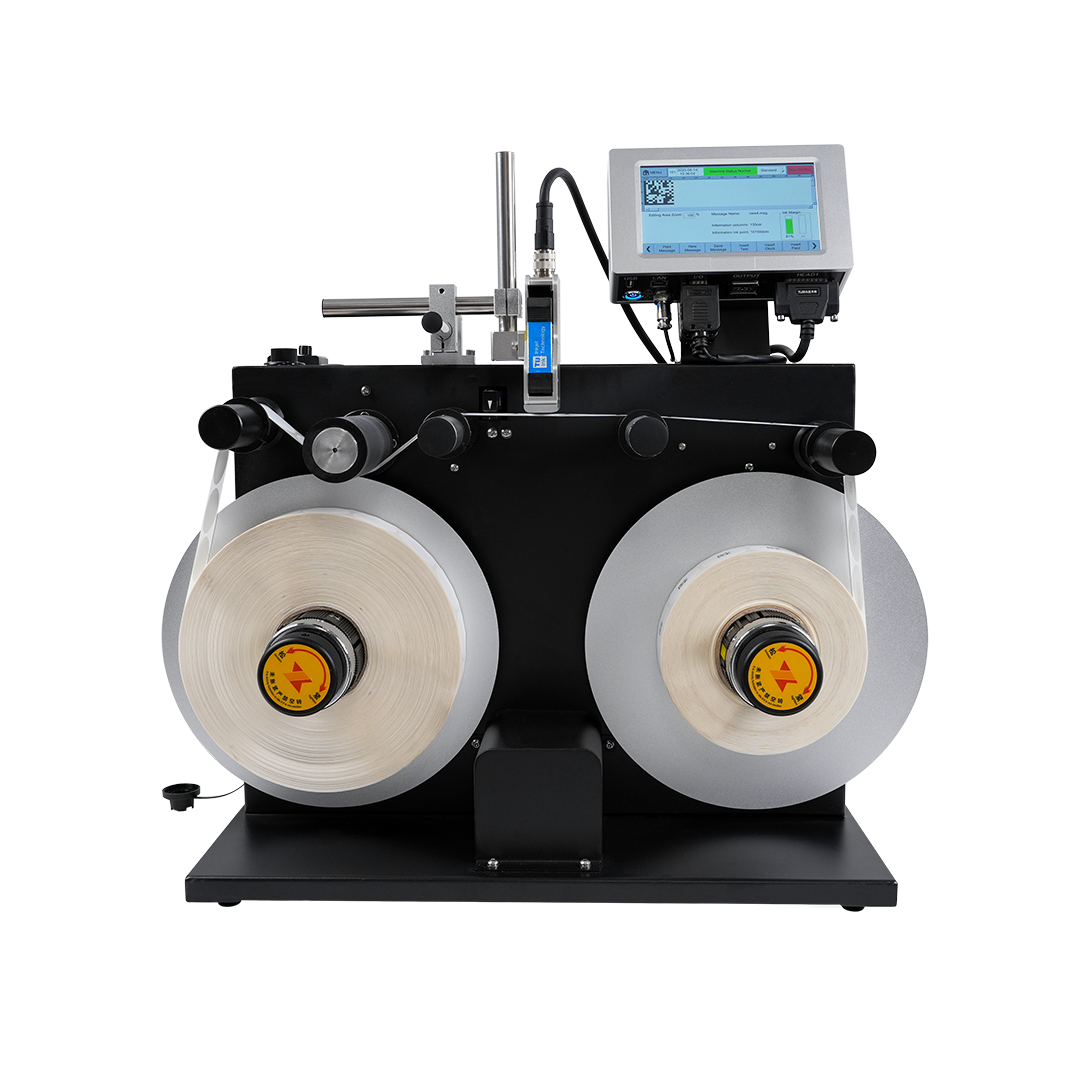
A label rewinding station with an integrated TIJ printhead: the configuration used for secondary rewinding and in-house label coding. Image: DOCOD.
The decision starts with a constraint, not a technology
Label coding projects usually begin with one of three constraints. The first is volume: a run that is too short to justify a pre-printed label order still has to carry a legible, compliant code. The second is variability: a serial number, batch, production date, GS1 DataMatrix or QR code that changes per roll cannot be pre-printed at all, which moves the print step into the buyer's own facility. The third is durability: some labels are applied to surfaces that are washed, heated, abraded or handled repeatedly, and an ink-based mark has to be specified to survive that environment or replaced by a non-ink process.
Those three constraints do not produce the same answer. A rewind station that adds variable data to an existing roll is a different engineering problem from a high-resolution code on a coated carton, and both differ from a permanent mark burned into a plastic surface. Treating them as one purchasing category is where mismatches begin — a printer that meets the resolution requirement may not meet the handling requirement, and a marking method that meets the durability requirement may not fit the label format at all.
What DOCOD covers across the three routes
DOCOD Precision Group Co., Ltd. is an industrial coding, marking and inspection equipment manufacturer founded in 2008 and based in Guangzhou, China. Its portfolio covers continuous inkjet (CIJ), thermal inkjet (TIJ), handheld inkjet, piezo high-resolution inkjet (PIJ), drop-on-demand (DOD), thermal transfer overprinters (TTO), laser marking machines, inline vision inspection systems, coding consumables, spare parts and product traceability solutions, and the company states that these technologies support date and batch coding, variable data printing, GS1 DataMatrix, serialization and product traceability. More detail on the range is published on the DOCOD official website.
How to read the specifications below. Product parameters are quoted from DOCOD specification units for the named models. Statements about outcomes come from DOCOD-reported application cases and are labelled as such; they describe individual installations, not a general performance guarantee. Where a model appears in the portfolio without a specification unit in the source material, this article says so rather than filling the gap.
Route 1: Short-run label rewinding with TIJ
The DOCOD XF30 vertical rewinding machine pairs a rewind station with a T210E thermal inkjet printer, and DOCOD lists it for label rewinding and secondary rolling, barcode and traceability printing, and short-run relabeling work. Its documented envelope is narrow and specific, which is exactly what makes it usable as a selection criterion: labels up to 100 mm wide, a maximum roll outer diameter of 300 mm on a 76 mm core, a maximum load of 3 kg, and a rewind speed range of 0–45 m/min from a 300 W drive running on 110 V or 220 V input.
The integrated T210E is a TIJ 2.5 thermal inkjet head specified to print 1–12.7 mm high at a print distance of 1–2 mm, at up to 300 × 300 DPI with six adjustable grey levels. Its documented print content covers multi-language text, GS1 DataMatrix, dynamic traceability QR codes, barcodes, images, serial numbers, dates, shifts, counters and variable database fields, including real-time dynamic data printing over a network serial port. The controller runs an embedded Linux platform on a Cortex-A7 1.2 GHz dual-core processor with an FPGA acceleration chipset, exposes USB, RS232 and network interfaces, and accepts optical sensor and encoder inputs.
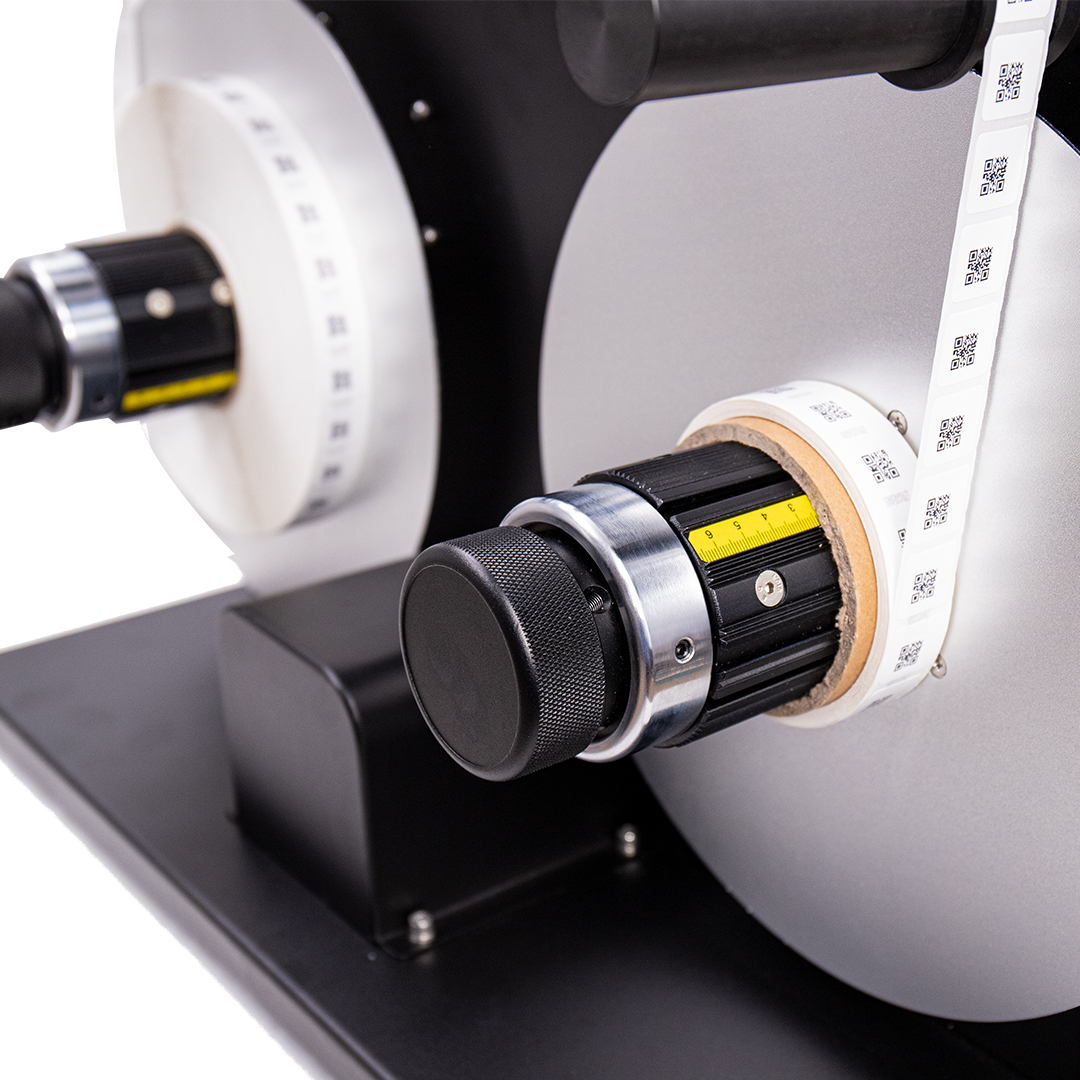
The XF30 rewinds and codes in one pass; print height (1–12.7 mm) and web width (up to 100 mm) define what fits. Image: DOCOD.
Translated into label work, those numbers settle several arguments early. If a label needs a print block taller than 12.7 mm, the XF30 with the T210E sits outside its documented envelope, and a dual-head arrangement or a different technology family has to be considered. If the roll is wider than 100 mm, heavier than 3 kg, or on a core other than 76 mm, the machine is the wrong format regardless of print quality. For example, a typical date-and-lot block of two short text lines plus a 2D code sits inside the 12.7 mm band; a multi-line ingredient panel does not.
DOCOD reports a label-converter installation in Brazil using a single XF30 station for label secondary rewinding and coding, in service for two years, with smoother short-run relabeling as the stated result. That case describes a rework and short-run workflow rather than continuous high-volume label production, which matches the machine's documented role in secondary rolling.
Ink choice decides whether the code survives
The DOCOD 3BK702 half-inch black solvent TIJ cartridge is the quick-drying consumable specified for this class of work: a 42 ml fill with 300 nozzles, up to 600 dpi with 300 × 300 recommended, a 12 kHz maximum firing frequency, and a stated substrate list of BOPP, PVC, PP, PET, OPP, glass and stainless steel. Its working window is 15 °C to 35 °C at 35% to 80% RH, its shipping and storage window is 5 °C to 40 °C at 20% to 80% RH, and the best-use period is six months. Nozzle cleaning is specified with a dust-free cloth or a cloth containing IPA-ethanol above 98%, used waterless.
Two of those numbers are easy to overlook and expensive to discover late. The six-month best-use period turns ink into a stock-planning item, not an unlimited shelf supply, and the working humidity range means a dry, cold label room can sit outside the ink's documented conditions even when the printer is rated for it. The resolution figures also need care: the XF30 system is specified at up to 300 × 300 DPI, while the 3BK702 cartridge itself is rated to 600 dpi with 300 × 300 recommended. Those are different levels of claim, and a buyer should confirm which figure the quotation and the acceptance sample refer to.
Ink chemistry is a second decision inside the same machine. The XF30 specification lists 42 ml cartridges in food grade, water-based, oil-based, weak-solvent and solvent types, plus a continuous ink supply option with a large-capacity ink bag, and offers black, white, red, yellow, blue, green, invisible and UV inks. Solvent ink buys fast drying and adhesion on film and coated stock; water-based and food-grade inks answer a different requirement. The substrate and the durability target should drive the ink choice, not the reverse.
DOCOD reports a regional distributor in Korea using 50 cartridges per month on plastic film and coated cartons over one year, with fewer smudging complaints as the stated result and fast drying plus strong adhesion as the highlighted characteristics. That is a reported application outcome on those two substrates, not a claim that solvent ink resolves smudging on every material.
Route 2: Piezo inkjet for high-resolution variable data
DOCOD positions the P2000 as its piezo inkjet printer, inside a product family the company describes as piezoelectric high-resolution inkjet. Piezo printheads eject ink by deforming a piezo element rather than by heating the ink, which places the technology in the high-detail segment of an industrial coding portfolio rather than in the large-character segment. For label and carton work, that distinction matters when the code itself is the quality requirement — a dense 2D symbol, a small character set or a graphic that has to stay readable.
DOCOD's documented application sets place the P2000 in medical packaging workflows involving UDI and GS1 DataMatrix codes on materials such as Tyvek medical paper, blister packs, cartons and flexible films, configured with scanner, vision system, reject unit and database connection in a closed-loop print-and-verify arrangement. The same model appears in an industrial packaging set for building materials and chemical packaging. A reported case describes a personal care manufacturer in Thailand running three lines for variable data printing on coated boxes, in service for one year, with improved traceability consistency as the stated result and high-resolution code printing as the highlighted capability.
The fit boundary here is documentary rather than technical. The material used for this article does not include a full specification unit for the P2000, so print width, native resolution, ink set, curing requirements and maximum line speed must be obtained for the configuration actually quoted. Buyers should also resist transferring the XF30/T210E envelope — 100 mm label width, 12.7 mm print height, 300 × 300 DPI — onto a PIJ line. They are separate specifications for separate machines, and mixing them is a common source of failed acceptance tests.
Route 3: Laser marking where permanence is the requirement
When the requirement is a mark that is not an ink layer at all, laser is the route. DOCOD's laser range covers UV, fiber and CO2 systems. The DOCOD L3000 Series 5W UV Laser Marking Machine, model L3005U-355W-V-IP43, is specified at a 355 nm wavelength with 5 W output, water cooling, a standard 70 × 70 mm marking area with 70–300 mm optional, 0.01 mm positioning accuracy, a minimum line width of 0.02 mm, character heights from 0.6 mm, IP43 protection and total power consumption of up to 900 W. DOCOD's specification gives a marking-time example: a date string 20 mm wide and 2.8 mm high on PP film takes 29 milliseconds at 5 W.
The Venus1 Series UV Laser Marker extends the same wavelength across 5 W, 10 W and 15 W options with air-cooled and water-cooled variants, IP43 or IP54 protection, a standard 110 × 110 mm marking area with 70–300 mm optional, and supported code formats that include QR Code, DataMatrix, GS1-128 and PDF417. Fiber and CO2 models sit alongside it for metal and non-metal substrates respectively.
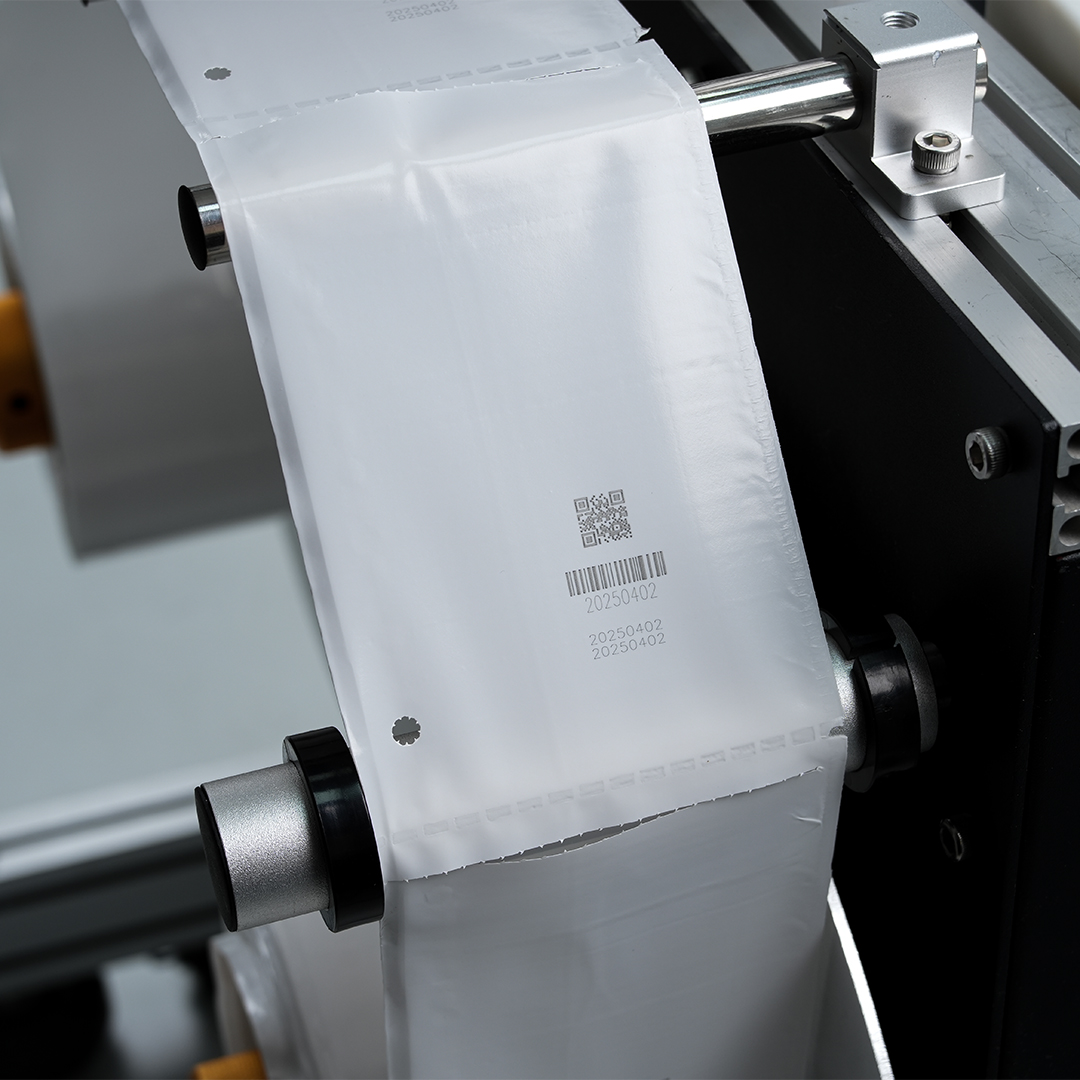
The L3000 5W UV system: a 355 nm, water-cooled marker with a 70 × 70 mm standard marking field. Image: DOCOD.
The reported applications show the split clearly. A cosmetics OEM in Poland used two lines of UV marking for lot coding on plastic bottles and caps over one year, reporting permanent high-contrast marks with low-heat UV marking as the highlighted characteristic. An electronics parts supplier in Germany marked metal connectors at two workstations with a fiber laser over three years, reporting durable readable marks. A plastic pipe producer in Saudi Arabia marked specification and date information on PVC pipe across two extrusion lines for two years, reporting clean non-contact coding with a CO2 system. Each case is an individual installation on a specific material.
Laser is not an automatic upgrade for label work. The L3000 specification states a laser life of 2–3 years, which is a maintenance planning input rather than a lifetime guarantee; the UV unit is water-cooled and draws up to 900 W; and the marking field is a fixed optical area of 70 × 70 mm standard rather than a moving web. Contrast depends on how the specific substrate reacts to the wavelength, which is why a laser decision for label stock should be settled on the actual topcoat and film with a sample, not on a generic material list.
Conveyor handling and the speed-matching question
Handling is the part of label coding that fails quietly. The DOCOD XC20 Mini Conveyor Belt is specified at 600 × 230 × 175 mm with pads, 7.5 kg, a 150 mm PVC belt with customizable length, 5–12 m/min through an AC motor with a digital display speed controller, 25 W maximum consumption, 220 V/50 Hz input and an aerospace-grade aluminium frame. DOCOD lists it as compatible with inkjet printers, visual inspection and weighing equipment, and describes it as suited to conveying fine products.
Two numbers deserve attention together. The XC20 runs at 5–12 m/min, while the XF30 rewind range extends to 45 m/min. Where a label or pouch station is fed from a conveyor, the conveyor becomes the pacing element and the printer's maximum throughput is never reached; where a rewinder runs standalone, the conveyor is irrelevant. A 12 m/min ceiling is not a defect in a bench conveyor — it is a statement about which workflows it belongs to, such as semi-automatic pouch coding, inspection feeding and small-product handling. DOCOD reports a small-batch food producer in the UAE running one bench line for conveying pouches into online coding for one year, with a smoother semi-automatic workflow reported and compact conveying of fine products as the highlighted characteristic.
Verification is the second handling consideration. DOCOD's portfolio includes inline vision inspection systems, and its application configurations describe closed-loop print-and-verify with scanner, vision system and reject unit for UDI and GS1 DataMatrix work. Whether a label line needs that layer is a compliance and risk decision the buyer makes; it is not built into the printer by default.
Scenario-fit matrix
| Workflow | Documented route | Documented envelope | Fit signal | Verify before ordering |
|---|---|---|---|---|
| Short-run label rewinding and relabeling | XF30 vertical rewinder with T210E TIJ | Label width up to 100 mm; roll OD up to 300 mm; 76 mm core; 3 kg max; 0–45 m/min; print 1–12.7 mm at 1–2 mm distance; 300 × 300 DPI | The variable field changes per roll and the print block is short | Label stock, ink type, drying, block height, roll weight |
| High-resolution variable data on cartons or labels | P2000 piezo inkjet printer | Configuration-specific; full spec unit not included in this article's source material | Code density and detail quality are the primary requirement | Print width, native resolution, ink and curing, line speed |
| Permanent marking on plastics, films and coatings | L3000 5W UV; Venus1 UV 5/10/15 W | 355 nm; 70 × 70 mm standard field (70–300 mm optional); IP43 / IP54; laser life 2–3 years | Mark must resist washing, heat or abrasion and no ink layer is acceptable | Substrate reaction test, field size, cooling and power |
| Permanent marking on metal parts | Venus1 fiber laser | Configuration-specific | Metal connectors, tags or hardware requiring durable marks | Material, marking depth and cycle time |
| Non-metal pipe, profile and extrusion marking | Venus1 CO2 laser | Configuration-specific | Continuous non-contact coding on non-metal surfaces | Line speed, extraction, surface additives |
| Bench handling and feeding | XC20 mini conveyor | 150 mm PVC belt; 5–12 m/min; 25 W max; 600 × 230 × 175 mm; 7.5 kg | Semi-automatic or small-format product flow | Product stability, speed match, belt length |
What to verify before a purchase order
A label project moves from research to evaluation quickly once the constraints are written down. The checklist below converts the specifications above into questions that can be answered by a supplier, a sample and an acceptance run.
- Web geometry. Confirm label width against the 100 mm limit, roll outer diameter against 300 mm, core against 76 mm and roll weight against 3 kg for an XF30 configuration.
- Print block height. Measure the tallest block, including 2D symbols and multi-line text, against the 12.7 mm print height and confirm the web path holds the 1–2 mm print distance.
- Resolution basis. Ask whether the quoted figure refers to the integrated system (300 × 300 DPI on the XF30) or the cartridge rating (up to 600 dpi on the 3BK702), and check the acceptance sample at the stated setting.
- Ink chemistry and stock. Match the cartridge type to the substrate list, confirm the six-month best-use period against planned consumption, and confirm the working range of 15–35 °C and 35–80% RH for the 3BK702.
- Solvent handling. If a solvent ink is selected, confirm that the site's storage, ventilation and handling arrangements suit it before the machine is specified.
- Variable data path. Confirm how the serial, batch, GS1 DataMatrix or traceability QR record reaches the printer — database, network serial or file — and whether vision verification and rejection are required.
- Throughput match. Compare the 0–45 m/min rewind range with any conveyor feeding the station (5–12 m/min on the XC20) and set the line speed to the slowest element.
- Consumables and acceptance. Settle cartridge supply, spare parts and the acceptance sample in one document, so the delivered print is compared against a mark produced on the buyer's own label stock.
Market context: scale, inkjet share and the 2D deadline
Fortune Business Insights reports the global coding and marking equipment market at USD 7.51 billion in 2025, measured as revenue from hardware and integrated software, and reports inkjet technologies — CIJ, TIJ and PIJ together — at 40.1% of the technology segment. Those two figures frame why the label question keeps returning to inkjet families: they are the largest single technology group in the category, which has consequences for consumable availability, service familiarity and the depth of the installed base a buyer can learn from.
The regulatory driver is separate and more concrete. GS1's Digital Link standard sets the Sunrise 2027 transition, under which retail barcodes move from 1D symbologies to 2D QR codes by the end of 2027 across the participating markets. For an in-house label operation, that converts 2D capability from an option into a purchasing criterion: the printer has to handle GS1 DataMatrix or QR content, and the data path has to deliver it reliably. It also raises the value of verification, because a 2D symbol that scans poorly fails differently from a 1D barcode that smudges.
Published forecasts for the category differ materially in scope, base year and method, so this article does not use any single growth rate as a planning number. The two data points above — one measured market value and one standard with a dated deadline — are the ones that translate into equipment requirements a buyer can actually specify.
Outlook and where the fit breaks
The direction of travel is toward more variable content per label and more verification of what was printed. If retail-facing packs migrate to 2D codes on the Sunrise 2027 timetable, the label station has to carry a symbol with far more data than a batch code, and the record behind that symbol has to be traceable to a production event. DOCOD's stated application scope — date and batch coding, variable data printing, GS1 DataMatrix, serialization and product traceability — sits directly on that requirement, and its portfolio includes the inline inspection layer that verification implies.
The honest limits are equally clear. The XF30 with the T210E covers labels up to 100 mm wide and print blocks up to 12.7 mm high; beyond that, the format changes. The UV laser's stated 2–3 year laser life belongs in the maintenance plan, and its water-cooled 900 W envelope belongs in the facility plan. The XC20 paces a line at 5–12 m/min, so it belongs to semi-automatic work rather than to a high-speed line. And the P2000's print width, resolution and ink set have to be confirmed per configuration, because they are not interchangeable with the TIJ figures.
A practical next step is to write the specification in the order the constraints appear: label and substrate first, then the code and its resolution requirement, then the ink or laser route, then the handling and verification layer. A sample print produced on the actual label stock, evaluated at the stated resolution and checked after the label has been handled, answers more than any comparison of technology names. DOCOD's corporate brochure lists the wider equipment range for buyers who need to compare routes across a full line rather than a single station.
FAQ
When does a vertical rewinder with a TIJ printer fit better than pre-printed labels?
A rewinder with an integrated TIJ printer fits when the label already exists as a roll but the variable content — date, batch, serial, GS1 DataMatrix or QR code — has to be added in-house, and when the run is too short to justify a separate pre-printed label order. The DOCOD XF30 with the T210E is documented for label secondary rewinding and coding, with labels up to 100 mm wide, roll outer diameter up to 300 mm on a 76 mm core, a 3 kg maximum load and a 0–45 m/min rewind range. If the label width, roll format or print block falls outside those figures, the configuration does not fit and another route should be evaluated.
What should I check on a label roll before specifying the XF30 with the T210E?
Check four physical values against the specification: label width against the 100 mm maximum, roll outer diameter against 300 mm, core diameter against 76 mm, and roll weight against the 3 kg maximum load. Then check the print requirement against the T210E's 1–12.7 mm print height and 1–2 mm print distance, and confirm the substrate appears in the ink cartridge's stated material list — BOPP, PVC, PP, PET, OPP, glass or stainless steel for the 3BK702 solvent cartridge. Where a material is outside that list, the print should be validated on a sample before the order is placed.
When is a piezo inkjet printer the better fit than TIJ for variable data?
Piezo inkjet becomes the relevant route when the code detail itself is the quality requirement — dense 2D symbols, small character sets or graphics on cartons and packaging where the print has to stay readable. DOCOD positions the P2000 as a piezoelectric high-resolution inkjet printer, and its documented application sets include medical packaging UDI and GS1 DataMatrix work configured with scanner, vision system and reject unit, as well as industrial packaging marking. Because the configuration details determine the answer, buyers should obtain print width, resolution, ink set and line speed for the quoted P2000 build rather than assuming values from the TIJ equipment.
Which laser should I choose for label and packaging marking — UV, fiber or CO2?
The substrate decides the family, not the label format. UV systems such as the DOCOD L3000 5W, at 355 nm with a 70 × 70 mm standard marking field, are specified for plastics, films and packaging materials where low heat input matters; the Venus1 UV marker extends that to 5 W, 10 W and 15 W options with IP43 or IP54 protection. Fiber lasers are the route for metal parts, and CO2 lasers for non-metal substrates such as pipe and profile. Marks on label stock depend on the topcoat and film, so the choice should be confirmed with a marking sample on the actual material, and the stated 2–3 year laser life should be carried into the maintenance plan.
How do conveyor speed and ink choice affect small-run label coding?
They set two different limits. The DOCOD XC20 mini conveyor runs at 5–12 m/min on a 150 mm PVC belt with a 25 W drive, so any station fed from it is paced by the conveyor rather than by a printer's higher maximum speed; the XF30 rewind range, by contrast, extends to 45 m/min for standalone rewinding. Ink choice sets the second limit: the 3BK702 solvent cartridge has a six-month best-use period and a documented working window of 15–35 °C at 35–80% RH, so consumption planning and room conditions affect the mark as much as the print setting does. Both should be confirmed before an acceptance run.
Have Questions or Need More Details?
Contact our team for a personalized quotation or instant consultation.
Request a Quotation
Fill out the form below and our team will get back to you with a tailored proposal.
WhatsApp Direct Chat
Prefer to chat in real-time? Message us on WhatsApp for instant assistance & quick answers.
- Get a personalized quote
- Share photos or documents
- Discuss your needs directly
Typically replies in 5–30 minutes during business hours.