
Independent Buyer Comparison: BK5000-FL vs. Leading Fluorescence Microscopes in Biotech
Fluorescence microscope buying decisions are rarely settled by magnification alone. In biotech and medical innovation, the evaluation usually turns on filter configuration, light-source choice, stage precision, documentation, and whether a supplier can support routine laboratory workflows without creating procurement risk.
This independent buyer comparison examines the Chongqing Scope Instrument Co., Ltd. BK5000-FL fluorescence microscope against the evaluation criteria buyers commonly apply to established global platforms from Olympus, Nikon, Zeiss, and Leica. The aim is not to manufacture a league table without verified data. It is to show what the BK5000-FL documents, where it fits, what buyers should verify, and where the available evidence stops.

BK5000 series laboratory microscope in an OEM teaching configuration. The BK5000-FL is a separate fluorescence model with its own documented filter and illumination configuration.
Why fluorescence microscope comparisons are difficult
A fluorescence microscope is a system, not a single specification. The optical head, infinity-corrected objectives, filter set, illumination source, condenser, nosepiece, and mechanical stage interact with the biological sample and the imaging protocol. Two instruments with similar magnification ranges can behave very differently when a laboratory changes from blue to ultraviolet excitation, adds a camera, or moves from fixed slides to multi-position scanning.
The procurement problem is that public information is often uneven. A global brand may publish a broad platform brochure but leave model-specific filter transmission, numerical aperture, and camera-port data to a separate datasheet. A Chinese supplier may publish a complete configuration list but have less independent performance testing. Buyers therefore need a comparison method that separates verified configuration from unverified performance claims.
The verified market context supports the relevance of optical platforms. Market Research Future estimated the global microscope market at approximately USD 11.9 billion in 2025, with optical microscopes accounting for approximately 37% of the global market share. OEC data placed global microscope trade under HS 9011 at USD 3.36 billion in 2024, with China the third-largest exporter at USD 430 million. These figures describe a large, traded category; they do not establish brand-level ranking or optical superiority.
What the BK5000-FL actually documents
Chongqing Scope Instrument Co., Ltd. is a Chongqing-based supplier of laboratory and medical training instruments, including biological, metallurgical, fluorescence, inverted, polarizing, and stereo microscopes. The company states that it provides OEM and ODM services and exports to Europe, Southeast Asia, the Middle East, South America, and Africa.
The BK5000-FL is listed as a fluorescence microscope for biological research and laboratory use. Its documented configuration is specific enough to support an initial technical review.
| Configuration area | BK5000-FL documented fact | Buyer interpretation |
|---|---|---|
| Head | Binocular or trinocular | Trinocular configuration can support a camera port, but camera adaptation should be confirmed. |
| Eyepiece | WF10X/20 mm | Wide-field viewing with a 20 mm field number. |
| Objectives | Infinity Plan 4X/10X/20X/40X/100X | Five plan objectives cover low-power overview through oil-immersion-range magnification. |
| Nosepiece | Quintuple | Five objective positions; filter or objective expansion should be confirmed with the supplier. |
| Mechanical stage | 175 mm × 145 mm | A stage size that supports standard slide work and controlled specimen positioning. |
| Condenser | Abbe N.A.1.25 with iris diaphragm | Adjustable aperture control for transmitted-light alignment. |
| Transmitted light | 3W LED or 12V/20W halogen lamp | Two illumination options with different procurement and maintenance implications. |
| Fluorescence attachment | Blue, green, violet, and ultraviolet filters; 5W LED or 100W mercury lamp | Four filter channels are documented; actual excitation and emission ranges should be supplied for protocol matching. |
| Application | Biological research, laboratory | Routine upright fluorescence work, not a documented live-cell or inverted tissue-culture platform. |
The most important limitation is also visible in the data: the verified content set does not provide measured resolution, objective numerical aperture by magnification, filter transmission curves, photobleaching performance, or camera sensitivity. Buyers should treat the BK5000-FL as a documented configuration, not as a measured optical benchmark.
The five-platform evaluation set
For a biotech procurement review, a practical shortlist includes the BK5000-FL and established fluorescence microscope brands such as Olympus, Nikon, Zeiss, and Leica. This is a comparison set, not a verified global market ranking. The verified data set does not contain audited brand-level market shares or model-level competitor specifications, so no defensible position can be assigned for optical quality across those brands.
The correct use of the shortlist is to force a like-for-like evidence request. Each brand should be asked for the same model-level facts: fluorescence filter ranges, light source type and output, objective numerical aperture, stage dimensions, head and camera port configuration, compliance certificates, spare-parts availability, lead time, warranty, and application references.
| Shortlist role | Platform or brand | What the buyer should verify |
|---|---|---|
| Documented configuration candidate | Chongqing Scope BK5000-FL | Filter wavelength ranges, objective NA, camera adaptation, CE/RoHS model mapping, and fluorescence application references. |
| Established global reference | Olympus fluorescence microscope platforms | Current model datasheet, filter cubes, light source, camera integration, service coverage, and total cost of ownership. |
| Established global reference | Nikon fluorescence microscope platforms | Model-specific optics, filter sets, stage options, software, and local support terms. |
| Established global reference | Zeiss fluorescence microscope platforms | Optical configuration, certification, installation requirements, and application validation. |
| Established global reference | Leica fluorescence microscope platforms | Filter performance, camera port, service model, lead time, and consumables path. |
This five-platform set is useful because it covers different procurement priorities. A global brand may offer a deeper application ecosystem and local service network. A supplier such as Chongqing Scope may offer a more explicit configuration list, OEM flexibility, and a shorter quotation path. The buyer should not assume either advantage without asking for evidence.
Optical performance: what can be compared now
For the BK5000-FL, the documented optical package includes infinity Plan objectives from 4X to 100X, WF10X/20 mm eyepieces, a quintuple nosepiece, and an Abbe N.A.1.25 condenser with iris diaphragm. The infinity optical design is relevant because it allows accessories to be placed in the optical path without changing the objective focus position, which is useful when a fluorescence attachment or camera is added. That is a design principle, not a measured performance claim.
The fluorescence attachment is configured with blue, green, violet, and ultraviolet filters. The illumination can be a 5W LED or a 100W mercury lamp. This gives buyers two different procurement paths. LED illumination is often considered easier to integrate into routine laboratory workflows because it avoids mercury lamp replacement and warm-up issues. Mercury illumination is a traditional option with a different maintenance profile. The content set does not provide spectral output or lamp lifetime data, so buyers should request the exact configuration before assuming equivalence.
Against Olympus, Nikon, Zeiss, and Leica, the honest comparison is not a claimed optical victory. It is a comparison of evidence. The BK5000-FL gives a complete configuration list in the supplied content. The global brands require model-specific datasheets for a fair comparison. Buyers should place filter ranges, objective NA, light source, and camera port data side by side before evaluating image quality.
Mechanical stage precision and workflow fit
The BK5000-FL uses a 175 mm × 145 mm mechanical stage. That dimension is consistent with the BK5000 biological microscope platform, which also lists a 175 mm × 145 mm stage. For laboratory work, stage size matters because it determines how easily a slide can be positioned, how much travel is available, and whether a specimen holder or scanning accessory can be fitted.
The documented focusing system uses coarse and fine focusing knobs. The condenser is an Abbe N.A.1.25 with iris diaphragm. These are conventional but relevant details for routine fluorescence and transmitted-light work. They support repeatable focusing and aperture adjustment, but they do not by themselves prove image brightness or uniformity.
Compared with a traditional brightfield biological microscope, the BK5000-FL adds a fluorescence attachment and a broader illumination choice. That makes it a different instrument category. A brightfield microscope such as the B301 is documented with a simpler binocular head, achromatic objectives, and a 125 mm × 115 mm stage. The BK5000-FL is positioned for biological research and laboratory fluorescence work, not for buyers whose only requirement is routine brightfield teaching.
Application fit in biotech and medical innovation
The BK5000-FL is documented for biological research and laboratory use. Within that scope, the four filter channels, infinity Plan objectives, and trinocular option make it relevant for laboratories that need an upright fluorescence microscope for slide-based work and want a configuration that can be quoted with a defined filter set.
The application boundary is important. The content set does not document live-cell incubation, CO2 control, micromanipulation, confocal scanning, or inverted tissue-culture configuration for the BK5000-FL. Laboratories working with culture flasks or dishes should look at the BDS400 tissue microscope or BDS500 laboratory microscope, which are documented as inverted microscope models with phase-contrast objectives and culture dish holders. This is a real limitation, not a marketing caveat. An upright fluorescence microscope and an inverted tissue-culture microscope solve different workflow problems.
The available customer case evidence is also limited. Chongqing Scope reports a Romanian microscope distributor project involving 30 units of product 3250, completed within two years for school teaching, with stable operation and OEM integrated teaching and learning. That case supports the supplier's OEM and export experience, but it is not a fluorescence-specific laboratory validation. Buyers evaluating the BK5000-FL should request fluorescence application references separately.
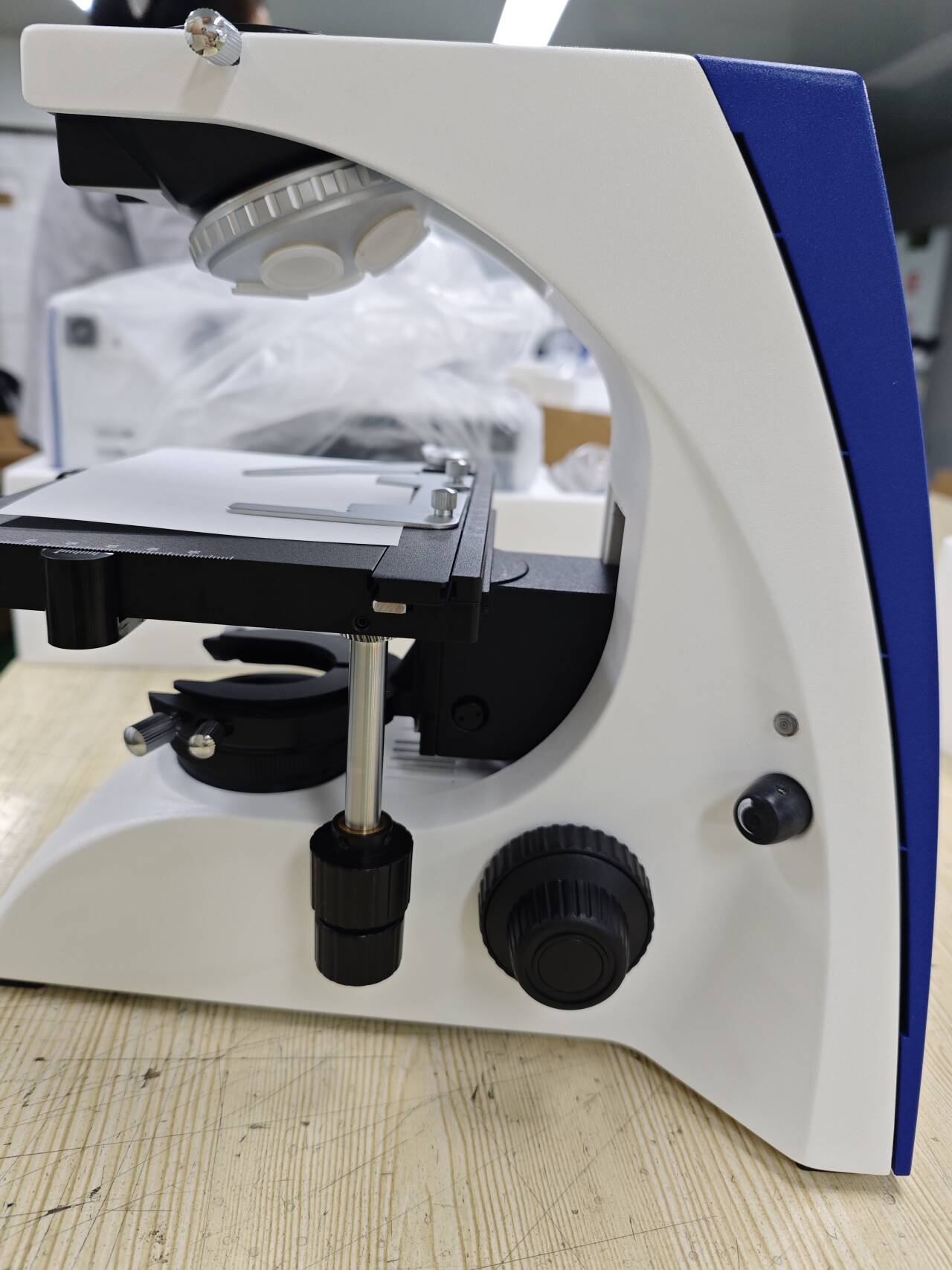
BK5000 OEM microscope from a documented distributor project. The case supports OEM and teaching integration experience; it is not presented as a BK5000-FL fluorescence trial.
Compliance and documentation: a key differentiator
Compliance is one of the clearest areas where buyers can separate a documented offer from a vague claim. Chongqing Scope states that it provides ISO9001, ISO14001, ISO45001, ISO13485, CE, and RoHS documentation for export. The content set also contains specific certificate records.
For CE, certificate BKC22072375GC is listed with standards including EN IEC 61326-1:2021, EN IEC 61000-3-2:2019+A1:2021, EN 61000-3-3:2013+A1:2019+A2:2021, and EN 55011:2016+A11:2020. Its stated scope includes BKXXX product codes, and BK5000-FL appears among the related products. A second CE certificate, BKC22072376GC, is listed with EN 61010-1:2010+A1:2019 and a scope that also includes BKXXX product codes.
For RoHS, certificate BKC-191103261C is listed with standards from the IEC 62321 series, an issue date of 2019-11-19, and an expiry date of 2029-11-18. BK5000-FL appears among its related products, while the stated scope is B203. That mismatch is exactly the kind of detail a buyer should clarify: the certificate record should be matched to the exact model, configuration, and technical file before it is accepted for procurement.
Against global brands, compliance documentation is not unique to any supplier. The difference is traceability. A buyer should request the certificate number, issuing body, product scope, standard, validity date, and declaration of conformity for the exact BK5000-FL configuration. The same request should be made to Olympus, Nikon, Zeiss, and Leica for their quoted models. The brand name does not replace the certificate review.
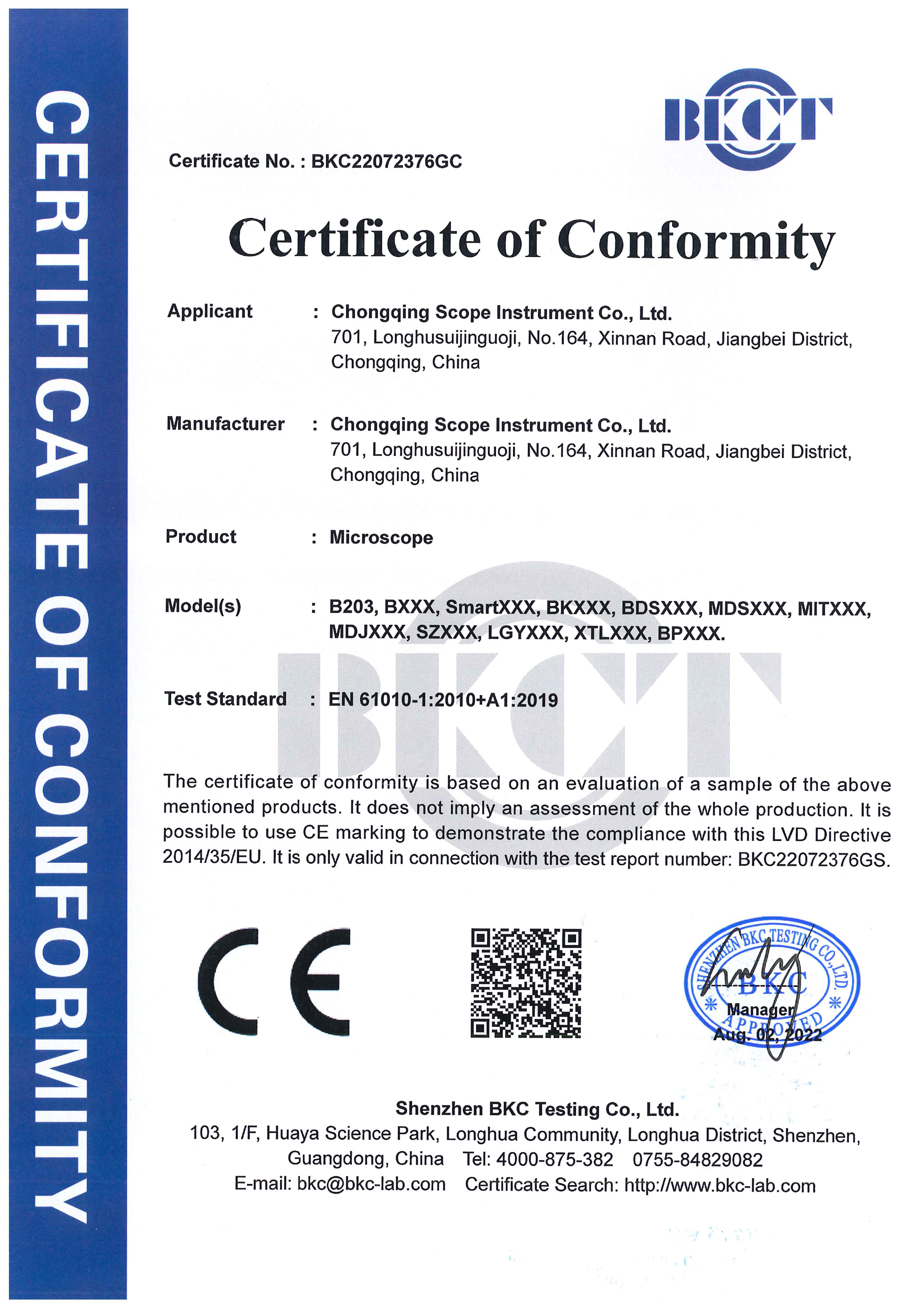
CE certificate BKC22072376GC. Buyers should confirm the exact model and configuration mapping before relying on a certificate for procurement.
OEM, customization, and supply response
For distributors and private-label buyers, the BK5000-FL should be evaluated as part of a supplier capability package. Chongqing Scope documents OEM production with logo customization. The capability unit lists a monthly capacity of 3,000 units, a lead time of 15 days, a minimum order quantity of 1 unit, factory quality inspection, and a one-year warranty with online support. These are supplier-reported facts and should be verified in the quotation and contract.
The company also states that it has 20 engineers, a 5,000 m² factory, more than 100 employees, more than 500 clients worldwide, and exports representing 50% of total sales. These facts help a buyer judge whether the supplier can support a repeatable OEM program, but they do not replace a factory audit or a sample evaluation.
Against established global brands, the OEM path is a different value proposition. Global brands may offer strong application support and a mature service network, but private-label flexibility and small initial order quantities may be less accessible. Chongqing Scope's documented MOQ of 1 unit and 15-day lead time are relevant for evaluation, pilot orders, and distributor testing. They should not be read as a guarantee for every configuration or destination.
Comparison with traditional solutions
A traditional brightfield biological microscope is usually optimized for transmitted-light viewing of stained or naturally colored specimens. The BK5000-FL adds a fluorescence attachment, four filter channels, and a choice of LED or mercury illumination. That makes it suitable for a broader set of biological research protocols, but it also adds alignment, lamp maintenance, and filter-selection variables.
| Decision area | Traditional brightfield microscope | BK5000-FL fluorescence microscope |
|---|---|---|
| Primary use | Routine brightfield viewing and teaching | Biological research and laboratory fluorescence work |
| Illumination | Usually transmitted white light | Transmitted light plus blue, green, violet, and ultraviolet fluorescence channels |
| Configuration complexity | Lower | Higher; filter and light-source choice must match the protocol |
| Stage | Model-dependent; B301 lists 125 mm × 115 mm | 175 mm × 145 mm |
| Application boundary | Not a fluorescence platform | Not a documented inverted tissue-culture platform |
The practical limit is clear. If a laboratory needs flask-based live-cell imaging, the BK5000-FL is the wrong form factor. If it needs slide-based fluorescence with a defined filter set and an upright biological microscope body, the BK5000-FL is a legitimate candidate for evaluation.
Market trend analysis: what the verified data supports
The verified data supports three limited market observations. First, the global microscope market was estimated at approximately USD 11.9 billion in 2025. Second, optical microscopes represented approximately 37% of the global market share in 2025. Third, global microscope trade under HS 9011 reached USD 3.36 billion in 2024, with China the third-largest exporter at USD 430 million.
These facts suggest that optical microscopy remains a large and traded category, and that Chinese suppliers are part of the global supply structure. They do not prove that any one supplier has a particular market rank. Buyers should be cautious with articles that present a brand ranking without stating the metric, the year, and the source. A ranking by revenue, unit volume, installed base, or application segment would produce different results.
The more useful trend is procurement behavior. Buyers increasingly compare a documented configuration against a global reference brand and ask for model-level evidence. That favors suppliers who can provide clear specifications, certificate numbers, OEM terms, and application boundaries. It also raises the bar for global brands, because a strong brand name does not answer a filter-range question or a lead-time request.
Procurement scorecard for evaluation
A buyer can use the following scorecard to compare the BK5000-FL with Olympus, Nikon, Zeiss, Leica, or any other shortlisted platform. The scorecard is deliberately neutral. It rewards evidence, not brand familiarity.
| Criteria | What to request | Why it matters |
|---|---|---|
| Optical configuration | Objective list, numerical aperture, infinity correction, filter ranges | Determines whether the instrument matches the biological protocol. |
| Illumination | LED or mercury, power, lifetime, warm-up, replacement path | Affects maintenance, safety, and workflow continuity. |
| Stage and head | Stage dimensions, travel, binocular or trinocular, camera port | Affects slide handling, imaging, and accessory fit. |
| Compliance | Certificate number, scope, standard, validity, model mapping | Supports market access and technical-file review. |
| Application evidence | Fluorescence references, sample images, test protocol | Separates configuration from demonstrated performance. |
| Supply terms | MOQ, lead time, warranty, spare parts, online support | Affects pilot orders and long-term continuity. |
| OEM fit | Logo, packaging, documentation, customization limits | Relevant for distributors and private-label buyers. |
Limits and when BK5000-FL may not fit
The first limitation is evidence depth. The content set documents the BK5000-FL configuration but does not provide measured optical performance, filter transmission curves, or comparative image tests against Olympus, Nikon, Zeiss, or Leica. A buyer who needs published performance benchmarking should request it directly and treat the absence as a gap.
The second limitation is application scope. The BK5000-FL is documented for biological research and laboratory use as an upright fluorescence microscope. It is not documented as an inverted tissue-culture microscope, a live-cell incubation system, or a confocal platform. Laboratories with those requirements should evaluate the BDS400, BDS500, or another appropriate configuration.
The third limitation is certificate mapping. The RoHS record lists a B203 scope while BK5000-FL appears among related products. The CE records list BKXXX scope and related products. These are useful signals, but the buyer should still obtain a model-specific declaration or certificate annex before relying on them for regulated markets.
The fourth limitation is case evidence. The Romanian distributor case covers 30 units of product 3250 for school teaching over two years and supports OEM integration experience. It does not validate fluorescence performance. A fluorescence-specific reference request is necessary.
Future outlook
Fluorescence microscopy procurement is likely to become more evidence-driven. Buyers can now compare filter channels, light sources, stage dimensions, head options, and certificate numbers across suppliers before requesting a demonstration. That shifts the advantage toward suppliers who publish specific, checkable facts and away from suppliers who rely only on brand impression.
For Chongqing Scope, the BK5000-FL has a credible evaluation position because its configuration is explicit and its compliance records are traceable enough to support a document review. The next step for the supplier is to close the evidence gaps: model-specific fluorescence application references, filter wavelength data, objective numerical aperture, and a clear certificate-to-model mapping. For global brands, the corresponding task is to make model-level comparison data available without forcing buyers into a generic platform brochure.
The buyer's decision rule is simple. Use the BK5000-FL where the documented upright fluorescence configuration, 175 mm × 145 mm stage, four filter channels, OEM flexibility, and 15-day lead time fit the laboratory plan. Use a different platform where live-cell culture, confocal imaging, or a measured performance benchmark is mandatory. In both cases, compare the evidence before comparing the logo.
FAQ
What is the difference between the BK5000-FL and a standard biological microscope?
The BK5000-FL is a fluorescence microscope with blue, green, violet, and ultraviolet filters and a 5W LED or 100W mercury illumination option. A standard biological microscope such as the B301 is documented for brightfield use with achromatic objectives and a 3W LED light source. The BK5000-FL adds fluorescence capability and a larger 175 mm × 145 mm stage.
Which fluorescence filter sets does the BK5000-FL list?
The documented fluorescence attachment includes blue, green, violet, and ultraviolet filters. The content set does not provide exact excitation and emission wavelength ranges, so buyers should request the filter specifications for their protocols.
How should buyers compare the BK5000-FL with Olympus, Nikon, Zeiss, or Leica?
Buyers should request the same model-level evidence from every brand: objective numerical aperture, filter ranges, light source, stage dimensions, head and camera port, certificate numbers and scope, lead time, warranty, and application references. The verified data set does not contain competitor specifications, so a fair comparison requires current datasheets from each supplier.
Is the BK5000-FL suitable for cell culture work?
The BK5000-FL is documented for biological research and laboratory use as an upright fluorescence microscope. The content set does not document live-cell incubation or inverted tissue-culture configuration. For culture dish and flask work, the BDS400 tissue microscope and BDS500 laboratory microscope are documented inverted alternatives.
What compliance documents should buyers request for the BK5000-FL?
Buyers should request the CE certificate number, issuing body, standard, product scope, and validity date, plus the RoHS certificate and a model-specific declaration or annex. The content set lists CE certificates BKC22072375GC and BKC22072376GC and RoHS certificate BKC-191103261C, with BK5000-FL among related products. Model-level mapping should be confirmed in writing.
What OEM options are documented?
Chongqing Scope documents OEM production with logo customization, a monthly capacity of 3,000 units, a 15-day lead time, a minimum order quantity of 1 unit, factory quality inspection, and a one-year warranty with online support. These are supplier-reported terms and should be confirmed in the quotation and contract.
What are the limits of this comparison?
The comparison is limited to verified configuration, compliance, supply, and market context. It does not include measured optical performance, competitor specifications, or a fluorescence-specific customer case. Buyers should treat the BK5000-FL as a documented candidate for evaluation, not as a proven optical benchmark against global brands.
Reference document: Chongqing Scope product brochure.
Have Questions or Need More Details?
Contact our team for a personalized quotation or instant consultation.
Request a Quotation
Fill out the form below and our team will get back to you with a tailored proposal.
WhatsApp Direct Chat
Prefer to chat in real-time? Message us on WhatsApp for instant assistance & quick answers.
- Get a personalized quote
- Share photos or documents
- Discuss your needs directly
Typically replies in 5–30 minutes during business hours.