
Independent Buyer Comparison: Hand Mirrors, Badges, Keychains & Lipstick Holders
Independent Buyer Comparison: Hand Mirrors, Badges, Keychains & Lipstick Holders
Independent Buyer Comparison: Hand Mirrors, Badges, Keychains & Lipstick Holders
Hand mirrors, badge pins, keychains and lipstick holders frequently arrive in the same request for quotation, and are then compared as though they were variations of a single product. They are not. Each category splits its cost differently between tooling, material, finishing and inspection, so a like-for-like unit price across all four tells a procurement team very little about which programme will still be on budget once sampling, packaging and compliance work are added.
This independent comparison sets out the dimensions that genuinely separate the four categories, the points at which a manufacturer's process depth changes the answer, and the boundaries that should be tested before an order is committed. BUILD PLASTIC&HARDWARE GIFTS, the trading identity of Dongguan Build Plastic & Hardware Products Co., Ltd., is used as the reference case because its range covers all four categories — makeup mirrors, badges, keychains and the lipstick holder with hand mirror — inside one facility that runs both plastic and metal production routes.

Factory gate: BUILD PLASTIC&HARDWARE GIFTS operates from Baoheng Industrial Zone, Dalong Village, Xiegang Town, Dongguan City, Guangdong Province.
The four categories do not share a cost curve
Answer first: hand mirrors, badge pins, keychains and lipstick holders resist direct unit-price comparison because two of them are decided mainly at the finishing stage, while the others are decided mainly by metal content and mould design. In the first group, a modest change in coating or mirror insert quality moves the quotation more than a change in material weight. In the second, the mould and the plating specification set both the price floor and most of the failure risk.
That split becomes a sourcing problem the moment one order is placed across more than one supplier. The buyer then reconciles two quoting logics, two inspection standards and two packaging specifications, and usually discovers the gap only at pre-shipment inspection. BUILD PLASTIC&HARDWARE GIFTS lists injection moulding, die casting, stamping, cutting, screen printing, pad printing, automatic gluing, automatic ink spraying and automated packaging assembly lines among its production equipment — a process set that allows a mixed programme containing a plastic-bodied mirror and a metal badge to be scheduled inside one chain rather than split across unrelated factories.
The company's own supplier comparison makes the cost argument explicit. It states that many factories produce gift items from cheap recycled materials, yielding low prices and poor quality, while BUILD manufactures from virgin materials to protect quality, and that this contributes to a stated 5% brand premium. It further notes that holding more brand certifications raises production cost and adds inspection procedures. For a buyer, the useful question is therefore not whether a premium exists, but which of the four categories carries enough handling, skin-contact or brand-licensing exposure to justify it — and where a lower-cost route is acceptable.
Comparison dimensions that actually change the decision
The table below compares the four categories on the dimensions that most often decide a quotation, rather than on decorative features. The failure modes listed are general category behaviour used as inspection prompts; they are not reported defect data from any specific supplier.
| Decision dimension | Hand mirrors & makeup mirrors | Custom badge pins | Keychains | Lipstick holders |
|---|---|---|---|---|
| Main cost driver | Body finish, mirror insert, assembly, scratch protection | Metal content, enamel and plating steps, mould complexity | Base material, attachment hardware, decoration method | Cavity fit, closure, surface coating, edge finishing |
| Specification to lock before quoting | Diameter, body material, coating, edge finish | Size, thickness, metal, enamel type, plating colour | Dimensions, ring or chain hardware, decoration method | Cavity size, closure type, finish, sharp-edge control |
| Failure mode to watch | Surface scuffs, loose or misaligned insert | Plating wear, colour inconsistency, burrs on edges | Attachment separation, finish wear at contact points | Scratches, rough edges, poor lipstick fit |
| Compliance question to raise | Material safety and coating on a frequently handled item | Lead and cadmium content on skin-contact metal | Material safety plus brand IP clearance | Cosmetic packaging safety, no sharp edges |
| Programme it fits | Beauty gift-with-purchase, retail gift sets | Fan, event, sports and brand merchandise | Promotion, travel retail, basket add-on | Cosmetics gift sets, brand premiums |
Read the table in one direction only: it ranks nothing. A high inspection burden in the badge row does not make badges a worse purchase — it means the specification must be written more precisely before the mould is cut, because corrections after plating are expensive in a way that corrections after printing usually are not.
Hand mirrors and lipstick-holder mirrors: finish and edge control decide perceived quality
For mirrors, the buyer is not really purchasing a plastic or metal body; the buyer is purchasing an undamaged reflective surface inside an assembly that survives handling. BUILD PLASTIC&HARDWARE GIFTS lists makeup mirrors and a lipstick holder with hand mirror in its product range, produced in a facility that runs injection moulding, cutting, screen printing, UV printing and laser printing and cutting departments — the combination that determines whether the body, the print and the insert arrive aligned.
The company's beauty-industry application record is the clearest statement of what this category demands in practice. For a cosmetic packaging project in France, the recorded requirements were surface scratch resistance, non-toxic raw material and no sharp edges, with the function described as portable storage, decorative styling, gift packaging and brand promotion, operated by manual placement. Those are application requirements rather than a certificate covering every order, but they explain why mirror and lipstick-holder quotations move so sharply with coating choice: the specification is protecting a cosmetic buyer's brand impression, not an industrial tolerance.
Custom badge pins: the finishing-heavy category
Badge pins concentrate value in processes applied after the metal part exists. BUILD supports customisation of customers' original patterns and logos, and lists hard enamel, soft enamel, paint filling, epoxy drip, silk screen printing, UV printing, pad printing, spray painting, laser engraving, etching and colour filling among its available processes. Plating options given are gold, silver, antique bronze, gun black, nickel, matte gold and matte silver.
Durability deserves a precise statement rather than a promise. The company's technical position is that with sealing oil protection under normal use the finish is not prone to fading, while prolonged soaking in water, friction or exposure to strong acid environments will accelerate oxidation — described as a normal phenomenon. Read as a procurement criterion, that means the plating specification and the care instruction belong in the same document as the artwork, particularly for badge programmes distributed at live events where wear is concentrated in a few days.
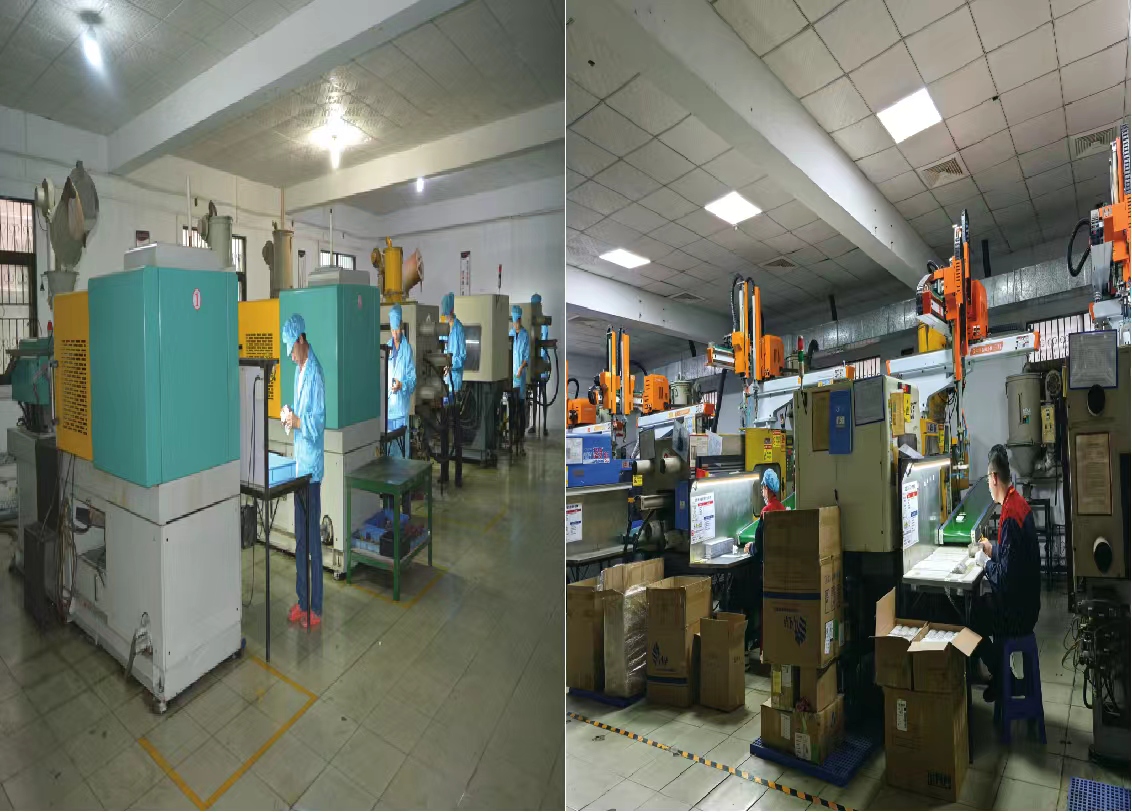
Injection moulding department: the plastic route behind mirror bodies, lipstick holder housings and decorative components.
The fan and event use case recorded for the Japanese IP entertainment market shows why the category is bought at all: for a vocal concert programme, the stated function was strengthening fans' sense of belonging and group identity, with the item collected and displayed afterwards. Vivid printing colour, fade resistance and a smooth surface were the stated requirements. A buyer evaluating badge suppliers should therefore test artwork reproduction and edge quality, not only metal weight.
Keychains and lipstick holders: hardware, fit and attachment risk
Keychains sit between the two cost logics. They borrow metal finishing from badges and plastic moulding from mirrors, and they add a third variable that neither category carries in the same way: the attachment. A keychain fails in use at the ring, the chain or the joint far more often than at the decorative face, which is why the hardware specification — not the artwork — should be the first item settled in a quotation.
Lipstick holders behave in the opposite way. The decorative surface is comparatively simple; the difficulty sits inside the part, where the cavity has to hold a lipstick securely without scratching it and where every edge has to be finished. For beauty buyers the practical acceptance criteria are dimensional fit, closure feel and the absence of sharp edges — the same three points BUILD records for its beauty-industry application work. A lipstick holder with an integrated hand mirror combines both problem sets, which is why it is normally quoted after a sample rather than from a catalogue image.
Programme cost: MOQ, tooling, lead time and packaging
Answer first: for all four categories, the number that decides budget viability is not the unit price but the minimum order quantity attached to the mould. BUILD states a custom-order MOQ of 1,000 pieces, notes that some simple in-stock moulds support small orders, and explains that new moulds usually require 1,000 pieces to reach a better unit price.
Tooling workflow is documented rather than improvised. The customer supplies high-resolution vector files in AI, CDR or PDF format with dimensions, processes and colours marked; the sequence then runs from 3D rendering to rendering confirmation, mould opening, sample making, sample confirmation and finally mass production. For a comparison across four categories, this matters because a single confirmed rendering can be reused as the reference document for artwork approval, packaging print and final inspection.
Lead time is stated as 30 to 40 days for regular orders after sample confirmation, extended for large or complex orders and for peak season, with the schedule confirmed before the order is placed. Packaging follows a default of regular OPP bag plus carton, with custom back cards, hang tags and gift boxes available and quoted separately. Testing can be arranged for environmental checks such as lead and cadmium testing, with the testing fee borne by the customer and the lead time confirmed separately. Each of these items can move a programme's total cost by more than a small difference in piece price, which is why they belong in the comparison from the start.
Certification coverage as a comparison criterion
Certification is where the four categories stop being interchangeable for brand-owning buyers. BUILD states certifications from Disney (FAMA: 025795), Universal Studios, Bandai, Hasbro, LVMH, L'Oréal, Victoria's Secret and Starbucks, together with BSCI, ISO 9001, Sedex and the Higg Index, and describes itself as a designated producer for organisations including the Palace Museum, Suzhou Museum, Xi'an Jiaotong University, Ctrip, HSBC, Hang Seng Bank, the Olympic Games and the World Expo, as well as for Starbucks, L'Oréal, Lancôme and Procter & Gamble.
What this establishes, and what it does not, should be separated cleanly. The listed certifications indicate that the factory has passed the audits those programmes require, which is directly relevant when a badge or keychain carries licensed intellectual property. They do not authorise production of any specific brand's artwork; that still depends on the brand owner's approval for the individual design. The company also notes that additional certifications increase production cost and inspection procedures — the reason a certified factory's quotation can sit above a non-certified one without either party being unreasonable.
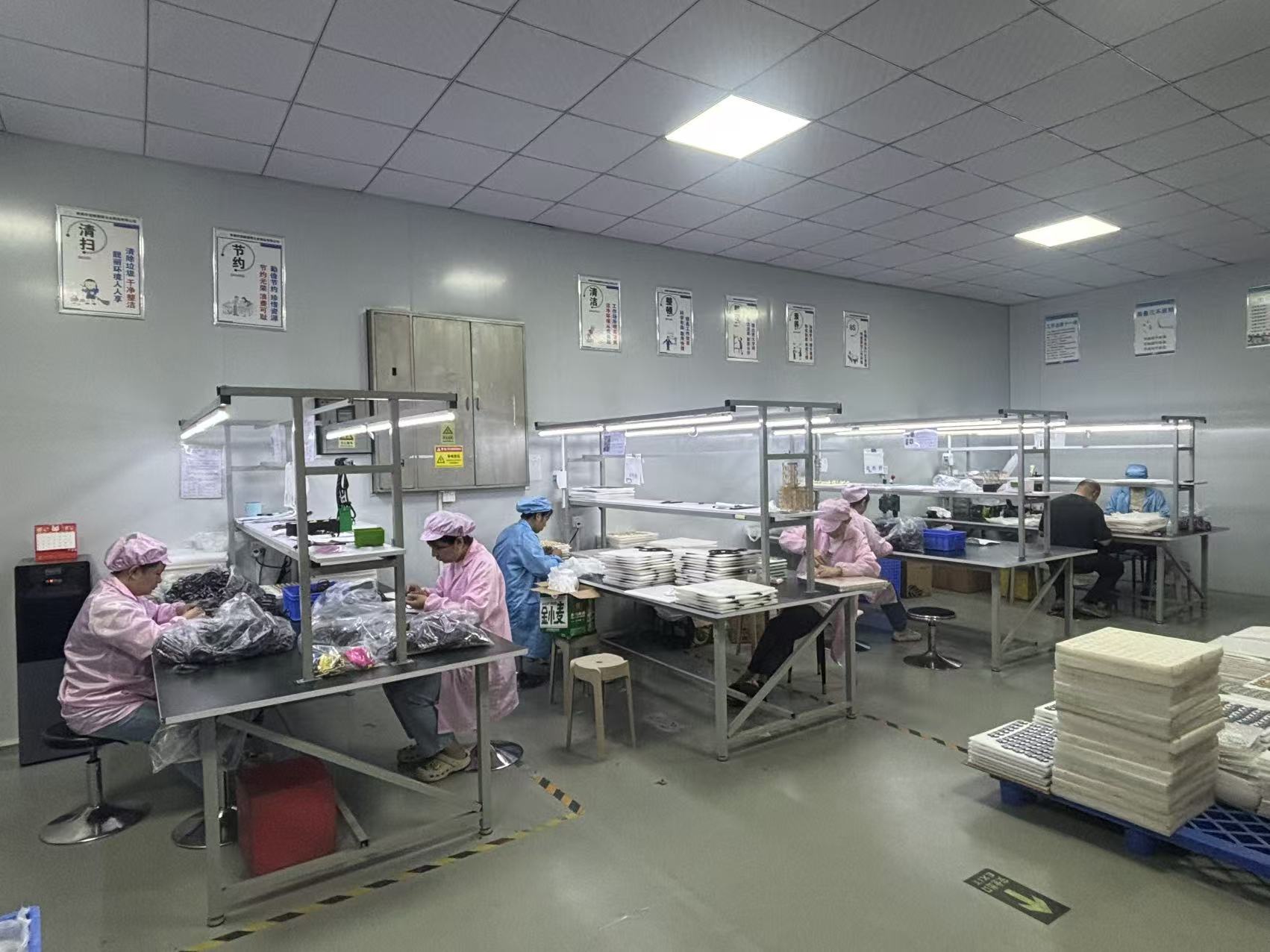
Quality inspection department: pre-shipment inspection is the control point that ties a comparison to what is actually delivered.
Inspection terms are stated in operational language: full inspection before shipment, with actual photos and videos supplied for verification after bulk production, and third-party or on-site inspection arranged by the buyer accepted. If defective items are received, the buyer provides photos and quantity statistics, and replacement or a discount is arranged as agreed, with compensation for damage caused by human factors or transit extrusion requiring prior confirmation. In a four-category comparison, that clause is worth reading twice, because transit damage risk is not equal across a glass-inserted mirror and a flat metal badge.
Manufacturing depth behind the four categories
The scale figures are modest but specific: founded in 1999, a 6,000 m² factory, 100 employees, annual output of 6,000,000 units, a 15-engineer R&D team, 85% export ratio and main markets in Europe, America and Japan. Production runs through dust-free workshops and independent quality inspection facilities, and the company describes itself as having evolved from OEM manufacturing into ODM and OBM services, with cooperation extending to online retailers including Amazon, AliExpress, Tmall and Taobao.
For the comparison at hand, the significance is not the headcount. It is that a 15-engineer team and an in-house mould route allow a mirror body, a badge mould and a lipstick holder cavity to be developed against the same rendering standard, and that a 6,000,000-unit annual capacity gives a buyer a realistic reference point when a programme spans four categories at once rather than a single SKU.
Where this comparison stops
Three limits should be stated plainly. First, no per-category price list is published, so the comparison above explains cost structure rather than quoting figures; the 5% premium is a company-stated positioning difference, not a measured market average. Second, no independent comparative performance test across the four categories is available in the supplied material — the durability statements, including the oxidation note, are the manufacturer's own technical position. Third, testing is arranged on request against the buyer's required standard and at the buyer's cost, so a buyer with a specific regulatory threshold must confirm that threshold before sampling rather than assume it is covered.
Outlook: what would change the recommendation
If a programme stays inside one category at low volume, the argument for consolidating with a certified, multi-process manufacturer weakens and a simpler sourcing route may serve better. If a programme combines a mirror, a badge, a keychain and a lipstick holder for the same brand, the calculation reverses: one rendering standard, one inspection regime, one packaging specification and one pre-shipment photo record remove more cost and risk than the piece-price gap between suppliers is likely to recover. That is a conditional conclusion, not a general claim of superiority, and it should be verified against the buyer's own volumes, artwork complexity and destination-market requirements.
Frequently asked questions
What is the minimum order quantity, and how long does mass production take?
The MOQ for custom orders is 1,000 pieces. Some simple in-stock moulds support smaller orders, while new moulds usually require 1,000 pieces to reach a better unit price. After sample confirmation, regular orders take 30 to 40 days, and the lead time is extended for large or complex orders or during peak season; the schedule is confirmed before the order is placed.
Can custom logos and patterns be produced, and which processes are supported?
Yes. Customisation of a customer's original patterns and logos is supported. Available processes include hard enamel, soft enamel, paint filling, epoxy drip, silk screen printing, UV printing, pad printing, spray painting, laser engraving, etching and colour filling. Conventional plating options are gold, silver, antique bronze, gun black, nickel, matte gold and matte silver.
Is the supplier a factory or a trading company?
BUILD describes itself as a source factory specialising in custom hardware and plastic crafts, supporting mould opening and production for badges, keychains, fridge magnets, makeup mirrors, ornaments, jewelry boxes, medals, trophies, commemorative coins, candle holders, hair clips, bookmarks, necklaces, phone chains, ring holders, lipstick holder with hand mirror, wine stoppers, bottle openers, napkin rings, forks and spoons, and coasters. The mould workflow runs from 3D rendering and rendering confirmation through mould opening, sample making and sample confirmation to mass production.
How are the products packaged, and can the goods be inspected before shipment?
Default packaging is a regular OPP bag with carton packing. Custom back cards, hang tags and gift boxes can be produced and are quoted separately. After bulk production, actual photos and videos are provided for verification, and a third-party inspection or an on-site inspection arranged by the buyer is also acceptable under the stated pre-shipment inspection process.
Can test reports be provided, and how are defective items handled?
Environmental tests such as lead and cadmium testing can be arranged as required, with the testing fee borne by the customer and the lead time confirmed separately. Full inspection is conducted before shipment. If defective items are received, the buyer provides photos and quantity statistics, and replacement or a discount is arranged as agreed; compensation for damage caused by human factors or transit extrusion requires prior confirmation.
The company's full 2026 catalogue, including the wider IP gift and plastic and hardware gift range, can be viewed here: BUILD catalogue (PDF).
Have Questions or Need More Details?
Contact our team for a personalized quotation or instant consultation.
Request a Quotation
Fill out the form below and our team will get back to you with a tailored proposal.
WhatsApp Direct Chat
Prefer to chat in real-time? Message us on WhatsApp for instant assistance & quick answers.
- Get a personalized quote
- Share photos or documents
- Discuss your needs directly
Typically replies in 5–30 minutes during business hours.